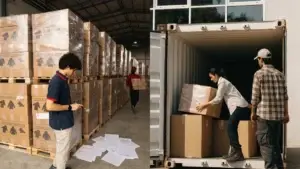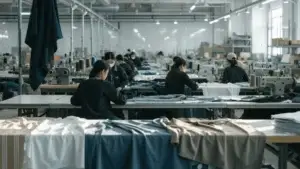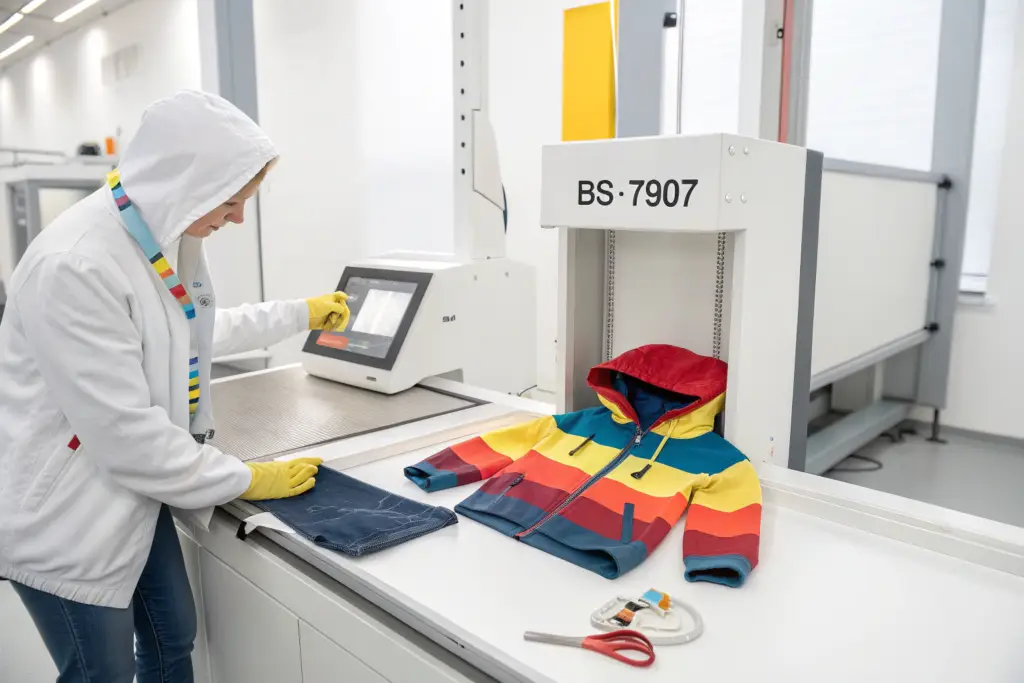
Three years ago, a well-meaning American children's wear startup shipped a batch of beautifully designed toddler hoodies to a major US retailer. The hoodies had functional drawstrings with small, decorative wooden toggles at the hood opening, a design detail borrowed from adult streetwear. An eight-year-old girl wore the hoodie to a playground. The toggle caught on a piece of playground equipment as she descended a slide. The drawstring tightened around her neck. She was fortunately rescued by a nearby parent, but the incident was reported. The retailer immediately recalled the entire batch, the brand lost the account permanently, and the founder spent months navigating the legal and emotional aftermath. The hoodie had passed all US mandatory safety tests, but it would have been illegal to sell in the United Kingdom, where functional drawstrings on children's hoods have been strictly banned for decades under a standard that the US market still does not mandate.
The strict UK kids wear safety standards that American brands should proactively adopt are the BS 7907 code for children's clothing safety, which mandates the complete elimination of functional drawstrings and cords in the hood and neck area of clothing for children up to age 14, sets specific maximum lengths for decorative cords and sashes, requires secure attachment of small components like buttons and sequins to prevent choking hazards, and enforces stringent flammability performance requirements under the Nightwear (Safety) Regulations that are more protective than the current US 16 CFR Part 1610 standard for general wearing apparel.
At Shanghai Fumao, I have adopted the UK BS 7907 standard as my internal baseline for all children's wear production, regardless of the destination market. I do not wait for US regulations to catch up to the safety science. A child's garment is either safe or it is not, and the UK standard provides a more protective, more specific, and more enforceable definition of "safe."
Why Does the UK BS 7907 Standard Completely Ban Functional Drawstrings in the Hood and Neck Area for Children Up to Age 14?
A Minneapolis-based children's outerwear brand once designed a charming little girls' raincoat with a functional drawstring at the hood, designed to cinch the hood snugly against the rain. The design was well-intentioned, practical, and aesthetically pleasing. It was also lethal. Between 1985 and 2020, the US Consumer Product Safety Commission documented multiple deaths and serious injuries caused by drawstrings catching on playground equipment, bus doors, and crib corners. Despite this data, US federal regulations do not completely ban hood drawstrings on children's clothing. The voluntary ASTM F1816 standard provides guidelines, but compliance is not legally mandatory. The UK BS 7907 standard makes the ban absolute and legally enforceable.
The UK BS 7907 standard completely bans functional drawstrings, cords, and ties in the hood, neck, and upper chest area of clothing intended for children from birth up to 14 years because epidemiological data collected over four decades demonstrates that these drawstrings create a strangulation and entrapment hazard when they catch on playground equipment, vehicle doors, escalators, and crib furniture, and the only effective mitigation is the complete physical elimination of the drawstring, replaced by snap-fastened or elastic-bound hood closures that cannot form a loop capable of entangling a child's neck.
A functional drawstring is designed to be pulled, tightened, and tied. Every one of these actions creates a loop. A loop is an entanglement hazard. The UK standard does not attempt to regulate loop length or attachment strength; it eliminates the loop entirely.
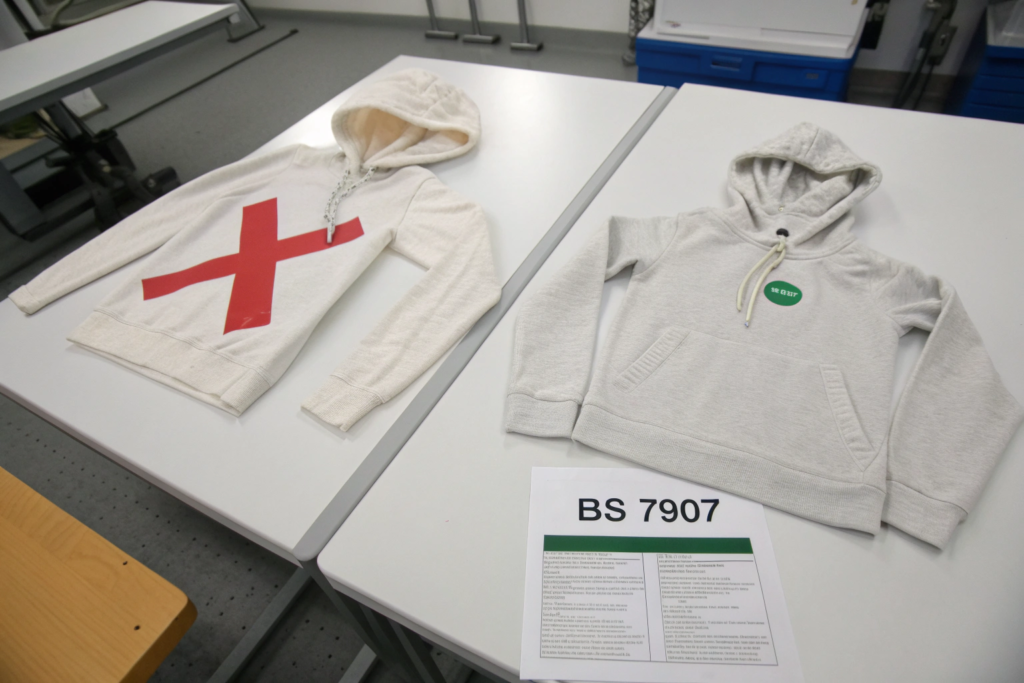
What Specific Playground Entrapment Data Led to the UK's Absolute Ban on Hood Cords?
The UK's Royal Society for the Prevention of Accidents (RoSPA) and the European Commission's injury database documented a consistent pattern: drawstrings catching on the tops of playground slides, on protruding bolts from climbing frames, and in the gaps between bus doors. The data showed that even very short drawstrings could form a loop when snagged, and that toggle size was irrelevant to the entanglement risk.
How Does BS 7907 Define "Functional" Versus "Decorative" Cords, and Why Are Both Regulated?
A functional cord is designed to adjust the garment's fit. A decorative cord is purely aesthetic. BS 7907 bans functional cords entirely in the hood and neck area and strictly limits the length of decorative cords to prevent them from forming an entanglement loop. Even a "decorative" cord can become an accidental noose.
What Is the "Small Parts Pull-Force Test" Requirement for Buttons, Sequins, and Embellishments Under UK Standards?
A Charleston-based infant wear brand once embellished a line of baby bodysuits with tiny, hand-sewn pearl buttons. The buttons were visually beautiful and a signature brand detail. The bodysuits sold to boutiques across the country. A nine-month-old baby, mouthing the fabric near the shoulder, managed to detach a pearl button with her newly developed pincer grip. She put the button in her mouth and began to choke. Her mother, trained in infant CPR, dislodged the button. The brand issued a voluntary recall, but the damage to their reputation was permanent.
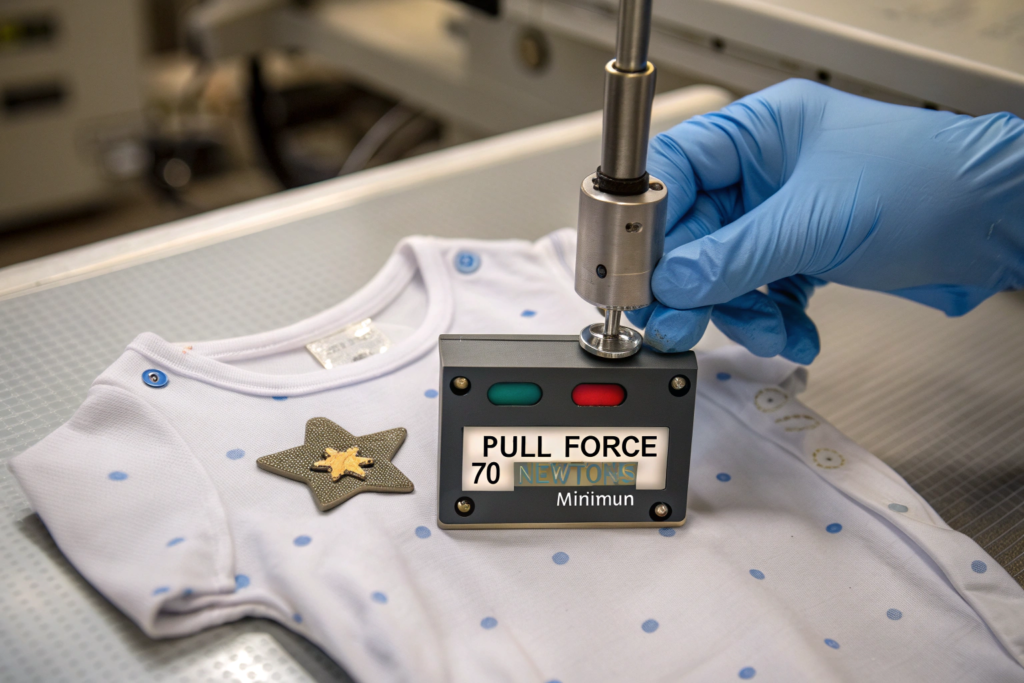
The UK small parts pull-force test requirement mandates that any component attached to children's clothing for ages 0-3 years—buttons, sequins, beads, rhinestones, appliqué patches—must withstand a minimum pull force of 70 Newtons applied steadily for 10 seconds without detaching, and additionally, any detached component must be too large to fit entirely inside a "small parts cylinder" with a diameter of 31.7mm, which simulates the size of a child's throat, ensuring that even if a component does detach, it cannot physically obstruct a child's airway.
The 70-Newton pull force is not an arbitrary number. It represents the approximate maximum pulling force a young child can generate using their developing hand and mouth muscles. A component that survives a 70-Newton pull is unlikely to be detached by a child in normal or reasonably foreseeable misuse.
How Is the "Small Parts Cylinder" Test Performed, and What Dimensions Define a Choking Hazard?
The small parts cylinder is a rigid plastic cylinder with an internal diameter of 31.7mm and a sloping internal depth of 25.4mm to 57.1mm. Any component that fits entirely inside this cylinder without compression is a choking hazard. The test is performed after the component has been subjected to the pull-force test, simulating the scenario where a component detaches and then enters the child's mouth.
Why Do Sewn-On Sequins on a Party Dress Pose a Higher Choking Risk Than Embroidered Sequins?
Sewn-on sequins are attached by a single thread passing through a small hole. A child's tooth or fingernail can easily sever the thread. Embroidered sequins are mechanically attached by the embroidery machine's stitching pattern, which passes thread through the sequin multiple times, creating a significantly stronger attachment.
How Do UK Nightwear Flammability Regulations Differ From the US 16 CFR Part 1610 Standard?
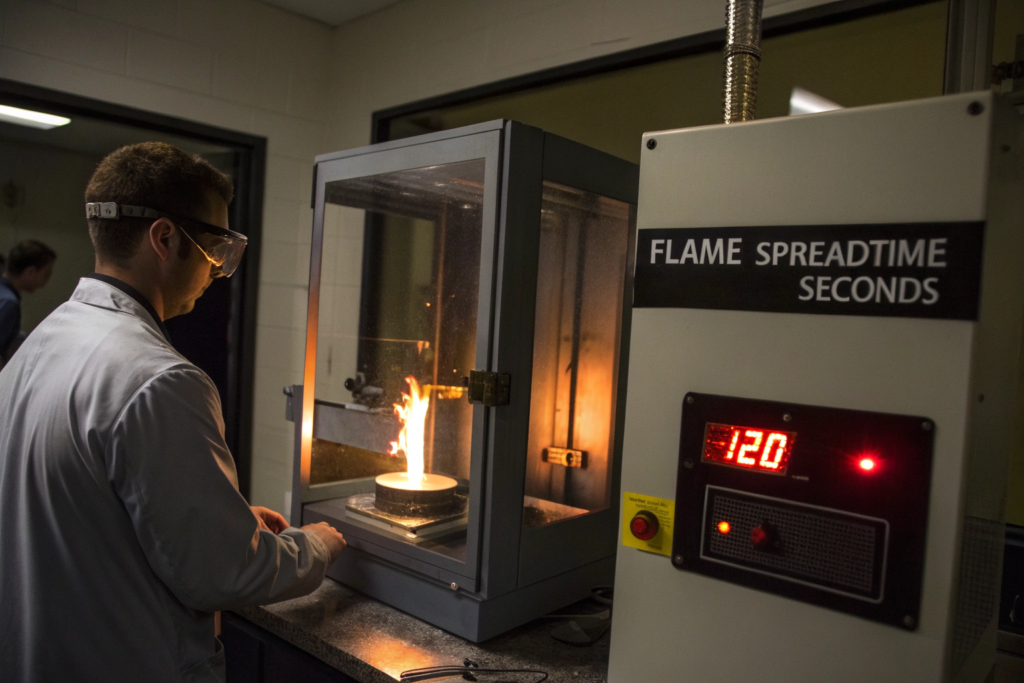
A Boston-based organic cotton children's sleepwear brand was proud of their product. The pajamas were made from 100% GOTS-certified organic cotton, beautifully soft, and completely free of chemical flame retardants. The brand marketed them as "pure, natural, and safe." What the brand didn't realize was that their loose-fitting, untreated cotton pajamas, while compliant with the US 16 CFR Part 1610 general apparel standard, would be illegal to sell in the UK. The US standard classifies most cotton fabrics as Class 1 (Normal Flammability) and allows their sale as sleepwear. The UK Nightwear (Safety) Regulations impose a far stricter flammability performance requirement specifically for children's nightwear, requiring a minimum flame spread time of 10 seconds or more on the British Standard 5722 test.
The UK Nightwear (Safety) Regulations differ critically from the US 16 CFR Part 1610 standard because the UK regulation applies a specific, more stringent flammability test (BS 5722) exclusively to children's nightwear, requiring a minimum flame spread time, whereas the US standard applies a general wearing apparel test (16 CFR Part 1610) that classifies most untreated cotton fabrics as Class 1 and permits their sale as sleepwear without additional treatment, creating a regulatory gap where US-compliant children's pajamas made from untreated cotton could legally be sold in America but would fail the UK nightwear-specific flammability test and be banned from sale.
The US standard treats children's sleepwear flammability as a special case requiring either tight-fitting design or chemical flame retardants. The UK standard treats all children's nightwear as inherently high-risk and subjects it to a specific, more demanding test regardless of fit or fiber content.
How Does the "Flame Spread Time" Test Under BS 5722 Differ From the US 45-Degree Flammability Test?
The US 16 CFR Part 1610 test holds a fabric strip at a 45-degree angle and measures the time for the flame to travel 5 inches. The UK BS 5722 test uses a vertical orientation, which is a more severe test because the flame travels upward more rapidly. A fabric that passes the 45-degree test can fail the vertical test.
Why Do Loose-Fitting Cotton Pajamas, Which Pass US Testing, Fail UK Nightwear Safety Standards?
Untreated cotton burns readily and quickly. In the US, loose-fitting cotton pajamas are required to be treated with flame retardants or must carry a warning label. The UK standard effectively prohibits the sale of loose-fitting, untreated cotton children's nightwear entirely, regardless of labeling, because the vertical flame test failure is considered an unacceptable risk.
How Does "Chemical Safety Beyond Lead" Under UK REACH Regulations Protect Children From Invisible Contaminants?
A Portland-based organic children's wear brand once sourced a line of beautifully printed t-shirts. The fabric was GOTS-certified organic cotton. The inks were water-based and certified non-toxic. The brand was confident in their safety. A European wholesale buyer requested a full chemical screen under UK REACH regulations. The test revealed the presence of di(2-ethylhexyl) phthalate (DEHP) at 150 mg/kg in the soft, flexible plastisol print on the chest. The phthalate had been used as a plasticizer in the ink by a sub-supplier that the ink manufacturer had not audited. The entire shipment was rejected.
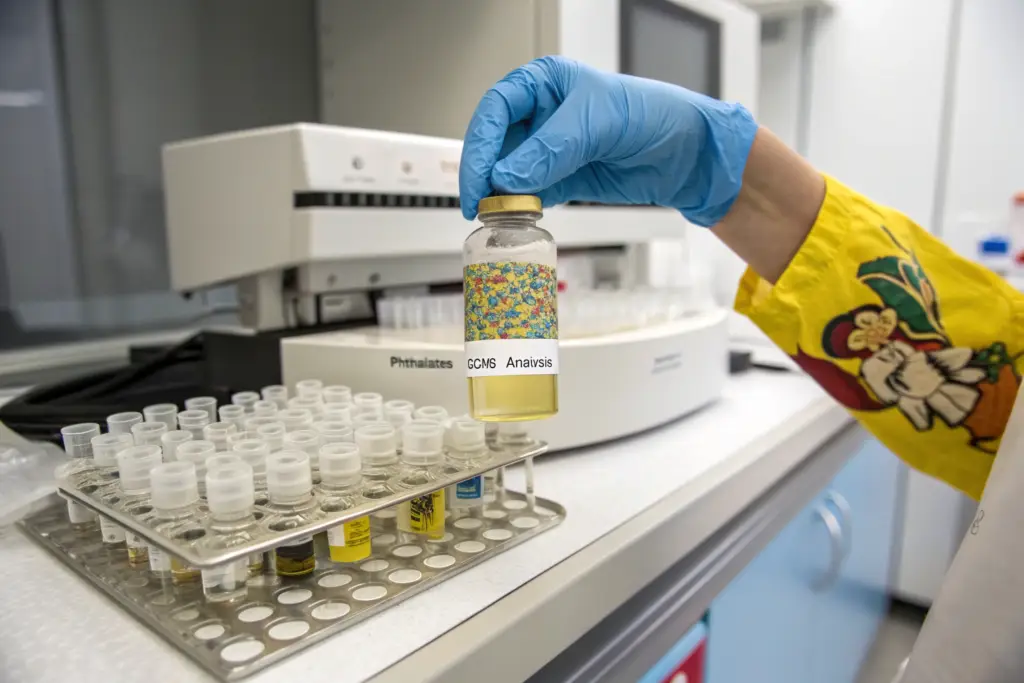
UK REACH regulations protect children from invisible chemical contaminants by regulating a far broader list of substances than US CPSIA requirements, specifically restricting nineteen classes of phthalates to a maximum concentration of 0.1% by weight, banning carcinogenic, mutagenic, or reprotoxic (CMR) substances in clothing, and placing strict limits on formaldehyde, allergenic disperse dyes, and organotin compounds, all of which are substances that can migrate from the fabric into a child's body through skin contact or mouthing, and which are not comprehensively regulated under current US children's product safety rules.
A fabric can look, feel, and smell safe while containing a plasticizer, a dye fixative, or a formaldehyde-based finish that is slowly absorbed through a child's skin. UK REACH regulates these invisible contaminants at the chemical level, requiring laboratory extraction testing that reveals what a visual inspection cannot.
What Are the Nineteen Specific Phthalates Restricted Under UK REACH Annex XVII, and Why Are They Used in Soft Plastic Prints?
The restricted phthalates include DEHP, DBP, BBP, DINP, DIDP, and DNOP, among others. They are used as plasticizers to make plastisol ink prints soft and flexible on fabric. A soft, rubbery print on a child's t-shirt should immediately trigger a phthalate test requirement.
How Does a "Formaldehyde Content Above 16 mg/kg" in a Baby's Onesie Violate UK Standards?
The UK voluntary standard for formaldehyde on baby clothing is a maximum of 16 mg/kg, tested by a water extraction method. Formaldehyde is used as a crease-resistant finishing agent. A level above 16 mg/kg can cause skin irritation and is classified as a potential carcinogen through dermal absorption.
Conclusion
The UK kids wear safety standards represent a more mature, more protective regulatory approach than the current US federal requirements. The BS 7907 ban on functional hood drawstrings addresses a well-documented strangulation hazard that the US still regulates only through a voluntary standard. The 70-Newton pull-force test and small parts cylinder test create a physically verifiable, quantitative barrier against choking hazards. The BS 5722 nightwear flammability test closes the untreated-cotton loophole that exists in the US 16 CFR Part 1610 standard. The UK REACH chemical safety regulations regulate a far wider spectrum of invisible contaminants than US CPSIA testing covers.
At Shanghai Fumao, I have adopted the UK BS 7907 and relevant chemical safety standards as my internal production baseline for all children's wear, regardless of whether the final destination is London or Los Angeles. A child's safety is not geographically variable. My QC team tests button pull strength to 70 Newtons. My pattern-making team eliminates all functional drawstrings from the hood and neck area. My fabric sourcing team requires phthalate-free certification on all plastisol prints.
If you are a US-based brand buyer who wants to proactively adopt the stricter UK safety standards for your children's wear line—not because you are legally required to, but because you believe a child in Chicago deserves the same level of protection as a child in Manchester—contact my Business Director, Elaine. She can share our UK-standard children's wear specification pack, our third-party chemical test reports, and our pull-force test certification data. Reach Elaine at: elaine@fumaoclothing.com. Safety is not a market preference; it is a universal standard of care.