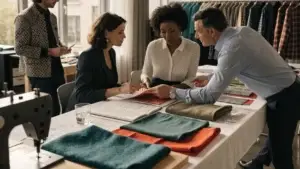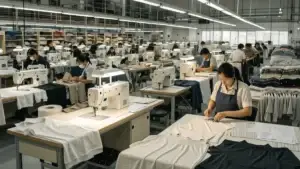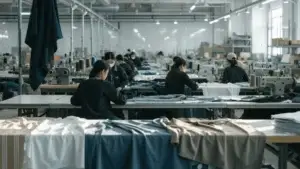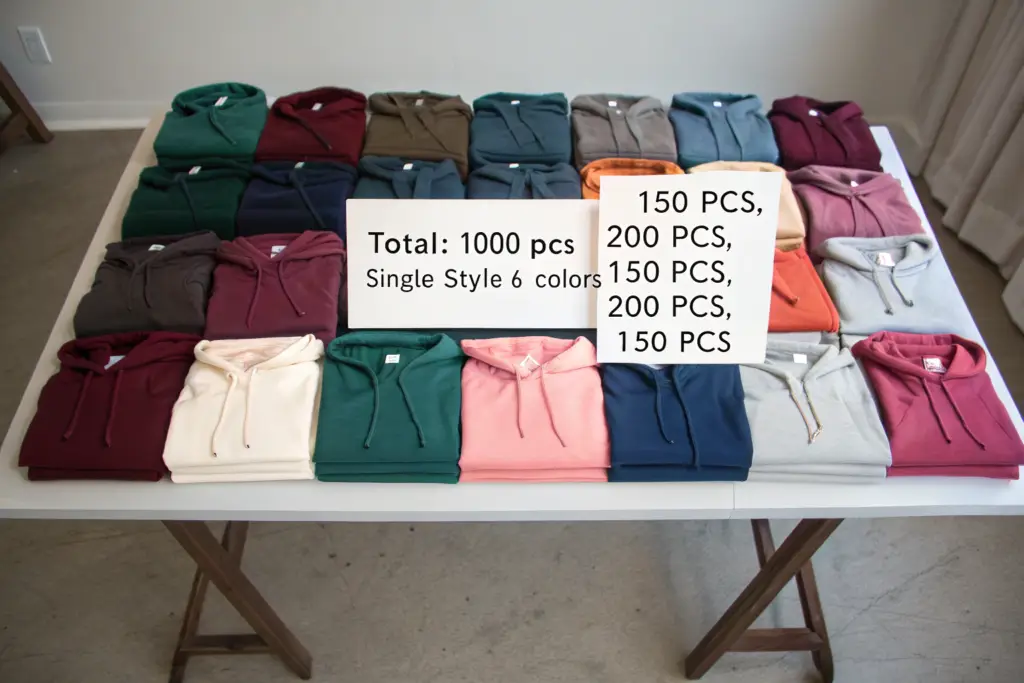
A Miami-based vacation wear startup founder once called me with a very specific frustration. She had designed a single, perfect resort shirt style—a relaxed camp collar, a soft rayon fabric, an easy, flattering fit. Her brand aesthetic demanded six color variations: a vibrant coral, a deep navy, a crisp white, a lush palm green, a sunset orange, and a soft cream. Every factory she contacted agreed to produce her 1,200-piece total order, but only if she ordered all 1,200 pieces in a maximum of two colors. The factories explained, with varying degrees of politeness, that splitting the order across six colors was "too complicated," "too expensive," or "not possible under our minimums." She was being forced to choose between her brand's colorful, vibrant identity and the factory's rigid production constraints. Her entire brand vision was being suffocated by MOQ policies designed for large, mono-color corporate orders.
To find a Chinese garment manufacturer that offers highly flexible MOQ color splitting, you must identify factories that operate their own in-house or closely partnered small-batch dyeing facility capable of processing dye lots as small as 50-100 kilograms per color, structure the production order as a single "Shared Greige Platform" where the entire 1,200-piece order is cut from a single batch of undyed greige fabric and then split into separate, small dye baths for each color after the garments are sewn, and negotiate a transparent "Color Split Surcharge" of $0.60-$1.20 per unit that covers the actual incremental dyeing setup costs rather than accepting a factory's blanket refusal to split colors.
At Shanghai Fumao, I specifically invested in a garment-dyeing capability because I understood that emerging and mid-sized brands build their visual identity around color variety, not volume. A factory that tells you "two colors maximum" is revealing that they are a bulk commodity producer, not a brand-building partner.
Why Is "Garment Dyeing" the Technical Key That Unlocks Unlimited Color Splitting on Small Orders?
A San Diego-based casualwear brand was told by factory after factory that their 800-piece order could not be split across four colors. The reason, which most factories never explained clearly, was that the factories were using a "fabric dyeing" process. In fabric dyeing, the entire roll of fabric is dyed in a single color before cutting and sewing. A large industrial dyeing vessel holds 500 kilograms of fabric. To dye four different colors, the factory would need to dye four separate 500-kilogram batches, requiring a minimum of 2,000 kilograms of fabric—far more than the 800-piece order required. The brand's order was mathematically impossible under the fabric-dyeing model.
Garment dyeing is the technical key that unlocks unlimited color splitting on small orders because, instead of dyeing large rolls of fabric before cutting, the garments are fully cut and sewn from a single, undyed greige fabric roll, and then the finished, sewn garments are split into small batches and dyed in individual, small-capacity garment dyeing machines that can process as few as 30-50 garments per color, allowing a 1,000-piece total order to be split across six or even eight different colors with no increase in minimum fabric order quantity.
Fabric dyeing requires each color to meet the dye house's minimum batch size. Garment dyeing shifts the dyeing step to after the garment is already sewn, so the entire order is cut from one undyed fabric roll, and only the finished garments are split into color batches.
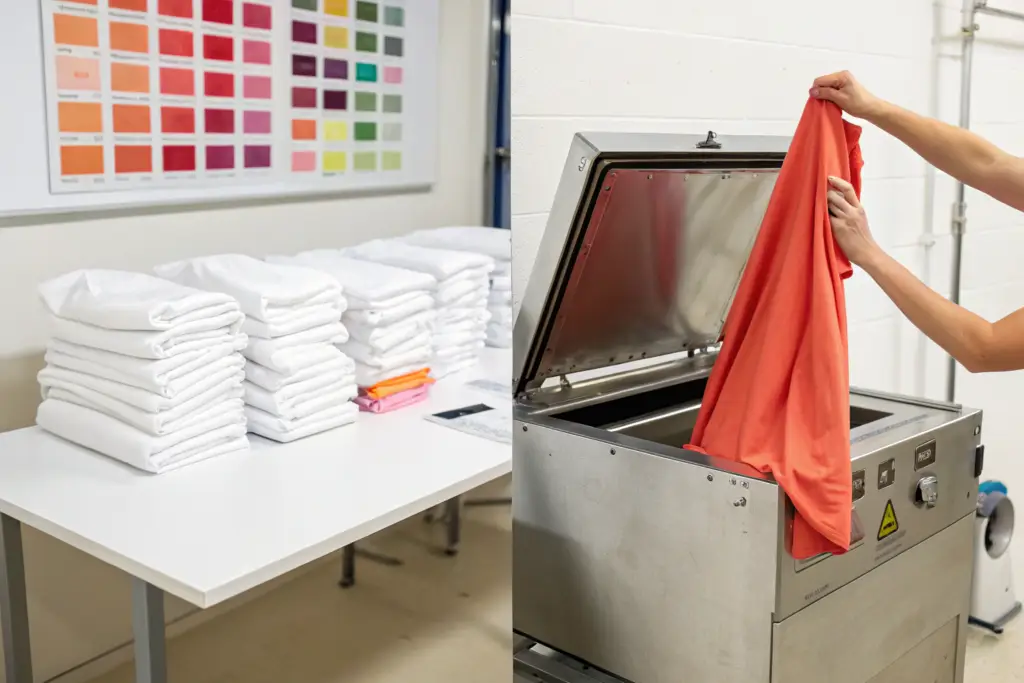
How Does a Garment-Dyed T-Shirt Differ in Appearance and Hand Feel From a Fabric-Dyed T-Shirt?
A garment-dyed t-shirt has a slightly softer, more lived-in hand feel because the dyeing process also softens the fabric and the stitching. The color may have a subtle, desirable "vintage" appearance with slightly lighter areas at the seams where the thread takes the dye differently. This aesthetic is often a premium selling point.
What Types of Fabrics and Garments Are Suitable for Garment Dyeing?
Garment dyeing works best on 100% cotton, cotton-elastane blends, rayon, and linen garments. It is ideal for t-shirts, sweatshirts, hoodies, casual trousers, and simple dresses. Garments with multiple fiber types, delicate trims, or heat-sensitive components are less suitable because the different fibers absorb dye at different rates.
What Specific "Small-Batch Dyeing Facility" Questions Should You Ask a Potential Factory to Verify True Color Flexibility?
A Denver-based outdoor lifestyle brand once asked a factory, "Can you split our order across five colors?" The factory's sales representative immediately said, "Yes, no problem." The brand signed the order. Two weeks later, the sales rep admitted that the factory's dye house had a 300-kilogram minimum per color, and the five-color split would require 1,500 kilograms of fabric for an order that only needed 800 kilograms. The sales rep's "yes" had been a hopeful guess, not a verified capability. The brand lost two weeks and had to renegotiate their entire production plan.
To verify true color flexibility, you must ask the factory these specific, technically precise questions: "Do you operate an in-house or directly partnered garment dyeing facility, and what is the minimum kilogram or piece load per dye batch?" (The correct answer for flexibility is 30-50 kilograms or 50-100 pieces), "Can you show me, on a live video call, the specific small-batch dyeing machine and its capacity specification plate?" and "What is the per-color setup surcharge for splitting a 1,000-piece order across five or more colors, expressed as a specific dollar amount per unit?"
Vague questions get vague answers. Specific, technical questions about minimum kilogram loads and machine specifications force the factory to reveal whether they actually have small-batch dyeing capability or are just hoping you won't ask.
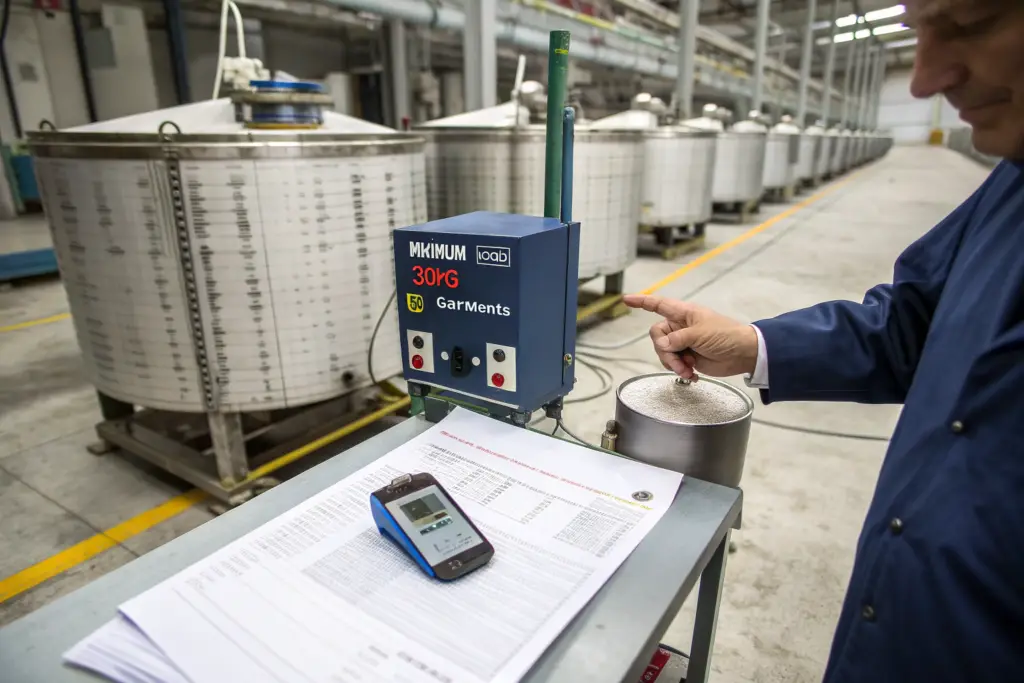
How Does a "Live Video Tour of the Dye House" Reveal Whether the Factory Is Brokering the Dyeing to a Third Party?
If the factory walks the camera into an actual dye house with machines operating, color swatch boards on the wall, and dye technicians in lab coats, they have genuine in-house or closely partnered capability. If the factory hesitates, makes excuses, or can only show you the sewing floor, they are likely brokering the dyeing to an external facility with no flexibility.
What Is the Exact Question That Reveals the "Per-Color Setup Surcharge" and Prevents a Surprise Invoice?
The question is: "Please provide a written, itemized surcharge for each additional color beyond two, including the dye formulation setup, the machine cleaning between colors, and any additional labor for color sorting. I need this in writing on the proforma invoice before I pay the deposit."
A Chicago-based streetwear brand once wanted six colors for their hoodie order but was quoted a prohibitive price by a factory that planned to source six different pre-dyed fabric rolls, each requiring a separate fabric minimum. The brand's total order of 1,200 hoodies, split across six colors at 200 pieces each, would have required the factory to purchase six separate rolls of dyed fleece, each with a 500-kilogram minimum. The fabric cost alone would have exceeded the brand's entire production budget.
To economically achieve a six-color split, the order must be structured as a Shared Greige Platform: the factory purchases a single, large roll of undyed greige fabric in a quantity sufficient for the entire 1,200-unit order, all 1,200 garments are cut and sewn identically from this single fabric batch, and then the finished, identical undyed white garments are split into six separate batches and dyed in the small-batch garment dyeing machines, with each 200-unit batch receiving its specific color formulation, achieving a true six-color split from a single fabric procurement that meets the mill's minimum order quantity.
The greige platform unifies the raw material procurement into a single, large, cost-effective purchase. The color variety is created at the final stage, after the sewing is complete, inside the dye bath rather than at the fabric mill.
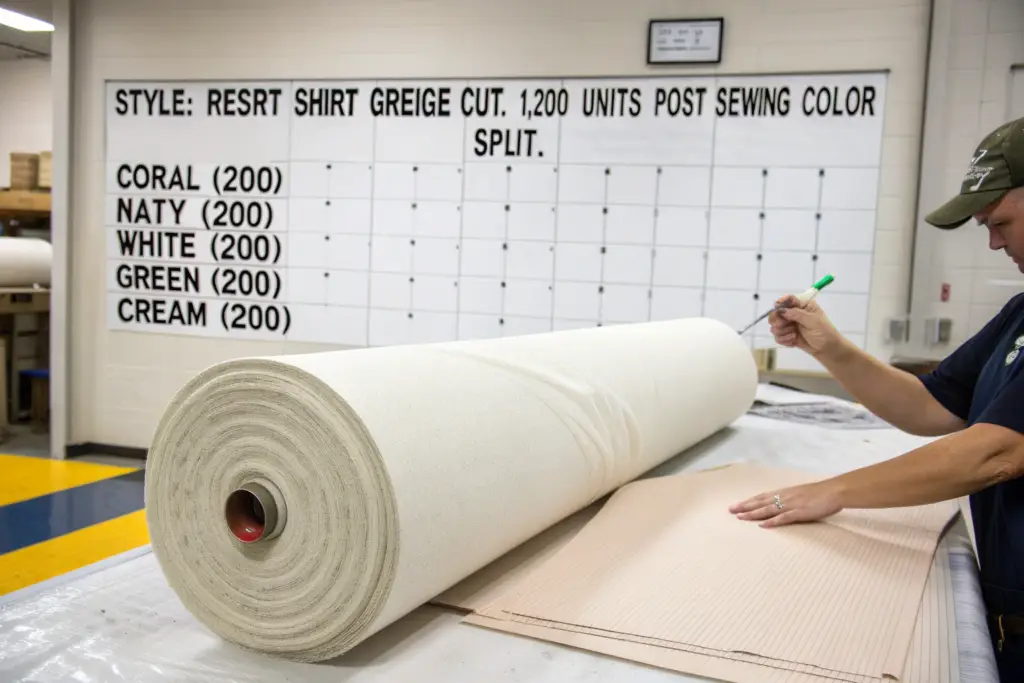
How Does the "Cut First, Dye Later" Sequence Reduce the Total Fabric Consumption by 12-15% Compared to Cutting Six Different Dyed Rolls?
When cutting from six different dyed fabric rolls, each roll generates separate marker wastage, and the accumulated end-of-roll remnants across six rolls are significantly larger than the remnants from one single large roll. A single large greige roll allows a single, highly efficient marker that minimizes fabric waste.
Why Does Garment Dyeing the Entire Finished Garment Create a Desirable "Vintage Wash" Effect at the Seams?
The sewing thread, typically a polyester core-spun, absorbs the garment dye at a different rate than the cotton shell fabric. This creates a subtle, tonal contrast at the seams—lighter thread against the dyed fabric—that is a highly desirable premium aesthetic in casual and streetwear markets.
How Do You Negotiate the "Color Split Surcharge" Transparently to Ensure Fair Pricing Without Losing the Deal?
A Toronto-based athleisure brand was once quoted a 40% surcharge for splitting their leggings order across four colors. The brand assumed the surcharge was a non-negotiable penalty and abandoned the four-color plan, settling for a boring, less brand-distinctive two-color order. What the brand didn't know was that the surcharge was the factory's initial, padded negotiating position, and the actual incremental cost to the factory for the additional dye setups was approximately $0.70 per unit. The brand left four distinctive colors and a stronger brand identity on the table because they accepted a surcharge at face value.
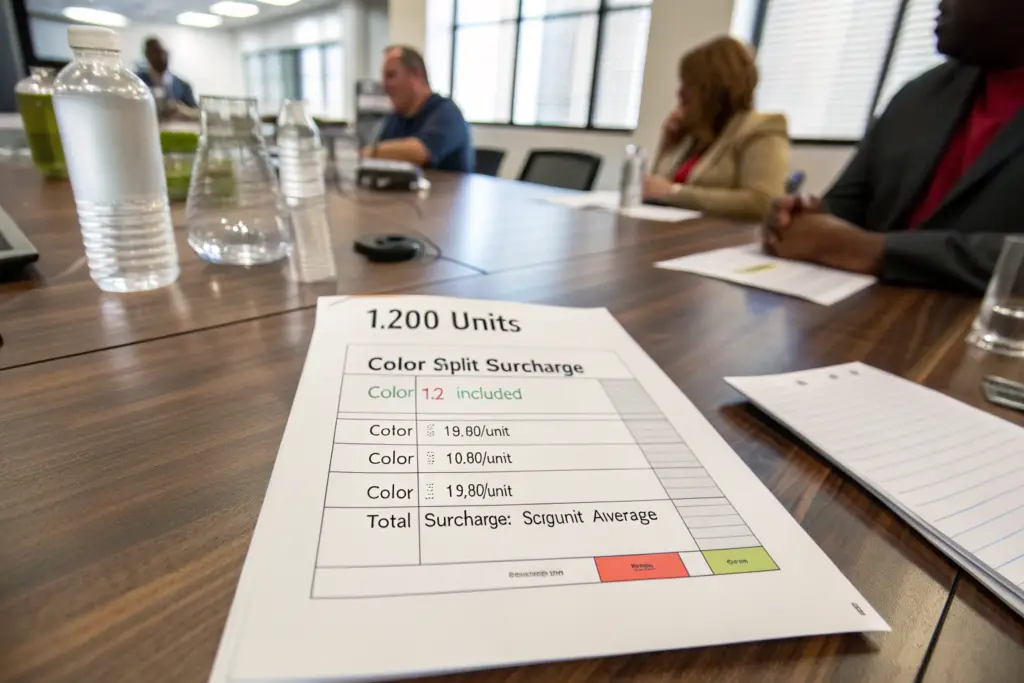
To negotiate the Color Split Surcharge transparently, you must request a written breakdown of the exact incremental costs the surcharge covers—the additional dye formulation setup labor, the machine cleaning and color change downtime, and the additional labor for sorting and labeling garments by color—and then negotiate against these specific, real cost items rather than the total surcharge number, typically landing at a fair $0.60-$1.20 per-unit surcharge for each additional color beyond the first two, which reflects the actual operational costs without an excessive penalty margin.
The surcharge is not a punishment. It is a reimbursement for real, additional labor. The dye technician spends 30 minutes cleaning the machine between colors. The packing team spends an extra hour sorting and labeling by color. These are real costs, but they are small when amortized across 200 units.
What Are the Three Specific Real Cost Components That Justify a Color Split Surcharge?
The three components are: Dye Formulation Setup Labor ($15-$25 per new color), Machine Cleaning and Color Change Downtime ($20-$35 per change), and Additional Sorting and Labeling Labor ($10-$15 per color batch). For a 200-unit color batch, these costs total approximately $45-$75, or $0.23-$0.38 per unit. The factory's surcharge of $0.80-$1.20 includes a small margin for the operational complexity.
How Does Committing to a "Replenishment Order" for the Best-Selling Colors Help Negotiate a Lower Initial Surcharge?
The brand can offer: "We will track sell-through data and place a replenishment order for the top two performing colors within 60 days, with a minimum of 500 units per color." This future volume commitment justifies the factory accepting a lower surcharge on the initial small-batch split order.
Conclusion
Finding a Chinese garment manufacturer that offers flexible MOQ color splitting is not about finding a factory that magically ignores the laws of textile chemistry and industrial production minimums. It is about finding a factory that has invested in garment dyeing technology, which fundamentally restructures the production process so that color variety is created at the end of the production line, in small, flexible dye baths, rather than at the beginning, in large, inflexible fabric mill minimums. The Shared Greige Platform unifies raw material procurement into a single, efficient purchase. The small-batch garment dyeing machine splits the finished, sewn garments into as many colors as the brand's visual identity requires. The transparent Color Split Surcharge covers the real, small operational costs without punishing the brand for wanting a colorful collection.
At Shanghai Fumao, I specifically invested in garment dyeing capability because I saw so many emerging brands being forced to choose between their colorful brand identity and the factory's rigid production minimums. My small-batch garment dyeing partner can process color batches as small as 50 pieces, and my Shared Greige Platform order structure makes a six-color split on a 1,200-piece order commercially viable.
If you are a brand buyer who has been told "two colors maximum" by too many factories, and you want to explore a garment-dyed, color-split order structure that preserves your brand's visual identity, contact my Business Director, Elaine. She can show you examples of color-split orders currently on our production lines, share our transparent Color Split Surcharge breakdown, and walk you through the Shared Greige Platform process. Reach Elaine at: elaine@fumaoclothing.com. Your brand should not have to choose between volume and color.