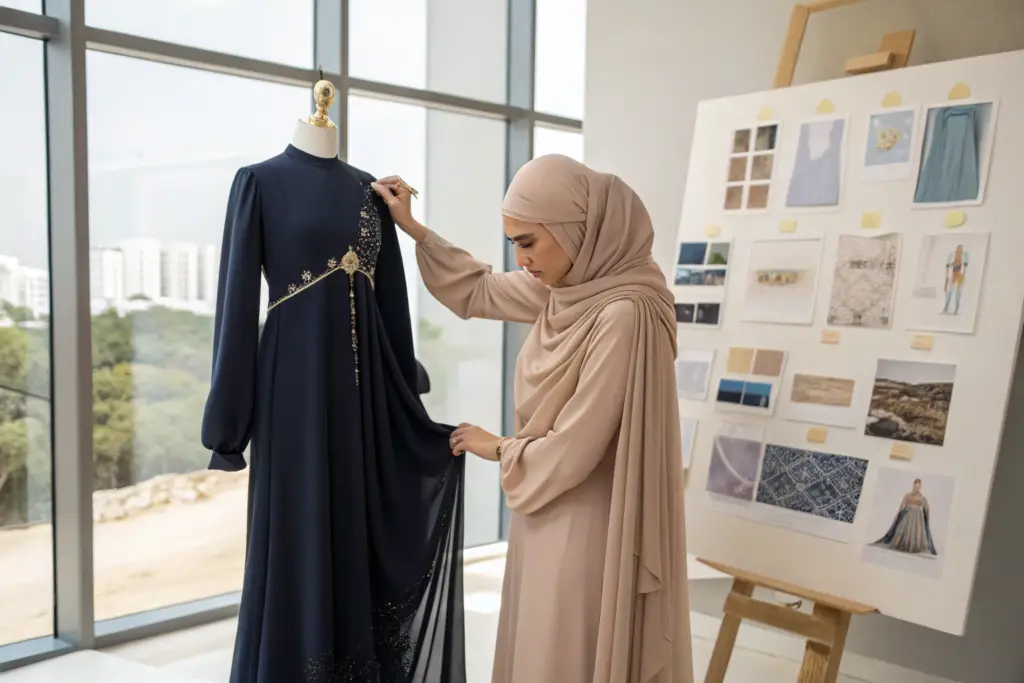
Three Ramadan seasons ago, a modest fashion brand owner from Dubai called me in a state of professional embarrassment. Her previous Chinese supplier had shipped a collection of "modest" maxi dresses that were technically long-sleeved and floor-length. But the fabric was a cheap, translucent viscose that required a full slip underneath. The neckline, while high, gaped open when the wearer leaned forward. The "loose fit" blouse clung to every curve because the supplier had used a static-prone polyester. The entire collection was returned by her Gulf customers. The factory had treated modesty as a simple pattern dimension problem—measure the length, cover the arm. They completely missed that modesty is a fabric behavior, a structural engineering, and a cultural trust contract with the end wearer.
To meet modest fashion demand for Middle Eastern markets, a manufacturer must engineer garments with "Active Opacity"—selecting fabrics that remain completely non-translucent even when backlit or stretched, constructing necklines with internal stability tape that prevents gaping during movement, and designing silhouettes that drape away from the body using fabric weight and bias cutting techniques rather than relying on heavy, hot layering, while also ensuring all supply chain components from fiber to button are halal-certified compliant where applicable.
At Shanghai Fumao, I have spent years studying the precise textile engineering requirements that separate a successful modest wear export to Dubai or Riyadh from a container of unsellable returns. This is a technical discipline, not a guessing game.
What Fabric Specifications Guarantee Full Opaqueness in White and Light-Colored Garments?
A Qatari boutique owner once emailed me a photo that looked like a disaster. She was holding up a "premium" white abaya from a previous supplier against her store's window. The morning sun cut through the fabric like it was tracing paper. Every outline of the mannequin underneath was visible. The garment wasn't defective in the traditional sense—no broken seams, no missing buttons. But it was completely unsellable in her market. The fabric weight was 120 GSM, which might work for a grey marl t-shirt sold in California, but for a white garment in a market where opacity is a non-negotiable requirement, it was a total failure. I sent her a swatch of our 180 GSM compact-spun cotton-modal blend, and she couldn't see her hand through it even with an iPhone flashlight pressed directly against the fabric.
The fabric specifications that guarantee full opaqueness in white and light-colored garments require a minimum weight of 160 GSM for knits and 110 GSM for high-density woven poplin, a yarn construction using compact spinning technology that eliminates the hairy, light-scattering fiber ends of ring-spun yarn, and a finishing process that applies an optical whitener replacement with titanium dioxide micro-particles to physically block light transmission rather than just brightening the shade.
How Does Compact Yarn Spinning Close the Microscopic Light Gaps?
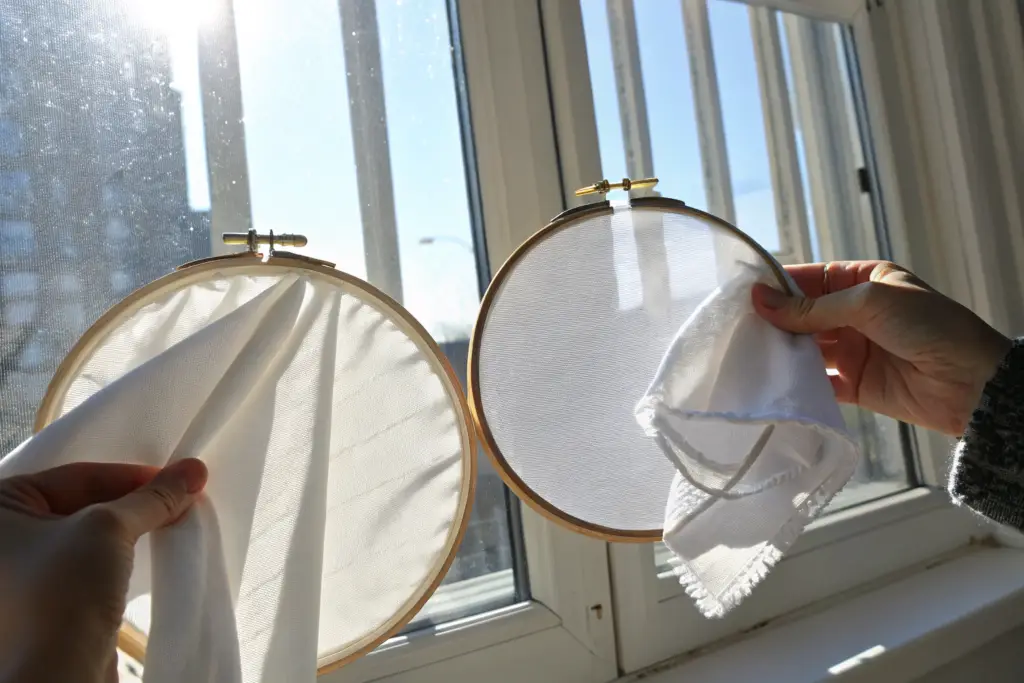
Standard ring-spun cotton yarn has a hairy, fuzzy surface full of protruding fiber ends. These microscopic hairs act like thousands of tiny fiber-optic cables, scattering daylight and creating the translucent "halo effect" that reveals skin tone beneath a white shirt. Compact spinning takes the same raw cotton but passes the fiber bundle through a vacuum condensation zone that tucks every single fiber tip tightly and parallel into the yarn core. The resulting yarn is smooth, dense, and almost cylindrical. When knitted into a jersey, the light has far fewer loose fiber ends to bounce off. At Shanghai Fumao, I source specific high-twist compact yarn for any white or ivory garment destined for a modest wear collection, because a 140 GSM compact-spun fabric can often outperform a standard 170 GSM ring-spun fabric in a light-box opacity test.
Why Does a Standard White Polyester Fail the "Hand Behind Fabric" Rain Test?
Customers in Jeddah or Dubai don't just worry about sunlight. Humidity can turn a dry, opaque fabric into a translucent one because water fills the air gaps between the fibers, altering the refractive index. I once had a client whose white polyester prayer dress passed the dry inspection but became suddenly transparent when the wearer perspired slightly during a humid evening event. The plastic-based polyester fibers, when wet, create a smooth, unbroken liquid film that transmits light far more efficiently than the dry, rougher surface. Natural fibers like cotton and linen maintain their microscopically rough texture even when damp, scattering light more effectively. For any women’s wear intended for hot climates, I strictly recommend cellulosic or natural fiber blends with a moisture-wicking finish that moves sweat away from the fabric surface, preventing the liquid film from forming.
How Do You Construct a Non-Gaping Neckline That Stays Closed During Full Forward Movement?
A modest wear brand owner from London, selling primarily to the Gulf market, sent me a competitor's sample once. She put it on a mannequin and tilted it 30 degrees forward, mimicking the motion of a woman picking up a child or reaching for a grocery shelf. The neckline gaped open a full 3 inches. The dress was perfectly modest on a static, upright hanger. But human beings are not static hangers. They bend, lean, pray, and drive cars. A neckline that opens forward is not a design flaw visible in a mirror selfie; it is a functional failure that the end customer discovers during her first wear. This single engineering oversight generates the most furious and betrayed product returns in the modest fashion segment.
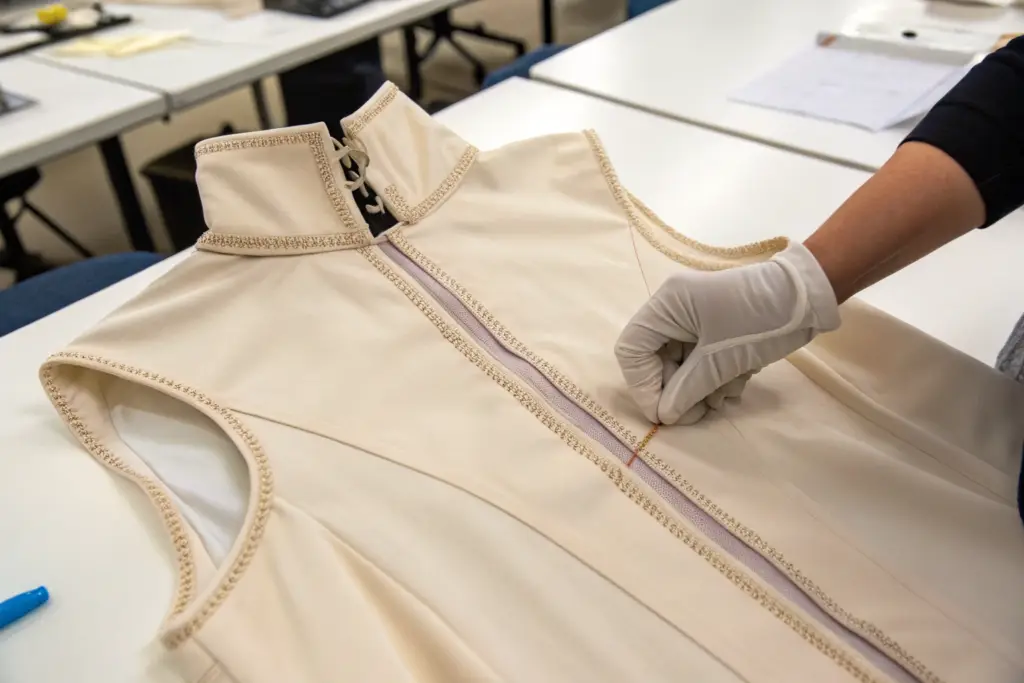
You construct a non-gaping neckline by fusing a 1.5cm-wide knit interfacing stability tape into the back neck seam at the pattern stage—not just the facing piece—drafting the front neck drop to sit at least 2cm above the suprasternal notch on the grade rule for all sizes, and installing a nearly invisible, flat clear-snap closure at the cross-over point of a wrap-style neckline, so that even during full spinal flexion the garment maintains complete thoracic coverage without any visible hardware.
This is a pattern-making problem, not a sewing problem. The geometry is decided in the 2D CAD stage, and many patternmakers who have never worn modest clothing themselves simply copy a standard Western block.
Why Does a Standard Western Neckline Block Gape in Modest Applications?
A standard Western woven blouse block assumes a lower front neckline that balances the tension across the shoulder slope. When you extend that neckline upward to create a high, modest collar, you are fundamentally changing the geometry. The fabric now has to travel a longer path over the trapezius muscles and the prominentia laryngea without the release point of a low V-neck. The tension concentrates at the center front point, pulling it forward. My patternmaker at Shanghai Fumao adjusts for this by adding a 0.7cm "wedge" at the front neck point on the pattern, effectively building a slight, invisible shelf that resists forward pull. It's a 20-minute digital alteration that makes the difference between a dress that stays put during a dinner and one that requires a safety pin.
How Can a Hidden Closure Point Prevent an Accidental Exposure Moment?
For a wrap dress or a crossover abaya, the layers can shift during wind or arm movement. A single, clear polyurethane flat snap, sewn internally at the precise intersection point where the two front panels overlap, completely immobilizes the crossover without any visible external button or metal that could catch on a hijab. I first engineered this for a Kuwaiti brand whose main complaint was "the wind reveals everything." The polyurethane snap is heat-resistant, passes through metal detectors without issue, and has a low-profile, flat surface invisible from the outside. Most importantly, we sew it high on the chest, right at the natural balancing point, not low near the waist where the leverage pull would still open the upper panel. This micro-detail turns a risky garment into a secure one.
Which Fabric Weights and Drapes Guarantee a Genuinely "Loose-Fit" Silhouette Without Heat Stress?
A Lebanese designer once sent me a sketch for a beautiful "flowing, modest kaftan." The previous factory made it in a heavy 240 GSM French terry because they assumed "heavy means luxurious." The kaftan weighed almost 1.5 kilograms. It hung like a wet blanket, trapping 38-degree Celsius heat against the body. The customer felt like she was wearing a portable sauna, not an elegant summer cover-up. The designer's brief said "loose fit," but the factory translated this as "make it wide." A wide, heavy garment is just a bigger, heavier blanket. A true loose-fit modest silhouette is a function of the fabric's internal bending rigidity and breathability, not just the chest circumference measurement. The garment must stand away from the body physically, but thermally, it must function like an open window.
The fabrics that guarantee a genuinely loose-fit silhouette without heat stress are structural weaves such as a 100-130 GSM high-twist cotton voile, a 150-170 GSM enzyme-washed Tencel twill, or a 90-110 GSM crinkle viscose georgette, because these fabrics possess high "drape coefficient" stiffness that pushes the fabric shell outward in a stable A-line, while maintaining an air permeability rating above 80 CFM (cubic feet per minute), allowing convective airflow to circulate freely between the garment shell and the skin.
The silhouette is created by the fabric's refusal to collapse. Cheap fabric collapses against the wearer's knees and shoulders; premium loose-fit fabric creates a portable climate zone.

How Does a "Crinkle" Georgette Hold Its Shape Better Than Flat Chiffon?
A traditional polyester chiffon is flat, limp, and statically charged. It wraps around the body's contours like plastic film, revealing the exact silhouette that the modest wearer is trying to conceal. A crinkle georgette, however, has a permanent, heat-set pleated texture. These micro-crevices create a physical spring-like structure. The fabric sits on the shoulders, and instead of hugging the bust line, the crinkles form a rigid, wavy bridge that pushes the fabric outward by several centimeters. The space between the fabric and the skin allows air to rush in. We developed a specific 18mm crinkle crepe for a Dubai Ramadan capsule at Shanghai Fumao, and the brand reported a significant drop in returns specifically complaining about the silhouette "showing the body shape" on the side profile.
What Is the Thermal Penalty of a Heavy Knit Versus an Engineered Woven Shell?
Chemically, polyester knits trap a layer of still air close to the skin, which is exactly the physics of a thermal fleece. If you insist on a knit modest dress, the temperature inside the garment will be roughly 4-6 degrees Celsius higher than the ambient air. A woven shell with a loose weave, like a leno-weave linen, has actual visible perforations. The body's thermal plume rises and escapes through the neckline and armholes, and fresh air enters through the bottom hem. I always test our modest capsule fabrics with a digital thermal probe. A woven Tencel abaya shell can have an internal cavity temperature only 1.5 degrees warmer than the outside air. A polyester knit dress, under the same Middle Eastern summer sun, can hit a 7-degree differential, making the wearer feel faint. This thermal data directly translates into the "unbearable comfort" complaint every brand buyer wants to avoid.
How Do You Certify a Complete Supply Chain as Truly "Halal-Compliant" for a Garment?
A Malaysian modest wear chain owner once asked me, "Brother, are these buttons haram?" I almost laughed, then immediately caught myself, because he was entirely serious. His previous supplier had used beautiful resin buttons made from a polymer that was processed with a stearic acid derivative. The stearic acid, it turned out, was sourced from a porcine (pig) fat-based feedstock. The buttons were physically identical to any other button, but chemically, the entire production run was now religiously contaminated. He lost a significant partnership with a major Islamic department store because a halal certification auditor had traced the button resin back to its chemical origin. Halal compliance in apparel goes far deeper than "no leather." It is a forensic chemical tracing exercise that extends to sizing agents, fabric softeners, and button resin.
To certify a complete garment supply chain as halal-compliant, a manufacturer must obtain a recognized Halal Certification from a JAKIM or GAC-accredited body, verifying that every chemical input—spinning oil, knitting lubricant, dye fixative, silicone softener, and button polymer—is derived from halal-approved, non-najis sources, and that the entire production line is physically segregated and cleaned from non-halal cross-contamination during storage, cutting, and sewing.
Why Does an Animal-Derived Sizing Agent Invalidate a Cotton Hijab?
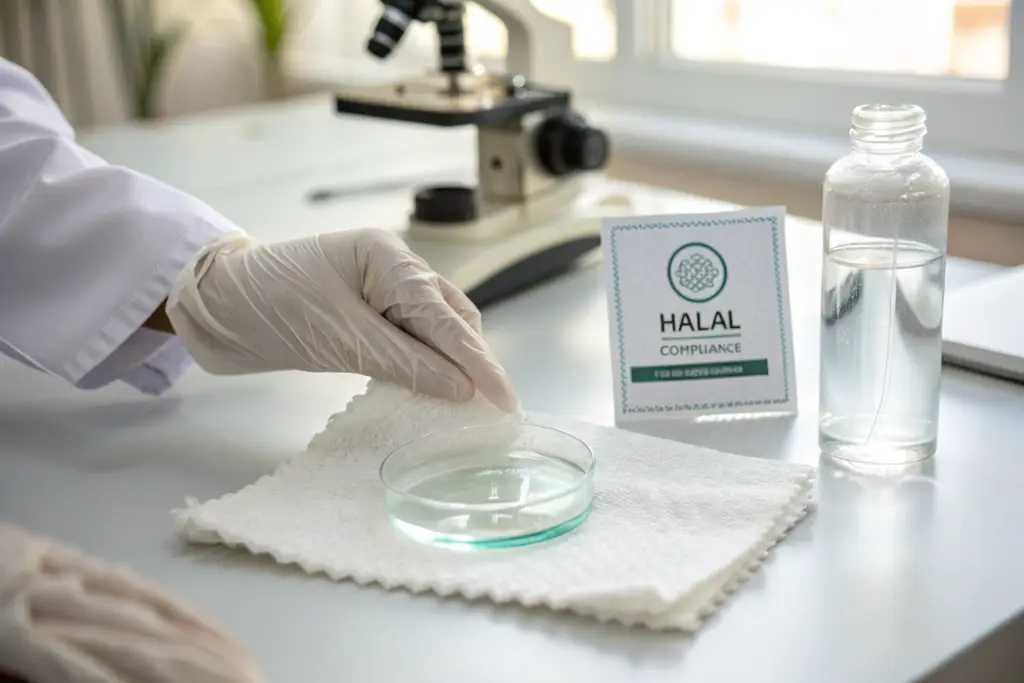
Raw cotton yarn is brittle. To weave it on a high-speed air-jet loom, the mill applies a "sizing agent"—a glue-like protective coating that washes off after the fabric is woven. Many mills use a gelatin-based sizing derived from animal bones or pig hides because it is cheap and effective. A "100% Cotton" hijab with no synthetic fibers might still be chemically contaminated with an animal-derived protein. A halal audit traces that specific starch. At Shanghai Fumao, I exclusively purchase our organic fabric from mills that use a starch-based or PVA-based synthetic sizing, documented in a mill declaration letter, and we spot-test random fabric swatches with a protein-specific hydroxyproline chemical assay to ensure no animal gelatin cross-contamination occurred.
Even if the yarn and fabric are halal, the fabric finishing stage is a disaster zone. Most commercial dye houses process conventional and halal orders in the same giant, warm stainless steel tanks containing silicone softeners. If the tank previously treated a non-halal batch with a tallow-based (animal fat) softener, the residual chemicals floating in the pipes will contaminate your halal batch. True halal-compliant production requires a dedicated, cleaned, and validated vessel. We have an auditable agreement with our dyeing partner to flush the entire main line with a caustic cleaning batch and a hot-water rinse, then test the rinse water for total organic carbon residue, before releasing the halal clothes batch into the machinery. This is an extreme but necessary procedure, and any factory claiming halal compliance without a segregated clean-in-place (CIP) log is performing an act of trust without evidence.
Conclusion
Meeting the demand for modest fashion in the Middle East is a craft of invisible engineering. The customer never sees the fusible tape in the neckline, but she feels the security when she bends forward. She never reads the compact yarn spinning specification, but she sees her own skin through a cheap white fabric and immediately returns it. She never audits the silicone softener tank, but a halal certification body does, and one non-compliant batch destroys a retailer relationship that took five years to build. The modest wear market is not asking for longer sleeves and longer hems. It is asking for physics-defying opacity, engineered airflow, structural pattern geometry that follows the body's movement without revealing its contour, and a chemical chain of custody that respects a detailed, non-negotiable ethical code.
I have spent years at Shanghai Fumao learning to speak this precise language of textile physics, not just tailoring. Our production lines have processed specific modest wear capsules where every seam, every fiber, and every silicone finish was documented. We treat modest fashion garments as technical products requiring a forensic production approach.
If you are launching or scaling a modest wear label into the Gulf, Levant, or Southeast Asian markets, your factory needs to think like a textile scientist, not a generic cut-and-sew shop. Reach out to my Business Director, Elaine. She has walked through our halal fabric storage segregation and neckline stability tests with partners from Dubai to London. She can guide you through the specific technical documentation we provide. Contact Elaine directly at: elaine@fumaoclothing.com. Let your next collection be defined by its engineering confidence, not its rate of return.