Two summers ago, I received a shipment of 1,000 women's linen blouses back from a furious California boutique owner. The blouses were beautiful. The stitching was immaculate. The fabric was exactly the right weight. But every single blouse had a sleeve length three inches shorter than the approved sample. How? The buyer had emailed a single sentence to the previous factory's sales rep: "Can we make the sleeves a bit more fitted?" The sales rep, not wanting to bother the busy patternmaker with a clarification, just told the cutting room to "shorten the sleeves a bit." This is the brutal, expensive mathematics of bad communication. The fabric, the freight, the duties, and the lost selling season cost that brand over $27,000. The culprit wasn't a bad factory. It was a loose sentence.
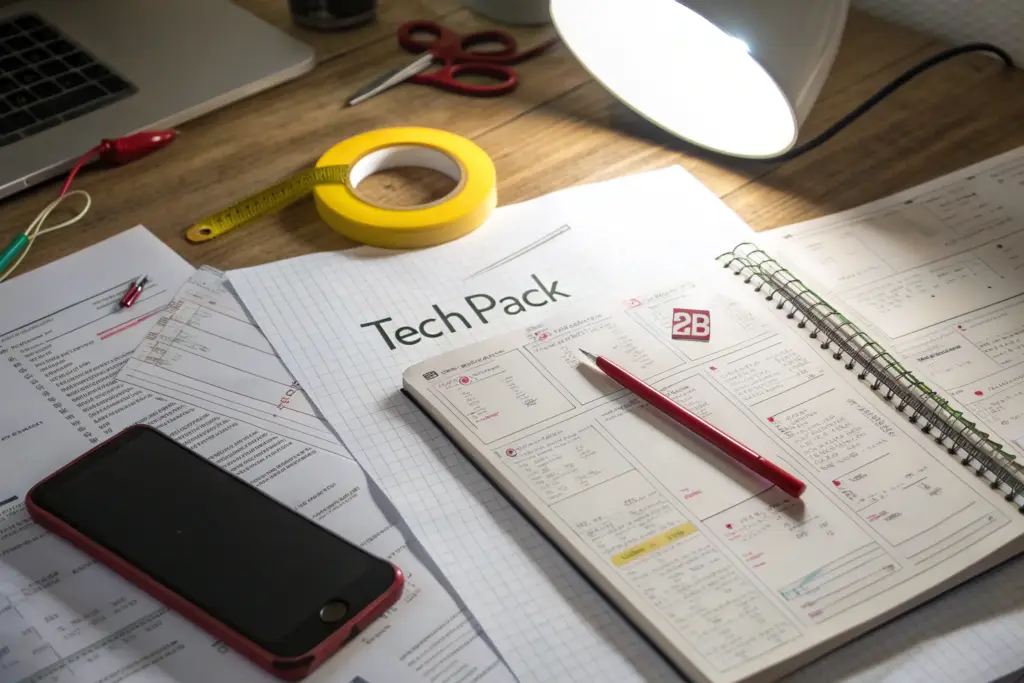
You can drastically reduce communication errors with foreign garment factories by completely eliminating verbal-only approvals and replacing them with a single-source-of-truth "Visual Tech Pack" that uses numbered annotations on high-resolution photographs or 3D digital samples, requiring the factory to mirror your exact vocabulary back to you as a written "Revision Confirmation Log" before any scissors touch the fabric.
At Shanghai Fumao, I have built our entire client-facing workflow around one principle: If it isn't written, measured, and photographed, it doesn't exist. You are not hiring a factory. You are hiring a translation layer between your creative vision and the physical needle. The better that layer, the fewer $27,000 disasters.
Why Do Written Specifications Always Beat Verbal Instructions?
"Just make it a regular fit," is the most expensive six-word phrase in the apparel industry. I once sat down with a New York streetwear founder who had used that exact phrase. He thought "regular fit" meant a relaxed, 90s skate silhouette with a 46-inch chest on a size Large. The factory interpreted "regular fit" as a slim-continental fit with a 42-inch chest, because that was their default block. The production run of hoodies came out looking like sausage casings on his core customers. He couldn't sell them. The factory refused a refund because "regular fit" was subjectively interpreted, and they technically hadn't made a "wrong" garment. They had just made a different garment. This is why words are poison in a production environment.
Written specifications always beat verbal instructions because they transform subjective adjectives like "soft," "loose," or "bright" into objective, measurable, and legally enforceable Pass/Fail criteria—a color must match a specific Pantone code, a hand-feel must match a physical lab-dipped swatch, and a fit must match a graded spec sheet with exact chest, hem, and sleeve length dimensions in centimeters.
We use a specific "mirroring" technique to test if a communication has truly been understood before we allow it to hit the production floor.
How Does the "Prototype Mirroring" Method Prevent Misunderstandings?
I never accept a client’s comment and pass it directly to a sewer. I force my merchandisers to "translate" the comment into a physical action and send it back for confirmation. If a client says, "The collar is gaping a bit," my team measures the gap at the center back point. We find it's 1.5cm away from the neck. We email back: "We will raise the back neck drop by 1.5cm and reshape the collar band curve to lie flat against the neck. Please confirm." We don't use the word "gaping." We use the number and the action. This prevents the clothing manufacturer from guessing.
What Key Metrics Must a Bulletproof Specification Sheet Include?
| A lot of small brands send us a sketch on a napkin and a "Size M" reference sample from a competitor. That's a starting point, but it's not enough. A bulletproof spec sheet must have graded measurements. Here is the minimum data field set: | Spec Category | Essential Measurement Points | Tolerance Standard |
|---|---|---|---|
| Torso | Chest (1" below armhole), Waist, Bottom Hem Sweep. | +/- 1/2" (12.5mm). | |
| Sleeves | Armhole Curve (measured along the seam), Bicep, Sleeve Opening. | +/- 1/4" (6mm). | |
| Neck | Neck Width (seam to seam), Back Neck Drop, Collar Point Length. | +/- 1/8" (3mm). |
We use a digital caliper and photograph the garment lying flat on a grid mat with the tape measure pinned in place to confirm each point. This photographic evidence of apparel measurements is stored in the cloud for both parties.
Is a 3D Digital Sample More Reliable Than a Physical Prototype for Approvals?
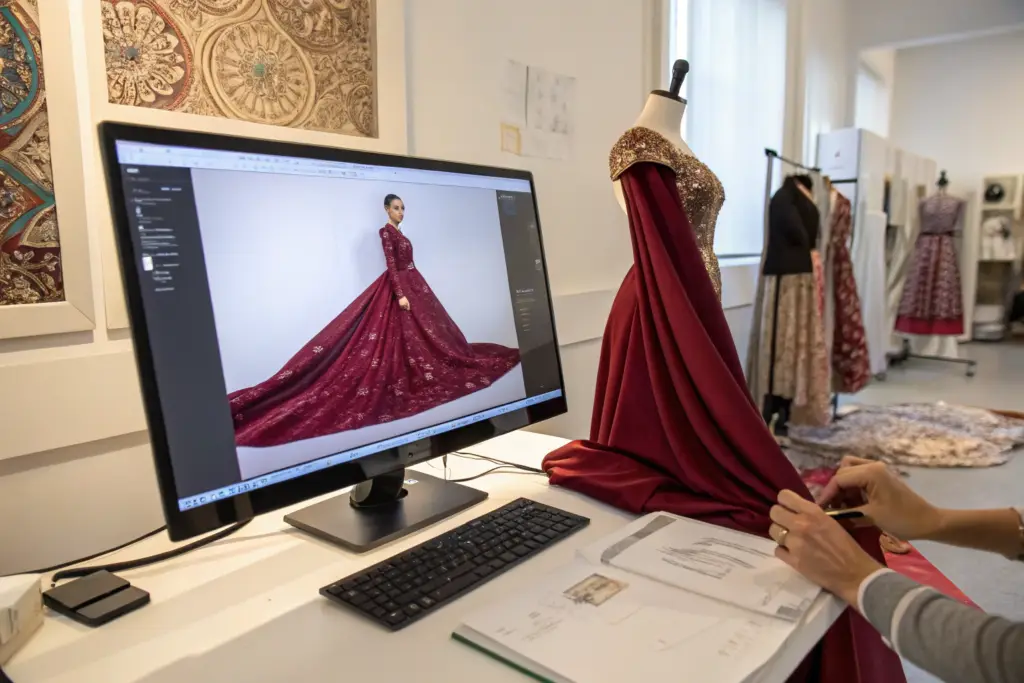
I used to be a purist. I believed nothing could replace the pinch, pull, and drape of a physical sample cut from the actual production fabric. Then, I met a client from Amsterdam who was launching a 12-piece collection on a tight eight-week timeline. We physically could not afford the two weeks of shipping a physical proto back and forth for two rounds of revisions. I suggested we try full 3D sampling using her exact fabric parameters, inputting the weight, stretch percentage, and bending rigidity into the software. We got the digital sample approved in 4 days. The physical sample at the end deviated by less than 2% from the digital twin. This shifted my entire view. Physical is the master reference, but digital is the high-speed scout.
A 3D digital sample is more reliable than a physical prototype specifically for approving the silhouette, proportion, and color-blocking placement in the early development stage, because it visually resolves 95% of catastrophic shape misunderstandings within hours instead of weeks, but a physical prototype is still mandatory for the final hand-feel, stitch tension, and live-model movement check before bulk cutting.
The reliability gap isn't the software anymore; it's the honesty of the data input. A 3D rendering engine is polygonal math. It doesn't lie. But if you feed it the wrong data for the fabric, you get a beautiful lie.
How Does Fabric Digitization Accuracy Affect the Virtual Drape?
The physics engine of programs like Browzwear or CLO3D needs more than just a scan of the weave. We use the Fabric Analyzer Kit (FAK), a physical machine from Browzwear that stretches the physical fabric swatch and measures the true elongation, shear resistance, and bending stiffness in all directions. If a cheap factory just selects "Generic Cotton Jersey" from a dropdown menu, the digital shirt will drape like a t-shirt, even if the actual fabric is a stiff, heavy interlock. The digital sample will show no puckering at the seams. The real production will pucker like crazy. This generates a "false positive" approval.
Why Cannot a 3D Render Confirm the True Stretch Recovery of a Swimsuit?
This is the specific performance edge case where digital fails. A 3D avatar can show you how far a 20% spandex blend stretches around the bust. It cannot simulate the plastic deformation after 10 minutes in chlorinated water. For an Australian swimwear brand, I agreed on the 3D block for the cut, but I insisted on a physical "AQL pack" for the stretch test. We physically sewed a size Medium hip block panel, stretched it 300% on a manual tensile rack for 30 minutes, and let it rest. The physical fabric recovered to 98% of its original size. The digital model just assumed a perfect 100% recovery. If I had trusted only the screen, the end-customer would have complained of a saggy, baggy bottom after a single swim because of "creep deformation" in the women’s wear elastane, which the software couldn't predict.
What Time Zone Management System Stops Overnight Production Delays?
Most people think the 12 to 15-hour time difference is a weakness of working with Asia. I have engineered it into our single greatest strength. At midnight in New York, a design comment is sent. At 8:00 AM in Shanghai, a patternmaker reads it and executes the revision. By 9:00 PM Shanghai time, the sample is updated. At 9:00 AM New York time, the buyer wakes up to a photo of the revised sample on his desk. This is a 24-hour continuous production wheel. If managed poorly, it’s a delay engine of "I'll check tomorrow." If managed well, you gain a free third shift.
The specific time zone management system that stops overnight production delays is an overlapping "Power Hour" shift schedule where the Chinese merchandising team begins work at 7:00 AM Shanghai time, precisely overlapping with the 4:00 PM–7:00 PM PST window for our US West Coast clients, ensuring we have a daily, live video block where the factory floor can be walked and decisions made in real time, rather than waiting a full Earth rotation for a single text reply.
At Shanghai Fumao, our merchandisers effectively work a staggered shift that aligns their highest cognitive output with your availability. They don't just answer emails; they run the line tours.

Why Do Standard Email Threads Destroy a Cut-Off Deadline?
Email is a "task graveyard." I see chain emails where a critical question like "Do you want the 2mm or 3mm toggle?" gets buried under ten new replies about swing tags. The sample room doesn't stop while that thread is alive. They keep sewing, using the wrong toggle. We use a "Redline Thread" system. The final production critical path is a shared Google Sheet, not hidden in an inbox. Any comment that has a "stop-work" implication is posted in a special, designated column. If the toggle question isn't answered in this "Decision Log" within 1 hour during the Power Hour, my senior merchandiser has authority to halt the specific trimming station, not the whole line, until an answer is received. This is proactive intervention.
How Does a "Golden Window" Workflow Compress an Approval Schedule?
| A physical approval schedule works on a 48-hour email latency cycle. We use a 4-hour burst cycle. Here is a sample daily schedule during a sampling sprint: | Time (Shanghai) | Time (US Eastern) | Critical Action |
|---|---|---|---|
| 7:00 AM | 7:00 PM (Previous Day) | Merchandiser reads overnight client comments, prepares technical questions. | |
| 8:30 AM - 12:00 PM | 8:30 PM - 12:00 AM | Factory works on revisions. Samples or digital images prepped. | |
| 1:00 PM | 1:00 AM | "Power Hour" starts (for West Coast, this shifts to PM Shanghai). Live Line Tour by video call. | |
| 5:00 PM | 5:00 AM | Revised sample photos uploaded. Client gives feedback upon waking. |
This standard schedule allows us to complete three full "query-response-execute" cycles in 72 hours, not one cycle every 48 hours, which is standard for a basic garment factory.
How Do You Bridge the Aesthetic Gap When a Factory Just Doesn't "Get" the Look?
A hipster brand owner from Portland came to me with a lexicon I couldn't find in any textile manual. He wanted the men’s wear shirts to look "dead," "exhausted," and "soulless." My production manager, a brilliant technician who spends her days looking at seam tensions, didn't know if she should wash the shirt in acid or run it over with a truck. The client's vocabulary was emotional; his base was heavy metal music. Our vocabulary was technical; our base was stitch density. This is the "aesthetic gap." If you don't bridge it, you get a technically perfect, neatly pressed shirt that makes your dark, brooding customer feel absolutely nothing.
You bridge the aesthetic gap by banning abstract adjectives and introducing a mandatory "Reference Triangulation" method where every design comment is cross-referenced with a physical vintage garment benchmark, a specific numeric wash recipe code from a denim laundry, and an evocative but non-technical mood image that captures the emotional territory of the style.
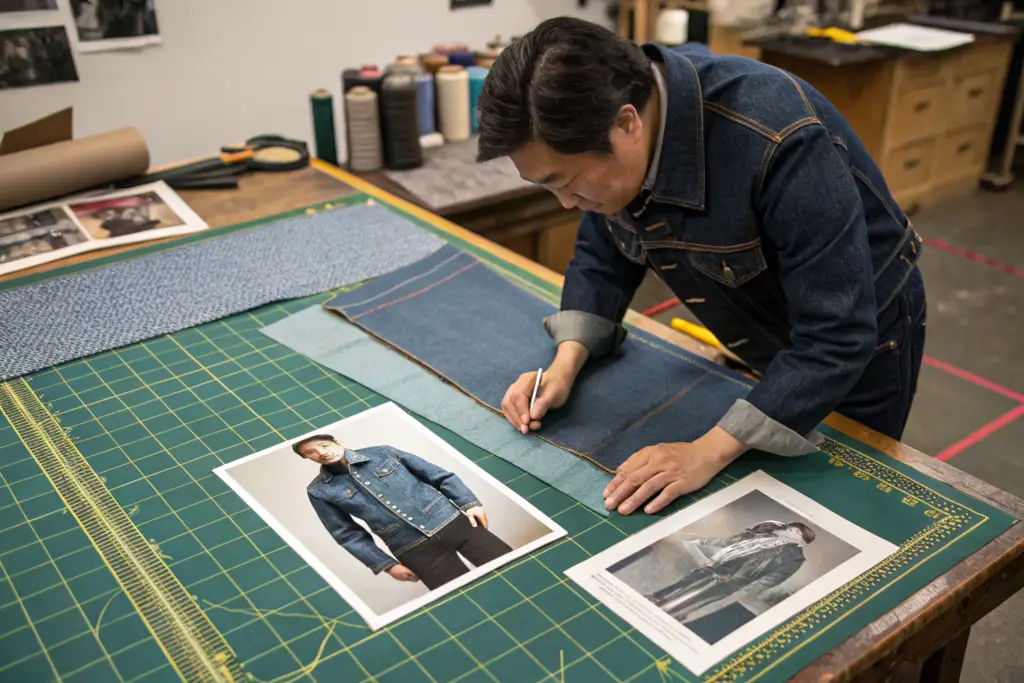
How Can a "Vintage Benchmark" Physical Sample Speak a Universal Language?
Words divide, but a physical benchmark unites. For the "dead" shirts, I asked him to send me his favorite band t-shirt—the one he wore until it was threadbare. We didn't copy the design. We analyzed the physical degradation. We found the collar had ripped at the shoulder seam due to specific stress. We noted the black dye had faded to a specific charcoal grey with a reddish cast due to UV exposure. We dismantled the benchmark. We sent its close-up photos on a shared fabric board, annotated with our findings. Then, we asked, "Do you want us to replicate this exact fibre degradation pattern on the seams?" He immediately said "Yes, that's the soul part." The word "soulless" was translated into a physical, mechanical garment wash called "Heavy Enzyme + Silicone Softener + Localized Seam Abrasion."
What Role Does Pantone Matching Play in Defining a "Mood"?
A mood isn't a color; it's a color in a certain texture. "Sad blue" doesn't mean anything. But Pantone 19-4030 "True Blue" on a brushed, hairy flannel communicates sadness because of the low saturation and soft, depressed surface texture. We use the Pantone Fashion, Home + Interiors color guide, specifically the cotton chip version, so the exact dyed fiber shade is signed off. But we always pair the Pantone chip with the fabric's finish reference. A glossy neon pink Pantone on matte, ring-spun cotton looks like a "vibrant, energetic" beach mood for kids' wear. That same exact Pantone on a cheap, shiny polyester tricot looks like a "cheap nightclub" mistake. You can't just pick a number; you must specify the finish and the yarn to communicate the mood.
Conclusion
The geography between you and your factory is not the problem. The distance between your mouth and the patternmaker's ear is the only distance that matters. Every dollar lost in this business to "bad quality" is actually a dollar lost to a vague sentence, an unconfirmed measurement, or a time zone "ping-pong" delay. I've seen the same factory produce catastrophic junk for one brand and runway-ready precision for another—simply because the second brand had a locked-down, visual, and measured communication system. The machines don't change. The clarity of the instruction changes.
Fixing this requires a hard reset on how you talk about clothes. No more "just make it nicer." No more "you decide." You become the co-pilot of the tech pack, not a distant critic. When you partner with Shanghai Fumao, you are plugging into a system built on this obsessive clarity. We don't just take an order; we mirror your intent, we digitize your uncertainties, and we force an alignment on the aesthetic before a single meter of fabric is wasted.
If you are tired of unboxing samples that feel like they were made for a completely different brand, the problem is solvable. It starts with a single, focused conversation with a partner who speaks the native language of both the sewing floor and the US retail floor. Reach out to our Business Director, Elaine. She is the master of the Visual Tech Pack and the Power Hour workflow, and she can walk you through how we turn your mood boards into measurable garments. You can contact her at: elaine@fumaoclothing.com. Let's remove the frustration and build the collection you actually see in your head.