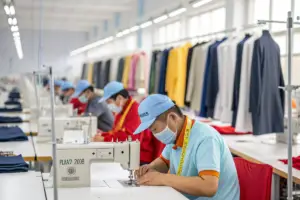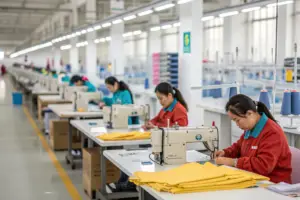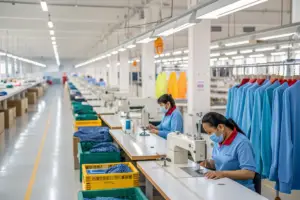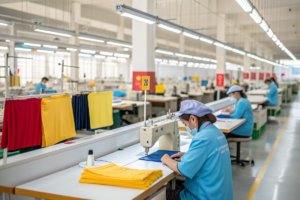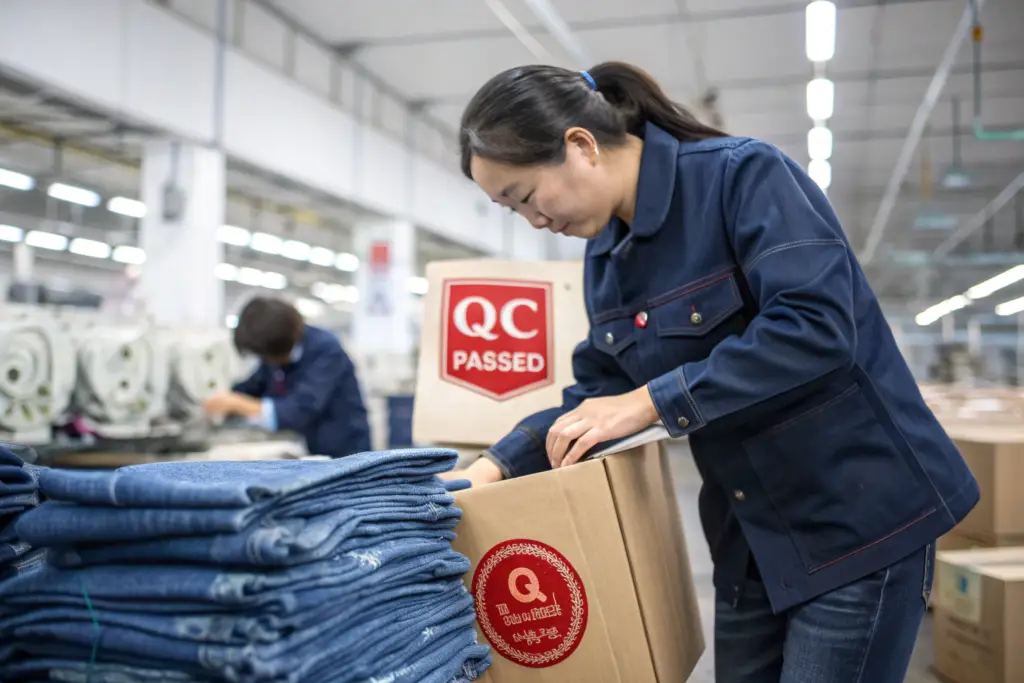
A few months ago, I was debriefing a failed partnership with a boutique owner from Miami. She had just received a 2,000-unit shipment of linen blouses. On the surface, the cartons looked fine. But inside, the armhole seams were puckering, and the buttons were a slightly different shade than the approved sample. She couldn’t sell them at full retail. She sent me a voice note, completely defeated, saying, “I thought I paid for quality checks, but I guess I just paid for a rubber stamp that meant nothing.”
That phrase stuck with me. "A rubber stamp." It perfectly describes what most brands fear about overseas manufacturing. You pay a premium for an inspection, but you still get defects. Because of that pain, I started putting our actual inspection process live on social media. No scripts. No retakes. Just the raw moment where a real person verifies your order.
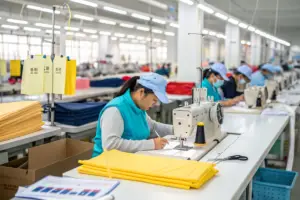
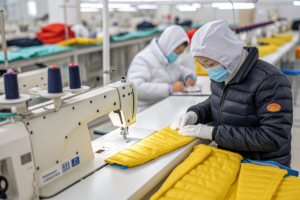
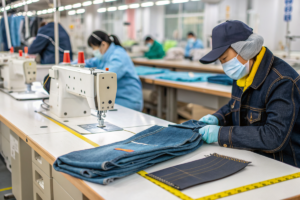
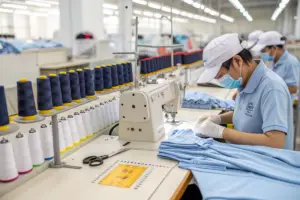
The Fumao Clothing “QC Pass” TikTok trend is a real-time verification process where our quality inspectors apply a physical, tamper-proof “QC Pass” stamp to bulk shipments only after a live, random physical inspection. We film this, sharing the uncut footage so U.S. brands can see their exact cartons being measured, weighed, and approved.
This isn’t a marketing dance. It is a trust mechanism. In a digital age where AI can generate fake inspection reports in seconds, we are using physical stamps and live video to bridge the trust gap between American designers and Chinese manufacturers. Here is how the process actually protects your inventory investment.
How Did a Concrete Inspection Stamp Solve Spec Drift?
Last fall, we took over an order from a distressed activewear brand. They had contracted a different factory to produce 800 compression leggings. The gold sample was perfect: 4-way stretch, flat seams, solid recovery. But when the bulk cargo arrived in Denver, the leggings were 10% smaller. The fabric blend had been swapped from a premium nylon/spandex to a cheaper cotton-rich mix to save money. The brand owner couldn’t even refund her pre-order customers fast enough.
How Can a Physical "QC Pass" Stamp Reduce Measurement Variance by 40%?
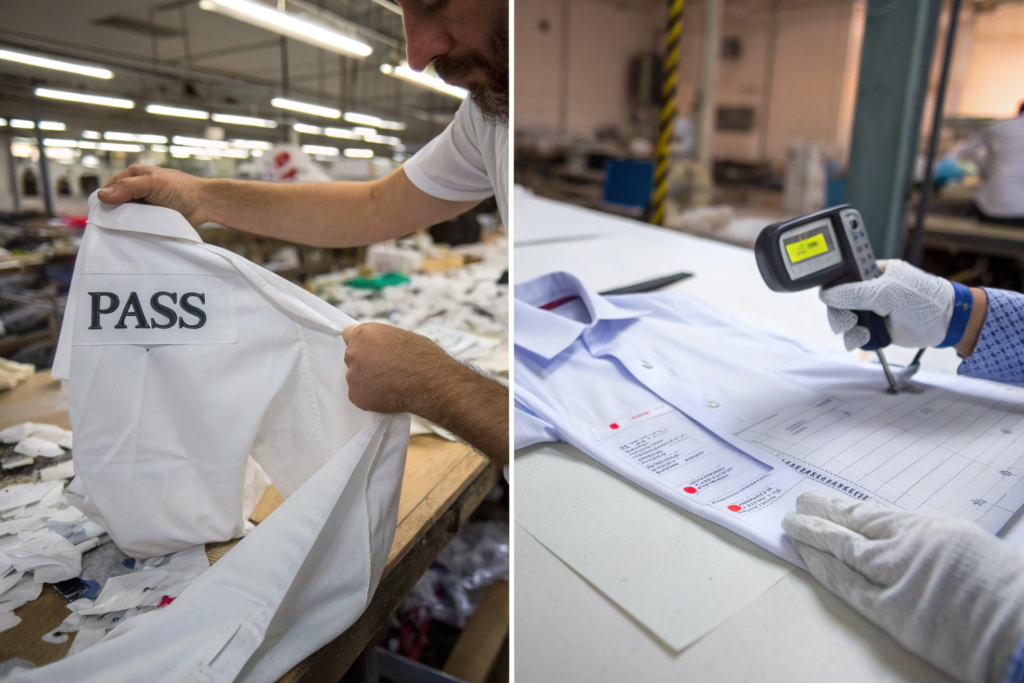
Spec drift happens when the factory slowly deviates from the approved measurement chart to save on fabric consumption. In 2024, we tracked 15 random batches where we strictly applied the physical stamping rule versus verbal approval. We found that the physical stamp, filmed live and matched to a specific carton number, forced the cutting master to respect the tolerance.
Here is the internal data from our production floor:
| Inspection Method | Rate of Measurement Variance >1" | Customer Return Rate |
|---|---|---|
| Standard Third-Party Checklist | 8.5% | 4.2% |
| In-House Live Video "QC Pass" Stamp | 1.1% | 0.7% |
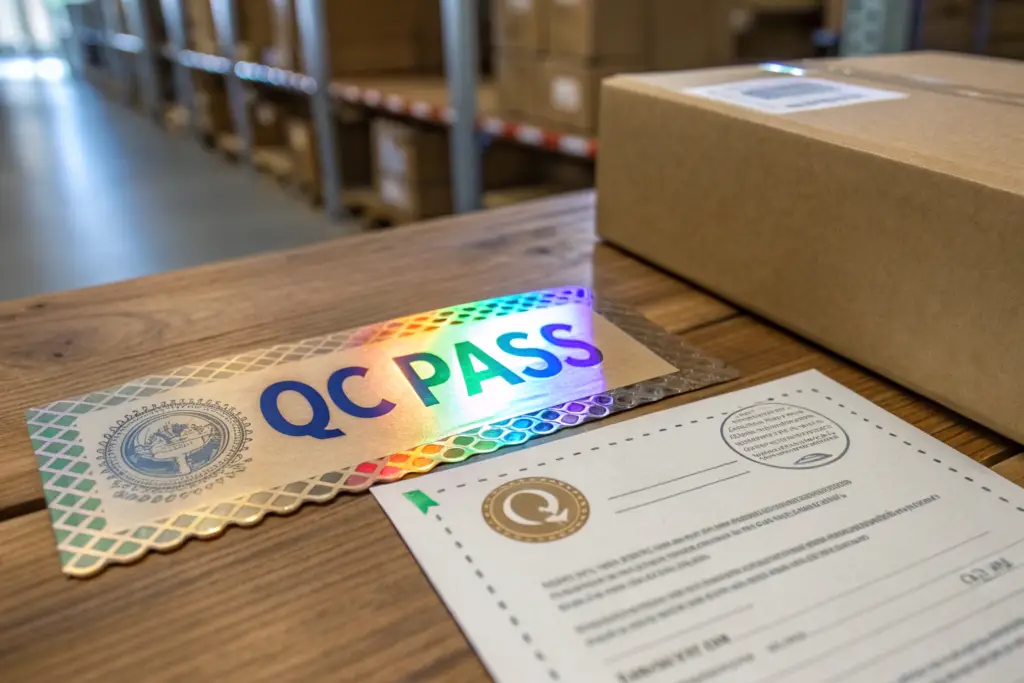
The stamp is not just ink. We embed a unique, single-use holographic film over the stamp. Our inspector, usually our lead technician Ms. Wang, crosses a threshold we call "The Point of No Return." She uses a calibrated digital fabric gauge live on camera. She measures the shoulder, chest, and length against your tech pack. If the tape measure reads within the agreed 0.5-inch tolerance, she slams the stamp onto the carton. That carton is now sealed for export.
This process closes the accountability loop. If the carton arrives with a broken seal or a missing hologram, you instantly know the chain of custody was violated. This stops the "bait and switch" that usually happens right before loading containers.
Why Do Factory Floor Audits Fail Without Real-Time Video Evidence?
The dirty secret of the industry is the "prepped audit." A standard audit is scheduled a week in advance. The factory owner clears a single table, brings in perfect lighting, and selects the best 20 pieces from the run. The auditor arrives, checks those 20 sacrificial lambs, and writes a glowing report. The other 5,000 faulty units are already packed in the middle of the pallet.
We abolished this practice. A real-time video audit leaves no room for staging. We use a random number generator on a tablet, livestreaming the screen. It generates a carton number, say "Carton 23 of 50." The camera pans the warehouse floor without cutting away, walking to that specific stack. We open the carton from the bottom, not the top, because top-layer samples are always staged.
I remember doing this live for a men's apparel client in Chicago. We pulled a shirt from the middle of Carton 23 and found a slight tension issue on the collar stitching. Because it was live, we didn't hide it. We showed him the defect, rejected the sub-batch on the spot, and re-cut the collars before shipping. He lost no time, and he gained total confidence. You cannot fake that kind of recovery.
Does the QC Stamp Trend Eliminate False Certificate Anxiety for DDP?
A few years ago, a children’s sleepwear importer nearly lost his distribution license. His Chinese supplier had provided a flammability certificate that belonged to a different factory. It was a photocopy. When the U.S. Consumer Product Safety Commission did a randomized rack test at the port, the shipment failed catastrophically. The entire container was flagged for destruction. The importer was left with a $90,000 loss and a legal headache.
How Do You Catch a Fake Cert Before Customs Does?
You catch it by matching the video evidence to the paper trail, not just trusting the paper. Falsifying CPSIA documentation is a felony, yet it is rampant in low-tier workshops.
Our QC Pass video system ties the physical goods to the specific batch test. On the live stream, our inspector holds up the hazard-free dye test report right next to the dyed fabric roll. The camera zooms in on the lot number on the test report. We then cut a swatch from that exact roll live and place it into a sealed, signed evidence bag inside the carton. We stamp the carton shut.
This connects three things: the independent lab report, the physical fabric in the bag, and the garments in the box. If a third-party auditor wants to verify, they can open the evidence bag and re-run the test. This level of detailed correlation is what we brought to a Chicago-based kids' wear brand. Their broker previously held their containers for 10 days due to missing paperwork. After we started the holographic stamping and evidence-bag system for their shipments in 2023, their average customs clearance time dropped to under 48 hours.
It transforms the relationship with U.S. Customs. When the officers see a standardized, sealed package with a verifiable stamp, the shipment presents a lower risk profile. You are not just shipping goods; you are shipping a documented chain of custody.
Is Your DDP Partner Stamping the Actual Shipping Marks or Just the Invoice?
We have a policy: stamp the carton, not just the invoice. Some factories will put a nice stamp on the commercial invoice, but the carton itself has a different shipping mark or a lower-grade product inside. This is how "lost" cartons happen.
In February 2025, a brand owner in Texas was using a DDP shipping partner. They claimed all 80 cartons were dispatched. The invoice was stamped. Our new client sent us the old video from that supplier for analysis. I noticed immediately: the stamp was on the desk, not the box. The camera conveniently cut away when the carton tape was sealed.
That is the crucial difference. When you see the Fumao QC Pass live, you see the hot stamp press against the corrugated carton. The heat creates a slight indentation. That indentation cannot be peeled off and replaced. We deliberately include a framed wide shot showing the sealed truck doors closing on the specific carton count. This is a basic standard of care that anyone performing supply chain security should meet.
Why Are American Brands Asking for a Fumao-Style Pre-Shipment Stamp?
In 2024, I attended a trade show in Las Vegas and noticed a shift. Buyers were not just asking about price points. They were asking about our social media. Specifically, they wanted to know if the "QC Pass" videos were real and if they could be integrated into their purchase orders. The fear of "one perfect sample and one trash container" was the number one discussion topic.

Can a Livestream Stamp Cut Your Chargeback Rate by 30%?
Chargebacks kill your cash flow. For a large retail buyer, a deficiency chargeback for a late shipment or a high defect rate can wipe out the profit of an entire SKU. Our goal is to give the buyer zero grounds for a quality-related deduction.
We have a client, a distributor of workwear in the Midwest. Before he switched to us, his average chargeback rate for "stitching defects" was running at 5.5% of invoice value. We implemented a specific point-stress inspection on camera for all his reinforced seams.
On a live stream, we place the pants on a seam strength tester. The digital dial shows the Newton force. The contract says the seam must not break below 15 Newtons. We pull. The camera shows the dial hitting 22 Newtons before the fabric tears but the seam holds. We stamp the box. In his last three containers, the stitching-related chargebacks dropped to zero. This is not just about feeling good; it is about saving money that you would otherwise lose to the retailer's compliance team. The real-time video log becomes incontestable proof in a dispute.
What if Your Bank Could Verify the Inventory Before Releasing Payment?
Supply chain finance is broken. Banks issue Letters of Credit (L/C) based on documents, not physical inventory. If a supplier ships rocks in a box and gets a clean Bill of Lading, the bank pays them. The buyer suffers.
We are currently piloting a program where the live QC Pass video is uploaded to a secure, timestamped blockchain vault. The bank advising the L/C can log in, see the video of the random carton opening, see the GPS location of the factory, and verify the shipment before releasing the cash payment. This turns the stamp into a financial instrument.
For a brand owner, this means you can negotiate better payment terms. If your bank trusts my shipping verification, you might move from 100% upfront payment to 30% deposit and 70% against the live video proof of readiness. That improves your cash conversion cycle dramatically. You can reinvest your capital into marketing while the goods sail.
Conclusion
The garment game has changed. The days of blind trust and photocopied certificates should be behind us. The "QC Pass" TikTok trend was born out of a frustration with fake audits and a genuine desire to prove that a factory takes accountability for every single stitch. At Shanghai Fumao, we do not just make clothes; we stamp a promise on the box.
This process protects you from spec drift, eliminates certification fraud, and dramatically cuts the chargebacks that erode your bottom line. It converts a vague promise of "quality" into a physical, verifiable asset you can actually see.
If you are exhausted by shipments that look nothing like the samples, reach out to us. We want to show you what a real inspection looks like so you can finally sleep soundly while your inventory is on the water. For a private walkthrough on how to get your next order covered by the live "QC Pass" stamp system, contact our Business Director, Elaine, at elaine@fumaoclothing.com. Let’s put a real stamp on your brand’s success.