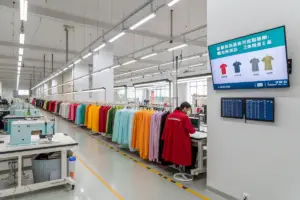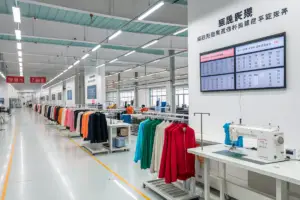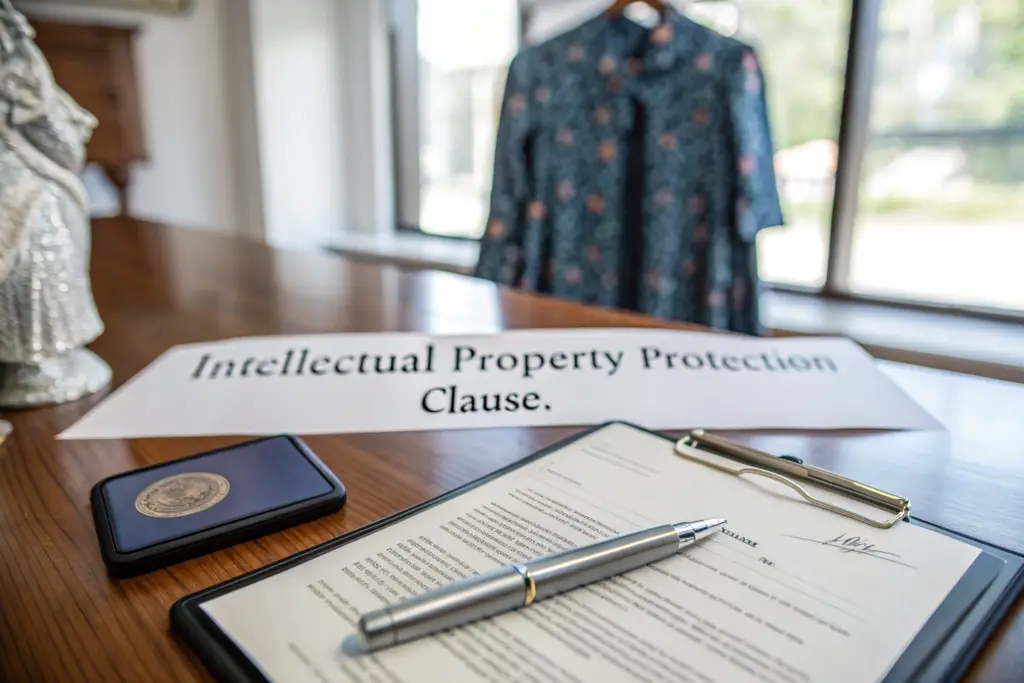
Three years ago, a Miami-based resort wear designer discovered her exact bestselling maxi dress—the one with the hand-painted tropical print she had spent six months developing—being sold on a major e-commerce platform by an unknown seller for 65% less than her retail price. The seller was using her own campaign photos, stolen directly from her Instagram feed. The factory she had hired to manufacture the dress had retained her digital print file after her production run ended. They continued producing the dress, selling it as "wholesale surplus," and shipping it to any buyer who placed an order. When she contacted a lawyer, she learned the devastating truth: her manufacturing agreement contained no intellectual property protection clause. The factory had not broken any contract, because the contract had never prohibited the resale of her designs. She lost her brand exclusivity, her wholesale accounts, and her legal case all at once.
To legally protect your unique custom clothing designs when manufacturing garments overseas, you must implement a four-layer defense system before a single sample is sewn: first, register your brand name and logo as a trademark with the US Patent and Trademark Office and record it with US Customs and Border Protection; second, sign a manufacturing agreement that includes an explicit "Intellectual Property and Non-Competition" clause with a liquidated damages penalty of at least 200% of the order value for any unauthorized reproduction; third, document a dated, timestamped digital trail of your original design files using a blockchain-based copyright verification service; and fourth, physically secure your production by requiring a signed "Digital Asset Destruction Certificate" after each completed purchase order.
At Shanghai Fumao, I have seen too many talented designers lose control of their own creations because they trusted a handshake and a smile. The protection of your intellectual property is not a factory’s moral obligation; it is your legal architecture that must be built, documented, and enforced proactively.
Why Is a US Customs Trademark Recordation Your Absolute First Line of Physical Defense?
A Portland-based outdoor apparel brand once called me in a panic. A former factory in another province, one they had stopped working with due to quality issues, had shipped a full container of counterfeit versions of their best selling fleece jackets toward the Port of Seattle. The factory had copied everything: the brand’s registered logo, the hangtag design, even the unique zipper pull shape. The brand owner had no US trademark recordation filed with Customs and Border Protection. CBP had no automated flag in their screening system linked to his brand. The container cleared customs, the counterfeit goods entered the US market, and his legitimate wholesale accounts began emailing him asking why his jackets were being sold at half price on discount websites. The brand damage was catastrophic and entirely preventable with a single, inexpensive electronic filing.
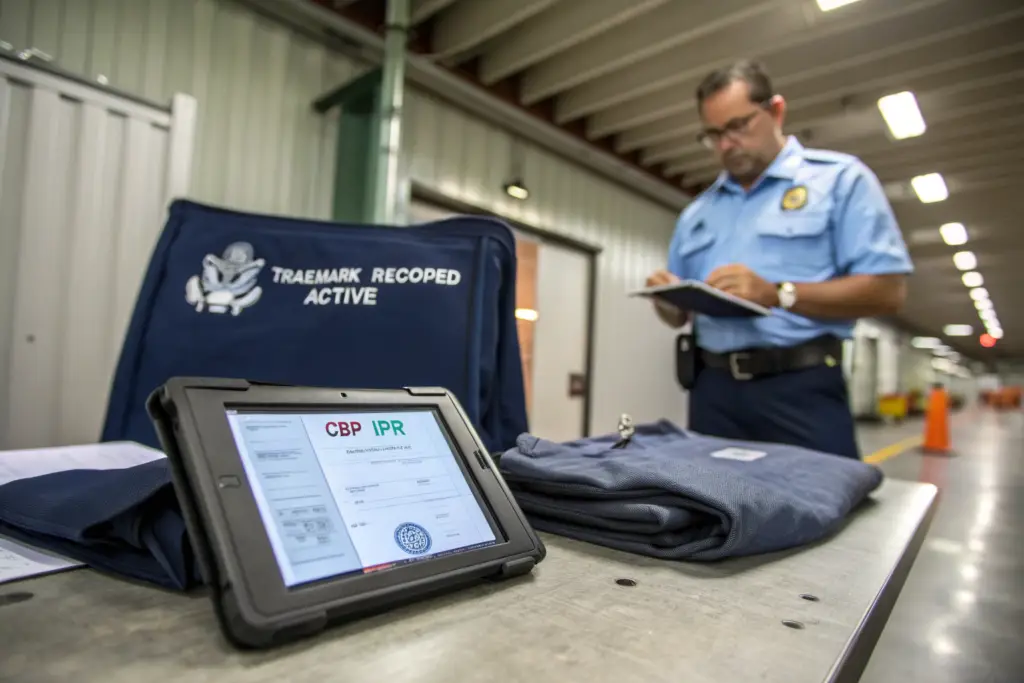
A US Customs and Border Protection trademark recordation is your absolute first physical defense because it enters your registered US trademark into the CBP IPR search database, training customs officers to recognize your brand’s identifiers and authorizing them to proactively seize, detain, and destroy any imported merchandise bearing your trademark that is shipped by an entity not listed as an authorized licensee, acting as a physical border wall that stops counterfeit or unauthorized grey market production at the port of entry before it reaches your wholesale customers.
A Chinese court injunction takes months and costs tens of thousands of dollars. A CBP recordation takes approximately two weeks, costs a few hundred dollars per trademark class, and is renewed every ten years.
How Does an e-Recordation Filing Link a Specific Brand Logo Image to the CBP Screening Algorithm?
The CBP e-Recordation portal does not just record a registration number. It requires you to upload a clean, high-resolution digital image of your exact trademark logo as it appears on your products. This image is loaded into CBP’s image-recognition screening system. When a container’s manifest is electronically filed, CBP’s algorithm can visually match a product image or a shipping label image against the recorded trademark database. A counterfeit hoodie with a slightly skewed logo will still trigger a match flag if the algorithm’s confidence score is above the threshold. I recommend that every brand buyer upload both a black-and-white version and a full-color version of their logo, plus an image of their specific hangtag design.
What Happens at the Physical Port When a CBP Officer Seizes a Suspect Container?
The seizure process is not a polite email. CBP physically removes the suspect cartons from the container, issues a formal seizure notice to the importer of record (the unauthorized seller), and places the detained goods in a bonded warehouse. The importer has a limited window, typically 30 days, to produce proof of authorization from the trademark owner. If they cannot—and they usually cannot, because they are an unauthorized factory or a grey market reseller—the goods are administratively forfeited and destroyed. The brand owner is notified and can provide a statement confirming non-authorization. This process stops the counterfeit goods from ever reaching a shelf.
What Specific Contract Clause Language Triggers a Crippling Financial Penalty for Design Theft?
A Los Angeles streetwear designer once included a simple clause in his manufacturing contract that saved his entire brand. The clause was one paragraph, written in plain English, and stated that if the factory reproduced, sold, or distributed any of his designs without his written consent, the factory would owe liquidated damages equal to 300% of the total purchase order value that the infringed design was originally produced under. Eighteen months later, the factory’s sales manager, who had since left the company, started a small side business selling "OEM surplus" versions of the designer’s hoodies online. The designer discovered the listings, sent a legal letter with a screenshot of the signed contract clause, and demanded the 300% penalty. The factory owner, facing a potential liability of over $120,000 on a $40,000 original order, immediately shut down the unauthorized listings, fired the former employee, and paid a negotiated settlement of $65,000.
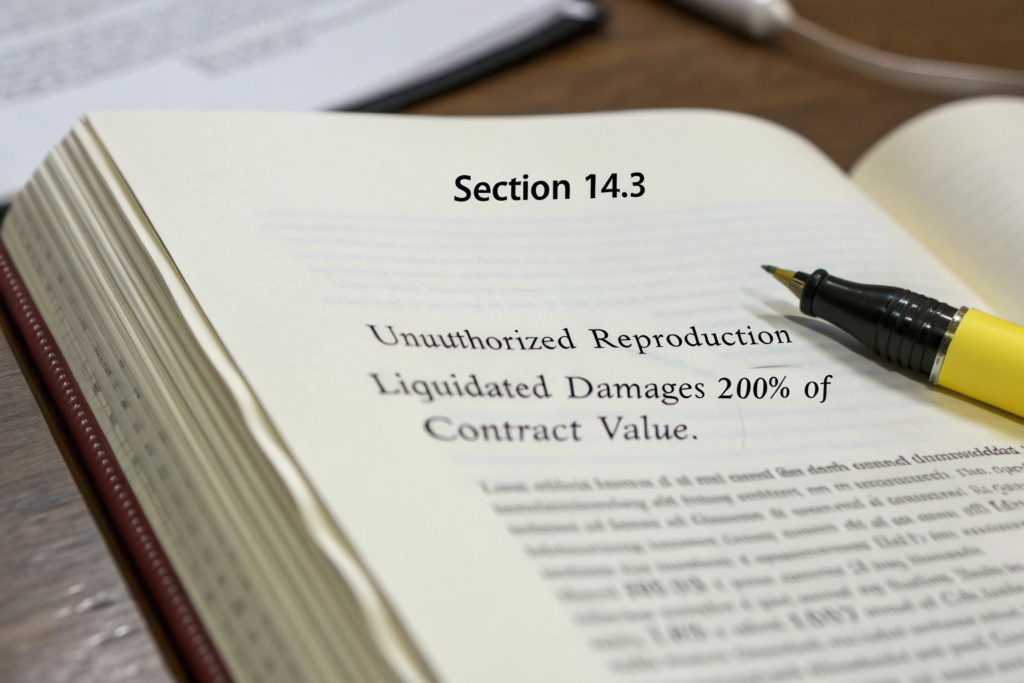
The specific contract clause language that triggers a crippling financial penalty for design theft must include a clear definition of "Confidential Information" encompassing all tech packs, patterns, samples, and print files, an explicit prohibition on reproduction, sale, or distribution without written authorization, a liquidated damages figure set at a minimum of 200% of the infringed order’s total FOB value to create a commercially devastating deterrent, and a binding international arbitration agreement specifying a neutral jurisdiction such as Singapore or Hong Kong under UNCITRAL rules that allows the designer to enforce the penalty judgment without litigating in the factory’s local court system.
A vague "the factory agrees not to copy your designs" clause is unenforceable. The penalty must be a specific, calculated, financially painful number tied directly to a specific purchase order.
Why Is a "Liquidated Damages" Clause Enforceable Where a Generic "We Will Sue You" Threat Is Not?
A generic threat to sue for "all damages" requires the designer to prove the exact financial loss in court—a nearly impossible task that requires forensic accounting of the factory’s illicit sales, a long and expensive discovery process. A liquidated damages clause pre-agrees the penalty amount as a reasonable estimate of the harm caused. Under international contract law, a liquidated damages clause is enforceable if it is a genuine pre-estimate of loss, not a punitive penalty. I draft the clause to explicitly state the logic: "The parties agree that the unauthorized reproduction of the Buyer’s designs will cause irreparable brand damage that is difficult to quantify precisely, and therefore agree that 200% of the PO value represents a reasonable and agreed pre-estimate of the minimum damages incurred."
How Does a Singapore or Hong Kong Arbitration Clause Solve the "Enforcement in China" Problem?
A Chinese court judgment can be difficult for a foreign brand to enforce. A Singapore International Arbitration Centre (SIAC) or Hong Kong International Arbitration Centre (HKIAC) award, however, is enforceable in China under the New York Convention on the Recognition and Enforcement of Foreign Arbitral Awards, which both China and the United States have ratified. If the factory refuses to pay the damages, the designer can take the SIAC award to a Chinese intermediate people’s court and have it recognized and enforced directly against the factory’s Chinese bank accounts. This legal structure gives the liquidated damages clause real, collectible teeth.
How Can a Blockchain-Based Digital Timestamp Prove Original Design Ownership in a Dispute?
An Australian print-based dress brand was once accused by a competing brand of stealing their fabric print. Both brands had used the same overseas factory, and both brands claimed they had developed the original artwork. The factory, caught in the middle, could not verify who had sent the file first. The dispute escalated into a public social media war, damaging both brands. The Australian brand, however, had timestamped their original artwork file on a blockchain-based copyright verification platform the day they created it. The timestamp was immutable, verifiable, and included a cryptographic fingerprint of the exact digital file. When the brand published the timestamp certificate publicly, the competing brand retreated, and the dispute ended. The timestamp was the silent, undeniable witness.
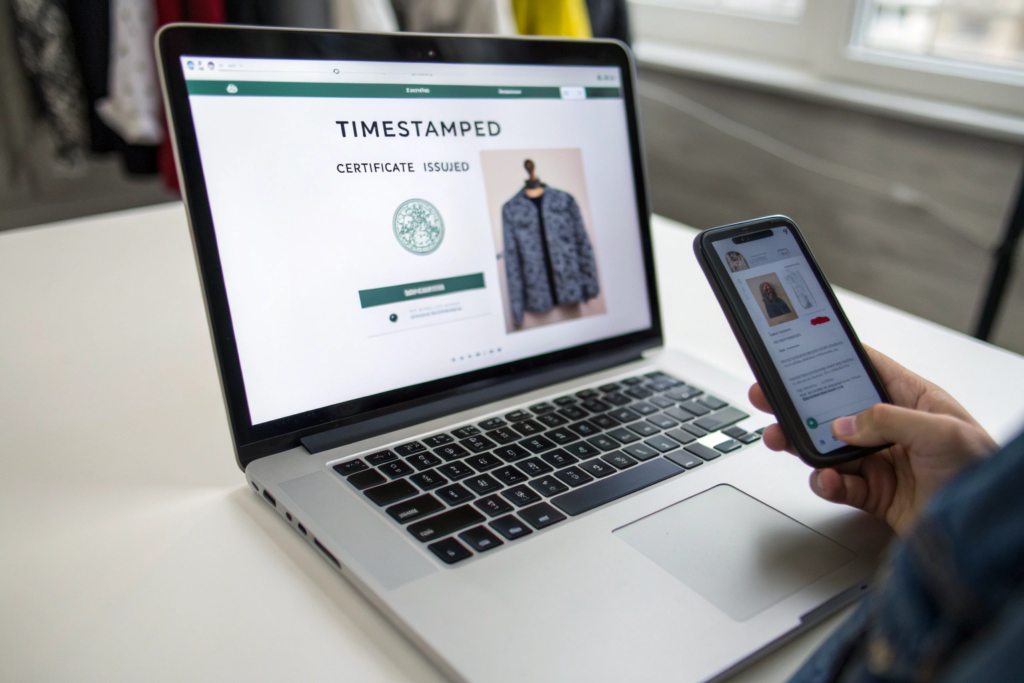
A blockchain-based digital timestamp proves original design ownership in a dispute by creating an immutable, third-party-verifiable record of the exact date, time, and cryptographic hash of your digital design file, registered on a public distributed ledger that no party—not the designer, not the factory, not a competing brand—can retroactively alter, providing a court-admissible evidence trail that establishes a specific, provable date of creation before any dispute ever begins.
A dated email to yourself is not proof. A screenshot of a file folder is not proof. A blockchain timestamp is a mathematical proof that a specific digital file existed at a specific moment in time, verified by a decentralized network.
What Is the Exact Process for Timestamping a Tech Pack or Print File on a Blockchain Service?
The process is simple. You upload your design file—an Adobe Illustrator vector, a PDF tech pack, a Photoshop print separation—to a service like Bernstein Technologies or similar blockchain IP platforms. The platform does not upload your actual secret design to a public network; it generates a unique cryptographic hash (a mathematical fingerprint) of your file. Only this hash, not the design itself, is written to the public blockchain. You receive a digital certificate containing the hash, the timestamp, and the blockchain transaction ID. If a dispute arises two years later, you run the same hash on the contested file, and it mathematically matches the timestamped record. This is legally recognized evidence under the eIDAS regulation in Europe and is increasingly accepted in US federal courts.
Why Is a Timestamped Design File More Powerful Than a Registered US Copyright in a Factory Dispute Context?
A US Copyright registration provides statutory damages in US litigation. But it takes months to process, and the official registration date is the date the Copyright Office receives the application, not the date of creation. A blockchain timestamp captures the exact moment the design was finalized, down to the second. In a dispute with a factory where speed and clarity are essential, the designer can immediately present the timestamp certificate and demand the factory identify who accessed the digital file after that date. This closes the investigative window rapidly.
What Is a "Digital Asset Destruction Certificate" and How Does It Prevent Post-Production Intellectual Property Leakage?
A Scandinavian minimalist brand once completed a successful production run of their signature linen shirting. The order was perfect. The payment was settled. The factory relationship was positive. Eighteen months later, a nearly identical shirt appeared in a fast-fashion chain’s collection, in the same unusual color palette, with the same distinctive pocket shape. The brand investigated and traced the production back to the same factory, which had simply re-used the brand’s archived pattern files for a different client. The factory had not "stolen" the designs maliciously; a production manager had pulled an old, convenient file to fulfill a new order quickly. The digital file was a passive, sleeping liability sitting on a factory server.
A Digital Asset Destruction Certificate prevents post-production intellectual property leakage by requiring the factory’s IT manager to permanently delete all digital design files—CAD patterns, embroidery digitization files, print artwork separations, and tech pack PDFs—after the final quality inspection is passed and the balance payment is settled, and then sign a formal, dated, and witnessed certificate confirming the complete and irreversible deletion, backed by a live video screen-share of the empty project folder.
Your designs do not leave the factory when your container ships. They remain on the factory’s hard drives indefinitely unless a specific, enforced deletion process is triggered.

How Is a Live Video Verification "File Shredding" Session Conducted Across Time Zones?
At the closing meeting for each production run, I schedule a ten-minute video call with the brand owner or their representative. My IT manager shares his screen live, navigates to the project folder containing the brand’s current season files, highlights all files, and initiates a permanent delete command with the shift-delete function on Windows or the secure empty trash function on Mac. The empty folder is then displayed. The brand owner sees the deletion with their own eyes in real-time. This ceremony is simple, cost-free, and psychologically powerful.
Why Must the Deletion Cover the Embroidery Machine’s Local Memory, Not Just the Main Server?
Industrial embroidery machines and digital fabric printers have their own internal storage drives. A print file or an embroidery digitization can be loaded directly onto the machine’s onboard memory and remain there indefinitely, accessible to any operator. The Digital Asset Destruction Certificate must explicitly list all peripheral production devices and confirm that their internal memories have been purged. At Shanghai Fumao, my embroidery department supervisor signs a separate deletion log for the specific machine head used for the order, verifying the local memory wipe.
Conclusion
The overseas factory that manufactures your custom designs is not automatically your enemy, but it is absolutely not your automatic guardian. The legal protection of your unique designs is a system you build, layer by layer, before you send a single tech pack. The CBP trademark recordation puts a physical border guard at the port who will seize counterfeit goods without you lifting a finger. The liquidated damages clause in the manufacturing contract puts a specific, painful dollar penalty on the factory’s breach, enforceable through neutral international arbitration. The blockchain timestamp creates an unalterable, mathematical proof of your original creation date that silences competing claims. The Digital Asset Destruction Certificate ensures that your design files do not sit passively on a server for years, waiting to be conveniently re-used for a different client.
At Shanghai Fumao, I welcome these protective measures from my brand partners. A legitimate factory does not fear a strong IP contract; it signs it confidently because it has no intention of violating it. I encourage every brand buyer I work with to record their trademarks, timestamp their designs, include a liquidated damages clause, and request a deletion certificate. These four actions signal that you are a professional business, not a naive first-time importer.
If you are about to send your unique designs to a factory and you want to ensure the legal architecture is in place before a single sample is cut, start with a protected conversation. Contact my Business Director, Elaine. She can share the exact contract clause templates, the blockchain timestamp process guide, and the deletion certificate template that our most protective brand partners use. Reach Elaine directly at: elaine@fumaoclothing.com. Your designs are your brand’s soul. Protect them with structure, not hope.