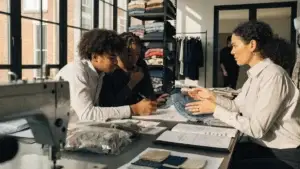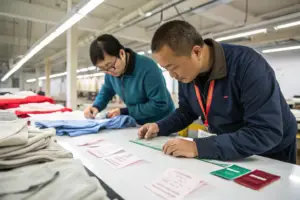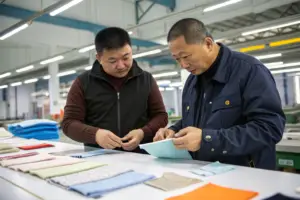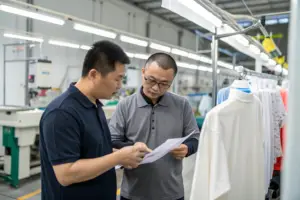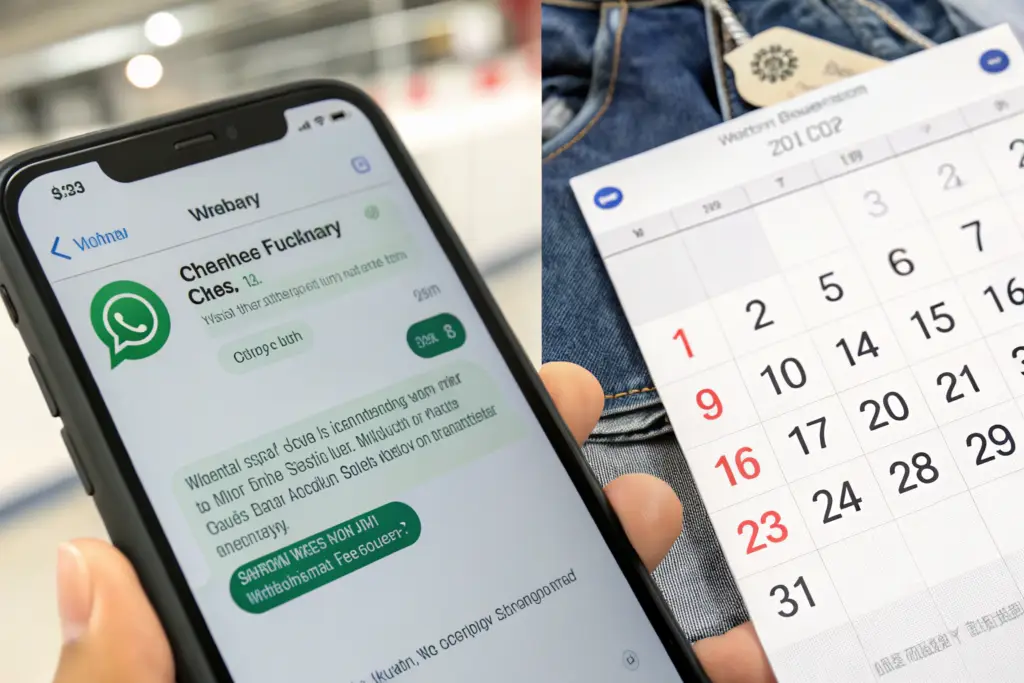
I received a text message at 9:30 PM on a Thursday night last spring. It was from a brand owner in New York who was in the middle of producing her first custom cut-and-sew collection with a new factory. The message had a photo of a lab dip. The caption read: "This is supposed to be Sage Green. It looks like Mint. Is this right?" I looked at the photo. It was definitely mint. I called our dye house manager at home. He checked the formula and realized the technician had misread the Pantone code. He said, "I can have a corrected dip by Monday morning." I texted the brand owner back within six minutes of her initial message: "It's wrong. Re-dip happening now. New sample Monday." She replied: "Thank God. I was about to have a panic attack." That six-minute response window saved three weeks of production delay and about $4,000 in potential fabric waste.
Fast factory communication is essential for custom clothing orders because custom manufacturing involves hundreds of micro-decisions about fit, fabric, color, and trim that cannot be fully anticipated in the initial tech pack. When a question arises on the cutting table or at the sewing machine, a 24-hour email delay stops production. A 5-minute WhatsApp reply keeps it moving. Speed of communication directly correlates to speed of delivery and accuracy of the final product. In an industry where missing a two-week selling window can wipe out a season's profit, communication velocity is a competitive advantage.
I want to be direct about this. At Shanghai Fumao, we do not view communication as a customer service chore. We view it as a production tool. It is just as important as the sewing machines and the fabric shears. A slow response does not just annoy the brand owner. It physically stops the garments from being made. Let me explain exactly why this matters to your bottom line and how we structure our communication to ensure your custom orders ship on time and on spec.
How Much Does a 24-Hour Email Delay Actually Cost a Clothing Brand?
Brand owners often underestimate the true cost of waiting for an answer. They think, "It's just one day. What's the big deal?" But in a multi-line factory, a one-day delay on one question creates a cascading effect that pushes your entire order back by a week or more. Production schedules are tightly packed. If your fabric is waiting for a color approval, the cutting table moves on to the next client's order. Your spot in the queue is lost.
A 24-hour email delay can cost a clothing brand between $500 and $5,000 in real terms, depending on the order size. This cost manifests in three ways: expedited shipping fees to make up for lost production time, storage fees at the port if the container misses the booked vessel, and most significantly, lost retail sales if the goods arrive after the peak selling window. For a custom order, where the buyer has already invested in unique fabric and development, these delays are particularly painful because the goods cannot be sold to another brand.
What Happens When a Production Line Stops for an Answer?
Let's walk through a real scenario from our factory floor. Line 3 is cutting a custom women's blouse for a client in Chicago. The tech pack specifies a "1/4 inch double-needle topstitch" on the collar. The sewer looks at the fabric. It is a very lightweight rayon challis. She knows from experience that a 1/4 inch double needle on this thin fabric might cause tunneling or puckering. She stops. She tells her supervisor.
Here is the fork in the road:
Scenario A: Slow Communication (Email Only)
- Supervisor emails the Production Manager. Production Manager emails the brand owner at 5:00 PM China time.
- Brand owner is asleep in Chicago. Sees email at 8:00 AM. Replies at 10:00 AM after checking her notes. That is a 17-hour delay.
- In those 17 hours, Line 3 cannot sew the collars. The operators are moved to another task. The momentum is broken. The order is now one day behind schedule. That one day pushes the shipment from a Friday vessel to a Tuesday vessel. That three-day difference at the port of Los Angeles triggers a $450 Pier Pass fee and a $180 chassis usage fee.
Scenario B: Fast Communication (WhatsApp/WeChat)
- Supervisor takes a photo of the fabric and the machine foot. Sends it via WeChat to the Shanghai Fumao account manager.
- Account manager forwards to brand owner with voice note: "Fabric is light. We recommend 3/8 inch single needle to prevent puckering. See photo. Approve?"
- Brand owner sees notification on phone. Looks at photo. Replies: "Approved. Do the 3/8 inch."
- Elapsed time: 8 minutes.
- Line 3 continues sewing. The order stays on schedule. No expedite fees.
This is the reality of custom manufacturing. The tech pack is a map, but the terrain of the actual fabric changes things. You need a guide who can radio back to base camp for a quick decision. At Shanghai Fumao, we use a combination of WeChat for instant photo/video sharing and Email for formal documentation. The informal chat solves the immediate problem. The formal email confirms the change for the record. This dual-channel approach has saved our clients tens of thousands of dollars in preventable delays.
Why Do "Small" Questions About Trims Cause the Biggest Headaches?
Trims are the buttons, zippers, labels, and hangtags. They seem minor, but they are the number one source of production stoppages. Why? Because they are often custom-made and have long lead times.
Consider a custom logo zipper pull. It takes 3-4 weeks to produce. If the factory waits until the main fabric is cut to ask, "What length zipper do you need for the front placket?" it is already too late. The zippers will not arrive in time.
Fast communication allows for Parallel Processing. This is a concept we drill into our team at Shanghai Fumao. We do not wait for one step to finish before asking about the next.
Here is a timeline comparison showing the impact of communication speed on a custom hoodie order:
| Task | Slow Communication Workflow | Fast Communication Workflow |
|---|---|---|
| Zipper Length Confirmation | Asked after fabric cut. Zipper order placed Week 3. | Asked during sample approval. Zipper order placed Week 1. |
| Zipper Arrival | Arrives Week 7. | Arrives Week 5. |
| Sewing Start | Week 8. | Week 5. |
| Ship Date | Week 10. | Week 7. |
The three-week difference in that table is entirely due to the timing of one question about a zipper. Fast communication allowed the zipper to be ordered before the fabric even arrived at the factory. When the cut pieces were ready, the zipper was already there waiting. This is how we consistently hit delivery windows that other factories miss. We ask the questions early. We do not assume. We confirm.
How Do Language Barriers and Time Zones Affect Custom Order Accuracy?
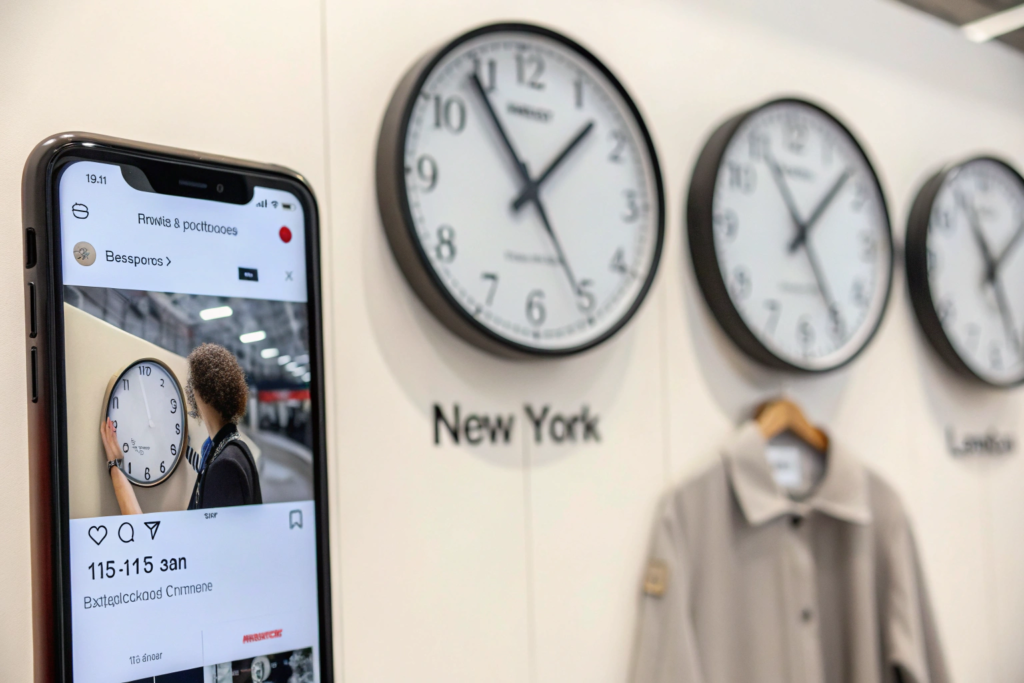
The distance between the U.S. and China is not just geographical. It is chronological. When you are waking up and drinking coffee, we are finishing dinner and preparing for the next day. When managed poorly, this 12-13 hour time difference creates a frustrating game of email ping-pong that stretches a simple clarification into a three-day ordeal. When managed well, it creates a 24-hour productivity cycle.
Language barriers and time zones affect custom order accuracy by increasing the risk of misinterpretation of technical specifications. Fast, clear communication mitigates this by favoring visual confirmation over text-based descriptions. A photo of a measurement being taken with a ruler eliminates ambiguity about where the sleeve length is measured from. A short video of the fabric drape conveys more than a paragraph of text. Factories that prioritize speed usually also prioritize clarity, using tools like annotated screenshots and voice notes to overcome linguistic hurdles.
What Is the "Overnight Advantage" of Working with a Factory in China?
There is a hidden benefit to the time zone difference that smart brand owners leverage. It is the ability to get work done while you sleep.
At Shanghai Fumao, we structure our internal workflow to take advantage of the U.S. night. Here is a typical 24-hour cycle for a custom order in development:
9:00 AM EST (New York Time) / 9:00 PM CST (Shanghai Time)
- Brand owner finishes work for the day. Sends an email with revised fit comments: "Please reduce the shoulder slope by 0.5 cm and send updated pattern."
10:00 PM - 12:00 AM CST
- Shanghai Fumao team receives the email (We have staff who monitor emails until midnight for U.S. clients).
- The instruction is translated and added to the pattern maker's queue for the next morning.
8:00 AM CST (Next Day)
- Pattern maker arrives at work. The adjusted pattern is already on her desk. She makes the 0.5 cm adjustment to the digital file. She cuts a new sample muslin.
- Elapsed time for brand owner: Still asleep.
5:00 PM CST
- New muslin is sewn. Photos are taken showing the new shoulder slope with a ruler for scale. Email with photos is sent to brand owner.
9:00 PM EST (New York Time)
- Brand owner wakes up, checks email. Sees the updated muslin photos. Approves it.
Cycle time: 24 hours.
If this same interaction happened between two companies in the same U.S. time zone, the pattern maker might not see the email until 9:00 AM, adjust the pattern by noon, cut it by 2:00 PM, sew it by 4:00 PM, and send photos at 5:00 PM. The brand owner sees it the next morning. That is a 48-hour cycle.
The time zone difference, when paired with a factory that works late to receive the handoff, actually accelerates the development calendar. This "overnight advantage" is how we help brands compress a typical 8-week sampling process into 5 weeks. It requires the factory to have a disciplined system for receiving, translating, and queuing work during the overnight hours.
How Does WeChat's "Voice Note" Feature Save Custom Orders?
This is a specific tool that I recommend every brand owner embrace. Typing long, technical explanations on a phone is slow. It is prone to autocorrect errors. It loses tone.
A voice note is fast. It is human. It conveys urgency and nuance.
I had a situation with a client's custom knit sweater. The shoulder seam was supposed to have a "slight drop." The sample came back with too much drop. It looked sloppy. Instead of typing a paragraph, the brand owner sent a 12-second voice note: "Hey, the drop is about 2cm too long. We want it to hit right at the edge of the shoulder bone, not halfway down the arm. Look at the photo I sent of the fit model."
My production manager listened to the note. He understood immediately. He showed the knitting technician. They adjusted the programming on the Shima Seiki machine. Done.
The alternative would have been a confusing email: "Please adjust the drop shoulder specification to reduce the distance from the high point shoulder to the sleeve cap by approximately 2cm." That sentence requires translation. It requires interpretation. A voice note combined with a marked-up photo is a universal language.
At Shanghai Fumao, we actively encourage our clients to use voice notes and video clips. We want to hear the frustration in your voice if something is wrong. We want to hear the excitement if something is right. Text hides emotion. Emotion drives urgency. Fast, rich communication prevents small misunderstandings from becoming big, expensive mistakes.
What Communication Tools Do Professional Apparel Factories Use in 2025?
The days of relying solely on email and fax are over. The most efficient factories in China have adopted a suite of consumer-grade messaging apps adapted for business use. This is not unprofessional. It is practical. It is how work gets done in the real world.
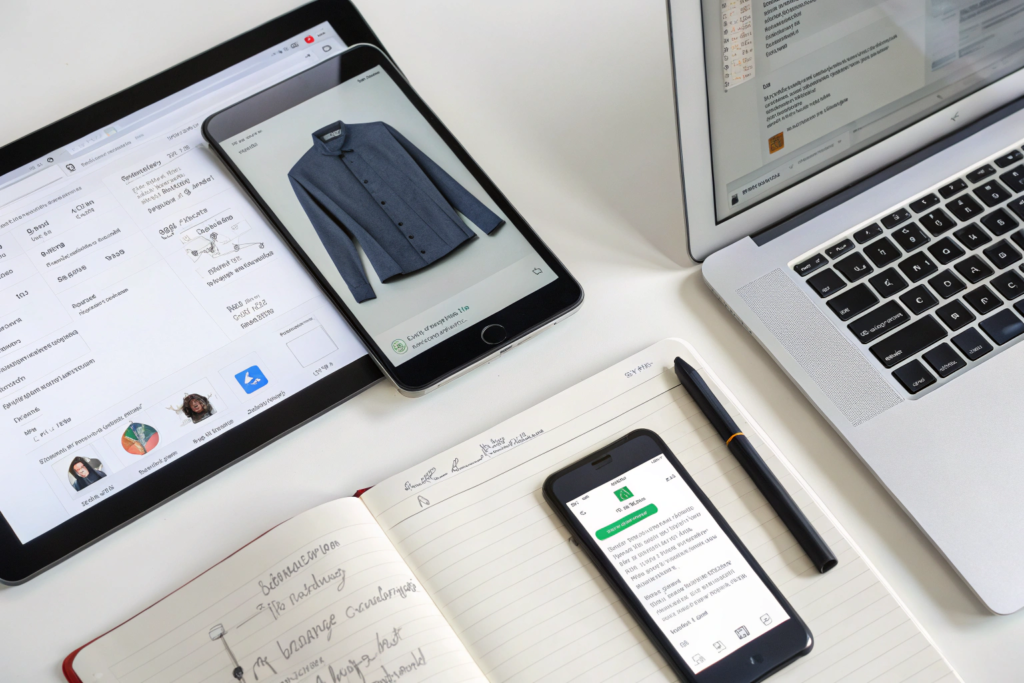
Professional apparel factories in 2025 use a hybrid communication stack: WeChat or WhatsApp for instant photo, video, and voice note sharing during production; Email for formal approvals, purchase orders, and legal documentation; and cloud-based project management tools like Trello or Google Sheets for tracking the status of multiple styles and samples across a collection. Some advanced factories are also using 3D sampling software like CLO or Browzwear, where comments can be pinned directly onto the virtual garment.
Lab dip approval is one of the most time-sensitive and subjective parts of custom manufacturing. A lab dip is a small swatch of fabric dyed to match your target color. The factory sends you a physical swatch via courier. That takes 3-5 days.
But what if the lab dip is close, but not perfect? You write an email: "Make it slightly warmer and 10% darker." That is subjective. The dye house technician reads a translated version of that email and guesses what you mean. The second lab dip takes another 3-5 days to arrive.
We accelerate this process by using Shared Digital Albums on WeChat or Google Photos.
The Process:
- Dye house creates the physical lab dip.
- We photograph the lab dip in our Light Booth under standard D65 (daylight) lighting. We place your original Pantone chip or reference swatch next to it.
- We upload the photo to a shared album.
- You view the photo on your calibrated phone or monitor. You reply with a voice note: "It's 90% there. Just needs a touch more red to kill the green undertone."
- The dye house technician listens to your actual voice explaining the nuance. They adjust the formula.
This shaves two full weeks off the color approval process. We still send the physical lab dip for final legal approval, but the digital collaboration gets us to 95% accuracy in 48 hours instead of 14 days.
At Shanghai Fumao, we maintain a permanent digital archive of every lab dip approved for every client. When you reorder that "Sage Green" blouse next year, we pull up the digital photo and the exact dye formula. We do not start from scratch. This is only possible because of fast, organized digital record-keeping.
A brand owner should never have to ask, "Where is my order?" That question should be answered before it is asked.
We provide all custom order clients with a link to a Google Sheets Production Tracker. This is a read-only document that we update daily.
The tracker shows:
- Style Number: SKU-101
- Fabric Status: Arrived / Passed Inspection
- Cutting Status: Complete (Date)
- Sewing Status: In Progress (Line 2)
- Finishing Status: Pending
- Estimated Ship Date: October 15 (On Track / Delayed)
This level of transparency eliminates the inefficient communication pain point. The brand owner can check the tracker at 2:00 AM if they cannot sleep. They see "Cutting Complete." They relax. They do not need to send an email that interrupts our workflow.
More importantly, the tracker acts as an Early Warning System. If a status changes from "On Track" to "Delayed (Fabric Late)," the brand owner sees it immediately. We include a note in the tracker explaining the delay and the recovery plan. There are no surprises at the shipping dock.
This is a simple tool, but it requires discipline from the factory to update it daily. At Shanghai Fumao, this is a non-negotiable task for our production coordinators. The tracker is updated before they leave for the day. It is a promise of accountability. It is fast communication in visual, digestible form.
How Does Responsive Communication During Sampling Prevent Bulk Production Disasters?
The sampling stage is where the garment is born. It is where the 2D design becomes a 3D object. This stage is messy. It requires back-and-forth. It requires failure and iteration. The speed of communication during sampling is the single biggest predictor of whether the bulk production will be smooth or a disaster.
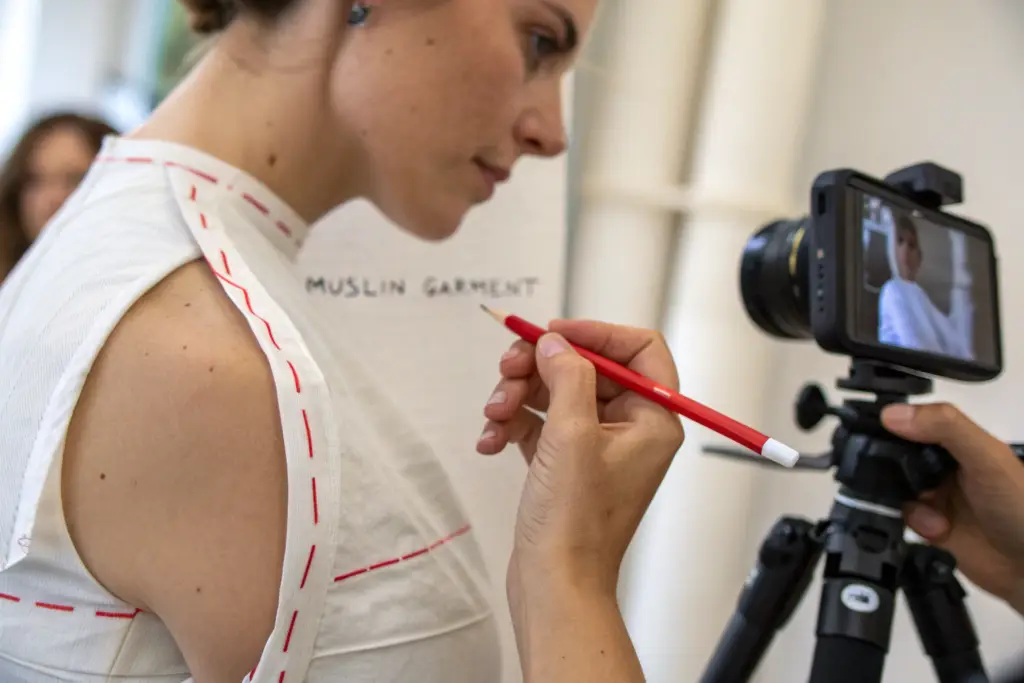
Responsive communication during sampling prevents bulk production disasters by allowing for rapid iteration on fit and construction before the fabric is cut for thousands of units. A fitting video sent and reviewed in one day allows for a pattern correction to be made the next day. A pattern correction made early prevents the entire bulk order from being cut with a fit flaw that will generate customer returns. Factories that are slow to respond during sampling force brands to either delay their launch or "approve with risk," gambling that the bulk goods will somehow be better than the sample.
What Is a "Virtual Fitting" and How Does It Save Weeks?
Traveling to China for a fitting is ideal but often impractical. We have developed a robust Virtual Fitting protocol that achieves 90% of the value of an in-person fitting.
Here is how it works at Shanghai Fumao:
- We ship the Fit Sample (size Medium) to the brand owner in the U.S. via DHL (3 days).
- The brand owner arranges a local fit model.
- They set up a video call with us (Zoom or WeChat Video).
- The model wears the sample. The brand owner (or a local technical designer) points to the issues. "See this pulling across the bust? See this excess fabric in the back?"
- Our pattern maker in Shanghai is on the call, watching live. She sees the fabric pulling. She asks: "Is the model's arm relaxed or lifted?"
- The pattern maker takes screenshots. She marks up the digital pattern file immediately after the call.
Time saved:
- Traditional Method: Ship sample to U.S., brand owner writes email feedback, ships sample back to China for reference (2 weeks round trip).
- Virtual Fitting Method: Video call (30 minutes), pattern adjustment begins same day.
This rapid feedback loop allows us to do three rounds of fit corrections in the time it takes a slower factory to do one round. The result is a garment that fits properly and consistently across the size run. This drastically reduces the return rate for online DTC brands. A garment that fits well does not get returned.
How Do We Handle "On-the-Fly" Trim Substitutions?
Sometimes a custom button or a specific zipper tape color is out of stock at the trim supplier. The factory has two choices:
- Slow Communication: Stop production. Wait 3 weeks for the backordered trim. Miss the ship date.
- Fast Communication: Find a suitable alternative immediately. Send a photo. Get approval. Keep sewing.
We always aim for option two.
Last month, we were producing a custom women's jacket. The spec called for a specific antique brass snap. Our supplier was out of stock with a 4-week lead time. We found an alternative snap that was 95% identical. The only difference was the engraving on the face was slightly finer.
Our production manager took a Macro Lens Photo of the original snap and the alternative side-by-side. She sent it via WeChat to the brand owner with the message: "Original on left. Alternative on right. Same size, same color, slightly finer engraving detail. Do you approve substitution to keep ship date?"
The brand owner approved it within 15 minutes. The jackets shipped on time. The customers never noticed the difference.
If we had waited for an email response, the cutting would have stopped. The line would have been re-tasked. The delay would have been measured in weeks, not minutes.
This is the essence of why fast communication is essential. It is not about being polite. It is about solving the inevitable, unpredictable problems of manufacturing in real-time. It is about keeping the factory floor moving and the container heading to the port. At Shanghai Fumao, we empower our production team to identify these issues and communicate them instantly. We do not wait for a weekly status meeting. We solve problems on the spot.
Conclusion
Custom clothing manufacturing is a conversation between a brand's vision and a factory's capability. That conversation happens in sketches, in measurements, in fabric swatches, and in the frantic, late-night text messages about a lab dip that looks too minty. The speed of that conversation determines the success of the outcome.
We have examined the true financial cost of slow communication. It is not just annoyance. It is lost production slots, expedited shipping fees, and missed selling windows. We have seen how managing the time zone gap effectively creates an "overnight advantage" that actually accelerates development. We have looked at the specific tools—from voice notes to shared trackers to virtual fittings—that modern factories use to collapse the distance between a design idea and a finished garment.
At Shanghai Fumao, our commitment to fast communication is a core part of our manufacturing service. It is why we staff our team to cover U.S. morning hours. It is why we use WeChat as eagerly as email. It is why we provide live production trackers. We understand that when you send us a custom order, you are not just sending us fabric and a tech pack. You are sending us a piece of your brand's reputation. You deserve a partner who responds with the same urgency that you feel.
If you have been frustrated by radio silence from previous suppliers, or if you are preparing a custom collection and want to experience a truly responsive manufacturing partnership, we are ready to demonstrate the difference.
Reach out to our Business Director, Elaine. Send her a message on WhatsApp. Ask her a question about a potential style. Watch how fast she responds. Let us show you what it feels like to have a factory that communicates at the speed of your business.
Contact Elaine at: elaine@fumaoclothing.com. Let's start a conversation that moves at the pace you need.