I have been in garment manufacturing for over fifteen years. I have seen brands rush through sample approval. I have seen brands take their time. The ones who take their time almost always succeed. The ones who rush almost always regret it.
Sample approval is the most critical step in garment manufacturing because it is the final opportunity to catch errors before bulk production begins. A single missed issue at the sample stage can become thousands of defective garments. The sample approval process verifies fit, construction, fabric behavior, color accuracy, and trim functionality. When the sample is right, bulk production has a clear target. When the sample is wrong, everything that follows is wrong. Investing time in sample approval saves time, money, and brand reputation in bulk production.
At Shanghai Fumao, we treat sample approval as a partnership. We guide our clients through each stage. This guide explains why this step matters so much and how to do it right.
What are the different types of samples and why does each matter?
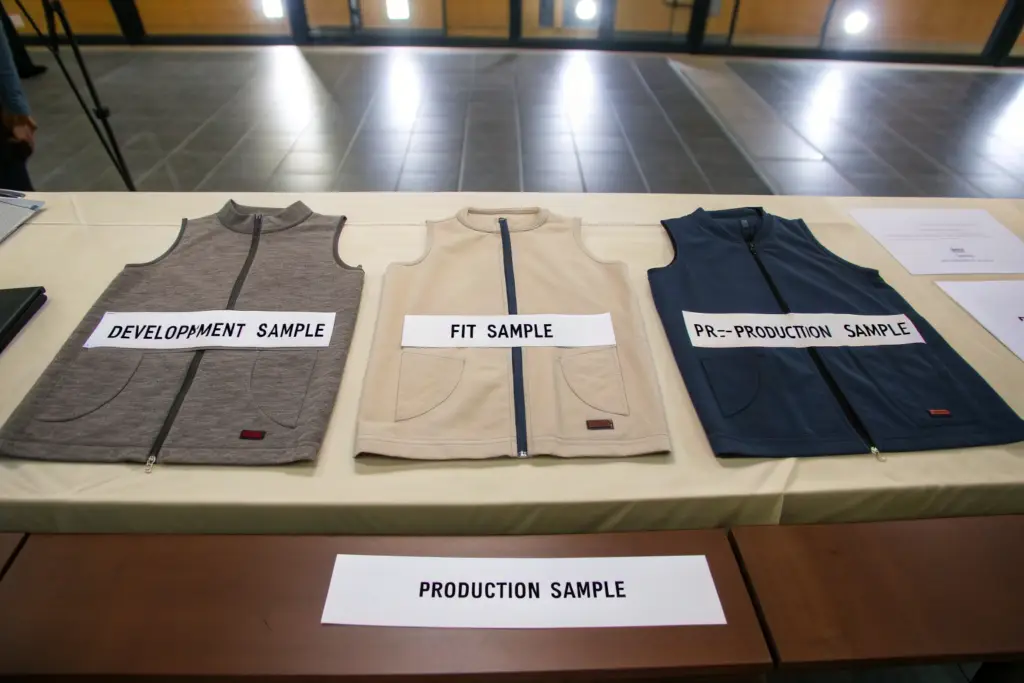
Sample approval is not one event. It is a process with multiple stages. Each stage serves a different purpose. Skipping any stage creates risk.
What is a development sample and why is it foundational?
The development sample is the first physical expression of your design. It translates your sketch and tech pack into a real garment. This sample establishes the basic silhouette, construction method, and fabric behavior.
I had a client from New York who approved her first sample quickly. She was excited to see her design come to life. She did not check the measurements carefully. The sample looked good on the hanger. When she tried it on, the fit was off. But she had already approved it. The factory went to production. She received 2,000 dresses with the wrong fit.
Here is what a development sample should verify:
| Checkpoint | What to Verify | Why It Matters |
|---|---|---|
| Silhouette | Overall shape and proportion | Establishes the design intent |
| Construction | Seams, finishes, assembly | Confirms production method |
| Fabric behavior | Drape, hand feel, stretch | Validates fabric choice |
| Basic fit | Overall fit on body | First fit assessment |
| Design details | Pockets, collars, cuffs | Confirms detail execution |
A client from Boston told me: "I now spend a full week with my first sample. I try it on. I wash it. I try it again. I do not approve until I am completely satisfied."
What is a fit sample and how does it prevent bulk issues?
The fit sample is where you perfect the fit. This sample is made after any adjustments from the development sample. The fit sample should be tried on a live model or fit form that matches your target customer.
I had a client from Chicago who skipped the fit sample. He went from development sample to production. His t-shirts fit his size medium model well. But when the bulk arrived, the size large had proportion issues. The grading had not been verified. He had to discount 500 shirts.
Here is what a fit sample should verify:
| Checkpoint | What to Verify | Why It Matters |
|---|---|---|
| Fit on model | Wear test on actual body | Confirms comfort and appearance |
| Size grading | All sizes proportioned correctly | Prevents fit issues across size run |
| Ease and movement | Arm lift, sitting, walking | Ensures functionality |
| Pressure points | Too tight or too loose areas | Prevents discomfort |
| Lengths and proportions | Consistent across sizes | Maintains design intent |
A client from Seattle told me: "I use the same fit model for every collection. She knows my brand. She tells me when something is off. The fit sample is non-negotiable."
What is a pre-production sample and why is it the final checkpoint?
The pre-production sample (PP sample) is made after all fit and design issues are resolved. It uses the production pattern, production machinery, and production fabric. This sample is the final verification before bulk cutting begins.
I had a client from Los Angeles who approved her fit sample but did not request a PP sample. The factory went to production. When the bulk arrived, the color was different. The production fabric batch was slightly different than the sample fabric. A PP sample would have caught the color variation before 5,000 pieces were cut.
Here is what a pre-production sample verifies:
| Checkpoint | What to Verify | Why It Matters |
|---|---|---|
| Production fabric | Actual bulk fabric batch | Catches color or hand feel variations |
| Production pattern | Final approved pattern | Confirms pattern accuracy |
| Production machinery | Machines used for bulk | Verifies seam and stitch quality |
| Production trims | Actual buttons, zippers, labels | Confirms trim appearance and function |
| Final measurements | All spec points measured | Last chance to correct sizing |
A client from Denver told me: "I never skip the PP sample. It has saved me from color issues twice. The $50 sample cost saves me thousands in bulk rework."
What is a production sample and how does it protect the bulk run?
The production sample is the first piece off the production line. It is made during production, not before. This sample verifies that the production line is executing correctly before thousands of pieces are made.
I had a client from Texas who had a production sample made at the start of his bulk run. The sample showed that the machine tension was off. The seam was puckering. The factory corrected the tension before any more pieces were made. The rest of the run was perfect.
Here is what a production sample verifies:
| Checkpoint | What to Verify | Why It Matters |
|---|---|---|
| Line setup | Machines configured correctly | Catches setup errors early |
| Operator technique | Workers executing correctly | Ensures consistent construction |
| Bulk fabric behavior | Fabric cutting and sewing | Confirms fabric works in production |
| First-piece quality | First garment meets all specs | Protects the rest of the run |
A client from Portland told me: "I wait for the production sample photo before I approve the factory to continue. It gives me peace of mind."
What specific issues does sample approval catch?
Sample approval is not just about the sample looking good. It is about catching issues that would be catastrophic in bulk.
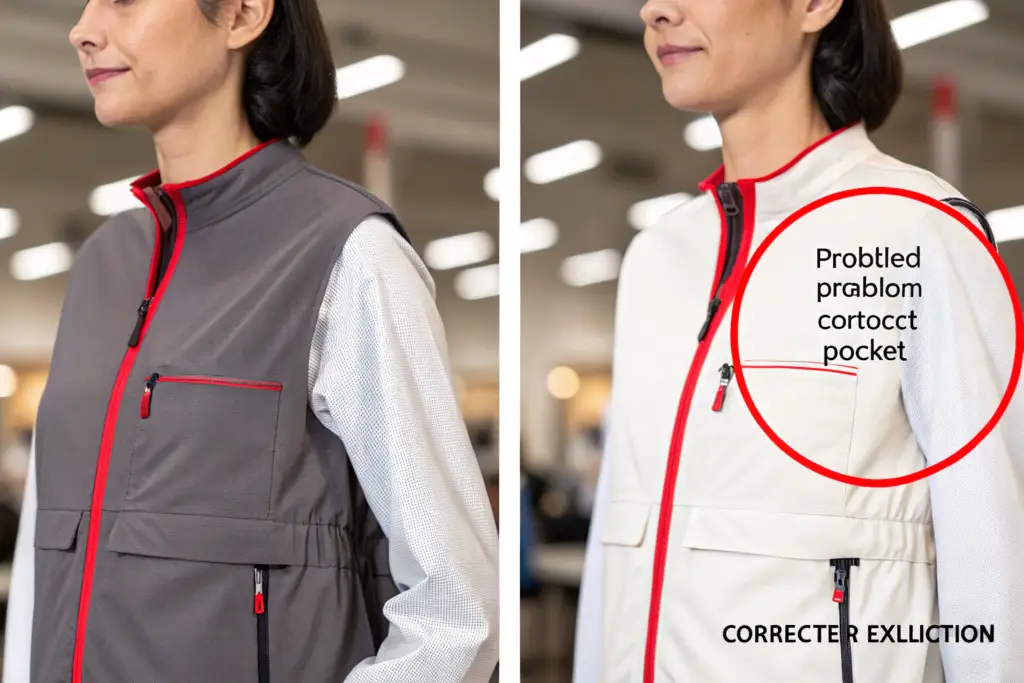
How does sample approval catch fit issues?
Fit issues are the most common problem in garment manufacturing. A fit issue in sample is a problem. A fit issue in bulk is a disaster.
I had a client from Miami who approved a sample without trying it on a fit model. The sample looked good on the hanger. When the bulk arrived, the armholes were too small. Customers returned the shirts. The client had to re-cut and re-sew 1,000 shirts. The cost was enormous.
Here are fit issues caught at sample stage:
| Fit Issue | How It Shows in Sample | Bulk Impact if Missed |
|---|---|---|
| Armhole too tight | Restricted movement | High return rate |
| Neckline gapes | Poor fit around neck | Unwearable product |
| Sleeve length wrong | Proportion off | Customer dissatisfaction |
| Waist placement off | Proportion looks wrong | Poor silhouette |
| Shoulder slope wrong | Jacket or shirt does not sit right | Poor appearance |
A client from Atlanta told me: "I try on every sample myself. I move around. I sit. I lift my arms. If it does not feel right in sample, it will not feel right in bulk."
How does sample approval catch construction errors?
Construction errors are mistakes in how the garment is made. Wrong seam type. Incorrect stitch length. Missing reinforcement. These errors are hard to see in a finished garment but affect durability.
I had a client from Chicago who approved a sample without checking the seam construction. The sample used a single-needle seam. The bulk should have used a double-needle seam for durability. The factory used the single-needle method for bulk because that is what was on the sample. The client received 3,000 shirts with weak seams.
Here are construction errors caught at sample stage:
| Construction Error | How It Shows in Sample | Bulk Impact if Missed |
|---|---|---|
| Wrong stitch type | Seam looks different | Durability issues |
| Incorrect seam finish | Raw edges exposed | Premature fraying |
| Missing reinforcement | Weak stress points | Seam failure |
| Wrong thread tension | Puckering or loose stitches | Poor appearance |
| Improper interfacing | Collar or placket floppy | Loses shape |
A client from Boston told me: "I have a checklist for construction. Seam type. Stitch count. Reinforcement. I check every point on the sample."
How does sample approval catch fabric issues?
Fabric issues are often invisible until the garment is made. The sample reveals how the fabric behaves in construction.
I had a client from Seattle who selected a beautiful silk fabric. The development sample looked great. But the fabric had high shrinkage. The PP sample showed the issue after washing. The client adjusted the pattern to account for shrinkage. If she had not caught it, the bulk garments would have shrunk two sizes after first wash.
Here are fabric issues caught at sample stage:
| Fabric Issue | How It Shows in Sample | Bulk Impact if Missed |
|---|---|---|
| High shrinkage | Sample smaller after wash | Customer returns |
| Poor dye consistency | Color variation across garment | Inconsistent appearance |
| Fabric flaw | Holes, streaks, uneven texture | Defective product |
| Stretch variation | Garment fits differently | Inconsistent sizing |
| Pilling tendency | Fuzz balls after wear | Poor durability perception |
A client from Denver told me: "I wash every sample. I wash it three times. I see how it holds up. I have rejected fabrics that looked great but failed after washing."
How does sample approval catch color and trim issues?
Color and trim issues are aesthetic but critical. A mismatched button or off-color logo damages the brand image.
I had a client from New York who approved a sample with the correct button color. The production batch of buttons was from a different lot. The color was slightly different. The PP sample caught the difference. The factory replaced the buttons before bulk production.
Here are color and trim issues caught at sample stage:
| Issue | How It Shows in Sample | Bulk Impact if Missed |
|---|---|---|
| Color variation | Sample color differs from standard | Inconsistent brand appearance |
| Trim mismatch | Buttons or zippers wrong color | Poor aesthetic |
| Logo placement off | Logo not centered or aligned | Unprofessional look |
| Label errors | Wrong size or care instructions | Compliance issues |
| Thread color mismatch | Visible contrasting thread | Poor appearance |
A client from Portland told me: "I keep a reference sample from the first run. Every reorder, I compare the new sample to the reference. If the color or trims do not match, I do not approve."
What is the cost of rushing sample approval?
Rushing sample approval seems like it saves time. It does the opposite. The cost of fixing a mistake in bulk is exponentially higher than fixing it in sample.

What is the cost of a fit error in bulk versus sample?
Fixing a fit error in sample takes hours and costs dozens of dollars. Fixing a fit error in bulk takes weeks and costs thousands.
I had a client from Texas who approved a sample without fit testing. The armhole was too small. In sample stage, the fix would have been: adjust the pattern, make a new sample, confirm the fix. Cost: $200. Time: 3 days.
In bulk, 2,000 pieces were already cut and sewn. The fix required: unpicking sleeves from 2,000 garments, recutting new sleeves, resewing sleeves, re-pressing. Cost: $12,000. Time: 2 weeks. The client missed his launch date.
Here is the cost comparison:
| Issue | Fix at Sample Stage | Fix at Bulk Stage |
|---|---|---|
| Pattern adjustment | $100-300, 2-5 days | $5,000-15,000, 1-3 weeks |
| Fabric substitution | $50-200, 1-3 days | $2,000-10,000, plus fabric cost |
| Trim replacement | $20-100, 1-2 days | $1,000-5,000, plus trim cost |
| Construction change | $100-300, 2-5 days | $3,000-10,000, rework labor |
| Color correction | $50-200, 1-3 days | $2,000-8,000, plus shipping |
A client from Chicago told me: "I learned the hard way. A $200 sample fix became a $10,000 bulk fix. Now I take my time on samples."
How does rushing sample approval affect production timeline?
Rushing sample approval often leads to production delays. A mistake caught in bulk stops the entire production line. The delay is longer than the sample stage would have taken.
I had a client from Los Angeles who approved a sample in one day. The factory started cutting. Two weeks into production, a quality issue appeared. The line stopped. The factory had to rework 500 pieces. The total delay was three weeks. If the client had taken three extra days on sample approval, the issue would have been caught before cutting.
Here is how rushing backfires:
| Scenario | Sample Time | Bulk Delay | Total Timeline Impact |
|---|---|---|---|
| Rushed sample, issue in bulk | 1 day | 15 days | +14 days |
| Thorough sample, no bulk issue | 7 days | 0 days | +7 days |
A client from Boston told me: "I used to rush samples to save time. I ended up losing more time in bulk. Now I take the time on samples. My overall timeline is shorter."
How does sample approval affect brand reputation?
The sample approval process is the last chance to ensure the product meets your brand standards. Rushing this step risks your reputation.
I had a client from Seattle who rushed a sample for a large retailer order. The retailer had given him a tight deadline. He approved the sample without thorough testing. The bulk arrived with a color variation. The retailer rejected the shipment. The client lost the order and the relationship.
Here is the reputation impact:
| Sample Approach | Risk Level | Potential Reputation Impact |
|---|---|---|
| Thorough sample approval | Low | Consistent quality, reliable |
| Rushed sample approval | High | Quality variation, returns, retailer issues |
A client from Portland told me: "My brand is built on quality. I cannot afford to rush samples. Every sample represents my brand."
What does a thorough sample approval process look like?
A thorough sample approval process is systematic. It uses checklists, testing, and documentation. It leaves nothing to guesswork.
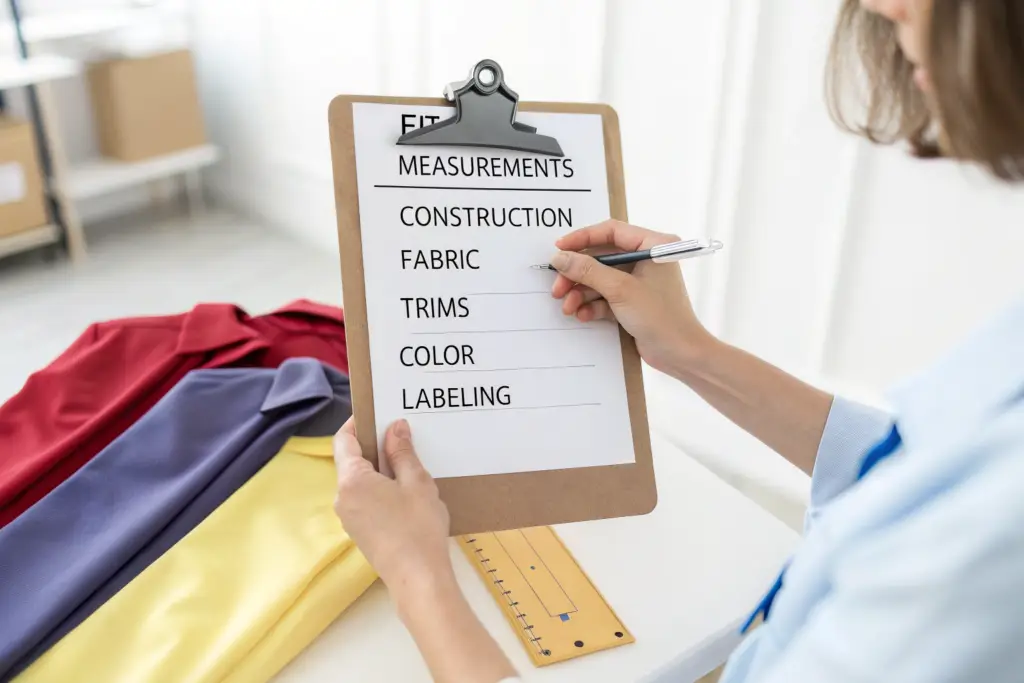
What should be on your sample approval checklist?
A sample approval checklist ensures you do not miss anything. Every sample should go through the same checklist.
Here is a comprehensive sample approval checklist:
| Category | Check Items |
|---|---|
| Fit | Try on fit model, check all size points, assess comfort and movement |
| Measurements | Compare to spec sheet, measure every spec point, check grading across sizes |
| Construction | Verify seam type, stitch count, seam finish, reinforcement points |
| Fabric | Check hand feel, drape, color, shrinkage after wash |
| Trims | Verify buttons, zippers, labels, thread color |
| Color | Compare to standard, check color consistency across panels |
| Labeling | Verify care labels, size labels, brand labels, tracking labels |
| Packaging | Check folding, poly bag, carton markings |
A client from Denver told me: "I have a printed checklist. I go through it for every sample. I do not approve until every item is checked."
How do you document sample approvals?
Documentation creates a record of what was approved. Without documentation, there is no proof.
I had a client from New York who approved a sample verbally. The factory went to production. The bulk had a different construction detail. The client said he had approved the correct construction. The factory said he had approved the sample as it was. Without documentation, there was no way to resolve.
Here is how to document sample approvals:
| Documentation | What to Include | Why |
|---|---|---|
| Approval email | Clear statement of approval | Written record |
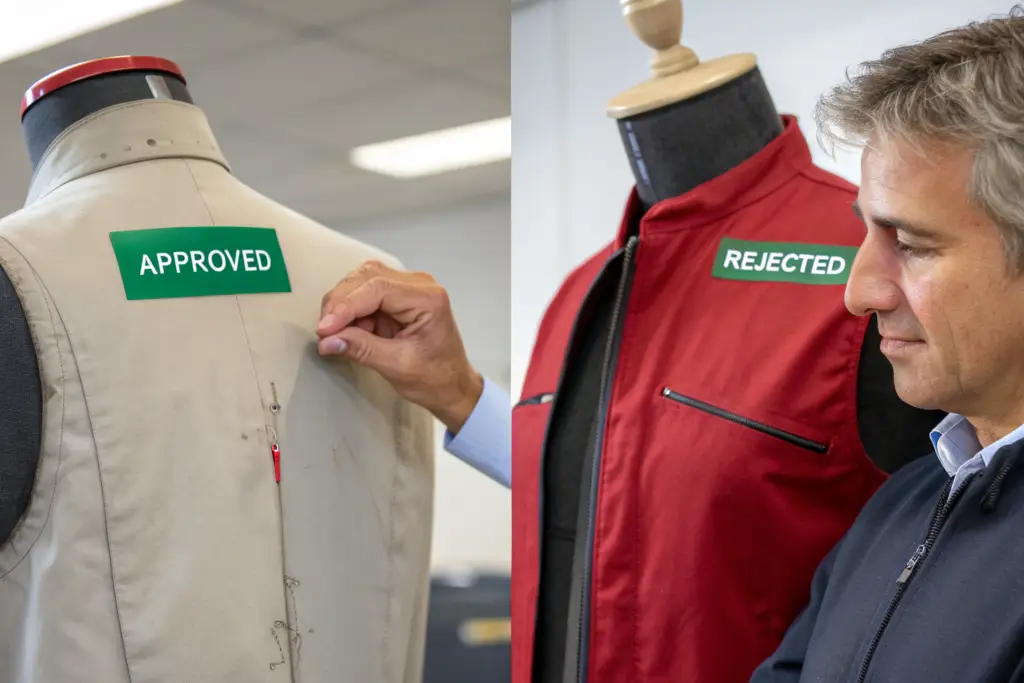
| Approved sample | Physical sample with approval tag | Reference for production |
| Sample comments | List of changes or corrections | Clear instructions |
| Photos | Photos of approved sample | Visual reference |
| Measurements | Recorded measurements from approved sample | Reference for bulk |
A client from Chicago told me: "I send an approval email with photos. I attach the measured spec. I keep the physical sample. I have proof of what was approved."
What testing should you do on samples?
Testing on samples protects you from issues that appear after production. Wash testing is the most important.
I had a client from Los Angeles who wash-tested her sample. The sample shrank 5%. She adjusted her pattern. The bulk garments came out the correct size. Her customers never knew there was an issue.
Here is sample testing to perform:
| Test | What to Do | Why |
|---|---|---|
| Wash test | Wash 3 times, measure shrinkage | Ensures size stability |
| Wear test | Wear for a day, assess comfort | Catches fit issues |
| Stretch test | Pull seams, test recovery | Ensures durability |
| Colorfastness | Wash with other colors, check bleeding | Prevents color transfer |
| Button pull test | Pull buttons with force | Ensures attachment strength |
A client from Boston told me: "I wash every sample three times. I wear it for a day. I test the buttons. I do not approve until I am confident."
Conclusion
Sample approval is the most critical step in garment manufacturing because it is your last chance to catch errors before bulk production. A problem caught at sample stage costs dozens of dollars and days of time. The same problem caught at bulk stage costs thousands of dollars and weeks of time. It can destroy your launch, your margin, and your brand reputation.
The sample process has multiple stages. The development sample establishes the design. The fit sample perfects the fit. The pre-production sample verifies production readiness. The production sample protects the bulk run. Each stage serves a different purpose. Skipping any stage creates risk.
A thorough sample approval process uses checklists, testing, and documentation. You check fit, measurements, construction, fabric, trims, color, and labeling. You wash test, wear test, and strength test. You document approvals with emails, photos, and physical samples.
At Shanghai Fumao, we guide our clients through the sample approval process. We do not rush it. We know that time invested in samples saves time in bulk. We provide detailed samples. We support fit testing. We document approvals. We treat sample approval as the partnership it is.
If you want to ensure your bulk production is right, I invite you to work with us. Contact our Business Director, Elaine. She will walk you through our sample process. She will help you develop a thorough approval checklist. She will ensure your samples are right before we cut bulk. You can email her at strong>elaine@fumaoclothing.com.
Let us get your samples right so your bulk is perfect.