I have been in garment manufacturing for over fifteen years. I have helped dozens of brands import children's clothing into North America. I have seen brands succeed. I have seen brands fail. The difference is almost always preparation.
Successfully importing children’s clothing into North America requires strict compliance with safety regulations, meticulous documentation, careful material selection, strategic pricing, and reliable logistics. Children’s clothing is the most regulated apparel category in the US and Canada. Lead times must account for third-party testing, which adds 2-4 weeks. Materials must meet flammability and toxicity standards. Labels must include specific tracking information. Brands that understand these requirements before they start production avoid costly delays and product recalls.
At Shanghai Fumao, we produce children's clothing for North American brands. I have learned the regulations through years of experience. This guide will help you navigate the process.
What are the critical safety regulations for children's clothing?
Safety is not optional for children's clothing. It is the law. The US Consumer Product Safety Commission (CPSC) enforces strict rules. Canada has similar requirements. Violations can result in recalls, fines, and legal action.
What are the CPSIA requirements for children's clothing?
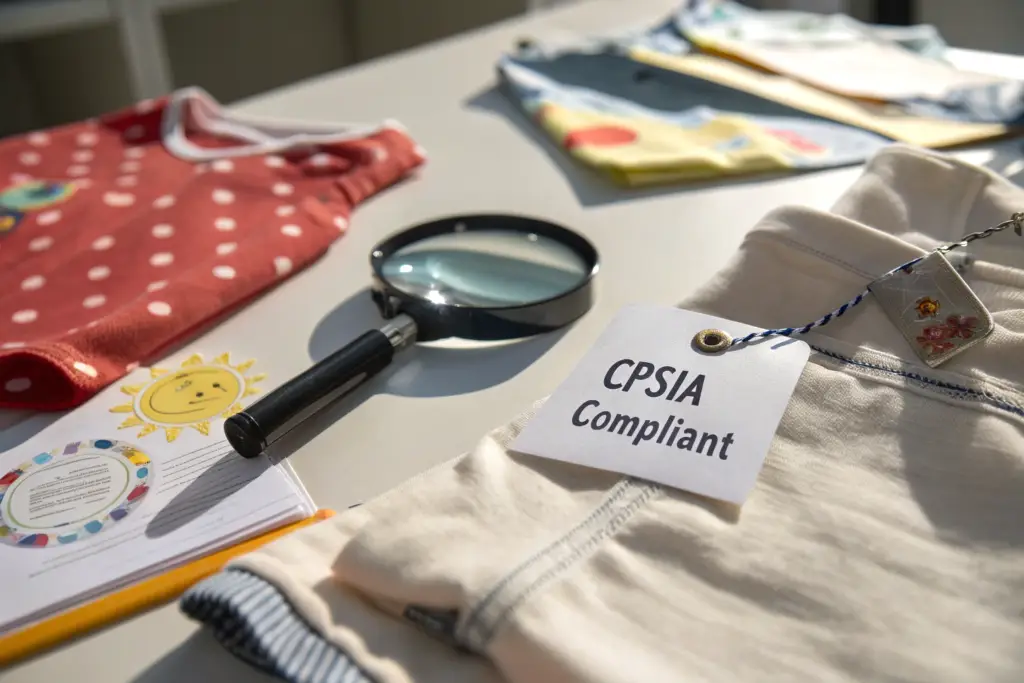
The Consumer Product Safety Improvement Act (CPSIA) applies to all children's products sold in the US. Children's clothing is defined as garments for children 12 and under. The requirements are extensive.
I had a client from New York who wanted to import children's pajamas. He found a factory that offered a low price. He did not ask about flammability testing. The pajamas arrived. He sold them online. A customer complained about the fabric. He had no test reports. He had to recall the entire batch. He lost $50,000.
Here are the key CPSIA requirements:
| Requirement | What It Means | How to Comply |
|---|---|---|
| Lead content | Surface coating: 90 ppm max. Substrate: 100 ppm max | Use certified lead-free materials, test every batch |
| Phthalates | 0.1% max for children's products | Avoid PVC, use tested materials |
| Flammability | Children's sleepwear must meet 16 CFR 1615/1616 | Use flame-resistant fabrics, test accordingly |
| Tracking labels | Must include manufacturer, date, batch info | Print labels with all required information |
| Third-party testing | Testing must be done by CPSC-accepted lab | Use labs like SGS, Intertek, Bureau Veritas |
A client from Boston now requires every fabric and trim supplier to provide lead and phthalate test reports. She keeps a file for every batch. When she ships, she has documentation ready.
How do flammability standards differ by garment type?
Flammability rules are different for sleepwear and daytime wear. Sleepwear has stricter requirements because children may be alone in a room with a fire source.
A client from Chicago made cotton pajamas. She used a standard cotton jersey. She did not know that cotton is considered flammable. Her pajamas failed the flammability test. She had to add a flame retardant treatment. The treatment changed the feel of the fabric. Her customers complained.
Here are flammability categories:
| Garment Type | Standard | Requirements |
|---|---|---|
| Children's sleepwear sizes 0-14 | 16 CFR 1615/1616 | Must pass strict flammability test |
| Tight-fitting sleepwear | 16 CFR 1615/1616 exemption | Must meet specific fit requirements |
| Daytime wear | 16 CFR 1610 | General flammability standard |
| Outerwear | Varies by material | Some exemptions for certain fabrics |
For sleepwear, many brands use inherently flame-resistant fabrics like polyester. For cotton sleepwear, it must pass the stricter test or be designed as tight-fitting.
At Shanghai Fumao, we guide clients through these distinctions. We help them select fabrics that will pass the required tests for their garment type.
What labeling and tracking requirements exist?
CPSIA requires tracking labels on all children's products. These labels must help consumers and regulators identify the source of the product in case of a recall.
I had a client from Seattle who imported children's t-shirts. The shirts had only a care label and a brand label. No tracking information. A quality issue arose. She could not trace which batch had the problem. She had to recall all shirts, not just the affected batch.
Here is what a CPSIA tracking label must include:
| Information | Example | Why |
|---|---|---|
| Manufacturer name | Shanghai Fumao Clothing Co. | Identifies who made it |
| Production date | 09/2025 | Identifies when it was made |
| Batch or lot number | LOT-2456-B | Links to production records |
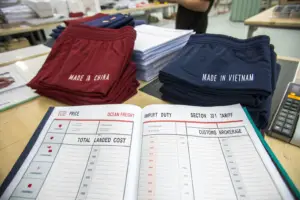
| Country of origin | Made in China | Required for customs |
A client from Texas now prints tracking labels on every garment. The label is small, sewn into the side seam. It contains a code that links to her production records. If there is an issue, she can trace it to the exact batch.
How do you select materials safe for children's clothing?
Children's skin is sensitive. Materials that are safe for adults may cause reactions in children. Material selection is critical for both safety and market acceptance.
What certifications should you require from fabric suppliers?
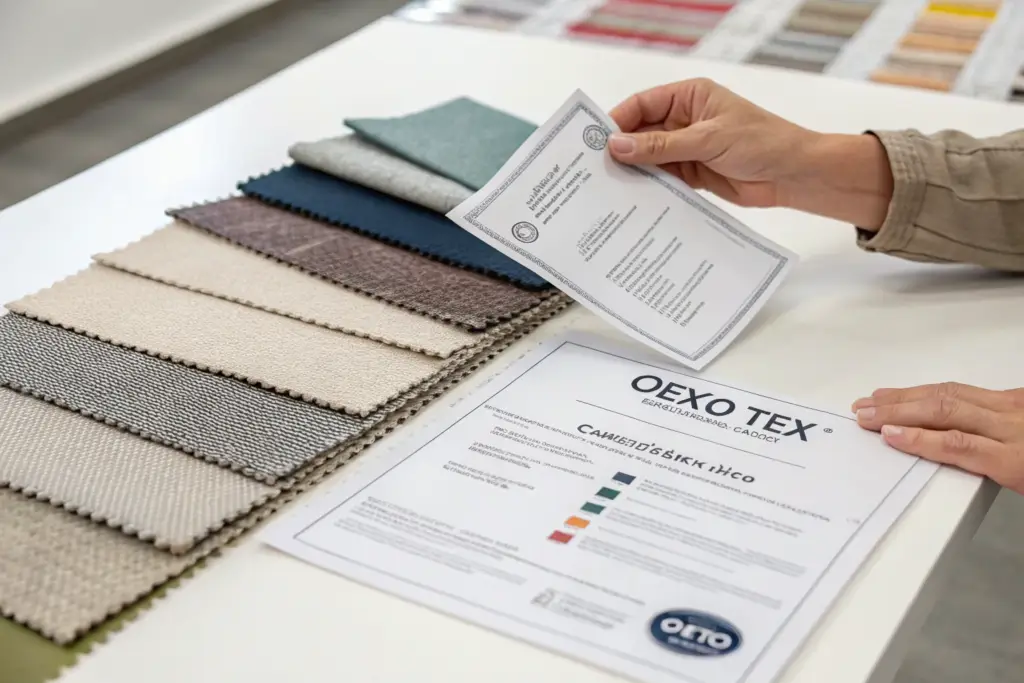
Certifications provide assurance that materials meet safety standards. The most recognized certification for children's clothing is OEKO-TEX Standard 100.
A client from Denver learned this lesson after a customer complained about a rash on their child. The fabric had tested positive for formaldehyde. The supplier had no certification. The client had no recourse.
Here are key certifications for children's clothing materials:
| Certification | What It Covers | Applicability |
|---|---|---|
| OEKO-TEX Standard 100 | Harmful substances, including formaldehyde and heavy metals | All children's clothing |
| OEKO-TEX Product Class I | The strictest class, for babies and infants | Clothing for ages 0-3 |
| GOTS (Global Organic Textile Standard) | Organic fiber content and processing | Organic children's clothing |
| Bluesign | Chemical management in production | Sustainable brands |
A client from Portland now requires OEKO-TEX Product Class I certification for all fabrics used in her baby line. She pays a premium for certified fabrics. Her customers trust her brand because of it.
How do you test for small parts and choking hazards?
Children's clothing should not have small parts that can detach and become choking hazards. Buttons, snaps, and decorative elements must be securely attached.
I had a client from Miami who made children's shirts with decorative buttons on the collar. The buttons were attached with standard thread. In testing, the buttons detached at 10 pounds of force. The standard requires 15 pounds minimum. We had to reattach all buttons with stronger thread and reinforced stitching.
Here are requirements for small parts:
| Component | Requirement | Test Method |
|---|---|---|
| Buttons | Must withstand 15 lb pull test | Torque and tension testing |
| Snaps | Must withstand 15 lb pull test | Torque and tension testing |
| Zippers | No small parts that can detach | Physical inspection |
| Decorative elements | Securely attached, no small parts | Pull test |
| Drawstrings | Not allowed in children's upper outerwear | CPSC guidance |
A client from Chicago had a hoodie with a drawstring. She did not know that drawstrings are prohibited in children's upper outerwear. They pose a strangulation risk. She had to remove all drawstrings before shipping.
What documentation do you need for customs clearance?
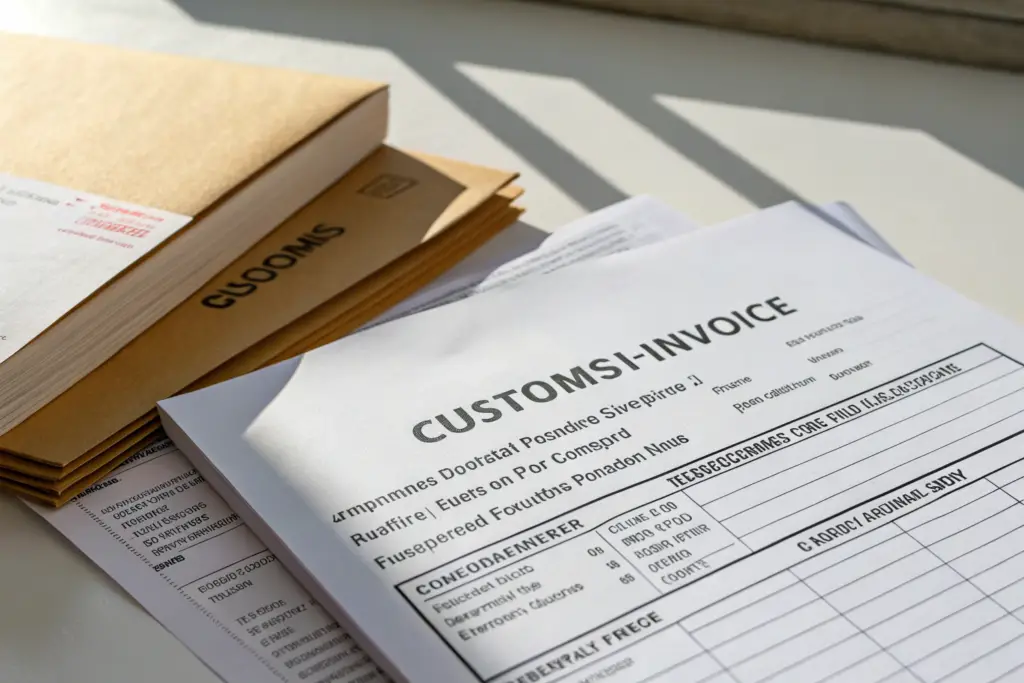
Customs clearance for children's clothing requires specific documentation. Missing documents cause delays. Incorrect documents cause seizures.
What import documents are required for children's clothing?
The documentation package for children's clothing is larger than for adult apparel. Customs needs proof of compliance.
A client from Los Angeles shipped a container of children's clothing. He had a commercial invoice and packing list. Customs requested his CPSIA test reports. He did not have them. The container was held for three weeks. He paid storage fees. He missed his launch date.
Here is the documentation checklist:
| Document | Purpose | Required For |
|---|---|---|
| Commercial invoice | Value, buyer, seller | All imports |
| Packing list | Contents, quantities, weights | All imports |
| Bill of lading | Shipping details | All imports |
| Certificate of origin | Country of manufacture | All imports |
| CPSIA test reports | Lead, phthalates, flammability | Children's clothing |
| Tracking label documentation | Proof of label compliance | Children's clothing |
| Importer of record | Importer identification | All imports |
A client from Boston now uses a checklist for every shipment. She gathers all documents before the container ships. She sends the package to her customs broker in advance. Her shipments clear within 48 hours.
How do you manage the importer of record requirement?
The importer of record is the entity responsible for the shipment. This must be a US-based entity. The factory cannot be the importer of record.
I had a client from Seattle who tried to use the factory as the importer of record. Customs rejected the shipment. The factory was in China, not the US. The shipment was delayed by two weeks while she established herself as the importer.
Here is how importer of record works:
| Role | Responsibility | Requirements |
|---|---|---|
| Importer of record | Customs clearance, duties, compliance | Must be US-based entity with EIN |
| Consignee | Receives goods | Can be same as importer |
| Notify party | Receives arrival notice | Usually freight forwarder |
A client from Texas set up her importer of record registration before her first shipment. She worked with a customs broker. The process took one week. Now every shipment is smooth.
How do you manage production timelines with testing requirements?
Testing adds time to your production timeline. You need to build this into your schedule. If you do not, you will miss your launch date.
When should you schedule third-party testing?
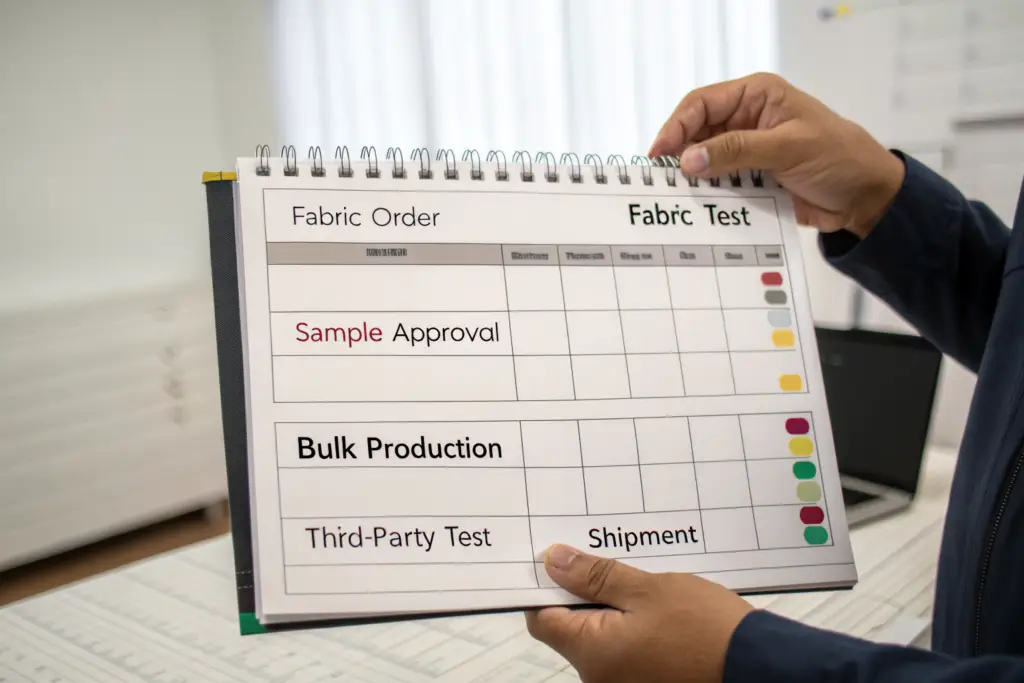
Third-party testing should happen after bulk production but before shipment. Testing after shipment is too late. Testing before production may not reflect the actual bulk materials.
I had a client from Denver who tested his fabric samples. The samples passed. He went to production. The bulk fabric was from a different batch. It failed testing. He had to hold the shipment and find a solution.
Here is a testing timeline:
| Stage | Testing | Timing |
|---|---|---|
| Fabric sourcing | Initial screening | Before ordering bulk fabric |
| Fabric arrival | Lead, phthalates, flammability | Before cutting |
| Pre-production | Sample testing | Before bulk production |
| Bulk production | Final testing on finished garments | After production, before shipment |
At Shanghai Fumao, we schedule testing into our production timeline. We reserve time for the CPSC-accepted lab to test. We do not ship until we have passing test reports.
How much time should you add for testing?
Testing takes time. The lab needs samples. The samples need to be prepared. The lab runs the tests. The results need to be reviewed. If tests fail, you need time to address the issue.
A client from Atlanta learned this the hard way. She planned 60 days from order to delivery. The testing took 3 weeks. She had no buffer. When the fabric failed the first test, she had no time to fix it. She missed her season.
Here is a testing time buffer:
| Testing Activity | Time Required | Notes |
|---|---|---|
| Sample preparation | 2-3 days | Cutting, labeling, shipping to lab |
| Laboratory testing | 5-10 days | Varies by test type and lab workload |
| Report generation | 2-3 days | After testing completes |
| Review and action | 1-5 days | If tests fail, time to address |
| Total buffer | 10-21 days | Minimum 2 weeks |
A client from Chicago now adds 3 weeks to her production timeline for testing. She told me: "If tests pass, I ship early. If tests fail, I have time to fix."
What market considerations affect children's clothing import success?
Compliance gets your product into the country. Market understanding gets your product into customers' hands. Children's clothing has unique market dynamics.
How does sizing differ between North America and other markets?
North American children's sizing is based on age and height. European and Asian sizing may be different. You must use North American sizing standards.
A client from New York imported children's clothing with Asian sizing. The 2T size fit like a 12-month size in the US. Customers returned the items. She had to discount the inventory.
Here are North American children's sizing standards:
| Size | Age | Height | Weight |
|---|---|---|---|
| Newborn | 0-3 months | up to 24" | up to 12 lb |
| 3-6 months | 3-6 months | 24-27" | 12-16 lb |
| 6-12 months | 6-12 months | 27-30" | 16-22 lb |
| 12-18 months | 12-18 months | 30-33" | 22-27 lb |
| 18-24 months | 18-24 months | 33-35" | 27-30 lb |
| 2T | 2 years | 35-37" | 30-33 lb |
| 3T | 3 years | 37-39" | 33-36 lb |
| 4T | 4 years | 39-41" | 36-40 lb |
A client from Seattle now uses ASTM D4910 sizing standards for all her children's clothing. Her fit is consistent with North American expectations.
How do seasonality and buying patterns affect planning?
Children's clothing is purchased ahead of season. Parents buy spring clothing in winter. They buy back-to-school in July. They buy holiday clothing in October. You need to ship accordingly.
I had a client from Boston who shipped winter jackets in November. They arrived in December. The selling season was half over. She had to discount.
Here is the children's clothing buying calendar:
| Season | Retail Selling | Import Shipment | Production |
|---|---|---|---|
| Spring | February-April | November-January | August-October |
| Summer | May-July | February-April | November-January |
| Back-to-school | August-September | May-June | February-March |
| Fall | September-November | June-August | March-May |
| Holiday | November-December | August-September | May-June |
| Winter | December-February | September-October | June-July |
A client from Denver plans her collections 9 months ahead. She tells me: "If I am not ordering fabric for holiday by March, I am late."
How do pricing and margins work for children's clothing?
Children's clothing has different pricing dynamics than adult clothing. Parents are price-sensitive because children outgrow clothes quickly. But they also care about safety and quality.
A client from Chicago priced her children's clothing at the same margin as her adult line. Sales were slow. She lowered her margin to 40% instead of 55%. Volume increased. Total profit increased.
Here is a margin framework for children's clothing:
| Category | Typical Retail Margin | Notes |
|---|---|---|
| Basic everyday wear | 35-45% | High volume, price sensitive |
| Special occasion | 45-55% | Lower volume, higher perceived value |
| Premium organic | 50-60% | Niche market, loyal customers |
| Licensed character | 40-50% | Licensing fees reduce net margin |
A client from Texas told me: "Parents will pay for safety and quality. But they will not pay luxury prices for something their child will wear for three months."
Conclusion
Importing children's clothing into North America is a complex process. The regulations are strict. The testing is mandatory. The documentation is extensive. The market has unique dynamics.
But successful importers do it every day. They do it by understanding the requirements before they start. They build testing into their timelines. They work with factories that understand children's clothing regulations. They document everything. They plan their collections around the buying calendar.
At Shanghai Fumao, we produce children's clothing for North American brands. We understand CPSIA requirements. We source OEKO-TEX certified fabrics. We work with CPSC-accepted testing labs. We track every batch. We provide the documentation you need for customs.
If you are planning to import children's clothing into North America, I invite you to work with us. Contact our Business Director, Elaine. She will discuss your collection. She will help you understand the testing requirements. She will guide you through the timeline. She will ensure your garments are compliant. You can email her at strong>elaine@fumaoclothing.com</strong.
Let us help you bring safe, compliant children's clothing to the North American market.