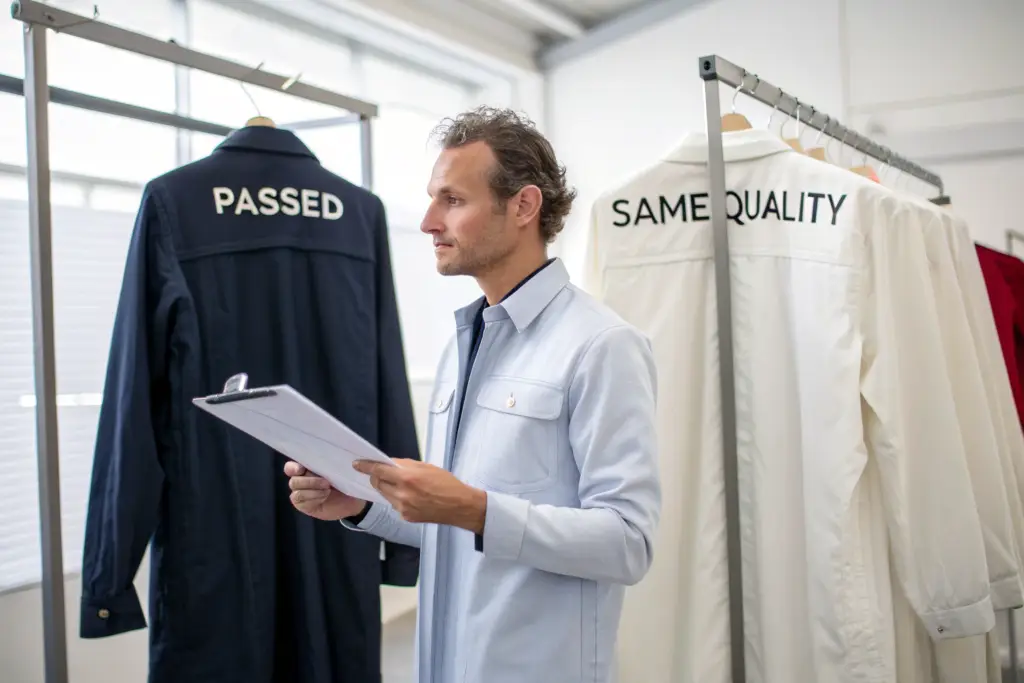
I have managed hundreds of production runs over the years. Some clients order one style once. Others order the same style again and again. The ones who order repeat styles face one big challenge: keeping quality the same every time.
Quality consistency across multiple production runs requires a systematic approach that starts before the first run and continues through every reorder. The key elements are: creating detailed technical specifications that leave nothing to guesswork, establishing fabric and trim standards with approved suppliers, documenting production processes with clear quality checkpoints, using the same production line or trained operators for repeat orders, and implementing a rigorous sampling protocol for every new batch. When these systems are in place, a t-shirt from run number five should be identical to run number one.
At Shanghai Fumao, we have clients who have reordered the same styles for years. Their customers expect the same fit, same feel, same quality every time. We deliver that through systems, not luck. This guide will show you how to build consistency into your production process.
What technical documentation ensures repeatable quality?
The first step to consistent quality is documentation. If you do not write it down, it did not happen. If you do not measure it, you cannot repeat it.
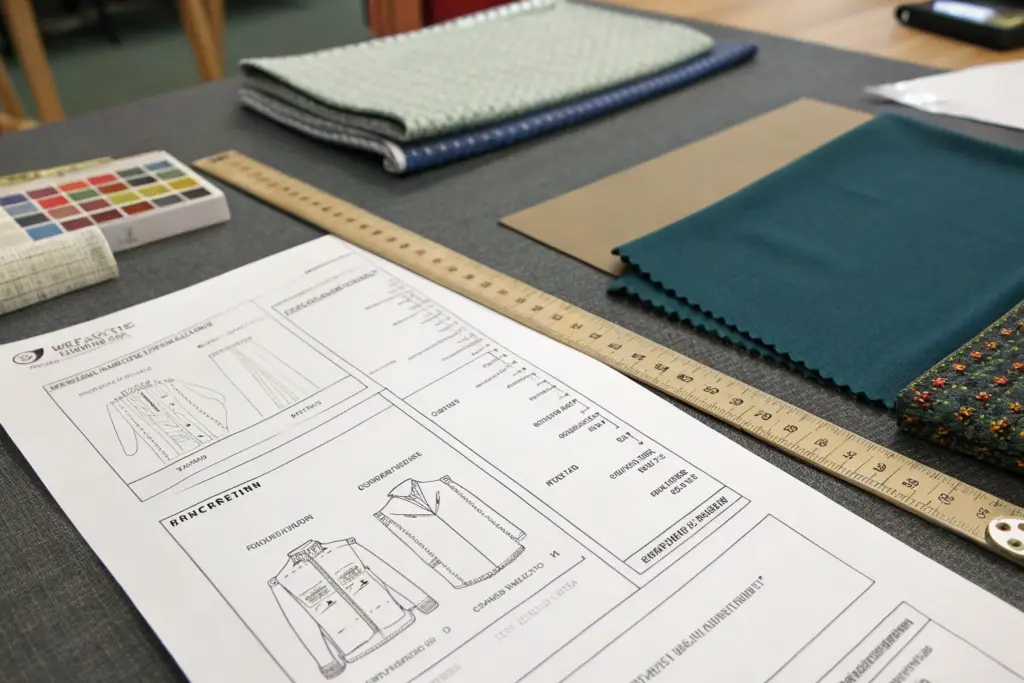
Why is a complete tech pack essential for consistency?
A tech pack is your style's blueprint. It tells the factory everything about the garment. When you have a complete tech pack, any factory can make your product. When you do not, every run becomes a guessing game.
I remember a client from New York. She had a successful t-shirt style. She ordered it three times. The first two runs were good. The third run was different. The fit was tighter. The sleeves were shorter. She was angry. She blamed the factory.
But when we looked at her tech pack, we saw the problem. It was incomplete. It had measurements for the first size but not for grading. It had a fabric description but no weight specification. The factory used the same pattern but the fabric was slightly different. The result was a different shirt.
Here is what a complete tech pack must include:
| Tech Pack Element | What It Specifies | Why It Matters for Consistency |
|---|---|---|
| Measurement spec | All measurements for every size | Ensures fit is identical run to run |
| Grading rules | How measurements change between sizes | Prevents proportion drift |
| Fabric specification | Fiber content, weight, construction | Ensures same hand feel and drape |
| Trim specification | Thread, zippers, buttons, labels | Ensures same appearance and durability |
| Construction details | Stitch type, stitch count, seam finish | Ensures same durability and look |
| Placement guides | Logo position, pocket position | Ensures visual consistency |
| Labeling instructions | Care labels, size labels, brand labels | Ensures compliance and branding |
| Packaging specifications | Folding, poly bag, carton details | Ensures consistent presentation |
A client from Chicago learned this lesson. After an inconsistent reorder, she invested in a complete tech pack. She hired a technical designer. She documented every detail. Her next reorder was perfect. She now uses the same tech pack for every run.
How do fabric and trim standards prevent variation?
Fabric is the biggest variable in apparel production. If the fabric changes, the garment changes. Even small variations in weight, shrinkage, or hand feel affect the final product.
A client from Los Angeles made a popular hoodie. The first run used a 320gsm French terry. The hoodie had a nice weight and drape. For the second run, the factory could not get the same fabric. They used a 350gsm fabric instead. It was heavier. It draped differently. Customers noticed. They complained.
The client had to discount the second run. She lost money. She lost customer trust.
Here is how to prevent fabric variation:
| Standard Element | What to Document | How to Verify |
|---|---|---|
| Fabric source | Approved mill and supplier | Only use fabric from approved sources |
| Fabric weight | Grams per square meter (GSM) | Test every batch with a scale |
| Fabric composition | Fiber percentages | Lab test for verification |
| Fabric shrinkage | Percentage shrinkage after wash | Test before cutting |
| Fabric color | Pantone number or lab dip | Approved lab dip on file |
| Fabric hand feel | Reference sample | Keep a physical reference sample |
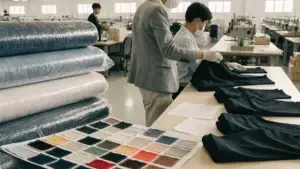
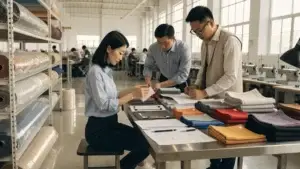
At Shanghai Fumao, we keep physical reference samples for every fabric our clients use. When a new fabric batch arrives, we compare it to the reference. We test the weight. We check the color. We feel the hand. If it is different, we do not cut it. We work with the client and the mill to fix the issue before production.
The same applies to trims. Zippers, buttons, and labels should come from approved suppliers. We keep reference samples of every trim. When a new batch arrives, we compare. No surprises.
What production controls maintain consistency across runs?
Documentation is the plan. Production controls are the execution. You need both. The best tech pack in the world means nothing if the production floor does not follow it.
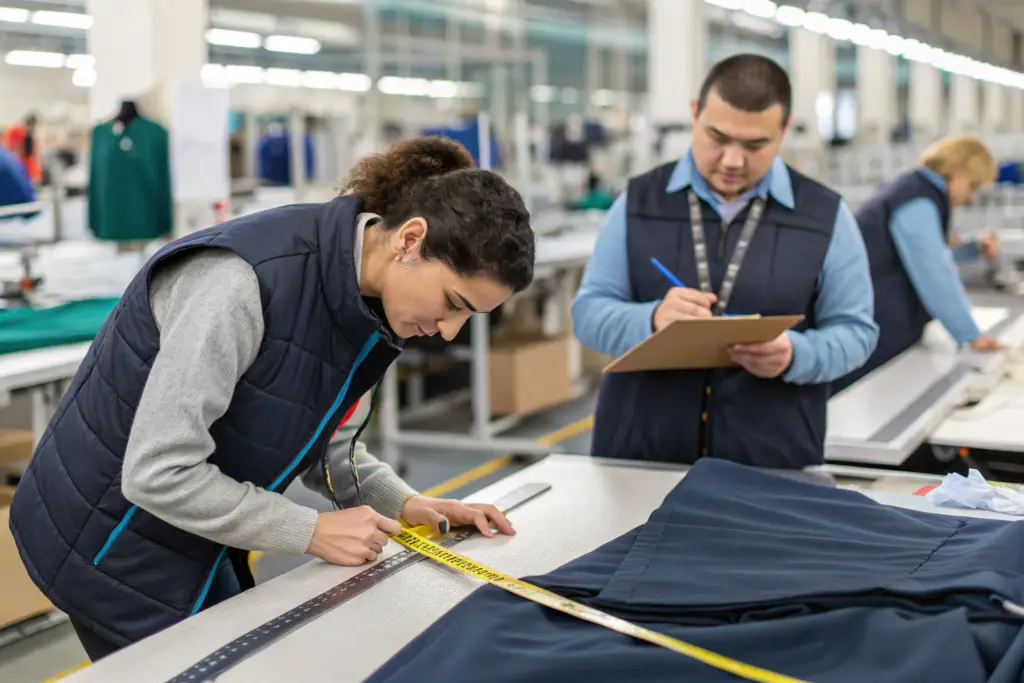
How do standard operating procedures ensure repeatable results?
Standard operating procedures tell workers exactly how to do their jobs. When every worker follows the same procedure, every garment comes out the same.
I visited a factory in Vietnam once. They made the same polo shirt for a major American brand. They had been making it for five years. I asked the production manager how they kept it consistent. He showed me their standard operating procedures.
Every workstation had a laminated instruction sheet. The pocket placer had a template showing exactly where the pocket went. The collar maker had a gauge for the collar height. The button sewer had a guide for button placement. Every operator knew exactly what to do. The polos from year one looked the same as year five.
Here are key standard operating procedures for consistency:
| Production Area | SOP Element | What It Controls |
|---|---|---|
| Cutting | Ply height, knife speed, pattern alignment | Prevents size variation |
| Sewing | Machine tension, needle size, stitch length | Prevents seam issues |
| Pocket placement | Template placement | Ensures consistent pocket position |
| Collar construction | Collar stand height, point length | Ensures consistent collar shape |
| Sleeve setting | Sleeve ease, shoulder alignment | Ensures consistent armhole fit |
| Hemming | Hem width, stitch type | Ensures consistent hem finish |
| Pressing | Temperature, pressure, time | Ensures consistent shape and finish |
A client from Boston had inconsistent sleeve lengths across her reorders. We implemented an SOP for sleeve measurement. Every sleeve was measured before sewing. The variation stopped. Her reorders became consistent.
How does using the same production team help?
People matter as much as procedures. When the same workers make your product repeatedly, they learn it. They know the tricky parts. They know what to watch for.
A client from Seattle had a complex dress with a difficult neckline. The first run was good. The second run was good. The third run had problems. The neckline was wavy on some pieces.
The issue was the sewing team. The first two runs were made by the same group of experienced operators. The third run was made by a different team because the first team was busy with another order. The new team did not know the dress.
We fixed it by assigning the dress to one dedicated team. That team now makes every run of that dress. They know the neckline. They know the fabric. The quality is consistent every time.
Here is how to use production teams for consistency:
| Approach | How It Works | Consistency Benefit |
|---|---|---|
| Dedicated line | Same workers, same machines, same style | Highest consistency |
| Style-specific training | Workers trained on your specific style | Consistent across runs even with some rotation |
| Key operator system | Same key operators for critical steps | Maintains consistency on important details |
| Production records | Records of who made previous runs | Allows same team for reorders |
At Shanghai Fumao, we track which team makes each style. When a client reorders, we try to use the same team. The workers remember the style. They know the challenges. They deliver consistency.
What sampling protocols catch problems before bulk production?
Sampling is your safety net. It catches problems before they become expensive mistakes. A good sampling protocol protects your consistency across reorders.
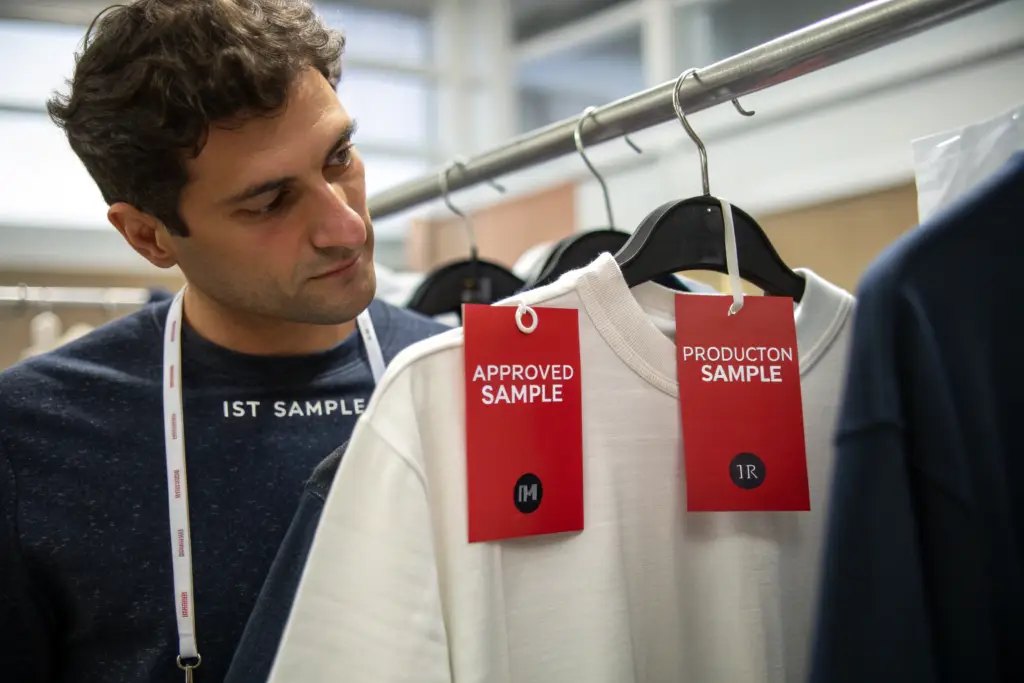
Why is the first sample critical for establishing standards?
The first sample sets the standard. Everything after that is compared to this sample. If the first sample is wrong, everything is wrong.
A client from Denver ordered a new jacket style. The first sample came. It looked good. He approved it quickly. The bulk order arrived. The fit was off. The pockets were in the wrong place. He had approved a sample that was not correct because he rushed.
We had to remake the entire order. It cost him time and money. The lesson: take time with the first sample. Check everything. Compare it to your tech pack. Try it on. Wash it. Make sure it is right before you approve.
Here is a sample approval checklist:
| Checkpoint | What to Verify | Why |
|---|---|---|
| Fit | Try on different body types | Ensures fit works for your customers |
| Measurements | Measure every point on the spec | Confirms pattern accuracy |
| Construction | Check seams, stitching, finishing | Ensures durability |
| Fabric | Feel, drape, color | Confirms fabric choice |
| Trim | Zippers, buttons, labels | Confirms trim selection |
| Placement | Logo, pocket, label positions | Ensures visual consistency |
| Wash test | Wash and dry, check shrinkage | Confirms care instructions |
A client from Texas now has a rule: she never approves a sample on the same day she receives it. She sleeps on it. She looks at it fresh the next day. This simple rule has saved her from many mistakes.
How do pre-production and production samples ensure consistency?
The first sample is for development. The pre-production sample is for production planning. The production sample is for bulk verification. Each serves a different purpose.
I worked with a client from Atlanta who ordered the same pants style for three years. Every season, we made a pre-production sample before cutting the bulk. We sent it to her. She compared it to her reference sample from the first run. If anything was different, we fixed it before cutting thousands of pieces.
Here is a sampling protocol for consistency:
| Sample Type | When to Make | Purpose |
|---|---|---|
| Development sample | During product development | Establish fit, construction, fabric |
| Pre-production sample | Before bulk fabric cutting | Verify pattern, fabric, trim before bulk |
| Production sample | First pieces off the production line | Verify bulk production quality |
| Shipment sample | Before packing | Final verification before shipping |
For a client from Miami with a repeat style, we keep a "master sample" from the first production run. Every reorder, we pull that master sample. We compare the pre-production sample to it. If they match, we go to bulk. If they do not, we stop and fix.
How do you handle changes between production runs?
Sometimes you need to change things between runs. New fabric. New trim. New size. Changes are fine. But they need to be managed. Unmanaged changes kill consistency.
How do you manage fabric substitutions?
Fabric mills change. Fabrics get discontinued. You may need to switch to a new fabric for a repeat style. This is a high-risk moment for consistency.
A client from Portland had a popular dress in a specific cotton-spandex jersey. The mill discontinued the fabric. She needed to find a replacement. She found a similar fabric. She assumed it would work the same.
It did not. The new fabric had more stretch. The dress fit differently. It was looser in the body. Customers complained. She had to take returns.
Here is how to manage fabric substitutions:
| Step | Action | Why |
|---|---|---|
| 1 | Source potential replacement fabric | Find options that match weight, composition, hand feel |
| 2 | Request lab dips | Verify color match to existing product |
| 3 | Request fabric test report | Verify shrinkage, stretch, strength |
| 4 | Make a new sample | Test the fabric in the actual garment |
| 5 | Fit test | Compare fit to original on same fit model |
| 6 | Wash test | Compare shrinkage and feel after washing |
| 7 | Approve or continue searching | Only proceed when satisfied |
A client from Chicago needed to replace a fabric for a repeat style. She followed this process. She made three samples with three different potential fabrics. She tested each one. She chose the one that matched the original most closely. Her customers never noticed the change.
How do you document and control other changes?
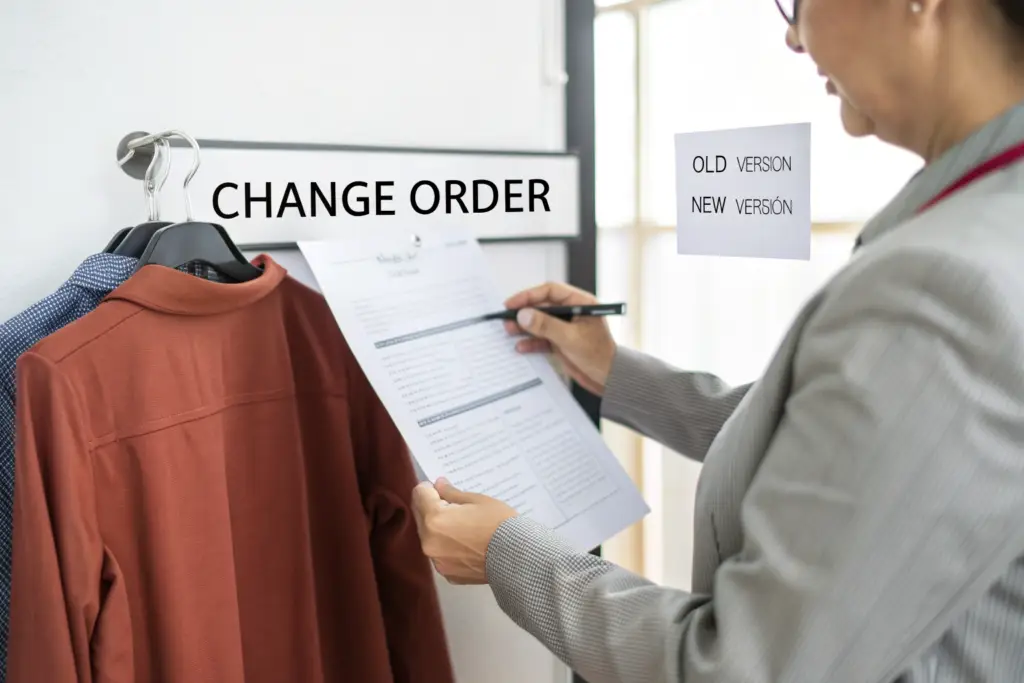
Any change between runs needs to be documented. New trim. New label. New size. New fit adjustment. If it is not documented, it is not controlled.
A client from New York wanted to upgrade the buttons on her popular shirt. The old buttons were plastic. She wanted mother-of-pearl. This was a good change. But she did not document it clearly. She told the factory "better buttons." The factory used a different plastic button that looked nicer but was not mother-of-pearl.
She was disappointed. The change was lost in communication.
Here is how to document changes:
| Change Type | How to Document | Verification |
|---|---|---|
| Fabric change | New fabric specification, new lab dip | Physical fabric sample |
| Trim change | New trim card with samples | Physical trim attachment |
| Fit adjustment | Revised measurement spec, new pattern | New fit sample |
| Size addition | New grade rules, new size spec | Sample in new size |
| Construction change | Revised tech pack, new seam detail | New sample showing change |
At Shanghai Fumao, we require written change orders for any modification to an existing style. We do not accept verbal changes. We update the tech pack. We make a new sample. The client approves the sample. Then we proceed.
What quality control systems catch variation before shipment?
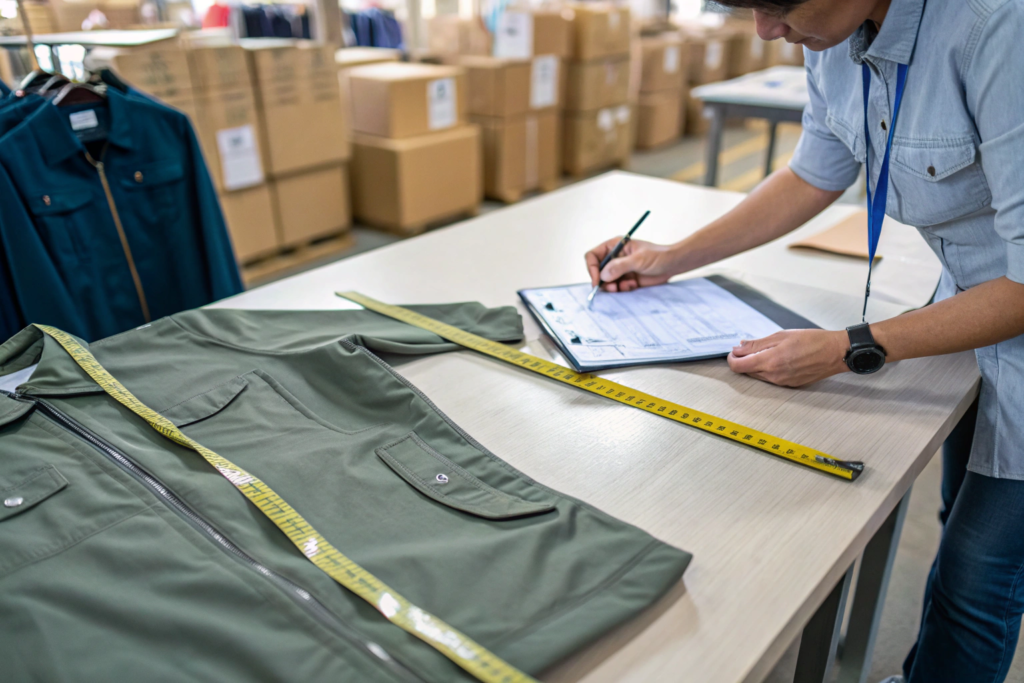
Quality control is your final defense. A good QC system catches variation before it leaves the factory. Once goods ship, variation becomes returns, discounts, and unhappy customers.
How does in-line inspection catch problems early?
In-line inspection means checking quality during production, not after. This catches problems when they can still be fixed.
A client from Boston had a repeat order of woven shirts. During the first production run, our in-line inspector noticed that the collar points were inconsistent. Some were sharp. Some were rounded. The sewing operator was using a different technique than the previous run.
We stopped production. We retrained the operator. We checked the collars already made. We fixed them. The bulk order was consistent. The client never saw a bad shirt.
Here is an in-line inspection framework:
| Production Stage | What to Inspect | When to Inspect |
|---|---|---|
| Fabric receiving | Weight, color, hand feel, shrinkage | Before cutting |
| Cutting | Pattern alignment, size accuracy | During cutting, before sewing |
| Sewing operation | Seam quality, measurement, placement | Throughout sewing, multiple checkpoints |
| Finishing | Trims, pressing, folding | Before packing |
| Packing | Labeling, carton quantity, packing list | Final stage |
A client from Seattle now requires weekly production photos. She wants to see her garments being made. This gives her confidence that quality is consistent.
How does final inspection protect your brand?
Final inspection is the last checkpoint. Every garment is checked. Defects are removed. Only good products ship.
At Shanghai Fumao, we use a random sampling method for final inspection. We follow AQL (Acceptable Quality Limit) standards. This is the industry standard for statistical sampling.
Here is how AQL works:
| Order Size | Sample Size | Acceptable Defects | Reject if More Than |
|---|---|---|---|
| 500 pieces | 50 pieces | 5 minor defects | 6 minor defects |
| 1,000 pieces | 80 pieces | 7 minor defects | 8 minor defects |
| 2,500 pieces | 125 pieces | 10 minor defects | 11 minor defects |
| 5,000 pieces | 200 pieces | 14 minor defects | 15 minor defects |
If the sample fails, we inspect every piece. We remove all defects. We do not ship until quality meets standards.
A client from Texas had a previous factory that shipped without final inspection. He received a batch with 15% defects. He had to inspect every piece himself. He wasted weeks. He learned to ask about final inspection procedures before placing an order.
Conclusion
Quality consistency across multiple production runs is not magic. It is system. It is documentation, production controls, sampling protocols, and quality inspection. When these systems are in place, every run is the same as the first.
Start with a complete tech pack. Document every detail. Keep fabric and trim standards. Use approved suppliers. Keep reference samples.
On the production floor, use standard operating procedures. Train workers on your styles. Use the same production team for repeat orders. This builds muscle memory for your product.
Use a rigorous sampling protocol. The first sample sets the standard. The pre-production sample verifies before bulk. The production sample checks the first pieces. The master sample gives you a reference for every reorder.
When changes are necessary, manage them carefully. Document every change. Make new samples. Verify before bulk.
And finally, use quality control systems that catch problems before shipment. In-line inspection catches issues early. Final inspection ensures only good products reach your customers.
At Shanghai Fumao, we have built our reputation on consistency. Our clients know that when they reorder a style, it will be the same as the last run. They trust us. Their customers trust them. That trust is built on systems, not luck.
If you are looking for a factory partner who will deliver consistent quality run after run, I invite you to reach out. Contact our Business Director, Elaine. She will walk you through our quality systems. She will show you how we maintain consistency. You can email her at strong>elaine@fumaoclothing.com</strong.
Let us help you build a collection that your customers can count on, every time.