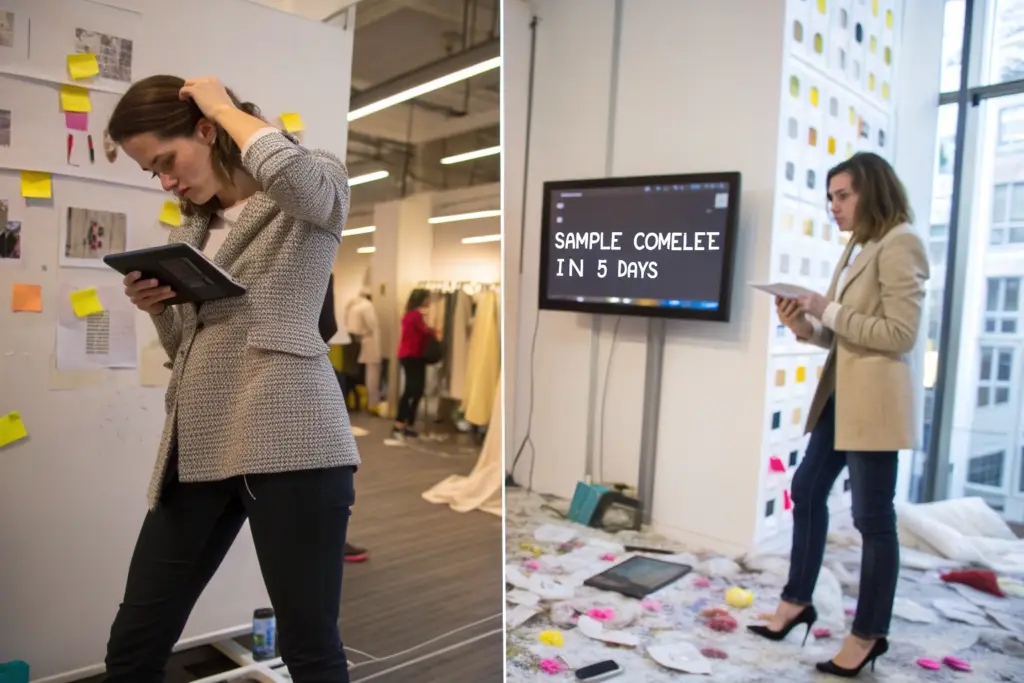
Time is the one asset you cannot buy more of. I learned this lesson deeply when a womenswear brand owner from Nashville called me in tears two years ago. She had spent eight weeks waiting for a sampling round from another supplier. Her pre-order launch date came and went. Her audience lost interest. When the samples finally arrived, the armhole was still too tight. She needed another revision. Another two weeks lost. That moment made me understand that speed is not just about efficiency. Speed protects your marketing calendar. Speed keeps your audience engaged. Speed is a competitive weapon.
Shanghai Fumao cut our average women's wear sampling time by 50% by running a parallel digital-physical workflow, maintaining a dedicated in-house sample room that operates six days a week, and eliminating the biggest bottleneck in the industry: the back-and-forth translation of vague fit comments into technical pattern corrections.
We did not just ask our sample team to work faster. That leads to burnout and sloppy stitches. Instead, I invested in a complete overhaul of how we process design information. I want to show you the specific changes we made to our cutting floor, our pattern software, and our communication protocols. These are not trade secrets. They are practical upgrades that any serious factory should adopt. But most factories will not make the upfront investment because they prioritize short-term cost savings over long-term client success.
What Are the Biggest Bottlenecks in Traditional Women's Wear Sampling?
The old way of making a sample is painfully slow. The designer sends a sketch. Maybe a tech pack if they are organized. The sales rep forwards it to the factory manager. The manager gives it to a pattern maker. The pattern maker reads the notes, often badly translated from English to Mandarin. They guess the designer's intent. They cut a paper pattern. They give it to a seamstress. The seamstress sews a muslin. The whole sequence takes ten to fourteen days. And that is just the first draft.
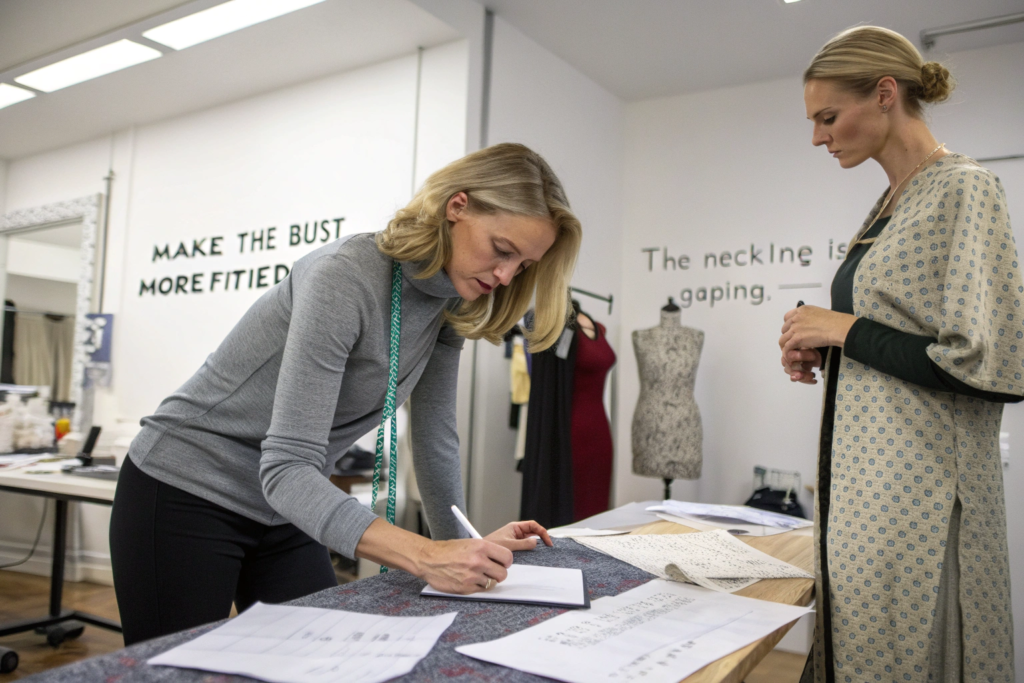
Then the real nightmare begins. The factory ships the sample internationally. The designer receives it a week later. She tries it on a fit model. She writes comments like "make the bust more fitted" or "the neckline is gaping." She emails those comments back. The pattern maker reads them, scratches their head, and guesses again. Revision two takes another two weeks. This iterative guessing game is why most women's wear sampling cycles take six to eight weeks. It does not have to be this way.
How Does "Translation Latency" Kill Your Launch Timeline?
Language is the invisible bottleneck. When a designer says "the shoulder pitch is off," that phrase is a technical concept. It means the angle of the sleeve relative to the shoulder slope is incorrect. A generic translator in a trading company does not know the word "pitch" in garment construction. They translate it as "shoulder angle." The pattern maker adjusts the wrong angle. The second sample comes back with a new problem. The designer loses trust.
We completely removed the generic translator from the sample room loop. Our sample room team communicates directly with me or the client using technical English. We maintain a master glossary of 300 specific fit terms in both English and Mandarin. "Forward shoulder," "swayback adjustment," "dart intake," "crotch depth." Every term has an exact pattern correction mapped to it. When a client sends a fit comment using a term from our glossary, the pattern maker executes the exact known adjustment. Zero ambiguity. This technical pattern terminology standardization cut our interpretation errors to almost zero. It saved at least seven days per sampling round.
Why Does Physical Sample Shipping Waste Precious Weeks?
International shipping kills momentum. A sample sits in a FedEx box for five days crossing the Pacific. You track the box. You wait. You cannot sell. You cannot photograph. When you finally open it, the tension of the wait amplifies your disappointment if something is slightly off. We ask ourselves constantly: what if we did not ship the first sample at all?
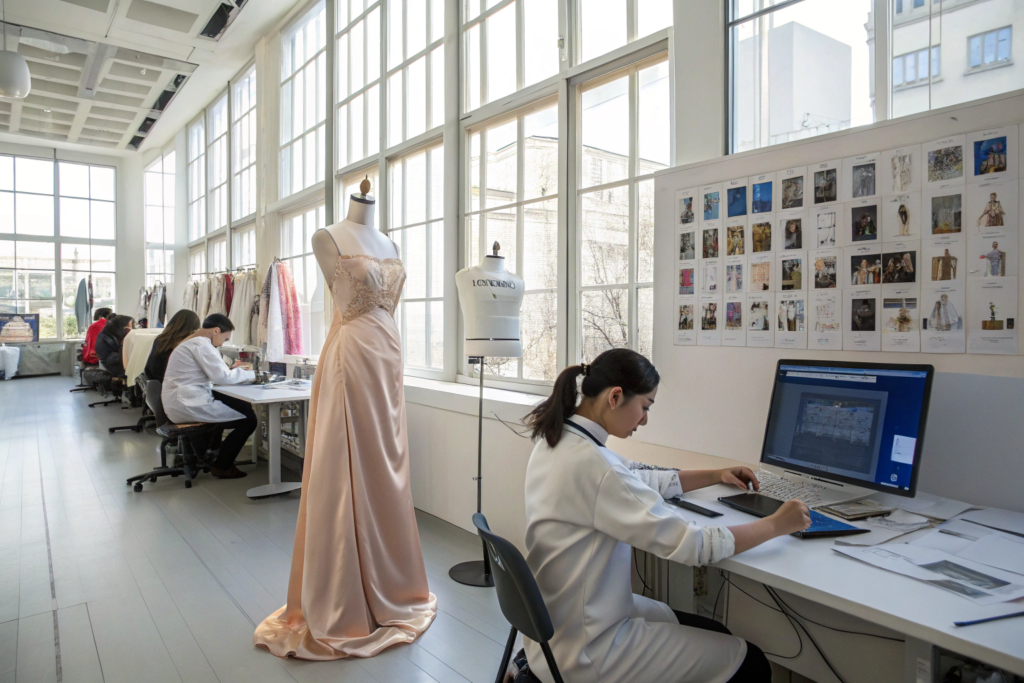
For many woven styles like shirts and simple dresses, we now offer a 3D digital twin before we cut the physical fabric. We use Browzwear software to build a virtual garment. We send the client a rotating 360-degree video of the 3D garment on a virtual fit model with their exact measurements. They can see the drape, the length, and the neckline shape digitally. They approve the proportions first. Only then do we cut and ship the physical fit sample. This parallel path eliminates one entire round of international shipping. The physical sample usually arrives approved in the first shot. This is not replacing physical fitting. It is filtering out obvious issues before the box leaves China.
How Does an In-House Sample Room Accelerate Your Womenswear Launch?
Most small and medium factories do not have a dedicated sample room. They outsource the sampling to a small third-party workshop across town. The factory manager throws the spec sheet over the wall and picks up the finished sample three weeks later. There is no feedback loop. There is no urgency. The sampling workshop has ten other factory clients. Your sample is a low-priority side hustle for them. This creates a fatal disconnect between the people who will mass-produce the garment and the people who prototype it.
I made a deliberate decision five years ago. I brought the sample room physically inside our main production building. It occupies the entire third floor. Six full-time sample makers work there. They do nothing else. They sit fifty feet from the production cutting tables. When a production manager notices that a particular seam construction in the sample might be too time-consuming for bulk, they walk upstairs and discuss it with the sample maker immediately. This proximity is a massive competitive advantage.
How Does 3D Prototyping Reduce Physical Sampling Rounds?
I touched on this earlier, but let me go deeper. A 3D simulation is not just a pretty video. It is an engineering tool. Last winter, a Los Angeles contemporary brand sent us a design for a draped viscose jersey dress. The design had a complex cowl neckline. In traditional sampling, we would cut and sew three different physical cowl depths to find the right drape. That would take ten days.
Using our 3D software, we simulated the drape of the 120 GSM viscose. We adjusted the cowl depth digitally in 2 cm increments. The client viewed the simulations side by side on a screen. She selected the 16 cm depth. We cut the physical sample once. It was approved within 48 hours. The 3D garment simulation technology paid for itself in materials saved and time accelerated. We invested heavily in this digital twin capability because we knew it would change the sample game for our clients. It turns "maybe" into "yes" before we sew a stitch.
Why Is a Dedicated Sample Fabric Library a Secret Weapon?
Here is a hidden detail that slows everyone down. A designer asks for a sample in "a soft peach silk charmeuse." The sample room coordinator has to source 2 meters of that exact fabric. They call the local fabric market. The vendor says it will take four days to arrive. The clock ticks. We eliminated this delay by building an archive.
We have a physical library of over 800 stocked sample fabrics inside our sample room. Cotton poplins, linen blends, silk alternatives, viscose twills, stretch crepes. They are organized on labeled racks by weight and fiber content. When a client asks for a quick mockup to check the silhouette, we can walk to the rack and pull a similar fabric instantly. We cut the sample that afternoon. We clearly label the sample with "Proto Fabric - Final Fabric May Drape Differently." But the shape and proportions are almost exact. This allows the designer to see the lines of the garment within 48 hours of approving the sketch. Access to a comprehensive fabric sourcing library on site is a physical asset that shaves weeks off the calendar.
What Role Does Direct Pattern Maker Access Play in Speed?
The traditional supply chain intentionally separates the designer from the pattern maker. The trading company or agent acts as a wall. They do this so the designer cannot cut them out and go direct. But this wall destroys speed. The designer cannot explain their vision. The pattern maker cannot ask clarifying questions. Both sides work half-blind, connected only by a middleman who does not understand the difference between a princess seam and a French dart.
I ripped that wall down. At Shanghai Fumao, our pattern makers join the initial onboarding video call with the client. They hear the designer's voice. They see the mood board. They can ask a direct question about the intended fit. The designer can point to a reference photo and trace the shoulder line on the screen. This immediate connection cuts through the noise. The pattern maker already has the design in their head before they open the CAD software.

How Does a Live Pattern Review Call Fix Problems Instantly?
I strongly recommend a 30-minute live pattern review for every new silhouette. We schedule this call after the first digital pattern is drafted but before the physical muslin is cut. Last March, we worked on a power-shoulder blazer for a womenswear brand. On the call, the pattern maker shared their screen showing the 2D pattern pieces. The designer looked at the lapel notch height and immediately said, "That is exactly 1.5 cm too low."
The pattern maker dragged the notch point up in real time. The designer watched it move on the screen. She confirmed the new position within seconds. If this had gone through email, it would have been a screenshot, a mark-up, a reply, a wait, and a misinterpretation. The entire conversation took 90 seconds. The live pattern review bypasses the back-and-forth entirely. It builds trust because the designer sees that the person behind the pattern is competent and responsive.
Why Is Fit Model Data Standardization Critical?
A sample is only as good as the fit model data it references. If the factory uses a standard Chinese size medium dummy, the sample will not fit an American consumer. But many brands also do not have their own fit model data standardized. They give vague instructions like "fit a true size 8." Size 8 means different things in different brands. We standardize this before we draw a single line. We send the client a detailed body measurement chart. Bust point to bust point. Across back width. Bicep circumference. Waist to hip length.
We ask the client to measure their own fit model or dress form with a tailor's tape and fill in the blanks. We map these exact numbers into our pattern CAD system as the base size avatar. For a recent activewear brand launch, the client provided us with the detailed measurements of a professional fit model they had used for years. We built the digital avatar exactly to her unique shoulder slope and torso length. The first physical sample fit her like a glove. The client told me it was the first time she did not need to pin anything during a fit session. Investing 30 minutes in measurement standardization up front saves weeks of alterations on the back end.
How Can Pre-Approved Trim Kits Shorten Your Production Cycle?
Trims seem like a small detail. Buttons, zippers, labels, and hang tags are the jewelry of the garment. But trims are also the number one hidden bottleneck after fit approval. The sample is finalized. The client is excited. The purchase order is signed. Then the production coordinator asks the factory, "Have the custom buttons arrived from the supplier?" Silence. The button factory in Dongguan needs 25 days for production. The entire bulk order sits waiting for a tiny piece of polyester resin.
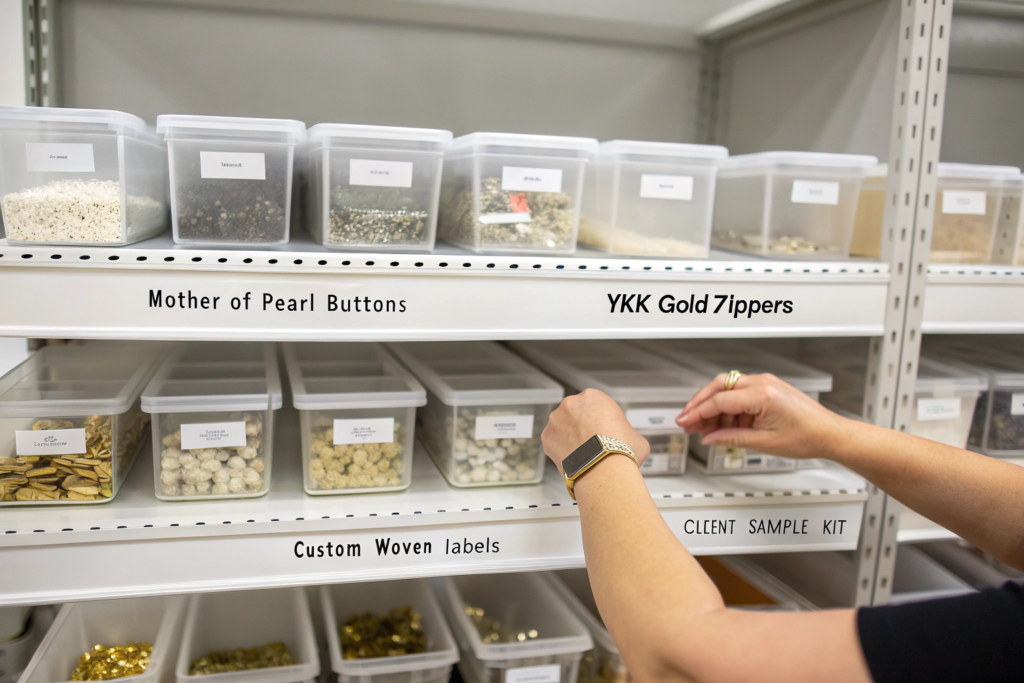
I hate this scenario. I redesigned our trim workflow to run in parallel with sampling, not after it. The moment we begin the second prototype, we also send the client a trim kit proposal. We select standard high-quality stock options from our physical trim library. We ship a small pouch with five button options and three zipper tapes directly to their office. They approve the trims before the sample is even finalized. By the time we start cutting bulk fabric, the zippers are already on our shelf.
How Does Trim Standardization Speed up Bulk Production?
Some factories let the client choose any custom trim from scratch. That freedom sounds nice but kills the calendar. Custom molds for metal buttons take four weeks. We encourage clients to browse our pre-vetted stock trim library first. We curate a selection of 200 premium stock trims that we keep in permanent inventory. These include genuine mother-of-pearl buttons, YKK metal zippers in gold and silver tones, and recycled polyester drawcords.
During a recent rush order for a resort wear brand, the owner needed 800 linen dresses shipped in 45 days. No custom trim supplier could deliver custom dyed-to-match coconut buttons that fast. We pulled our stock natural shell buttons from the shelf. We showed her a high-resolution photo next to the fabric. She approved instantly. The order shipped on day 43. Using in-stock garment trims eliminates the most unpredictable variable in the production chain: a third-party supplier's delivery promise.
Why Should Care Labels and Hang Tags Be Approved Before Production?
The final packing stage is a bad place to discover a typo. I saw it happen once with a client who rushed their care label approval. The label said "Do Not Iron" instead of "Cool Iron Only." The garments were packed and ready to ship. The client caught the mistake in a final photo. We had to unpack 1,200 poly bags. We had to unstitch and replace every label. The delay was three days. The extra labor cost a few hundred dollars. The brand trust cost more.
Now, we require signed digital approval on all care label artwork and hang tag designs before the cutting starts. We check the fiber content breakdown, the country of origin mark, and the RN number if applicable. We verify the washing symbols against the textile care labeling rules enforced by the Federal Trade Commission. This is a simple administrative gate. It takes ten minutes of focused review from the client. It prevents an embarrassing packaging error that could trigger a consumer complaint or a regulatory fine. Strong brand packaging starts with getting the small print right.
Conclusion
Reducing the sampling timeline by half is not about rushing people. It is about removing the empty waiting periods that add no value. The days a sample sits in a customs warehouse. The days a pattern maker guesses what "too tight" means. The days the cutting table waits for a zipper to arrive from a distant supplier. These are all solvable problems. We solved them by digitizing the fit preview, bringing the sample room inside our factory walls, and telling our pattern makers to speak directly to the designers who dream up the clothes.
The speed of your sample directly controls the speed of your revenue. A faster sample means a faster pre-order campaign. It means a faster bulk delivery. It means you hit the season when demand is hot, not when the clearance sales have already started. Our investment in 3D technology and a stocked trim library was made with this exact return on investment in mind. We want your brand to be the first one live, not the last one scrambling.
If you are tired of waiting eight weeks for a sample that still needs three revisions, let us show you a different rhythm. At Shanghai Fumao, we approach womenswear sampling as a strategic sprint, not a slow marathon. You send the vision. We send a fit-approved sample fast. To start a conversation about your next collection, email our Business Director Elaine at elaine@fumaoclothing.com. Let us prove that speed and quality can coexist in your supply chain.