You have built a beautiful wholesale brand. A boutique buyer places a reorder for your best-selling chino. When the shipment arrives, she unboxes the pants and puts them on the rack next to a pair from your last delivery. A loyal customer comes in, grabs his usual size, and heads to the fitting room. He comes out, confused and frustrated. This pair is inches tighter in the waist than the last one he bought. He doesn't blame the factory; he blames your brand. He leaves the store, and he doesn't come back. A veteran wholesale buyer once told me, "I don't care how beautiful a garment is. If my customer can't trust the size on the label, I'll never buy that brand again. Consistent sizing isn't a quality metric; it's the absolute foundation of a wholesale partnership. It's the promise you make to my customer."
Consistent garment sizing is the single biggest challenge in wholesale production because it is a fragile chain of dozens of interdependent technical processes, any one of which can fail and destroy the fit. The primary enemies of consistency are: 1) Unmanaged Fabric Shrinkage and Behavior (a natural fiber that shrinks differently from one dye lot to the next), 2) The "Grade Rule Drift" in Pattern Making (inaccurate or inconsistent scaling of a pattern across the size curve), and 3) The Cumulative Tolerance of Human Error in Cutting and Sewing (a millimeter of error per seam, multiplied across 10 seams, equals a full-size miss). The only solution is a systematic, data-driven, and relentlessly audited production process.
At Shanghai Fumao, we understand that a customer's trust is built one consistent fit at a time. Our entire quality control and production system is engineered to conquer this challenge, providing our B2B partners with the unshakeable sizing reliability that wholesale buyers demand. Let me explain the hidden sources of sizing inconsistency and the specific, rigorous methods we use to eliminate them.
How Does Raw Fabric Behavior Conspire to Destroy Sizing Consistency?
The single biggest hidden cause of sizing inconsistency is the fabric itself. A garment is not a static object; it is a dynamic system of fibers that will react to moisture, heat, and tension in different ways. A "100% Cotton" jersey from one dye lot can have a completely different shrinkage and stretch profile than the same fabric from a different lot. If the factory does not test and account for these batch-specific behaviors, a size Medium produced today will not fit the same as a size Medium produced last month.
Raw fabric behavior is the primary hidden enemy of sizing consistency. All natural fibers shrink, but the exact percentage of shrinkage can vary significantly between different dye lots of the exact same fabric specification. If a factory uses a generic shrinkage allowance for a fabric instead of testing and calculating the precise shrinkage for each specific batch, the resulting garments will be of inconsistent sizes. A professional factory tests every incoming batch, quarantines it, and mathematically adjusts the pattern for that specific batch's unique properties.
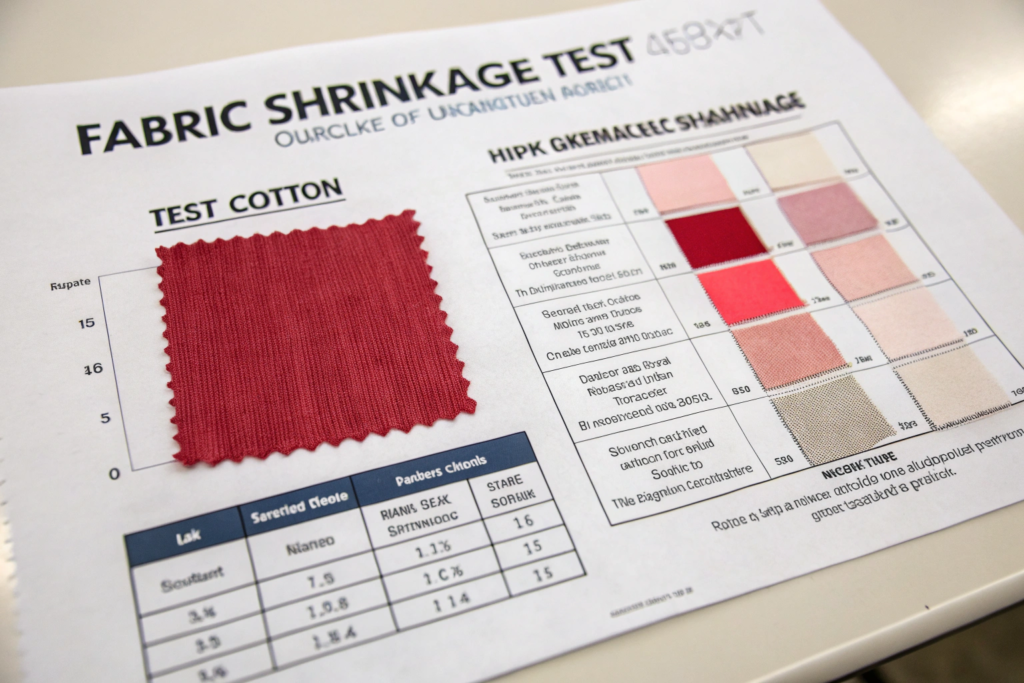
A brand we work with had a disastrous season where their entire run of cotton blazers was returned because the size Large fit like a Medium. The root cause was a new dye lot of their cotton twill that had a significantly higher shrinkage rate than the previous lot. The factory had not re-tested the batch and had used the old, outdated shrinkage allowance. At Fumao, we operate a strict, non-negotiable protocol: every single incoming roll of a natural-fiber fabric is subjected to a standardized wash test. The precise, batch-specific shrinkage percentage is calculated, and the digital pattern is automatically adjusted before a single cut is made. This is the discipline of proactive shrinkage management .
Why Can Two Dye Lots of the "Same" Fabric Shrink Completely Differently?
Dyeing is a complex chemical and mechanical process. Subtle variations in the temperature, the chemical concentrations, or the tension on the fabric as it passes through the dyeing and finishing machines can result in a fabric that looks identical but has a completely different internal "relaxed" state. One lot might shrink 2%, while the next, processed on a slightly different machine, might shrink 5%. This is why every batch is a unique new challenge.
What Is the "Batch Test and Quarantine" Protocol That Guarantees Consistency?
This is the gold standard process. When a new batch of fabric arrives, it is immediately placed in quarantine. A small test swatch is cut, measured, and then washed and dried according to the care label. The post-wash shrinkage is calculated. The fabric is only released for cutting once the batch-specific shrinkage allowance has been programmatically applied to the cut file for that specific batch. This single discipline is the most powerful tool for batch-to-batch size consistency. This is a core part of our incoming material QC .
How Can "Grade Rule Drift" and Pattern Inaccuracy Ruin a Size Run?
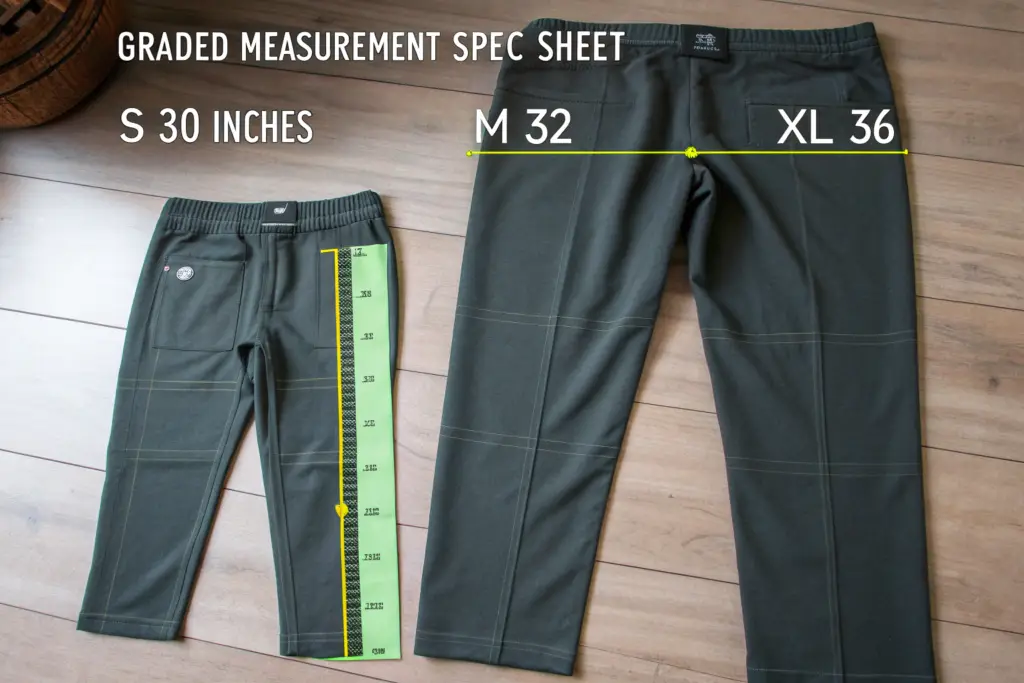
A perfect pattern for a size Medium is just the anchor. A full wholesale size run requires the pattern to be accurately "graded" up for larger sizes and down for smaller sizes. This is a precise mathematical function. An inconsistent or inaccurate grading rule—for example, one that adds 2 inches to the waist for one size jump but only 1.5 inches for the next—will create a size run that fits no one correctly. This "drift" in the grade rules is a major source of inconsistency.
Grade rule drift is a mathematical error that ruins a size run. Grading is the process of scaling a base pattern to create all other sizes using specific, consistent rules for each Point of Measure (POM). A correct grade rule for a men's trouser waist might be a 2-inch increase per size. If this rule is applied inconsistently or incorrectly in the CAD software, the size Large will not be a proportional, correct version of the Medium. A professional factory maintains a strict library of pre-validated grade rules for different markets (US, EU) and conducts a physical "Grading Audit" on samples from multiple sizes before bulk production to verify the math is correct.
We once re-graded a brand's entire size run after they complained that their sizes L and XL always fit poorly. The issue was a subtle, incorrect grade rule for the bicep. The original rule added 0.5 inches per size, but the correct, proportional rule for their customer's build was 0.75 inches. This single, small mathematical error was causing consistent returns from their larger customers. We corrected the grade rule, and the fit issues vanished. This is the precision of expert pattern grading .
What Is a "Grading Audit" and Why Is It Non-Negotiable Before a Bulk Cut?
A Grading Audit is a physical reality check on the mathematical grade. We sew one sample from the smallest size and one from the largest size in the run. We put them on the appropriate fit models. We measure every critical POM. We do not just look at the numbers on a screen; we verify that the rule has maintained the intended proportions and fit on a real body across the entire size spectrum. This is a vital, proactive QC step. This is a key part of our pre-production process .
How Do US, UK, and EU Grading Rules Differ for the Same Garment Style?
They are completely different mathematical systems. A US grade typically uses inches, while an EU grade uses centimeters, but the differences are deeper than just units. The grade rules themselves—how much the hip expands vs. the waist—are different, reflecting different average body proportions. A correct US-graded pattern will not fit an EU customer, even if the label is changed. This is why market-specific grading is essential for a global brand. This is the core of our international sizing expertise .
How Do Tiny Sewing Errors Multiply into a Full-Size Catastrophe?
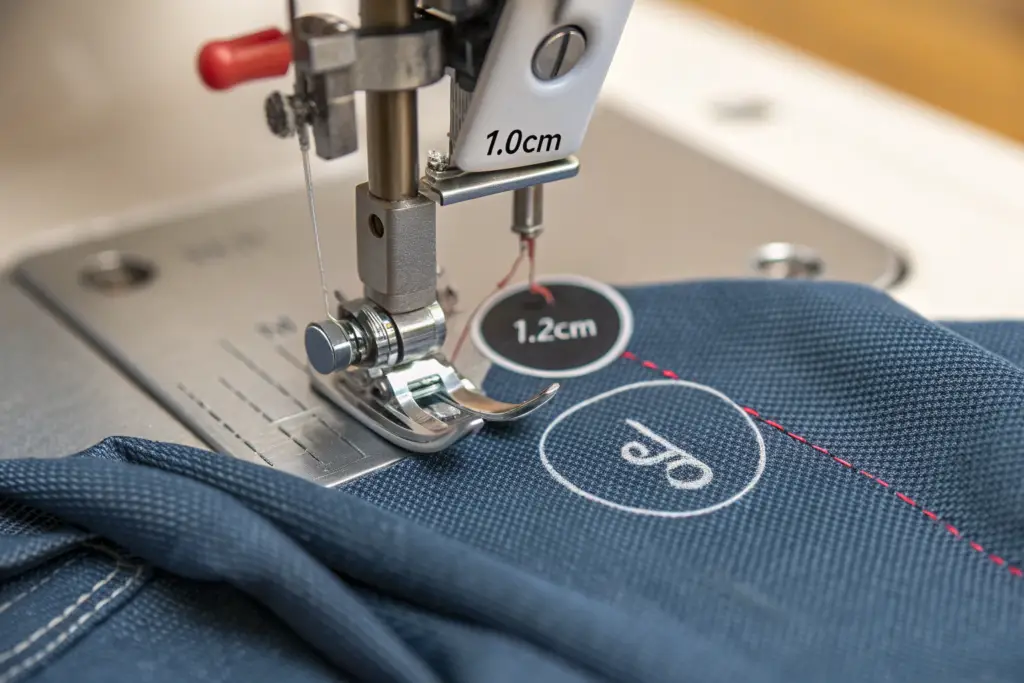
The final, and perhaps most insidious, source of sizing inconsistency is human error on the sewing line. A sewer who takes a seam allowance that is just 2 millimeters too wide will create a garment that measures 4 millimeters too small across that seam. If that same, tiny error is repeated across the 5 main seam closures on a fitted shirt, the total cumulative error can be a full size smaller. This "cumulative tolerance" effect is invisible to a casual glance but devastating to a consistent fit.
Tiny sewing errors multiply into a full-size catastrophe through the "cumulative tolerance" effect. A 1-2 millimeter error on a single seam is negligible. However, when that same small error is unknowingly repeated by an operator across multiple seams (shoulders, side seams, sleeves) on a single garment, the total dimensional error can be 1-2 inches in the total circumference. The garment is now a completely different size. The only defense against this is proactive, in-line QC with precise measuring, not relying on a final, visual check.
At Fumao, our in-line QC inspectors do not just look for visual defects. They are trained to spot-check the seam allowances with a small measuring tool. If an operator is consistently taking a 1.2 cm allowance instead of the specified 1.0 cm, the inspector catches it on the first few pieces, stops the line, and the operator's machine guide is recalibrated immediately. This prevents a subtle error from being replicated across hundreds of units. This is the discipline of proactive, in-line quality control .
What Is "Cumulative Tolerance" and Why Is It Invisible to a Final Visual Check?
Cumulative tolerance is the snowball effect of small errors. A final visual inspector might look at a shirt and think it "looks like a Medium." They will not see that the chest is subtly too small because of five minor, accumulated seam errors. The problem only becomes apparent when the garment is put on a body or measured against a spec sheet. This is why visual inspection is not enough; measurement against a calibrated spec is the only way to catch this drift.
How Is In-Line QC the Only Way to Stop a Sewing Drift Before It Ruins a Batch?
An end-of-line inspector can only find the problem after 1,000 units are already sewn and packed. An in-line inspector, who checks a sample every hour from a sewer's output, catches the drift as it begins. They can immediately correct the operator's technique or fix a misaligned machine guide. This is the difference between preventing a fire and sifting through the ashes. This is the philosophy of our factory-floor quality system .
How Does Fumao's Systematic Approach Make Sizing Consistency a Managed Certainty?
Consistent sizing is not an accident; it is the predictable outcome of a systematic, multi-layered, and relentlessly data-driven production process. Our entire quality system—from the moment we test an incoming batch of fabric to the final measurement audit on the packed goods—is engineered to catch and correct the three enemies of consistency: fabric behavior, grade rule drift, and sewing tolerances. We provide our B2B partners with the transparency and the data to prove that their customer can trust the size on the label.
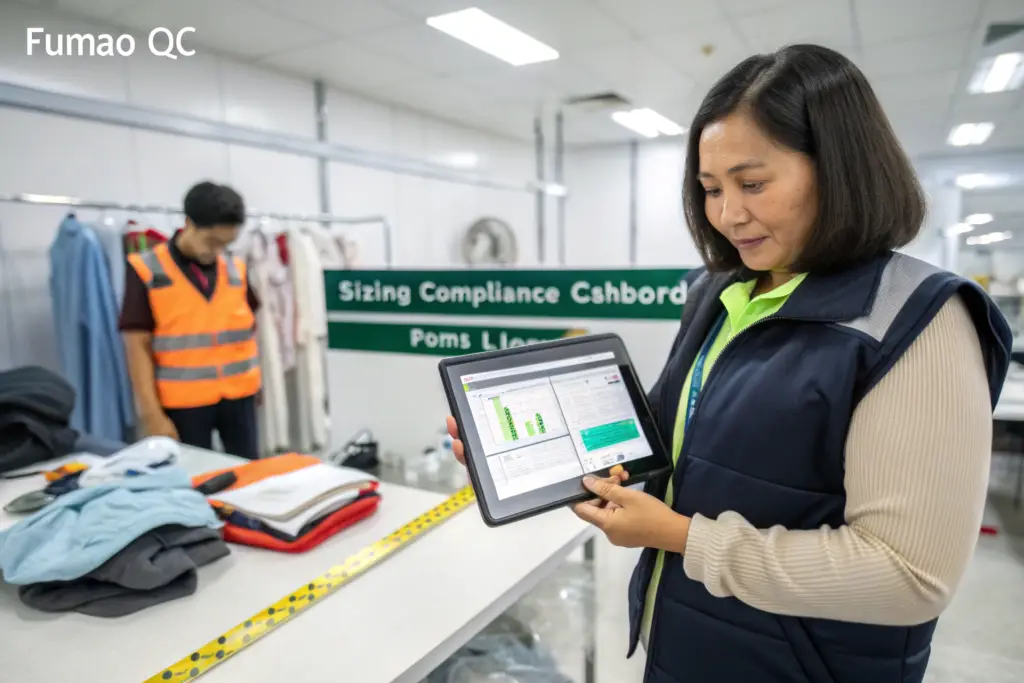
Fumao's systematic approach makes sizing consistency a managed certainty. Our process is a series of interconnected, data-driven checkpoints. We test every fabric batch for shrinkage and adjust the pattern. We audit the grade rules with physical samples. Our in-line QC inspectors constantly monitor and correct seam allowances. And we provide our partners with a transparent, digital "Sizing Compliance Report" for each bulk run, showing the actual measured dimensions against the target spec. We transform sizing from a gamble into a verifiable, documented, and reliable outcome.
A brand founder who had been plagued by sizing complaints told us, "Your weekly measurement audit reports are the most beautiful things I've ever seen. For the first time, I have data that proves my entire size run is consistent. I can show my wholesale buyers that a size 8 from this season will fit exactly like a size 8 from last season. That data is the foundation of my business's reputation." That is our goal. To provide the systematic, transparent process that turns sizing consistency from a challenge into a proven, managed, and predictable reality. This is the value of a true manufacturing partnership .
What Is in the "Sizing Compliance Report" You Provide with a Bulk Shipment?
Our report is a data-rich document for every size in the run. It lists the key POMs, the target specification, the acceptable tolerance, and the actual, measured values taken from the AQL sample. It provides a transparent, statistical view of the sizing accuracy of the entire production run. This is the proof that your size Medium is a size Medium.
How Do You Use a "Golden Sample" and In-Line Measurement Audits to Anchor the Size Standard?
The approved, sealed Pre-Production (PP) Sample is the physical, legal standard for the fit. Our in-line QC inspectors carry the detailed measurement spec sheet for this sample and constantly audit the bulk production against it. Every measurement taken is compared back to this single, approved reference point. This creates an unbreakable link between the approved fit and the bulk production, preventing any "drift" over the course of a long production run. This is our quality anchoring system .
Conclusion
Consistent sizing is the single biggest challenge in wholesale clothing production because it is a fragile outcome, vulnerable to a hidden army of enemies: unpredictable fabric behavior, imprecise mathematical grading, and the tiny, compounding errors of human hands. Conquering this challenge is not about hoping for the best; it is about building a systematic, data-driven, and relentlessly audited manufacturing process.
At Shanghai Fumao, this system is the bedrock of our B2B service. Our proactive protocols for fabric testing, pattern grading, and in-line QC make consistent sizing not a happy accident, but a managed, predictable, and verifiable certainty. We protect your brand's most valuable asset: the trust your customer places in you every time they choose your size.
If you are ready to build a brand on a foundation of unshakeable sizing reliability, let's talk. Our Business Director, Elaine, can walk you through our sizing compliance and QC process. Please email Elaine at: elaine@fumaoclothing.com.