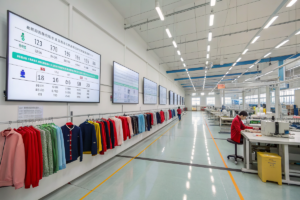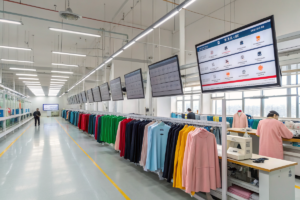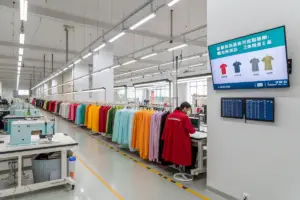
A Vancouver-based technical outerwear brand once sent a factory a "tech pack" that consisted of a single JPEG image of a hand-drawn sketch and an email that read, "Make it look like this but in a size large and with a slightly looser fit." The factory, unable to interpret "slightly looser," guessed at the chest measurement. The brand, unable to provide a stitch type specification, received a jacket with single-needle topstitching that unraveled at the first stress point. The entire 2,500-unit order was a catastrophic write-off. The factory had not made an error; the brand had issued an impossible instruction. A tech pack is not a suggestion. It is a legally binding manufacturing specification document. If a measurement is not written down, the factory will guess. If a stitch type is not specified, the factory will use the cheapest available. If a trim component is not physically attached, the factory will substitute.
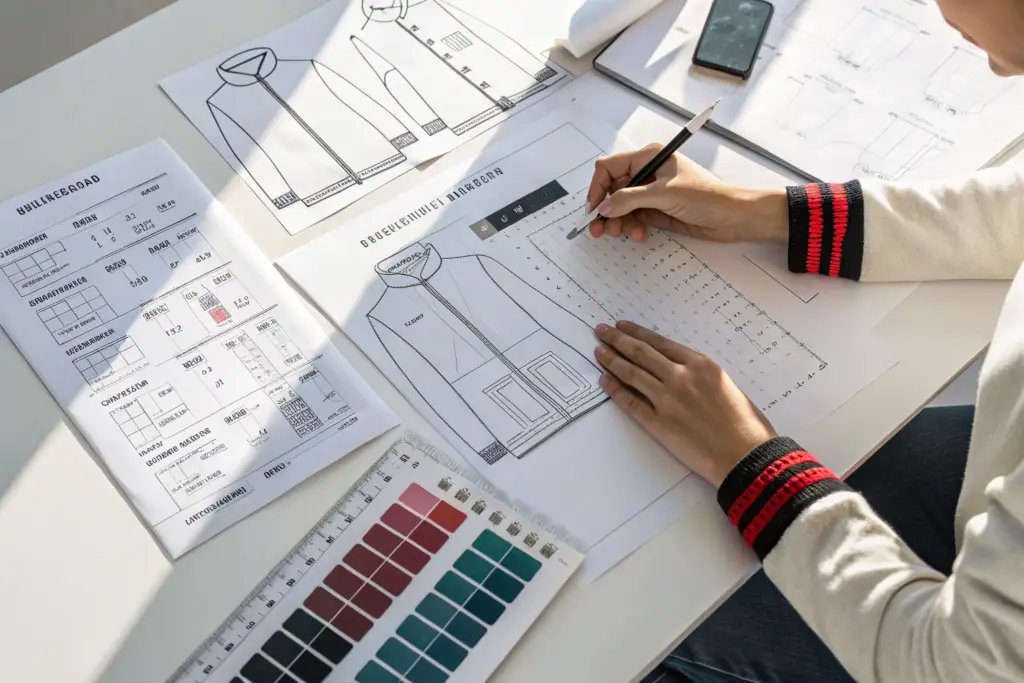
A perfectly detailed apparel manufacturing tech pack must strictly include seven non-negotiable sections: one, a dimensionally accurate, fully annotated technical flat sketch in black and white showing all seam lines, topstitching, and design details; two, a fully graded measurement specification chart with at least fifteen critical points of measure per garment type; three, a physical bill of materials with actual specimens of every single trim component stapled and signed across; four, a fabric specification sheet with weight, composition, weave, and an approved lab dip swatch; five, a stitch and seam construction library with SPI density and ISO stitch type codes; six, a print and embroidery placement diagram with exact Pantone color callouts and digitization file numbers; and seven, a packing and labeling instruction sheet with folded dimensions, polybag specifications, and barcode placement.
At Shanghai Fumao, I can manufacture a garment precisely to a detailed tech pack. I cannot manufacture a garment from a vague inspiration email. The difference between a profitable season and a container of unsellable returns is the thickness of your tech pack.
Why Is a Fully Graded Measurement Chart With Fifteen Points of Measure an Absolute Non-Negotiable?
A New York contemporary brand once sent me a measurement chart with exactly three data points: Chest, Length, and Sleeve. The chart specified the measurements for a size Medium only. The brand assumed the factory would “know how to grade” the other sizes. The factory used a generic linear grade rule that produced a size 3XL sleeve that was disproportionately long and a size XS armhole that was disproportionately deep. The sizes above Large and below Small fit nobody. The brand absorbed a 22% return rate on those sizes.
A fully graded measurement chart with fifteen points of measure is an absolute non-negotiable because it removes all ambiguity from the factory’s pattern-making and cutting process by providing exact, numerical target measurements for every single size in the range, covering not just the primary body dimensions but the secondary control points like armhole depth, bicep circumference, neck width, and sleeve opening that govern fit and comfort, with a clearly stated tolerance of +/- 1/2 inch for body measurements and +/- 1/4 inch for collar and cuff measurements.
The factory’s pattern maker cannot grade a sleeve length correctly if she does not know whether the brand’s size increment between a Medium and a Large is 1 inch or 1.5 inches. The measurement chart is the mathematical answer sheet.
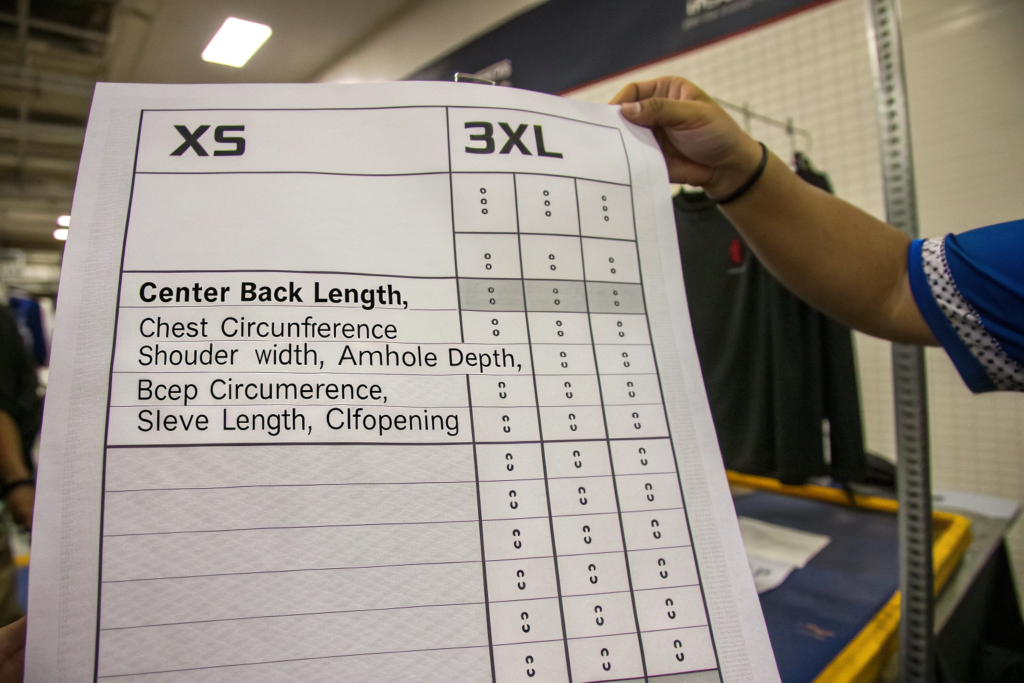
What Are the Exact Fifteen Mandatory Points of Measure for a Woven Button-Down Shirt?
The fifteen points are: Center Back Length, Chest Circumference (1 inch below armhole), Waist Circumference, Bottom Hem Sweep, Shoulder Width (point-to-point), Sleeve Length (from center back neck), Sleeve Length (from shoulder point), Armhole Curve Length (measured along the seam), Bicep Circumference (1 inch below armhole), Sleeve Opening Circumference, Neck Width (seam to seam), Front Neck Drop, Back Neck Drop, Collar Point Length, and Collar Band Height. These fifteen points control the entire silhouette.
How Does a “+/- 1/4 Inch Tolerance” on a Collar Point Legally Define an Acceptable Versus Rejectable Garment?
If the tech pack specifies a collar point length of 3.25 inches with a tolerance of +/- 0.25 inches, any collar point measuring between 3.00 and 3.50 inches is contractually acceptable. A collar point measuring 2.85 inches is a Major defect, and the factory is obligated to rework or replace the unit. Without a stated tolerance, the acceptable range is undefined, and a quality dispute cannot be resolved.
What Specific Stitch and Seam Construction Details Prevent a Garment From Unraveling at Stress Points?
A Chicago-based workwear brand once discovered their “heavy-duty” shirts were tearing at the shoulder seams after two weeks of wear. The tech pack had specified “double stitching.” The factory had used a simple double-needle lockstitch with a low stitch density of 8 stitches per inch. The seam was aesthetically a double line of stitching, but structurally, it was a standard parallel lockstitch that concentrated stress on a single line of fabric perforations. The seam failed under the load of a worker reaching forward repeatedly.
The specific stitch and seam construction details that prevent garment unraveling at stress points must include the exact ISO or ASTM stitch type code for every seam—such as ISO 301 Lockstitch for main construction, ISO 504 Three-Thread Overedge for seam finishing, and ISO 406 Two-Needle Coverstitch for hemming—along with the exact Stitches Per Inch (SPI) density specified as a numeric range (10-12 SPI for woven main seams, 12-14 SPI for knit seams), and a clear designation of which seams require a safety stitch or a reinforced bar-tack at the seam termination points.
“Double stitching” is a visual description, not a seam specification. The factory’s sewing mechanic needs to know the exact stitch type number and the exact number of needle penetrations per inch of fabric.
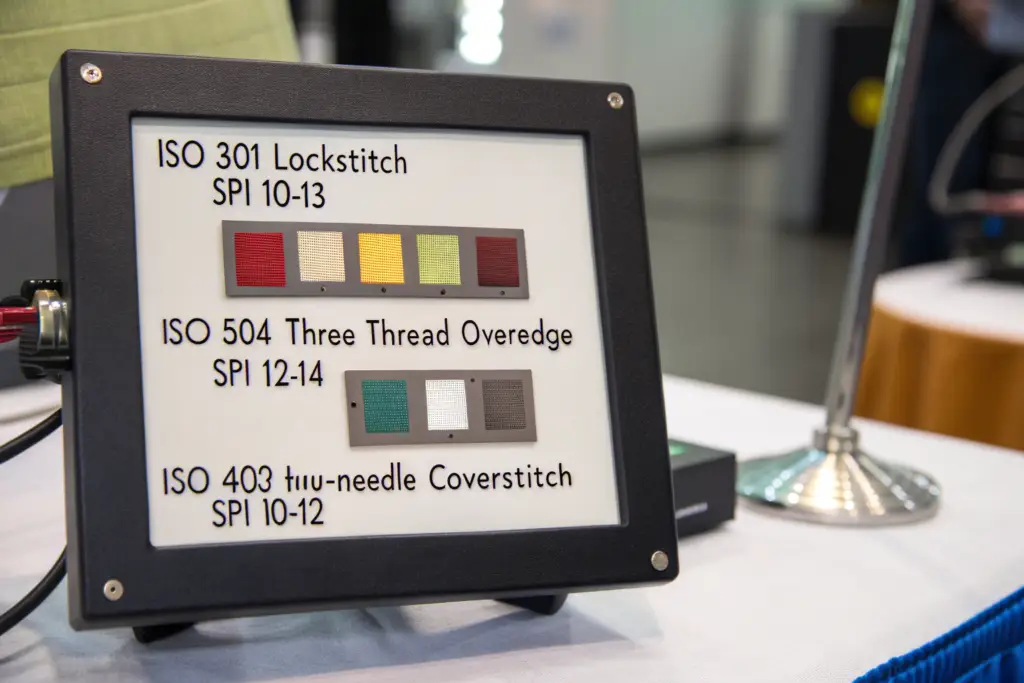
How Does a “Safety Stitch” (ISO 516) Differ Structurally From a Standard Overedge Stitch?
A standard overedge stitch (ISO 504) finishes the raw edge of a single layer of fabric. A safety stitch (ISO 516) combines a row of lockstitch seam joining with a simultaneous overedge finishing stitch, all in one operation. The lockstitch row provides the seam strength, and the overedge prevents fraying.
Why Does a Bar-Tack at the End of a Stress Seam Prevent a 2-Inch Rip?
A bar-tack is a dense, zigzag stitch, usually 1/2 inch long and 1/8 inch wide, placed perpendicularly across the end of a seam. It distributes the pulling force across a wider area, preventing the seam from unzipping from the endpoint.
What Does a Physical Bill of Materials (BOM) Specimen Page Reveal That a Written List Cannot?
A London-based premium knitwear brand specified “horn buttons” on their written BOM. The factory sourced a standard, dark brown resin button that was visually indistinguishable from horn on a computer screen. The brand approved the sample via low-resolution photos. The bulk order arrived with plastic buttons that split in half after two dry-cleaning cycles. The written words “horn buttons” had no physical, tactile, or destructive-test verification.
A physical Bill of Materials specimen page reveals what a written list cannot by providing a tangible, three-dimensional, and tactile reference for every single trim component, physically affixed to a single archival sheet with each specimen signed across onto the cardstock to create a tamper-proof reference, allowing both the factory’s purchasing department and the brand’s quality inspector to perform a direct physical comparison—including a destructive flame test on the thread and a pull-force test on the button—against the actual approved specimen before bulk production begins.
Words describe a component. A physical specimen is the component. No translation, no substitution, no misunderstanding is possible when the reference is a physical object stapled to a page.
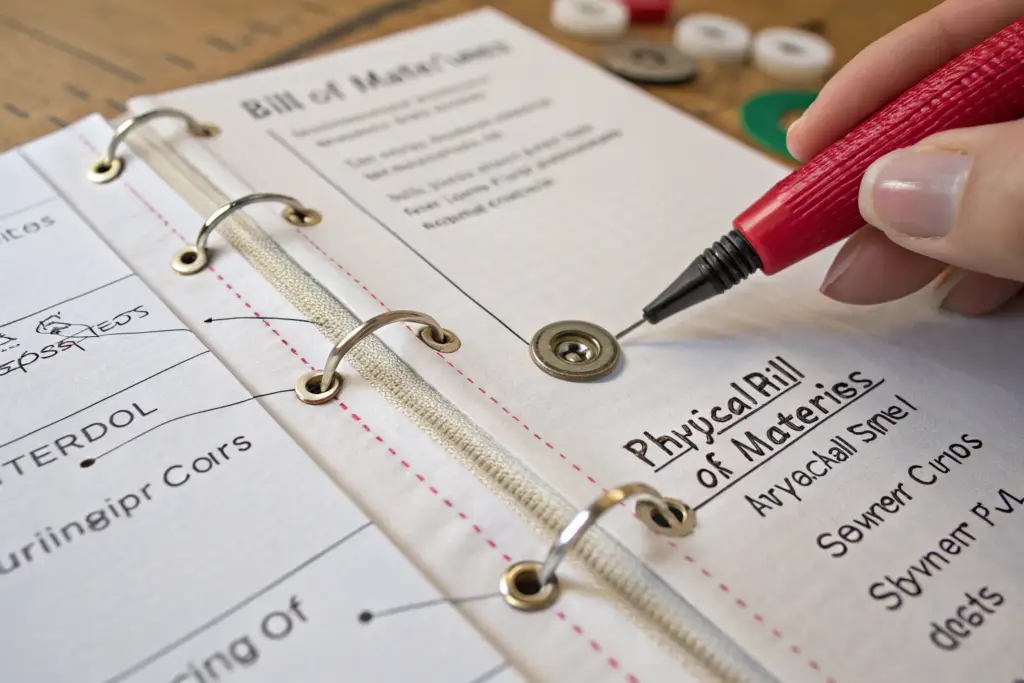
How Does a “Cross-Signed” Specimen Prevent the Factory’s Purchasing Department From Substituting a Cheaper Component?
The signature crosses the boundary between the specimen and the cardstock. If the factory purchasing manager replaces the approved horn button with a cheaper resin button, the new button will not have a signature line that perfectly matches the crossing line on the cardstock. The physical break in the signature is immediate, visible evidence of substitution.
What Destructive Tests Should the Brand Perform on the BOM Specimen Thread Before Approving It?
The brand should perform a flame test: cotton thread burns to soft grey ash, polyester thread melts into a hard black bead, nylon thread melts and shrinks away from the flame. The brand should also perform a tensile pull test using a simple spring scale to measure the force required to break the thread. If the thread snaps at 3 pounds of force and the garment will experience stress exceeding that, the thread is wrong for the application.
How Do You Specify Print and Embroidery Placement With Zero Margin for Factory Interpretation?
An Australian streetwear brand once sent a tech pack that specified “chest print, centered.” The factory screen-printed a massive, 14-inch wide graphic that filled the entire chest panel of the t-shirt. The brand had envisioned a small, 4-inch wide logo placed subtly over the left pectoral. The word “centered” had been interpreted by the factory’s print operator as centered on the garment’s entire chest area, not centered on a specific measurement from the neck seam.
To specify print and embroidery placement with zero margin for factory interpretation, the tech pack must include a dimensionally scaled technical flat sketch showing the garment outline, the exact rectangular or circular boundary of the print or embroidery with precise horizontal and vertical measurement callouts from a fixed, unmistakable reference point—the center front neck seam or the shoulder seam intersection—a stated maximum print dimension in inches or centimeters, and a physical Pantone color chip with the specific code number attached to the page for every color in the design.
“Centered” is a word. “4.5 inches below the center front neck seam, centered horizontally within a 3-inch wide print area” is an instruction that a print operator can execute exactly.
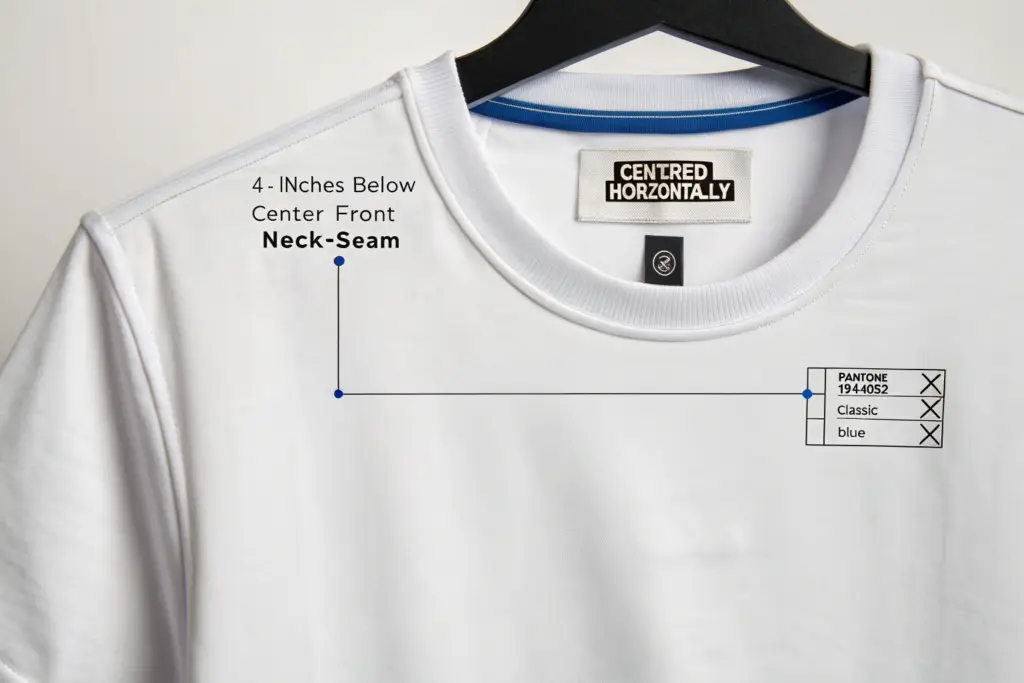
Why Must the Measurement Reference Point Be the “Center Front Neck Seam” and Not the “Collar”?
A collar is a separate piece of fabric that may shift slightly during construction. The center front neck seam intersection is a fixed, physical point on the garment body that does not move relative to the chest fabric. Measuring print placement from this fixed seam guarantees consistent placement across every unit.
How Does a “Digitized Embroidery File Number” on the Tech Pack Link the Approved Sample to the Production File?
An embroidery design, once approved, is saved as a specific digitized file on the embroidery machine’s computer. The tech pack should reference this exact file name, such as “LOGO_FUMEO_3IN_LEFTCHEST.DST.” This prevents the production team from accidentally loading an older, unapproved version of the logo file.
Conclusion
A perfectly detailed tech pack is the difference between a factory that executes your vision and a factory that guesses your vision. The fully graded measurement chart provides the mathematical target for the pattern maker. The ISO stitch type codes and SPI densities provide the structural engineering for the sewing mechanic. The physical BOM specimen page provides the un-substitutable material reference for the purchasing department. The dimensionally called-out print placement diagram provides the exact coordinates for the screen printer. Every ambiguous word removed from the tech pack and replaced with a number, a code, a specimen, or a coordinate reduces the probability of a costly manufacturing error.
At Shanghai Fumao, I do not accept tech packs that rely on vague descriptive language. My pre-production team reviews incoming tech packs and flags any missing dimension, missing stitch code, or missing physical trim specimen before a single pattern is drafted. This collaborative review process has prevented countless errors before they reached the cutting table.
If you are a brand buyer preparing a tech pack for a new collection and you want a manufacturing partner who will rigorously review your specifications for completeness before production begins, contact our Business Director, Elaine. She can send you our standard tech pack template, our BOM specimen page format, and our stitch construction reference guide. Reach Elaine at: elaine@fumaoclothing.com. Build the garment on paper first, and the factory will build it correctly in fabric.