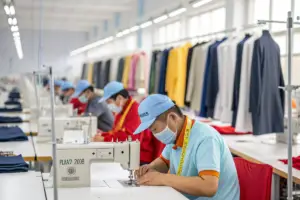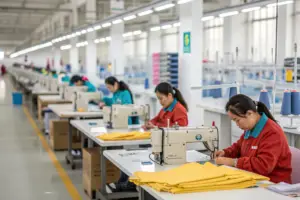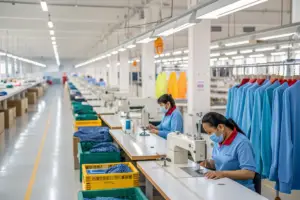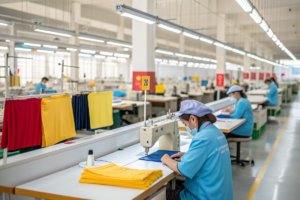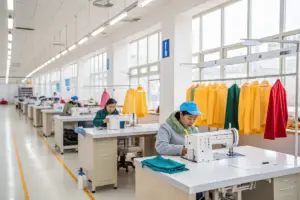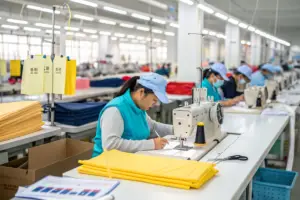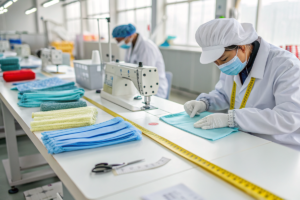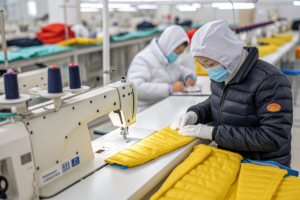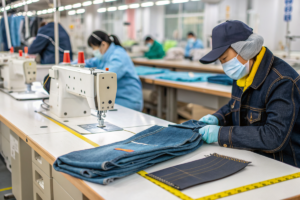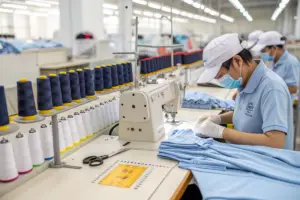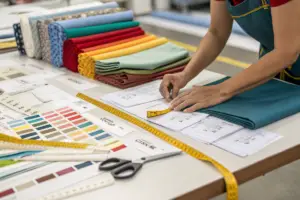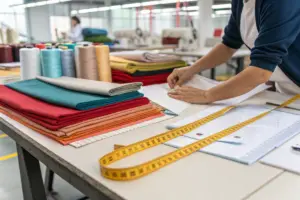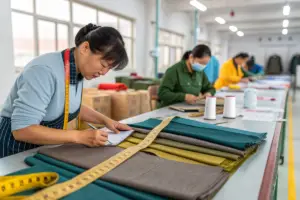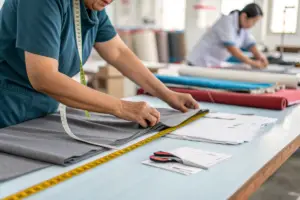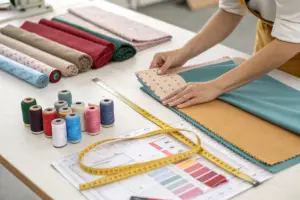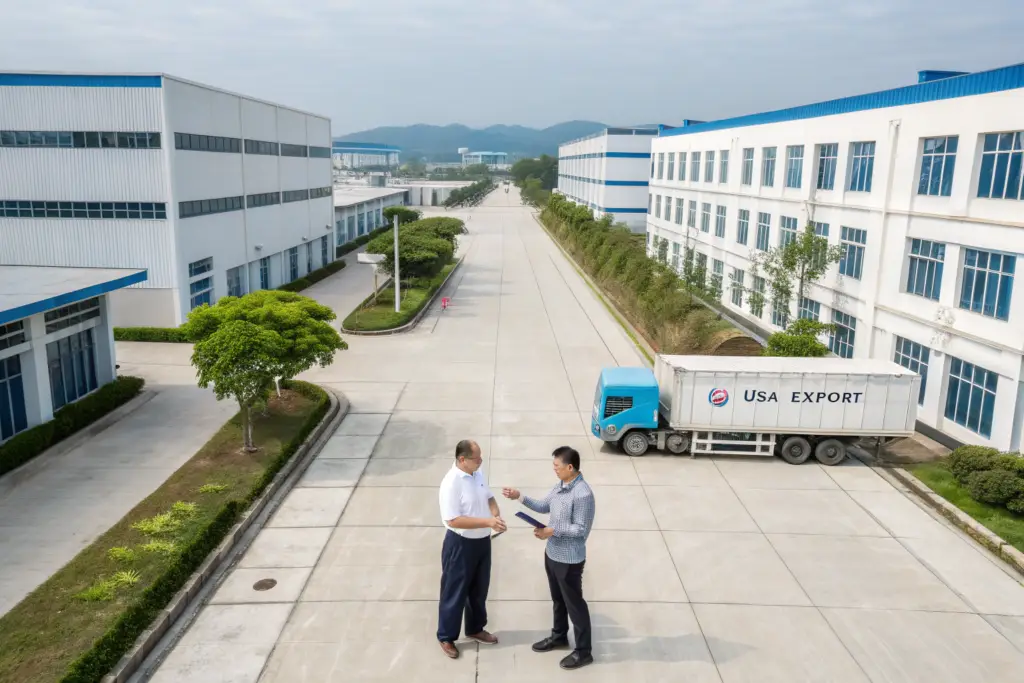
About eight years ago, a Los Angeles sportswear brand owner moved his entire production from a factory in a remote inland province to a partner factory in Zhejiang. He had been lured inland by promises of lower labor costs, but he discovered that the cheaper sewing labor was irrelevant when every shipment was delayed by five extra days of trucking to the Shanghai port, when the local dye houses couldn't match his seasonal Pantone colors, and when the specialized moisture-wicking fabric he needed simply wasn't available within the local supply chain. In Zhejiang, his freight transit to the port dropped from five days to three hours. The fabric mill that produced his performance jersey was a 45-minute drive away. The zipper factory that made his custom YKK pulls was in the next industrial park. His entire supply chain compressed geographically, and his time-to-market shrank by three weeks. His production moved to Zhejiang because the entire textile ecosystem is physically located there.
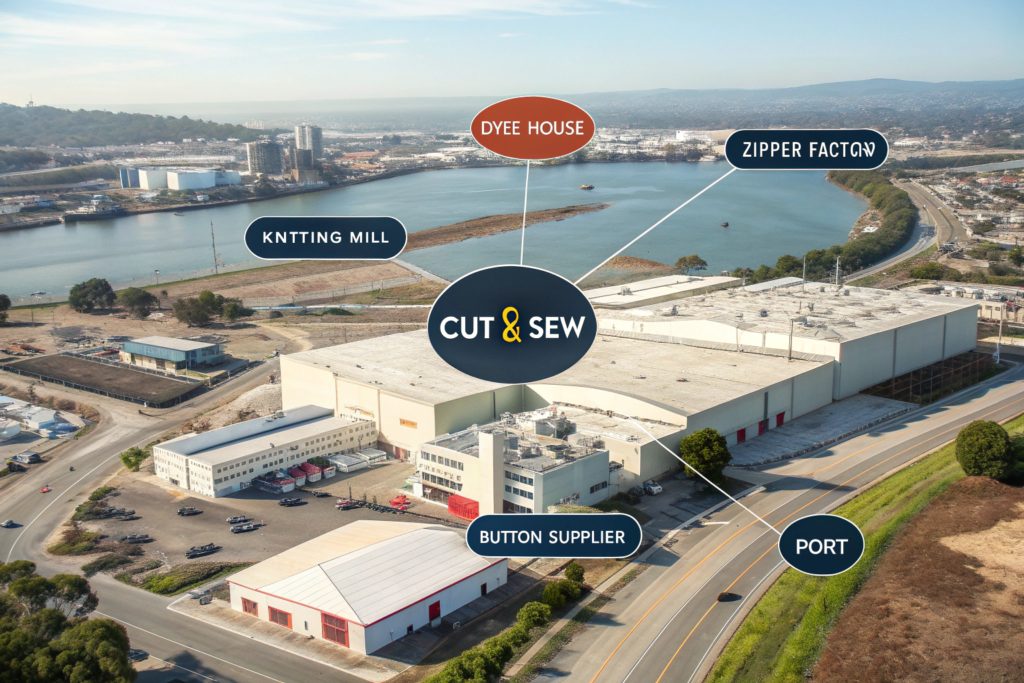
Zhejiang factories are the absolute top choice for American clothing buyers because this single province contains the densest, most vertically integrated textile and garment manufacturing ecosystem in the world, where a brand buyer can drive between the knitting mill, the dye house, the zipper factory, the button supplier, and the final cut-and-sew factory all within a 90-minute radius, eliminating the multi-province logistics fragmentation, communication delays, and quality-control blind spots that plague factories located in isolated, low-cost inland provinces with no local supply chain infrastructure.
At Shanghai Fumao, I chose to establish my five production lines in Zhejiang specifically because of this industrial density. My fabric mills, my dye house partners, my trim suppliers, and the Shanghai container port are all within a single concentrated geography that allows me to control the entire production timeline with a level of precision that a factory in a distant province simply cannot replicate.
How Does Zhejiang's Vertically Integrated Textile Ecosystem Eliminate the "Fragmented Supply Chain" Problem Entirely?
A Denver-based outdoor apparel brand once experienced a bizarre, infuriating delay with their previous factory, located in a distant western Chinese province. The factory had sewn 6,000 jackets perfectly, but they were waiting on a shipment of custom zippers from a supplier in Zhejiang, 1,200 miles away. The zipper truck was delayed by a snowstorm in the mountain passes. The entire finished jacket order sat in the factory warehouse, 95% complete, for eleven days, waiting on a single truck carrying zippers. The brand missed their retail delivery window, and the factory was powerless because the zipper supplier was in a completely different economic and geographic world.
Zhejiang's vertically integrated textile ecosystem eliminates the fragmented supply chain problem because every component of a garment—the yarn, the dyed fabric, the zippers, the buttons, the sewing thread, the labels, the polybags—is manufactured within the same province, often within the same industrial district, allowing a factory to source a critical missing component within hours via a short truck delivery, rather than waiting days or weeks for a cross-country shipment from a distant supplier over whom the factory has no direct operational control.
A factory is only as fast as its slowest supplier. If the supplier is a 45-minute drive away, the factory can send a driver to pick up the component personally. If the supplier is a two-day truck journey away, the factory is helpless.
How Does the Shaoxing Textile Market Enable Same-Day Fabric Sourcing for Rush Orders?
Shaoxing, located in Zhejiang province, is home to the China Textile City, one of the largest textile wholesale markets in the world. A factory in Zhejiang can send a fabric sourcing specialist to the Shaoxing market in the morning, physically touch and inspect hundreds of available greige and finished fabric rolls, purchase the required yardage, and have it delivered to the cutting table by the same evening. A factory in a distant province relies on mailed swatches and week-long freight.
Why Does Proximity to the Ningbo-Zhoushan and Shanghai Ports Reduce Export Transit Time by 5-7 Days?
Zhejiang factories are located between two of the world's busiest container ports: Shanghai to the north and Ningbo-Zhoushan to the east. A finished container can be loaded onto a truck and reach either port's container terminal within three to six hours. A factory in an inland province may require two to three full days of trucking, plus potential highway delays, just to reach the port.
What Specific Zhejiang Fabric Mill Specializations Produce the Exact Knits and Wovens American Buyers Demand?
A Miami-based resort wear brand once designed a collection that required a specific, high-end 16mm silk charmeuse for a line of premium caftans. Their factory in a different province sourced the silk from a distant mill with inconsistent quality. The fabric arrived with visible slub imperfections and an uneven sheen that ruined the luxurious drape. The brand switched to a Zhejiang factory that sourced silk from the specialized mills in Hangzhou, a region with a thousand-year history of silk weaving. The fabric quality transformed instantly.
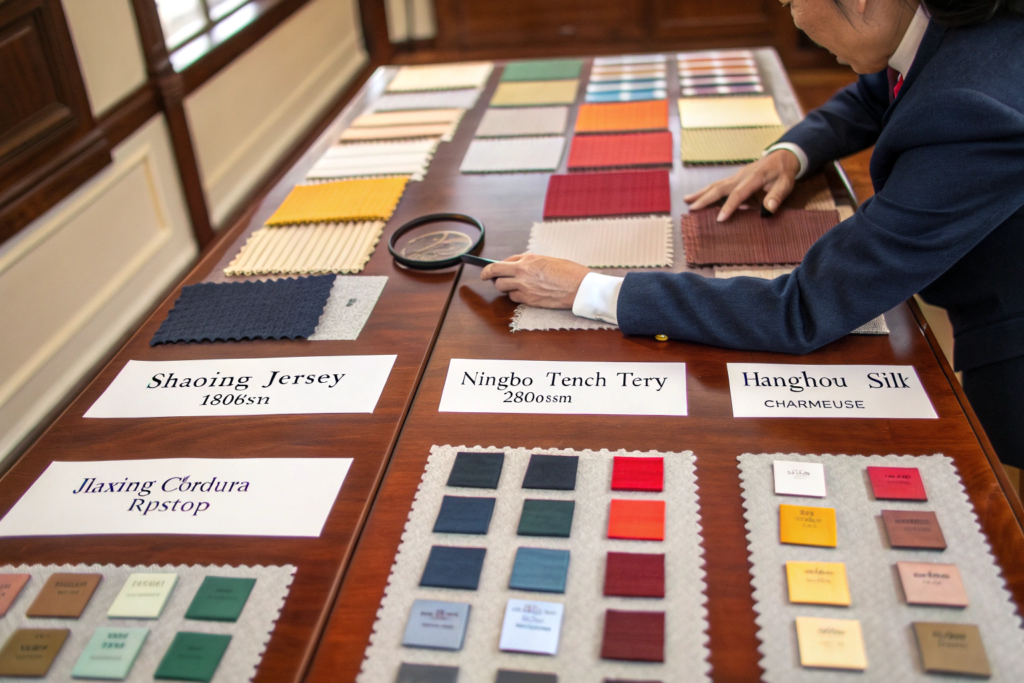
Zhejiang's specific fabric mill specializations directly meet American buyers' demands because the province hosts deeply specialized, multi-generational industrial clusters: Shaoxing for knitted cotton jersey and single-knit fabrics, Ningbo for heavyweight cotton fleece and French terry, Hangzhou for silk and high-end woven fabrics, Jiaxing for technical synthetics and Cordura-certified nylons, and Huzhou for children's wear-safe organic cotton and bamboo blends, allowing a Zhejiang-based factory to source each specific fabric type from the exact mill that has decades of specialized experience producing that exact quality.
Fabric quality is not generic. A mill that has specialized in cotton jersey knitting for thirty years produces a measurably superior fabric to a generalist mill that knits everything from polyester to linen on the same machines.
How Does the Ningbo Fleece Cluster Produce a 280gsm French Terry That Outperforms Generic Alternatives?
Ningbo mills have specialized in fleece and terry fabrics for the global sportswear market for decades. They use specific, fine-gauge circular knitting machines calibrated to produce a smooth, pill-resistant face and a dense, soft loopback interior. This specialized equipment and the generations of technician expertise produce a 280gsm French terry with superior dimensional stability and a softer hand feel than a generalist mill can achieve.
Why Is Hangzhou Silk Charmeuse Considered the Global Standard for Premium Woven Dresses and Blouses?
Hangzhou silk production combines traditional mulberry cultivation, controlled water quality from the local river systems for the degumming process, and multi-generational weaving expertise. The resulting 16mm and 19mm silk charmeuse has a depth of luster, a fluid drape, and a consistency of weave that global premium brands have relied on for centuries.
How Do Zhejiang Factories Handle Massive Peak Season Capacity Without Breaking Delivery Promises?
During the pre-Christmas peak season of 2023, a New York-based holiday gift brand's factory in a less-developed manufacturing region completely collapsed. The factory had overbooked its lines, the local power grid experienced rolling blackouts that halted production for hours each day, and the single, overwhelmed trucking company serving the area could not handle the volume surge. Shipments were delayed by four weeks. The brand lost their entire holiday window.
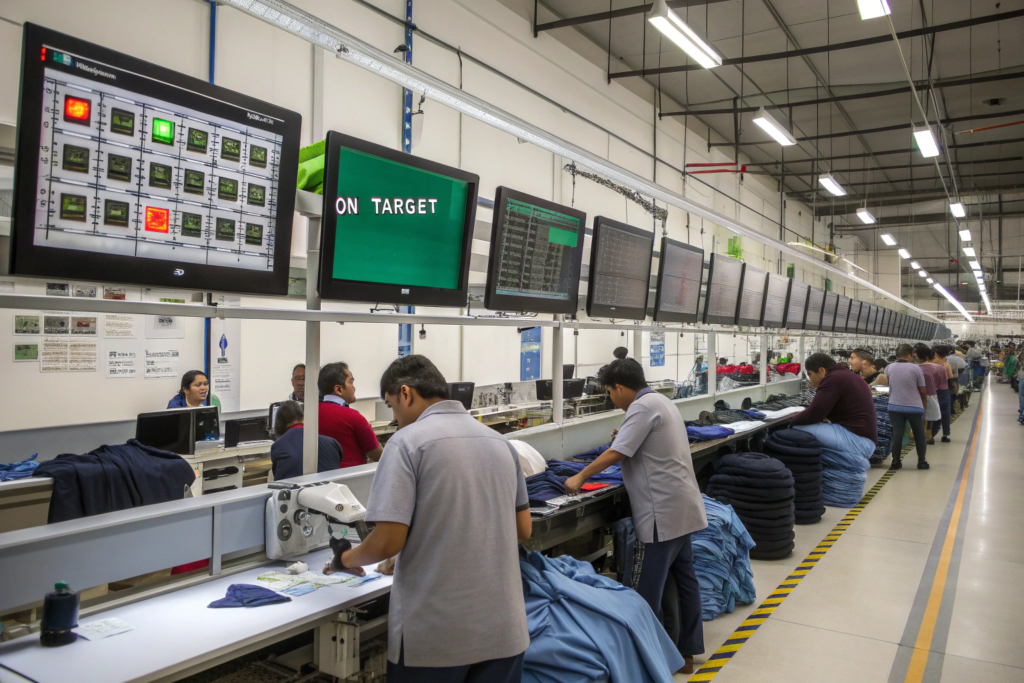
Zhejiang factories handle massive peak season capacity without breaking delivery promises because the province operates on a robust, triple-redundant infrastructure backbone: a modern, stable electrical grid with backup industrial generators at most factories, a dense network of hundreds of competing trucking and freight forwarding companies that can absorb a sudden volume spike without bottlenecking, and a massive, flexible labor pool of skilled sewing operators who migrate between factories within the same industrial zone to meet seasonal demand surges, allowing a factory to scale its workforce temporarily without sacrificing quality or missing a ship date.
Peak season breaks weak links in the chain. A stable electrical grid prevents blackout-driven machine stoppages. A dense logistics network prevents trucking monopolies. A deep labor pool prevents understaffing. Zhejiang has all three.
How Does the Zhejiang Electrical Grid's Industrial Reliability Differ From Less-Developed Manufacturing Regions?
Zhejiang's industrial zones are served by a modern, high-capacity power grid with fewer unplanned brownouts or rolling blackouts than more remote manufacturing regions. Many larger factories also have on-site diesel backup generators that can power the entire production floor if the main grid experiences an interruption.
Why Does a "Flexible Labor Pool" Within an Industrial Zone Allow a Factory to Scale From 80 to 120 Workers in a Week?
Zhejiang's manufacturing zones, such as those in the Haining or Tongxiang areas, contain dozens of garment factories within a short distance. Skilled sewing operators live in the surrounding communities. If a factory receives a sudden peak season order surge, the factory manager can recruit experienced operators from neighboring factories or from the local labor market, often adding 30-40 workers within a week.
What Is the Quantifiable "Zhejiang Quality Premium" That Justifies a Slightly Higher FOB Price?
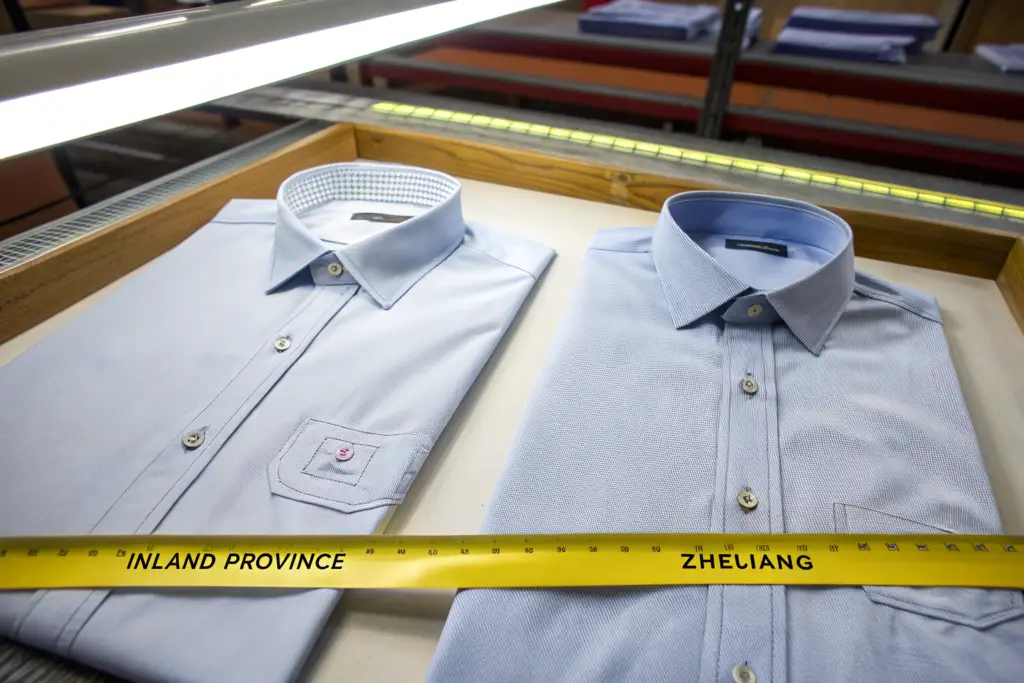
A Chicago-based menswear brand once compared two identical-spec button-down shirt samples: one from a Zhejiang factory, priced at an FOB of $8.20, and one from an inland province factory, priced at $7.50. The $0.70 difference seemed significant on a 5,000-unit order. But the inland sample had inconsistent stitch density, a collar interlining that bubbled after the first wash test, and buttonholes that were slightly undersized. The Zhejiang sample had ruler-straight topstitching at exactly 10 stitches per inch, a collar that lay perfectly flat after three wash tests, and buttonholes precisely sized to the button diameter.
The quantifiable Zhejiang quality premium that justifies a slightly higher FOB price is composed of three measurable factors: a consistently achieved stitch density within +/- 0.5 SPI of the specification rather than the generic industry +/- 2 SPI, a seam tensile strength that retains over 92% of the specified Newton force requirement due to higher-quality locally sourced sewing thread, and a defect rate of 1.5-3% at AQL 2.5 inspection compared to the 5-8% typical of less-specialized regions, which translates into a mathematically lower cost-per-sellable-unit when return shipping, chargeback fees, and brand reputation damage are factored into the true total cost.
The cheaper FOB price is a seductive headline number. The true cost is calculated after defective units are returned, chargeback fees are paid, and wholesale accounts are lost. The Zhejiang quality premium nearly always results in a lower total cost per successfully sold garment.
How Does a Consistently Achieved SPI of 10 +/- 0.5 Extend a Garment's Seam Life by 15-20 Wash Cycles?
Stitch density directly controls seam strength. A seam sewn at 9.5 SPI is 5% weaker than a seam sewn at 10 SPI. Over 50 wash cycles, the repeated mechanical stress of laundering causes the weaker seam to fail sooner. The tighter tolerance maintained by Zhejiang factories translates directly into a measurably longer garment lifespan.
What Is the "Return Shipping and Chargeback" Calculation That Reveals the True Cost of an Inland Factory's 5% Higher Defect Rate?
Assume a 5,000-unit order. A 3% defect rate equals 150 defective units. A 8% defect rate equals 400 defective units. The 250 additional defective units generate 250 chargeback fees at $15 each ($3,750) and require 250 return shipping labels at $8 each ($2,000). The $5,750 in additional post-sale costs far exceed the $0.70 per-unit FOB savings across 5,000 units ($3,500).
Conclusion
American clothing buyers choose Zhejiang factories not because of a vague reputation, but because of a specific, measurable set of structural advantages. The province's vertically integrated textile ecosystem compresses the entire supply chain into a 90-minute driving radius, eliminating the multi-province logistics delays that cripple inland factories. Its specialized regional mills—Shaoxing for jersey, Ningbo for fleece, Hangzhou for silk—produce fabric qualities that are globally competitive and deeply consistent. Its modern electrical grid, dense logistics network, and deep labor pool allow factories to absorb peak season demand surges without breaking delivery promises. And its consistent quality, measured in tighter SPI tolerances and lower defect rates, produces a lower true cost per sellable unit, even at a slightly higher headline FOB price.
At Shanghai Fumao, my factory is embedded in this Zhejiang ecosystem. My fabric mills are in Shaoxing and Ningbo. My dye house is 40 minutes away. My trim suppliers are in the adjacent industrial park. The Shanghai port is three hours from my loading dock. This geographic concentration is not a convenience; it is a competitive weapon that delivers shorter lead times, more consistent quality, and a higher probability of on-time delivery.
If you are an American brand buyer evaluating your current supply chain and wondering whether the geographic location of your factory matters to your bottom line, I invite you to study the Zhejiang difference directly. Contact my Business Director, Elaine. She can walk you through a map of our supplier network, show you our specific mill partnerships in Shaoxing and Ningbo, and explain how our location in Zhejiang translates into a measurably faster, more reliable production timeline for your brand. Reach Elaine at: elaine@fumaoclothing.com. Source from the province where the entire textile supply chain lives.