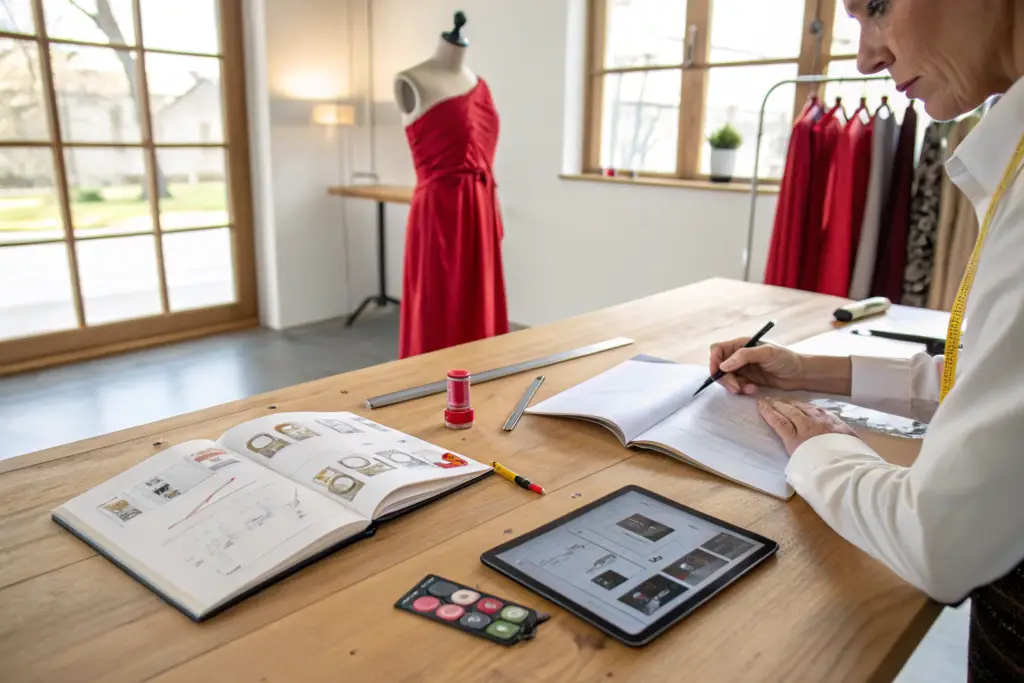
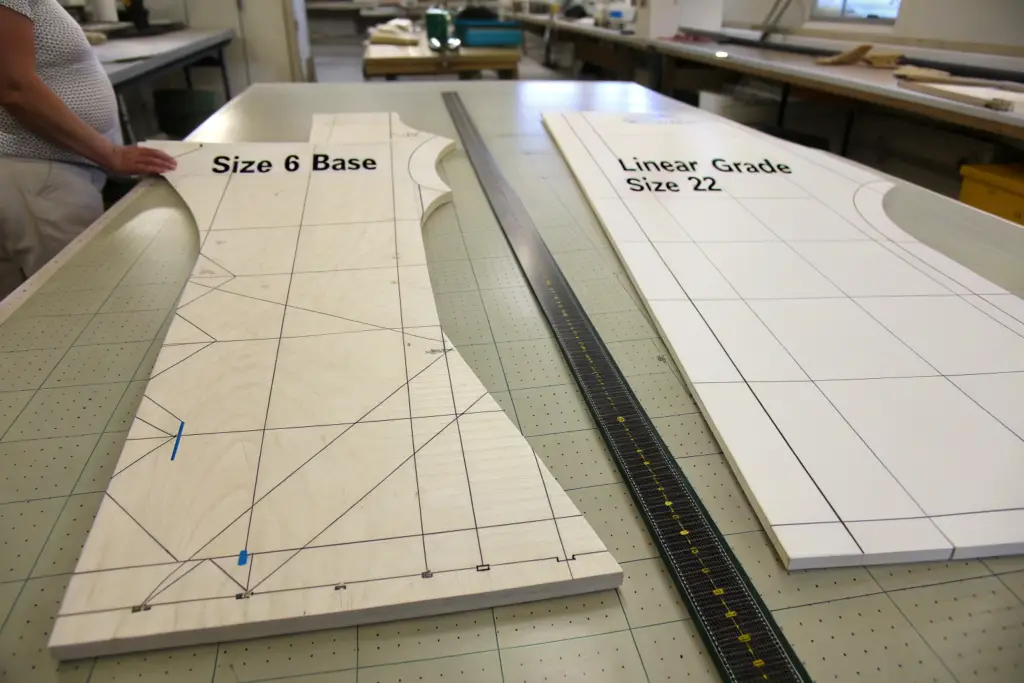
Three years ago, a Portland-based contemporary brand launched a "curve" collection that was supposed to be their breakthrough into the plus-size market. They had beautiful marketing, inclusive campaign imagery, and significant social media buzz. Within six weeks of launch, the return rate on the curve line hit 41%. The reason was brutal and consistent across hundreds of customer reviews: the armholes were too tight, the bust darts sat three inches too high, the waistband on the trousers gaped open at the back, and the sleeve cuffs cut into the upper arm like a tourniquet. The brand had not designed for plus-size bodies. They had simply taken their standard size 6 pattern block and mathematically scaled it up using a linear grade rule designed for straight sizes. The result was a collection that fit no one.
To design inclusive sizing for plus-size collections, you must abandon linear grade scaling and build a dedicated, body-specific "Plus-Size Base Block" from scratch, drafted on a size 18 or 20 fit model with a full bust, full upper arm, rounded abdomen, and defined waist-to-hip curve, incorporating specific pattern adjustments including a raised armhole depth, forward-rotated shoulder seam, bust darts with a 30-degree apex angle minimum, and a contoured back-rise curve on trousers that prevents the universal "waist gap" complaint that destroys plus-size sell-through.
At Shanghai Fumao, I do not allow my pattern-making team to grade a size 6 block up to a size 24. The plus-size block is a separate, independently developed, and independently fit-tested pattern foundation, because the mathematics of the plus-size body are not a proportional enlargement of a straight-size body.
Why Does Linear Grade Scaling From a Size 6 Block Absolutely Destroy Plus-Size Fit?
A Denver-based activewear brand's technical designer once showed me their plus-size grading spec sheet during a factory visit. The grade rules were identical from size 2 through size 26. The chest increased by 2 inches per size. The armhole depth increased by 0.5 inches per size. The shoulder width increased by 0.375 inches per size. The math was neat, even, and completely wrong. A size 6 woman and a size 22 woman do not increase in shoulder width at the same linear rate, because the skeletal frame does not expand proportionally with soft tissue. The size 22 woman's shoulder width is closer to the size 6 woman's than to the size 18 woman's the linear grade predicted. The result was that the size 22 jacket had shoulder seams that drooped two inches off the natural shoulder point.
Linear grade scaling from a size 6 block destroys plus-size fit because standard grading assumes that all body measurements increase at a constant, proportional rate from the base size, but the plus-size body does not grow proportionally from a straight-size frame—the shoulder width increases minimally beyond a size 14, while the bust circumference, upper arm circumference, and hip depth continue to increase significantly, creating a non-linear shape that requires a completely different geometric pattern architecture rather than a stretched version of a smaller block.
The plus-size body has a fundamentally different architecture from the straight-size body. The pattern must reflect this architectural difference from the foundation block upward.
What Specific Pattern Measurement Deviations Reveal a "Stretched 6" Versus a "True Plus Block"?
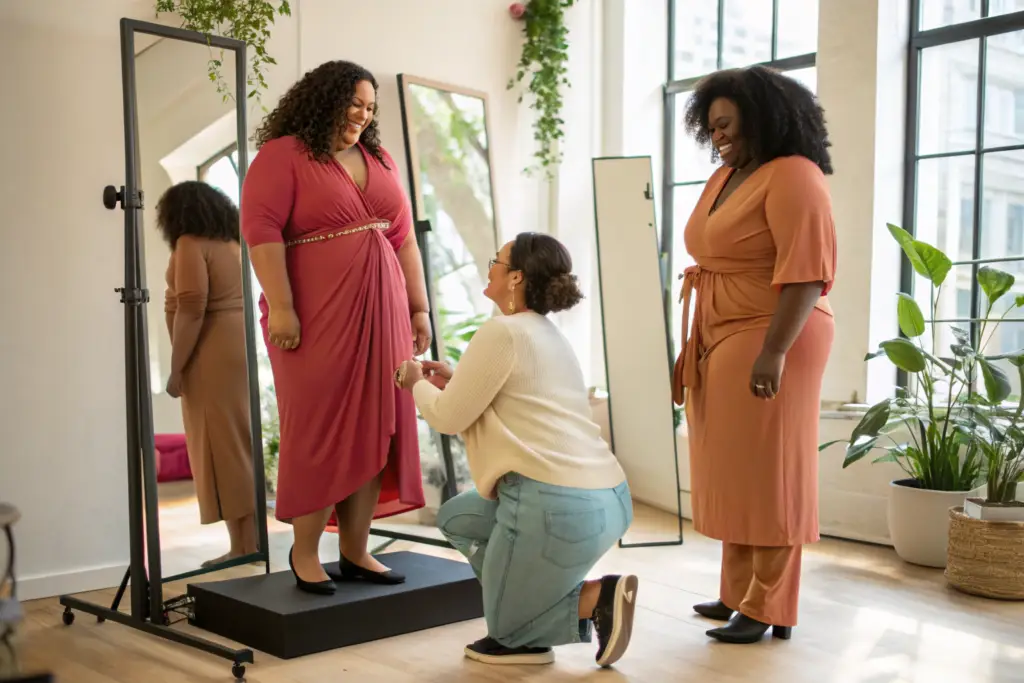
A true plus-size block can be identified by three key measurements. First, the shoulder seam length on a size 22 true plus block is typically only 0.5-0.75 inches longer than a size 14, whereas a linear grade would add 1.5 inches. Second, the armhole depth on a true plus block is raised by 0.5-0.75 inches relative to the linear grade prediction, because plus-size arms do not hang proportionally lower. Third, the bust dart apex on a true plus block sits at least 1.5 inches lower and is angled outward at a wider degree to accommodate a fuller bust projection.
How Does a "Forward-Rotated Shoulder Seam" Correction Prevent the Collar-Gaping Problem?
Many plus-size women have a slightly more forward-set shoulder posture due to the weight of the bust pulling the shoulder girdle forward. A pattern cut for a neutral, upright standard posture will gape open at the back neck and pull tight across the front shoulder. A true plus block rotates the shoulder seam forward by 1.5 to 2 degrees, moving the neck point slightly forward and the shoulder point slightly forward, so the garment hangs perpendicular to the actual shoulder slope.
What Is a "Dedicated Plus-Size Fit Model" and How Does She Transform a Pattern's Commercial Success?
A London-based premium womenswear brand once made a catastrophic financial decision disguised as a cost-saving measure. Instead of hiring a true size 20 fit model for their plus-size collection, they used a size 14 fit model and simply "imagined" how the fit would scale up. The technical designer made mathematical assumptions about bust projection and arm circumference. The factory executed the spec sheet perfectly. When the plus-size collection launched, the dresses didn't fit any of the brand's actual plus-size customers, because the brand had never seen the clothes on a plus-size body before approving bulk production.
A dedicated plus-size fit model transforms a pattern's commercial success because she provides a living, breathing, three-dimensional reference body that reveals the specific, unmathematical fit issues that a 2D spec sheet or a 3D avatar cannot predict—the way the fabric drags across a full bust during arm movement, the specific gravity of a rounded abdomen pulling the front hem upward, and the exact pressure point where an elastic waistband creates discomfort during seated posture—allowing the technical designer to correct these issues before a single production unit is cut.
A fit model is not an expense line item. She is a diagnostic instrument more precise than any digital simulation. A plus-size fit model is a specific human being with a specific bust circumference, arm circumference, and torso length, not a "general size 20."
What Specific Fit Issues Does a Live Fit Model Reveal That a 3D Avatar Cannot Simulate?
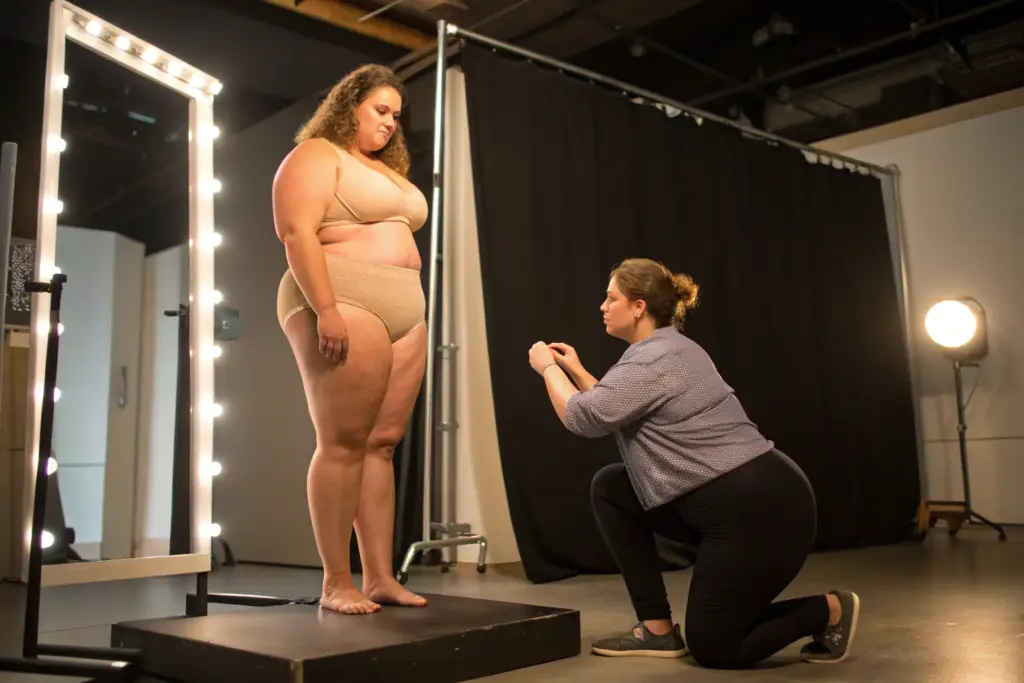
A 3D avatar can show fabric drape and basic tension maps. It cannot simulate the soft tissue compression that occurs when a full upper arm presses against the torso, creating a fabric drag line that only appears during live movement. It cannot simulate the waistband digging into a seated abdomen. A live fit model, asked to sit in a chair for five minutes, then stand and walk, reveals these dynamic fit failures immediately.
How Should a Brand Select a Fit Model Whose Measurements Truly Represent Their Target Plus-Size Customer?
The fit model should not be a fashion model. She should represent the brand's actual target customer demographics in bust, waist, hip, and upper arm circumference. For a US plus-size collection targeting the 18-24 size range, the fit model should ideally measure a true size 20 in bust, waist, and hip, with an upper arm circumference of 15-17 inches. The fit model's body shape—whether she carries weight in her abdomen, hips, or evenly distributed—should match the brand's target customer avatar.
How Do You Structurally Engineer an Armhole and Sleeve That Actually Fits a Full Upper Arm?
A Chicago-based premium knitwear brand received consistent, devastating feedback on their plus-size line: "The sweater is beautiful, but I can't bend my elbow." The sleeve design, graded proportionally from a size 6 block, had produced a size 22 sleeve with a bicep circumference that was technically wider but with an armhole that had grown disproportionately deep and wide in the wrong direction. The sleeve cap height had been shortened in the linear grade, reducing the range of motion. The armhole was gigantic and gaping, yet the sleeve still bound at the elbow.
To structurally engineer an armhole and sleeve for a full upper arm, the pattern must use a "Two-Piece Sleeve" construction with a curved outer seam that mimics the arm's natural forward bend, an armhole depth that is only fractionally lowered from the size 14 measurement, and a bicep circumference that is widened specifically at the back of the sleeve cap rather than evenly distributed, providing the necessary fabric volume where the triceps and upper arm soft tissue are concentrated without creating excess fabric under the armpit.
The upper arm is not a cylinder. It is a teardrop shape, wider at the back near the triceps and narrower at the front near the bicep muscle. The sleeve pattern must be drafted with this asymmetrical cross-section.
Why Does a Two-Piece Sleeve Provide Dramatically More Arm Mobility Than a One-Piece Sleeve?
A one-piece sleeve is a flat tube. A two-piece sleeve has a vertical seam running along the outside of the arm, curving forward at the elbow. This seam can be shaped to match the arm's natural forward postural curve, providing more room for the elbow joint to flex without the fabric pulling across the forearm.
How Does a "Bicep Dart" Release Tension at the Fullest Point of the Upper Arm?
In a woven sleeve, inserting a small, 1.5cm dart at the bicep line on the back sleeve pattern piece creates a subtle dome shape that accommodates the convexity of a fuller triceps without requiring the entire sleeve circumference to be widened. This dart is invisible from the front view and eliminates the horizontal pull lines that signal an over-stretched fabric.
Why Do Plus-Size Trousers Need a Fundamentally Different Back-Rise Curve and Waistband Construction?
A San Diego resort wear brand's plus-size linen trousers were returned at an astonishing 35% rate, with the primary complaint being "the waistband gaps open at the back when I sit down." The trousers had been graded from a size 8 block with a flat back-rise curve designed for a relatively flat seat and a small waist-to-hip differential. The plus-size body typically has a significantly deeper curve from the waist to the fullest point of the seat, requiring a much longer and more curved back-rise seam to sit flush against the body.
Plus-size trousers need a fundamentally different back-rise curve that extends 3-5cm longer than a linearly graded curve at the center back seam, with a deeper "J" shaped contour that wraps around a fuller seat, combined with a contoured, two-piece curved waistband that is cut on the bias or with a slight stretch interlining, which physically conforms to the natural inward slope of the plus-size waist relative to the hip, eliminating the rigid, straight waistband gap that forces many plus-size women to size up and then tailor the waist.
The waist-to-hip differential in a plus-size body is often a pronounced curve, not a gentle slope. A straight, single-piece waistband is a rigid hoop. A curved, two-piece waistband is a conforming band.
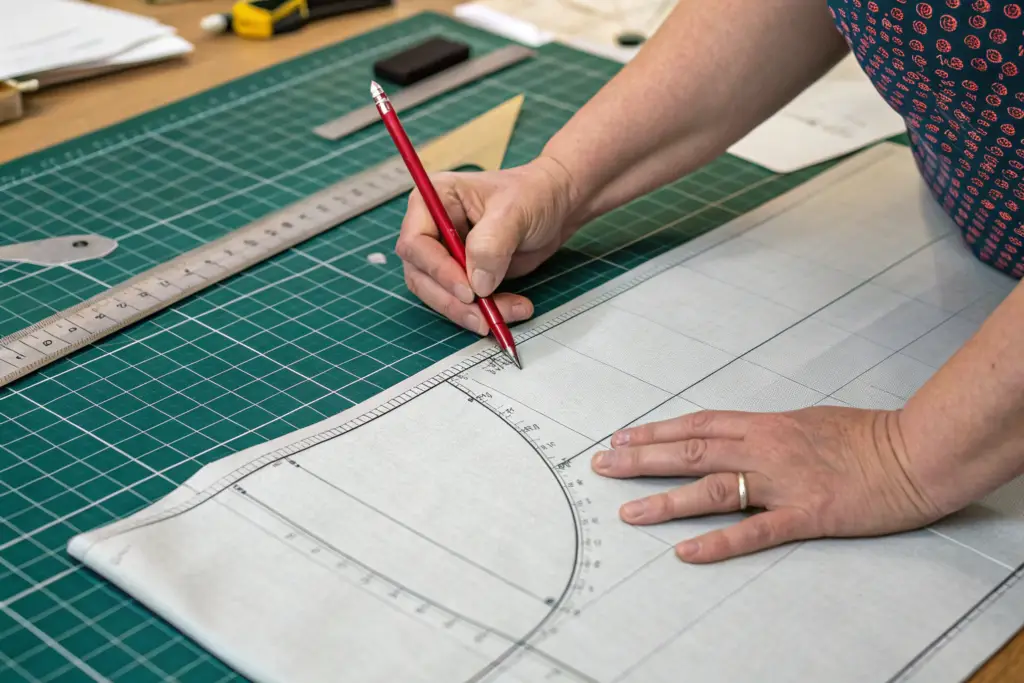
How Does a "Fisheye Dart" at the Center Back Waist Eliminate the Universal Waist Gap?
A fisheye dart is a long, tapered vertical dart placed at the center back of the trouser waistband, removing a lens-shaped wedge of fabric. This dart narrows the waistband opening at the very top edge while leaving the seat curve below it full and roomy. It closes the gap without pulling the seat seams tight.
Why Should a Plus-Size Trouser Fly Front Be Extended Lower to Prevent Gaping?
The natural waistline on a plus-size body often sits at a different vertical level, and the abdomen's convex curve pushes the trouser front away from the body just below the waist. Extending the fly front closure by 2-3cm lower allows the trousers to open wider when stepping in, and then close securely with the fabric lying flat against the lower abdomen.
Conclusion
Inclusive sizing is not a marketing strategy. It is a pattern-making discipline. The plus-size woman's body is not a mathematically enlarged version of a straight-size woman's body. It has its own specific skeletal frame proportions, its own soft tissue distribution, its own postural characteristics, and its own fit requirements. The armhole must be raised and the sleeve cap reconfigured for a full bicep. The trouser back-rise must be extended and contoured for a fuller seat. The bust dart must be deepened and angled for a fuller bust. The waistband must be curved, not straight. The shoulder seam must be rotated forward. A pattern that begins as a size 6 and is simply scaled up to a size 22 will fail on a real plus-size body every single time.
At Shanghai Fumao, I have invested in dedicated plus-size blocks, relationships with experienced plus-size fit models, and a pattern-making team that understands the geometry of the full-figure body from the foundational block upward. We do not "grade up" a straight-size sample. We draft a true plus-size foundation, fit it on a true plus-size body, and then grade outward.
If you are developing a plus-size collection and you are serious about a sub-15% return rate, you need a manufacturing partner whose pattern room speaks this specific technical language. Contact my Business Director, Elaine. She can share our plus-size block specifications, our fit model measurement profiles, and our specific pattern adjustments for the armhole, sleeve, and trouser rise. Reach Elaine at: elaine@fumaoclothing.com. Design for the body that will wear your clothes, not the body you wish were wearing them.