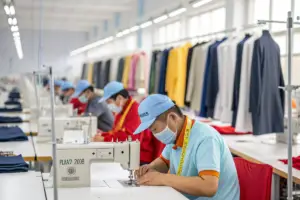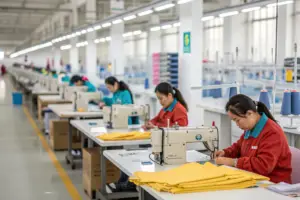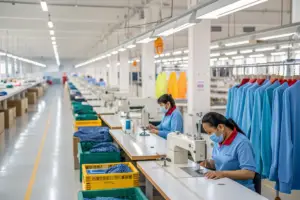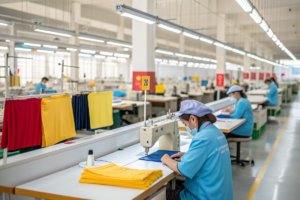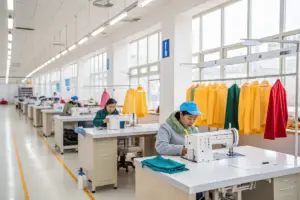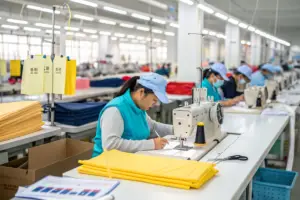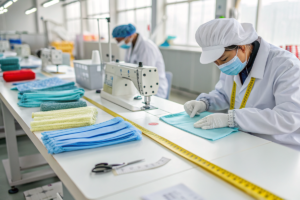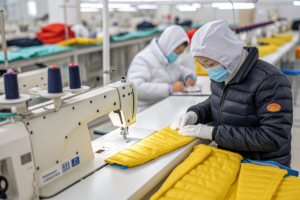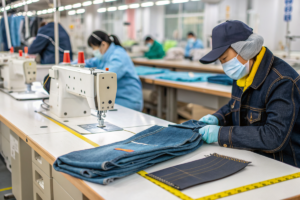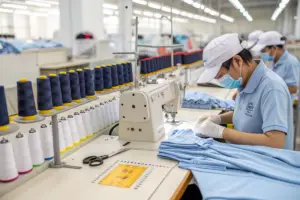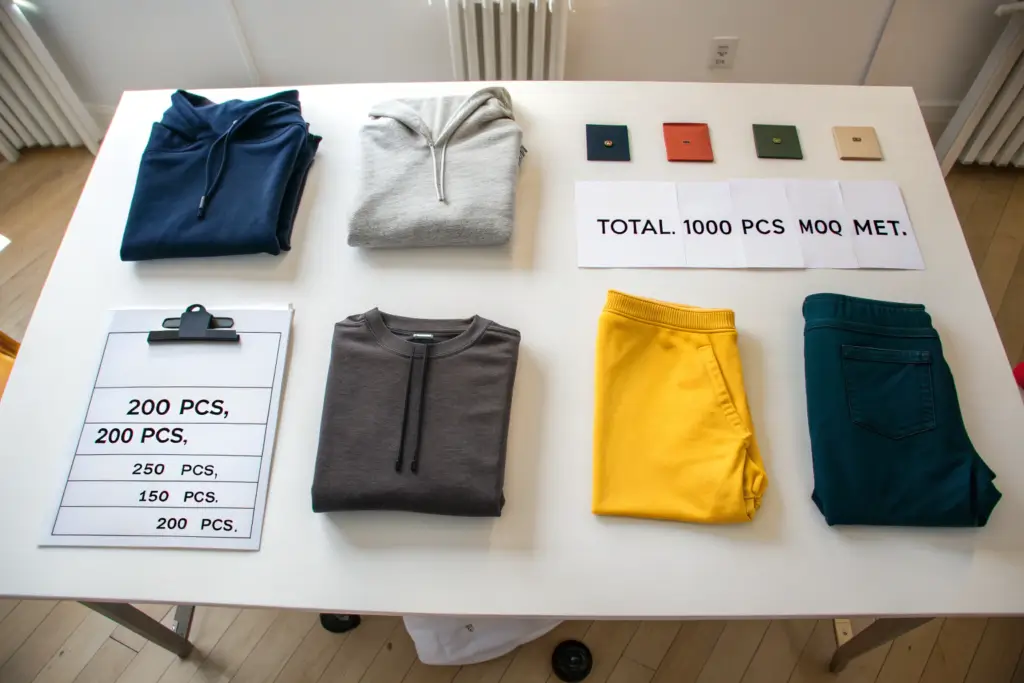
A Miami-based streetwear startup founder once called me in a quiet panic. She had designed a debut collection of six styles—two graphic tees, a hoodie, a crewneck, a pair of sweatpants, and a long-sleeve tee—and every single factory she contacted demanded a 1,000-piece minimum order quantity per style. She needed 6,000 pieces total, a $90,000 production commitment that her cash flow could not support. She was ready to abandon half her collection. Then she found a factory that understood something most factories don't: an MOQ is a production line commitment, not a single-style mandate. A smart factory can split a 1,000-piece total order across multiple styles that share the same base fabric, the same sewing operations, and the same trim package, turning a restrictive minimum into a flexible, collection-launching production strategy.
To easily split a 1,000-piece wholesale MOQ across multiple garment styles, you must group your styles into a "Shared Fabric Platform" where all garments are cut from the exact same base fabric quality, weight, and composition, then negotiate a "Style Mix MOQ" agreement where the factory commits to the total 1,000-piece volume across up to four or five style variations, with a minimum per-style quantity of 150-200 pieces to cover the cutting table setup and screen-printing screen costs, and a small per-style surcharge of $0.80-$1.50 to compensate the factory for the additional pattern-making and line changeover labor.
At Shanghai Fumao, I actively encourage emerging brands to split their MOQ across styles because I understand that a new label cannot sell 1,000 units of a single hoodie design. A collection needs variety, and a factory's MOQ policy should enable that variety, not kill it.
A Berlin-based minimalist streetwear brand once tried to split their MOQ across a hoodie, a crewneck, and a pair of joggers. The factory refused because the brand had specified three different fabric compositions: a 400gsm organic cotton fleece for the hoodie, a 320gsm recycled polyester fleece for the crewneck, and a 280gsm cotton-polyester terry for the joggers. The factory would have had to source, inventory, and cut three entirely different fabric rolls, tripling the raw material procurement complexity. The split was refused not because of the style count, but because of the fabric count.
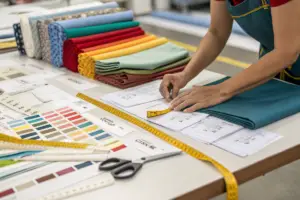
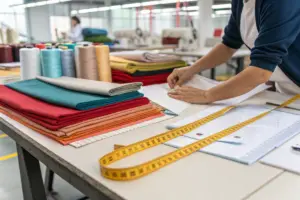
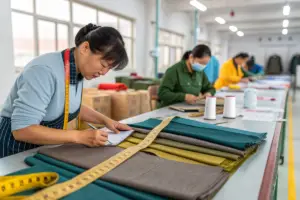
A Shared Fabric Platform instantly unlocks a split MOQ agreement because it allows the factory to purchase a single, large-volume fabric roll at a lower per-yard bulk price, lay all the pattern pieces for all the split styles onto a single, efficient cutting marker that minimizes fabric waste, and run the entire order through the same dye lot ensuring perfect color consistency across every style, transforming what would be three separate, small-batch production headaches into one streamlined, large-batch production run.
The factory's resistance to splitting MOQ is fundamentally about fabric procurement complexity. A single fabric quality, purchased in a single large roll, simplifies every downstream operation.
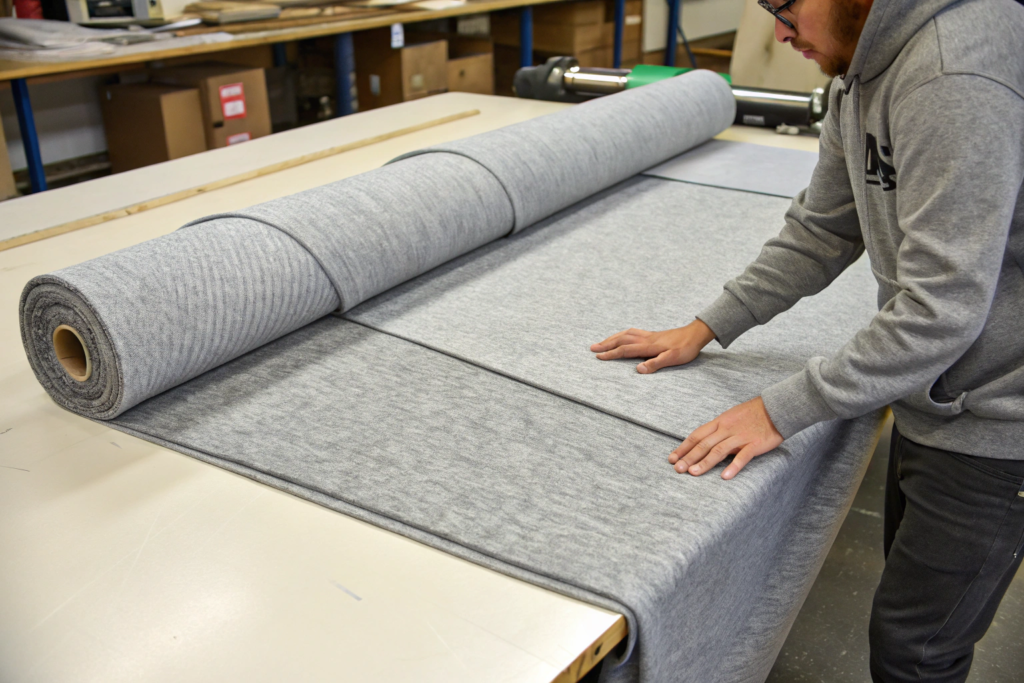
How Does a Single Cutting Marker Containing Multiple Style Panels Reduce Fabric Waste Below 8%?
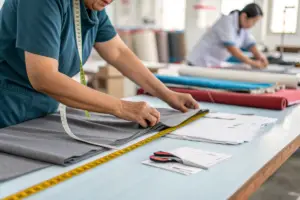
When cutting a single style in small quantities, the awkward spaces between pattern pieces generate significant fabric waste. When multiple styles are combined into a single, larger marker, the pattern pieces can be interlocked more efficiently, filling the gaps between a hoodie body with a jogger leg panel. The fabric utilization rate improves, and the factory's raw material cost per unit decreases.
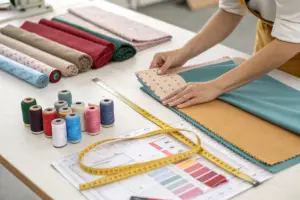
The ideal shared platform fabrics are mid-weight, versatile basics: 280-320gsm cotton-polyester fleece for sweatshirts, hoodies, and joggers; 180-200gsm combed cotton jersey for t-shirts, tank tops, and long-sleeve tees; 220-260gsm cotton interlock for polos, dresses, and lightweight shorts. A collection built on a single core fabric quality is a manufacturing dream.
What Is a "Style Mix MOQ" Clause and How Do You Negotiate It Without Paying Massive Premiums?
A Toronto-based athleisure brand once received a quote from a factory that effectively penalized small quantities per style with a 35% surcharge. The hoodie at 300 pieces was quoted at $18.50 per unit. The identical hoodie at 1,000 pieces was quoted at $12.80. The brand assumed they could not afford to split MOQ. They didn't realize the surcharge was a negotiation starting point, not a fixed penalty. A transparent conversation about the factory's actual additional costs—the extra pattern-making hour, the extra cutting table setup, the extra screen-printing screen burn—revealed that the true cost of splitting was approximately $1.00 per unit, not $5.70.
A Style Mix MOQ clause is a negotiated agreement within the purchase contract that explicitly states the factory accepts a total order volume of 1,000 pieces split across a defined list of up to five styles, with a minimum per-style quantity of 150 pieces, a maximum per-style quantity of 350 pieces, and a transparently itemized "Small-Batch Surcharge" of $0.80-$1.50 per unit that covers the actual incremental costs of the additional pattern adjustments, cutting table setups, and screen printing screen burns, not an arbitrary penalty disguised as a minimum order enforcement.
The surcharge is not a punishment. It is a reimbursement for real, additional labor. The pattern maker spends one extra hour adjusting the crewneck neckline. The cutting table is reset once. The screen printer burns one extra screen. These costs are real but small.
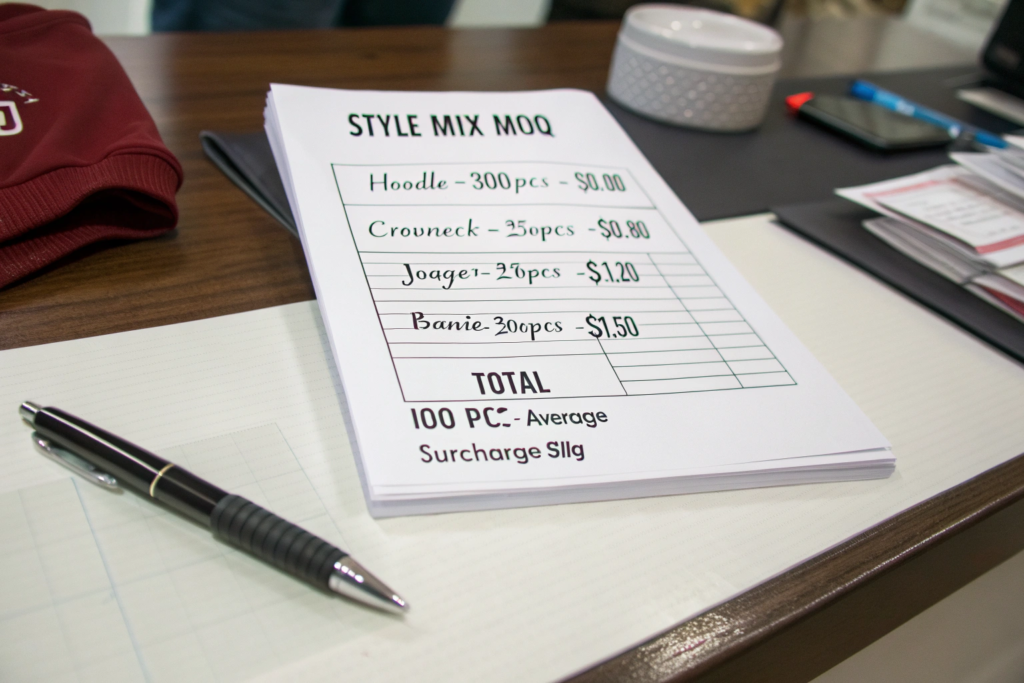
How Does a "150-Piece Minimum Per Style" Threshold Cover the Cutting Table Setup Cost?
Cutting a single garment style requires the cutting master to lay out the fabric, position the marker paper, and calibrate the cutting machine. This setup takes approximately 30-45 minutes. If only 50 pieces are cut, the setup cost is amortized over too few units. At 150 pieces, the setup cost per unit drops to an acceptable level. This is the mathematical floor.
What Is the Exact Cost Breakdown of a "Small-Batch Surcharge" That the Brand Should Agree to Pay?
The surcharge should cover: the additional pattern-making labor for the extra style, typically $40-$60 for a simple adjustment; the additional cutting table setup labor, typically $30-$50; the additional screen-printing screen burn, typically $25-$40 per color per screen; and the additional sewing line changeover time, typically 20-30 minutes of idle operator labor. For a 200-piece sub-batch, these costs translate to approximately $0.80-$1.50 per garment.
How Do You Group Printing and Embroidery Techniques Across Styles to Avoid Doubling Setup Costs?
A Los Angeles streetwear brand once designed a collection where the hoodie had a large back print, the t-shirt had a small left-chest print, and the crewneck had a woven label. Each style required a completely different decoration setup. The factory quoted three separate screen-printing screen setup fees at $45 per screen, plus a woven label digitization fee. The brand's split MOQ order carried a $200 decoration setup cost alone, eating into their margin.
To group printing and embroidery techniques across styles and avoid doubling setup costs, the brand must design the collection with a unified "Decoration Platform" where the same screen-printed logo at the same size is used on the chest of the t-shirt, the hoodie, and the crewneck, meaning the screen printer burns one screen at a one-time setup cost of $45 and then runs it across all three styles, the total impression count reaching 700 prints across the combined volume, turning multiple small, unprofitable print runs into a single, efficient, bulk print job.
A screen-printing screen is a fixed-cost asset. Burning one screen for 200 prints costs $0.23 per print in setup amortization. Burning that same screen for 700 prints costs $0.06 per print. The cost per print drops by 74% when the same screen is used across multiple styles.
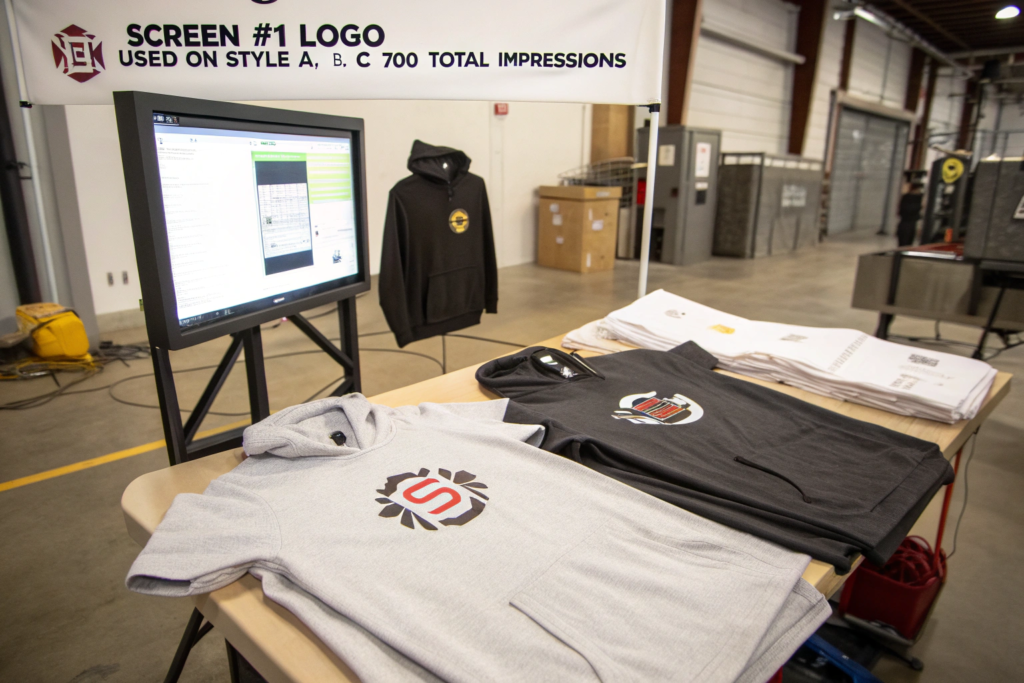
How Does a "Unified Print Placement" Across Styles Reduce the Screen Burn Cost From $135 to $45?
If the hoodie uses a large 12-inch back print, the t-shirt uses a small 3-inch chest print, and the crewneck uses a 4-inch sleeve print, the factory must burn three separate screens. If all three styles use the same 4-inch chest print in the same position, only one screen is burned. The $90 saved represents increased margin for the brand.
An embroidery digitization file is a computerized stitch pattern. The same file, "LOGO_2IN_LEFTCHEST.DST," can be loaded into the embroidery machine and stitched onto the chest of a hoodie, the front panel of a beanie, and the upper thigh of a sweatpant. The digitization fee of $35-$65 is paid once, and the file is used across all applicable styles.
What Is a "Sewing Line Family Group" and How Does It Allow Style Variations on the Same Production Line?
A Nashville-based music merchandise brand once asked a factory to split their MOQ across a hoodie, a t-shirt, and a woven button-down shirt. The factory refused. The reason was not the quantity. The reason was that these three garments belonged to three entirely different sewing line families—knit fleece outerwear, knit jersey tops, and woven shirting. They required entirely different machine configurations, operator skill sets, and thread types. Splitting across families would have meant three separate line setups.
A Sewing Line Family Group is a set of garment styles that share the same base fabric type, the same stitch construction methods, the same machine calibration settings, and the same sewing operator skill set, allowing them to be produced sequentially on the same production line without a full line teardown and reconfiguration, making a split MOQ commercially viable where a multi-family split would be operationally impossible.
A sewing line configured for knit fleece can sew a hoodie, then a crewneck, then a pair of joggers, with only a 20-minute style changeover between each. That same line cannot sew a woven cotton button-down shirt without completely replacing the machines and reassigning the operators.
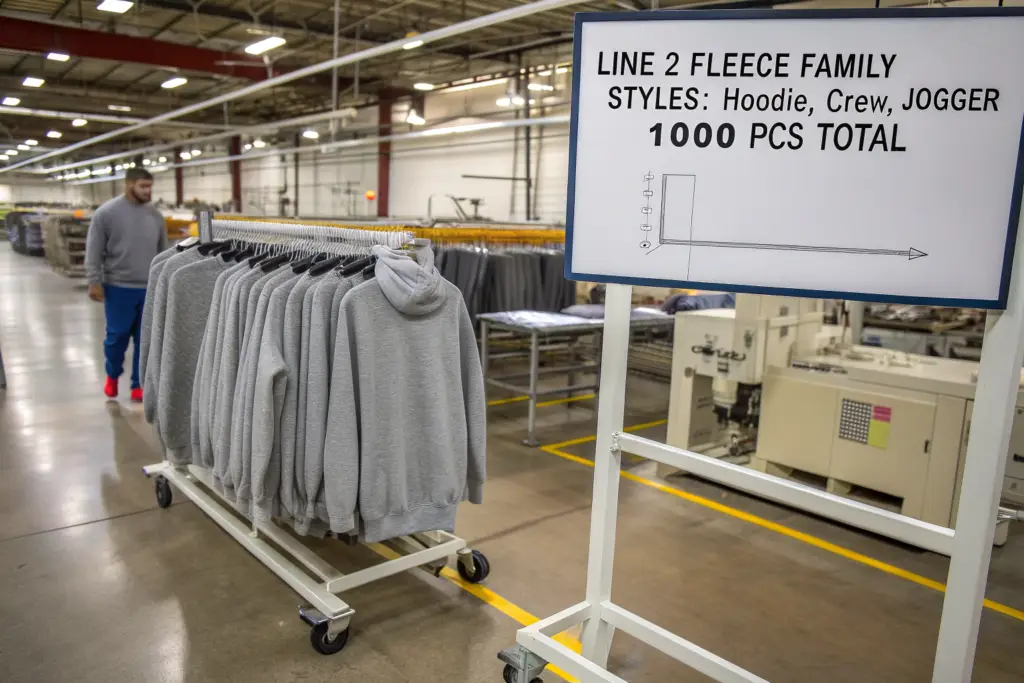
What Are the Five Most Common Sewing Line Family Groups in a Standard Factory?
The five groups are: Knit Jersey (t-shirts, tank tops, lightweight dresses), Knit Fleece (hoodies, crewnecks, sweatpants, shorts), Woven Lightweight (button-down shirts, blouses, light dresses), Woven Bottomweight (chinos, denim jeans, cargo pants, structured skirts), and Cut-and-Sew Knit Outerwear (sweaters, cardigans, ponte pants).
How Long Does a "Style Changeover" Within the Same Family Take, Compared to a Family Switch?
A style changeover within the same family—switching from hoodie to crewneck on a fleece line—requires changing the pattern pieces at each station and adjusting the folding attachments. This takes approximately 20-30 minutes. A family switch—changing from knit fleece to woven shirting—requires swapping out overlock machines for lockstitch machines and retraining operators. This takes an entire shift or more.
Conclusion
Splitting a 1,000-piece wholesale MOQ across multiple garment styles is not a favor you beg from a factory. It is a structured, negotiated production strategy built on four engineering realities. The Shared Fabric Platform reduces raw material complexity to a single, bulk-purchased roll. The Style Mix MOQ clause transparently itemizes the small, real additional costs and places them into a fair per-unit surcharge. The Decoration Platform consolidates screen-printing and embroidery setup fees across styles. The Sewing Line Family Group ensures that your split styles can be produced sequentially on the same line without a costly reconfiguration.
At Shanghai Fumao, I have structured dozens of split MOQ arrangements for emerging brands launching their first collections. I do not view a small, multi-style order as an annoyance. I view it as the beginning of a long-term production partnership, and I am willing to absorb some of the initial setup complexity because I know the brand's volume will grow.
If you are a brand owner with a collection you need to split across styles and you have been told "MOQ is 1,000 per style" by too many factories, contact my Business Director, Elaine. She can review your line sheet, identify which styles share a fabric platform and a sewing line family, and structure a Style Mix MOQ agreement with a transparent surcharge that makes your collection financially viable. Reach Elaine at: elaine@fumaoclothing.com. Launch the full collection, not just the one style you could afford.