I have noticed a significant shift in the emails I receive from U.S. brand owners over the past twelve months. Two years ago the conversation was mostly about price per unit and minimum order quantities. Today the first question is often about sustainability certifications. "Can you provide OEKO-TEX certification for your recycled polyester?" "Do you have the Grade 1 standard specifically?" This change is not coming from the brands themselves. It is coming from their customers and from the retail buyers who are demanding proof of chemical safety before they will place a wholesale order. The days of simply saying "eco-friendly" on a hangtag are over. In 2026 you need documentation.
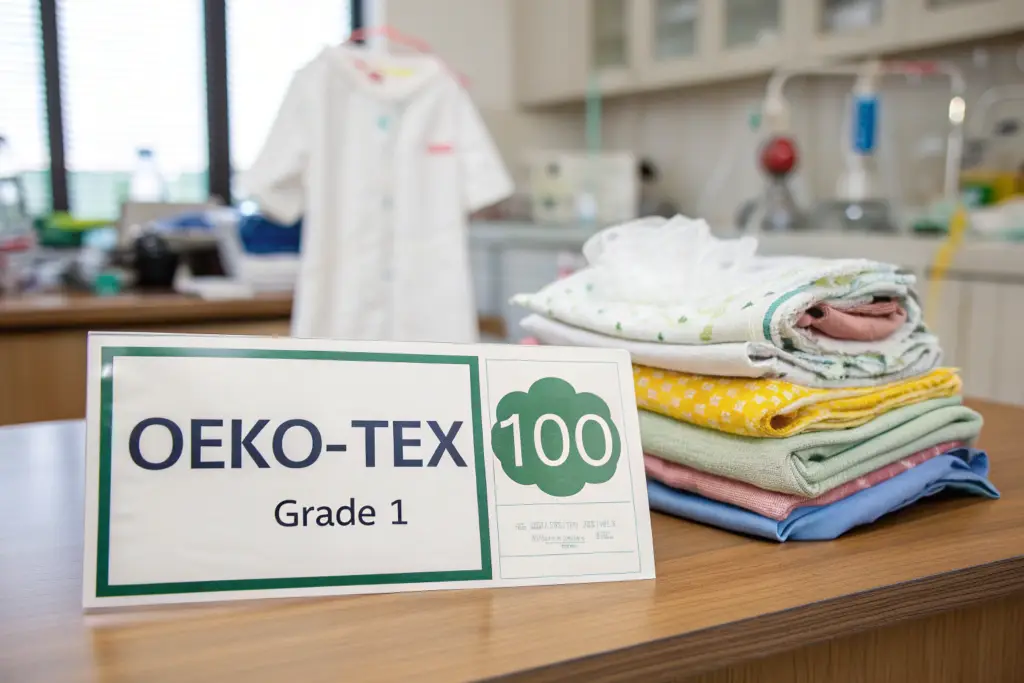
OEKO-TEX 100 Grade 1 matters critically for recycled polyester garments in 2026 because it represents the strictest global standard for chemical safety specifically designed for articles intended for infants and toddlers. For recycled polyester which carries an inherent risk of containing legacy chemicals from its previous life as plastic bottles or industrial waste the Grade 1 certification provides verifiable proof that the material has been thoroughly tested and cleared of over 100 harmful substances including heavy metals phthalates and bisphenols.
I want to explain why this specific certification is becoming non-negotiable for brands selling in the U.S. and European markets. As the owner of Shanghai Fumao I have seen the testing process up close. I have worked with fabric mills to trace the supply chain of recycled yarn. In this article I will break down what Grade 1 actually tests for why recycled polyester needs more scrutiny than virgin polyester and how this certification protects your brand from the regulatory and reputational risks that are intensifying in 2026.
What Does OEKO-TEX 100 Grade 1 Actually Test For?
Most brand owners have heard of OEKO-TEX. They know it is a good thing to have. But very few understand the difference between the four product classes. This distinction is everything when you are manufacturing garments that touch human skin. The testing requirements are not the same across all classes. The limits for harmful substances become dramatically stricter as you move from Class 4 to Class 1.
OEKO-TEX 100 Grade 1 tests for the presence and concentration of over 100 regulated harmful substances with the strictest limit values of any product class. The testing covers prohibited azo dyes that can break down into carcinogenic amines formaldehyde levels heavy metals like lead and cadmium extractable in artificial sweat solution and most critically for recycled polyester the presence of bisphenol A and phthalates which are common contaminants in post-consumer plastic waste streams.
How Do the Four OEKO-TEX Product Classes Differ in Strictness?
The OEKO-TEX system divides textile products into four classes based on how much skin contact they have and the sensitivity of the wearer. The testing limits are adjusted accordingly. A curtain that hangs on a wall does not need to meet the same standard as a baby onesie.
Here is a comparison of the four classes and their relevance to U.S. apparel brands in 2026:
| Product Class | Intended Use | Strictness Level | Example Garment | Relevance for Recycled Polyester |
|---|---|---|---|---|
| Class 1 | Baby articles (0-36 months) | Most Strict | Infant bodysuits bibs blankets | Critical. Babies mouth fabric. Any chemical migration is a direct ingestion risk. |
| Class 2 | Direct skin contact | Strict | T-shirts leggings underwear | Important. Adults sweat. Sweat can extract chemicals from fabric. |
| Class 3 | No direct skin contact | Moderate | Jackets outerwear linings | Relevant. Lower risk but still regulated. |
| Class 4 | Decoration material | Least Strict | Curtains upholstery tablecloths | Not applicable for apparel manufacturing. |
The difference in formaldehyde limits illustrates the gap. Class 2 allows up to 75 mg/kg of formaldehyde. Class 1 allows a maximum of 16 mg/kg. That is a nearly 80% reduction in the allowable limit. For heavy metals like lead the Class 1 limit is 90 mg/kg while Class 2 and 3 allow 90 mg/kg as well but the extraction test for Class 1 is more rigorous simulating saliva and sweat simultaneously. The OEKO-TEX Standard 100 documentation provides the full technical specifications.
Why Are BPA and Phthalates the Biggest Concern for Recycled Polyester?
This is the core of the issue for 2026. Recycled polyester often comes from post-consumer PET bottles. The process of collecting washing and melting these bottles down into chips and then extruding them into yarn is generally safe and well-controlled. But the supply chain is not perfect. Contamination happens. A batch of recycled bottles might contain a small percentage of non-PET plastics. These rogue plastics can contain Bisphenol A or phthalates.
Phthalates are plasticizers used to make hard plastics flexible. They are endocrine disruptors. BPA is an industrial chemical used in certain polycarbonate plastics and epoxy resins. It is also an endocrine disruptor. If these chemicals are present in the recycled feedstock and the washing process is inadequate trace amounts can remain in the finished yarn. When that yarn is made into a garment that touches human skin particularly a sweaty activewear garment the heat and moisture can facilitate the migration of those chemicals onto the skin.
The OEKO-TEX Grade 1 certification tests specifically for this. The lab uses an artificial sweat solution to extract chemicals from the fabric sample. Then they analyze that solution using liquid chromatography-mass spectrometry. They are looking for the presence of specific phthalates like DEHP DBP BBP and DINP. The limit for each is 0.1% by weight of the plasticized material. For a baby garment any detectable level above the reporting limit is a failure. I have seen mill test reports where a batch of recycled polyester yarn passed the standard PET testing but failed the Grade 1 phthalate screen because of a contaminated bale of feedstock. This is why the certification is not just paperwork. It is a gatekeeper. The endocrine disruptor research from NIH explains the health rationale behind these strict limits.
Why Is Recycled Polyester Under More Scrutiny Than Virgin Polyester?
There is a perception among consumers that "recycled" automatically means "better." From a resource conservation standpoint it is better. It diverts plastic from landfills and oceans. It uses less energy and water than virgin polyester production. But from a chemical purity standpoint recycled polyester carries a burden of proof that virgin polyester does not. Virgin polyester is made from petrochemicals in a controlled closed-loop reactor. The chemical inputs are known and consistent. Recycled polyester starts with a variable unpredictable waste stream.
Recycled polyester is under greater scrutiny than virgin polyester because the source material is post-consumer or post-industrial waste that may contain legacy chemicals from its previous life. Virgin polyester is synthesized from pure monomers under controlled conditions. Recycled feedstock must be aggressively cleaned and tested to ensure these legacy contaminants are removed to safe levels.
What Legacy Chemicals Can Survive the Recycling Process?
The recycling process for PET bottles involves grinding the bottles into flakes washing those flakes with hot water and caustic soda and then melting them at high temperatures around 280 degrees Celsius. This process destroys many organic contaminants. But it is not perfect for everything.
Certain heavy metals used in catalysts or pigments in the original plastic can remain. Antimony trioxide is a common catalyst used in PET production. It is a suspected carcinogen. OEKO-TEX sets a strict limit on extractable antimony. The washing process can also struggle to remove certain UV stabilizers and flame retardants that were added to the original plastic product. If a small amount of polycarbonate plastic which contains BPA gets mixed into the PET bale the high heat of extrusion can cause the BPA to migrate into the PET polymer matrix.
We source recycled polyester yarn from a specific mill in Jiangsu province for our clients who require Grade 1 certification. That mill uses an additional proprietary solvent wash process specifically designed to target and remove BPA residues. It adds about $0.40 per kilogram to the yarn cost. But it ensures the yarn passes the Grade 1 lab test every time. I have visited their facility. The difference between standard recycled yarn and Grade 1 certified yarn is not visible to the naked eye. The yarn looks identical. The difference is in the chemical signature which only a $200,000 mass spectrometer can detect. This is why buying recycled polyester from an uncertified source is a gamble. You are trusting the mill's internal controls without independent verification.
How Does the FTC Green Guides Impact "Recycled" Marketing Claims?
This is a U.S.-specific concern that many brands overlook. You can have a garment made from 100% recycled polyester. But if you make a broad claim like "Eco-Friendly" or "Non-Toxic" without substantiation you can be in violation of the FTC Green Guides. The Federal Trade Commission has been increasingly active in 2025 and 2026 in sending warning letters to apparel brands making unqualified environmental benefit claims.
The FTC Green Guides state that marketers must have a reasonable basis for any environmental claim. A reasonable basis means competent and reliable scientific evidence. An OEKO-TEX Grade 1 certificate is exactly that kind of evidence. It is a third-party lab report that substantiates the claim that the garment is free from harmful levels of specific regulated chemicals.
I had a client last year who wanted to market their recycled polyester activewear line as "Safe for Sensitive Skin." They had not done any specific chemical testing. They assumed that "recycled" implied "safe." I advised them against that claim. We sent a sample of their fabric for Grade 1 testing. The result came back with a slightly elevated level of extractable antimony just 2% above the Grade 1 limit. It would have passed Class 2 but it failed Class 1. We worked with the mill to adjust the washing process. The second test passed. The client could now legally and ethically make their "Safe for Sensitive Skin" claim because they had the FTC Green Guides substantiation in hand.
How Does Grade 1 Certification Protect Your Brand in the US Market?
The U.S. regulatory landscape for chemicals in textiles is not as comprehensive as the European REACH regulation. But it is not a free-for-all either. The Consumer Product Safety Commission enforces limits on lead in children's products. State laws like California Proposition 65 require warnings for products containing chemicals known to cause cancer or reproductive harm. And the plaintiff's bar is very active in filing class-action lawsuits against brands for alleged deceptive marketing or product safety failures.
Grade 1 certification protects your brand in the U.S. market by providing a robust legal defense against claims of chemical contamination and by satisfying the vendor compliance requirements of major retailers who are increasingly mandating third-party safety certifications for all private label goods.
What Are the Specific CPSC Requirements for Children's Apparel?
The Consumer Product Safety Improvement Act sets strict limits for lead in surface coatings and lead in substrate materials for children's products. Children's products are defined as items designed for kids 12 and under. The limit for total lead content in the substrate which includes the fabric is 100 parts per million. The limit for lead in paint or surface coating is 90 ppm.
OEKO-TEX Grade 1 tests for extractable lead using an artificial saliva and sweat solution. The CPSC test is for total lead content using acid digestion. They are different analytical methods but they are correlated. A fabric that passes OEKO-TEX Grade 1 for extractable heavy metals is extremely unlikely to fail CPSC total lead testing.
Here is a comparison of the two standards for a children's polyester jacket:
| Requirement | CPSC (US Law) | OEKO-TEX Grade 1 (Voluntary Standard) |
|---|---|---|
| Lead in Substrate | 100 ppm (Total Content) | 90 ppm (Extractable) |
| Phthalates (DEHP DBP BBP) | 0.1% in children's toys and child care articles | 0.1% for all Class 1 articles including apparel |
| Cadmium | 75 ppm (if ASTM F963 applies) | 40 ppm (Extractable) |
The OEKO-TEX standard is often stricter than the legal minimum. By certifying to Grade 1 you are not just complying with the law. You are exceeding it. This provides a margin of safety that protects you from batch-to-batch variation. A fabric test that shows 85 ppm extractable lead is a warning sign even if the total lead might still be under the 100 ppm legal limit. The CPSC children's product requirements are the minimum legal bar. Grade 1 is the gold standard.
Why Are Major US Retailers Now Mandating OEKO-TEX for Private Label?
If you are a brand selling wholesale to Target Nordstrom or REI you already know this. These retailers have implemented Restricted Substances Lists that go far beyond U.S. law. They require their vendors to test every production batch and submit lab reports. OEKO-TEX certification is a streamlined way to meet these requirements.
A large retailer's vendor compliance manual is often 80 pages long. It specifies limits for dozens of chemicals including many that are not regulated by the U.S. government. Failure to comply results in chargebacks. A chargeback for a failed random audit can be $10,000 per SKU. I have seen brands lose their entire profit margin for a season because of a single compliance failure.
By sourcing from a factory that uses OEKO-TEX Grade 1 certified materials you shift the compliance burden upstream. The fabric mill provides the certificate. The certificate covers the chemical inputs. The retail buyer's compliance team sees the certificate number and checks the OEKO-TEX database. The process is faster. The risk of a chargeback is lower. I have a client who produces baby blankets for a major U.S. registry retailer. They use our Grade 1 certified recycled polyester fleece. The retailer's compliance audit took two days instead of two weeks because the material certification was already in their system. This efficiency is a direct competitive advantage.
Can Grade 1 Certified Recycled Polyester Still Be Cost-Effective?
This is the question I get from every brand owner after I explain the benefits. "This sounds great but what does it cost?" There is a premium for Grade 1 certified recycled polyester compared to standard recycled polyester. The premium comes from the extra testing the additional washing steps and the supply chain segregation required to keep certified material separate from uncertified material.
Grade 1 certified recycled polyester can be cost-effective when you account for the total cost of quality including the avoided costs of failed retail audits consumer lawsuits and brand reputation damage. The per-unit fabric premium is typically in the range of $0.35 to $0.65 per garment depending on the weight. This premium is recoverable through a slightly higher retail price justified by the verified safety claim.

How Much Premium Does Certification Add to the Fabric Cost?
Let me give you a real cost comparison based on a standard 240gsm recycled polyester fleece used for a hoodie. This data is from our fabric sourcing team at Shanghai Fumao as of Q1 2026.
| Fabric Type | Cost Per Kilogram | Cost Per Yard (Approx) | Cost Impact Per Hoodie (1.2 Yard Consumption) |
|---|---|---|---|
| Virgin Polyester Fleece | $4.20 | $2.10 | $2.52 |
| Standard Recycled Polyester Fleece | $4.80 | $2.40 | $2.88 |
| Grade 1 Certified Recycled Polyester Fleece | $5.40 | $2.70 | $3.24 |
The step up from standard recycled to Grade 1 certified is $0.72 per hoodie. On a retail price of $68 that is approximately 1% of the retail price. The consumer will not notice a $0.72 difference in the price tag. But they will notice the OEKO-TEX hangtag. And the retail buyer will definitely notice the certification when they review your vendor packet.
I worked with a children's activewear brand in early 2026. They were using standard recycled polyester for their leggings. They wanted to start selling into a higher-end boutique channel that required Grade 1 certification. We switched their fabric to the certified version. Their landed cost per unit increased by $0.48. They increased their wholesale price by $1.50. The boutiques accepted the price increase without question because the Grade 1 hangtag allowed the boutiques to market the leggings as "The Safest Choice for Your Child." The brand's margin actually increased slightly. This is the power of a verifiable product differentiator.
What Is the ROI of Avoiding a Single Product Recall or Lawsuit?
The premium paid for certified fabric is an insurance policy. You hope you never need to use the insurance but you are very glad you have it when something goes wrong. A product recall for chemical contamination is a catastrophic event for a small or medium-sized apparel brand.
The costs of a recall include the cost of retrieving the product from stores and warehouses the cost of destroying the contaminated inventory the cost of consumer refunds and the legal fees associated with any class-action lawsuit. Then there is the unquantifiable cost of brand reputation damage. News articles with headlines like "Popular Kids Brand Found to Contain Toxic Chemicals" stay online forever.
I am aware of a situation involving a brand I do not work with. They imported a container of printed t-shirts from a supplier who used a non-certified ink. The ink contained lead above the CPSC limit. The shipment was flagged during a random CBP exam. The entire container was seized. The brand had to recall the small quantity that had already shipped to a few boutiques. The total cost of the seizure destruction and legal fees was estimated by the brand owner at over $120,000. That is a business-ending event for many small brands. The cost of using OEKO-TEX certified inks and fabrics on that order would have been approximately $1,800. The CPSC recall database is full of similar stories.
Conclusion
In 2026 the apparel industry is moving past vague sustainability claims and toward verifiable safety standards. Recycled polyester is a valuable material for reducing plastic waste. But its benefits are only fully realized when it is processed and tested to ensure it does not introduce new chemical hazards into the supply chain. OEKO-TEX Standard 100 Grade 1 is the most rigorous and globally recognized certification that provides this assurance.
For brands selling in the U.S. market particularly those targeting children or making skin-contact activewear the Grade 1 standard is quickly becoming a baseline expectation rather than a premium add-on. Major retailers are writing it into their vendor manuals. Consumers are learning to look for the certification hangtag. And regulators are watching environmental marketing claims more closely than ever before.
The incremental cost of switching to Grade 1 certified recycled polyester is small when measured against the financial and reputational risk of a chemical compliance failure. It is an investment in supply chain transparency and consumer trust. It allows you to make a "safe for sensitive skin" or "non-toxic" claim with the scientific evidence to back it up.
At Shanghai Fumao we have invested in the relationships with mills and testing laboratories to make Grade 1 certified recycled polyester accessible to brands of all sizes. We handle the documentation so you can focus on design and sales. If you are developing a collection that requires certified safe materials or if you need to upgrade your current sourcing to meet new retail compliance standards we are ready to help. For more information on our OEKO-TEX certified fabric options please contact our Business Director Elaine. You can email her at elaine@fumaoclothing.com. Let us help you build a supply chain that is as safe as it is sustainable.