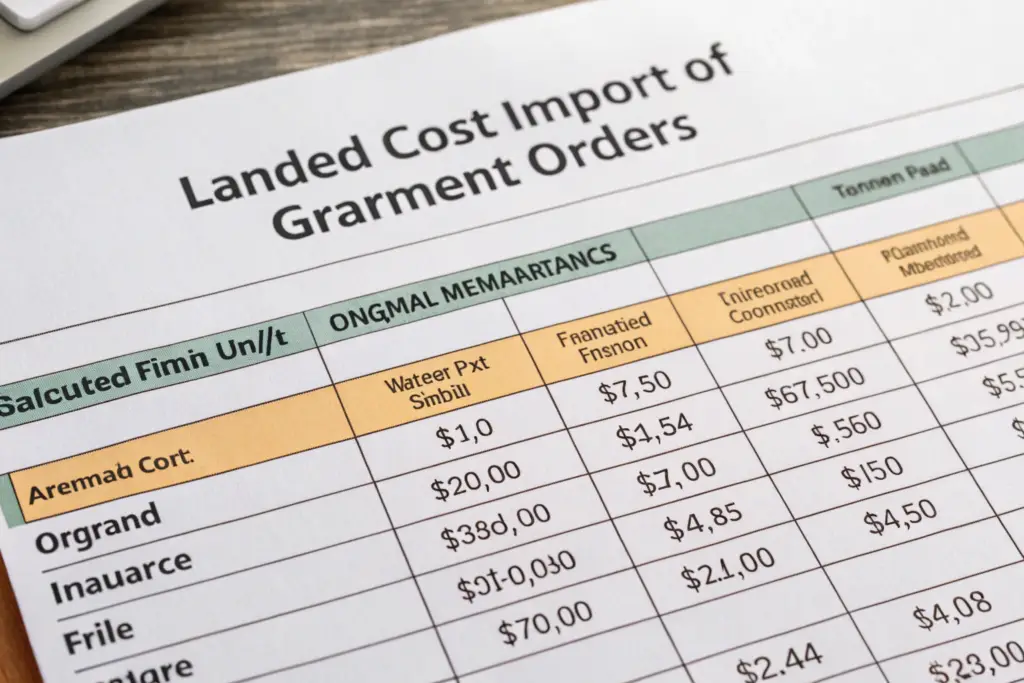
I cannot count the number of times I have received an email from a brand owner who just got their first shipment and is in a state of panic. The subject line is usually something like "Urgent Invoice Discrepancy" or "Hidden Fees?" They budgeted $12,000 for their order based on the FOB price we quoted them. But the final bill from their freight forwarder and customs broker came in at $17,500. That is a 45% increase. That is profit margin that just evaporated. The problem is not that the fees were hidden. The problem is that the brand owner did not know which fees existed to look for in the first place.
Accurately calculating the landed cost of imported garment orders requires building a complete cost model that includes not only the FOB unit price but also all origin charges ocean freight insurance U.S. customs duties merchandise processing fees harbor maintenance fees and final mile trucking. The true landed cost is the only number that matters for determining your actual profit margin and setting a sustainable wholesale or retail price.
I want to give you a tool that will protect your business from these expensive surprises. As the owner of Shanghai Fumao I see both sides of this equation every day. I see the factory costs and I help my clients navigate the shipping costs. In this article I will walk you through every single line item that belongs in a proper landed cost calculation. I will show you how to build a spreadsheet that gives you the real number before you commit to a purchase order. And I will share real examples from shipments we have managed so you can see exactly where the money goes.
What Are the Hidden Fees That Inflate Landed Clothing Costs?
The ocean freight quote you get online for $3,200 is not the final cost of moving your goods. It is just the starting point. The shipping industry has developed a complex system of surcharges and accessorial fees over the past decade. Some of these fees are legitimate and unavoidable. Others are negotiable if you know they exist. But you cannot negotiate a fee you do not know about. The first step to accurate costing is understanding the full menu of potential charges that will appear on your final invoice.
The hidden fees that most commonly inflate landed costs include the Terminal Handling Charge at the destination port the Pier Pass fee for California shipments the Customs Merchandise Processing Fee and most critically the demurrage and detention charges that accrue when containers are not picked up promptly. These fees can add 18% to 35% to the base ocean freight cost.
Why Does the Terminal Handling Charge Vary So Much by Port?
The Terminal Handling Charge is a fee charged by the port terminal operator for moving your container from the ship to the truck chassis. It covers the use of the massive cranes and the yard space. This fee is not set by the shipping line. It is set by the port authority and the terminal operator. And it varies wildly depending on which U.S. port you use.
Here is a comparison of approximate THC fees for a standard 40-foot container based on data from our shipments in early 2026:
| U.S. Port of Entry | Approximate Terminal Handling Charge | Notes |
|---|---|---|
| Los Angeles / Long Beach | $450 - $550 | Highest volume port but also high congestion fees. |
| New York / New Jersey | $350 - $450 | Slightly lower THC but higher trucking costs to inland destinations. |
| Savannah | $325 - $400 | Generally more efficient with lower wait times reducing demurrage risk. |
| Seattle / Tacoma | $400 - $500 | Good option for Pacific Northwest distribution but watch for winter weather delays. |
I had a client in Denver who insisted on shipping everything through Los Angeles because "it is the closest port." But the THC plus the Pier Pass fee plus the chassis rental split fee in LA added $680 to his container cost. We ran the numbers on routing through Seattle instead. The ocean freight was $200 higher but the destination port fees were $350 lower and the trucking to Denver was $400 cheaper. His total landed cost dropped by $470 per container. This is the kind of analysis that strong factory leadership provides to clients. The port fee structure is public information but most new importers do not know where to look.
What Is the Difference Between Demurrage and Detention Charges?
These two words sound similar. They both mean you are paying extra because of a delay. But they apply to different stages of the process. Mixing them up can cost you thousands of dollars.
-
Demurrage: This is a fee charged by the port terminal. It applies when your container sits inside the port terminal yard beyond the "free days" allowed. Usually you get 4 to 7 free days. After that you pay per day. The rate escalates the longer the container sits. Day 8 might be $150. Day 15 might be $350 per day.
-
Detention: This is a fee charged by the shipping line for the use of their container. It applies when you keep the container outside the port for too long before returning it empty to the depot. You typically get 7 to 10 free days for trucking and unloading.
I recall a painful situation from November 2025. A brand owner who was new to importing used a freight forwarder who did not explain the process clearly. The shipment arrived in Long Beach on a Tuesday. The brand owner did not have their customs bond filed correctly. The container sat at the terminal for 12 days while they sorted out the paperwork. The demurrage bill was $2,850. Then when they finally got the container to their 3PL warehouse the warehouse was backed up. They took 14 days to unload the 800 cartons. The detention bill from the steamship line was another $2,100. That is nearly $5,000 in delay fees on a shipment that had a base ocean freight of $3,800. The total cost of the shipment more than doubled. This is why we push all new clients at Shanghai Fumao toward DDP shipping terms. We manage these timelines so you do not pay these penalties.
How Do Tariffs and Duties Impact My Total Garment Cost Calculation?
This is the part of the calculation that causes the most anxiety for new importers. And for good reason. The U.S. tariff schedule is thousands of pages long. It changes based on trade policy and the country of origin. Getting your classification wrong can mean underpaying duty which leads to fines and interest. Or it can mean overpaying duty which eats into your margin unnecessarily.
Tariffs and duties directly increase your total garment cost by a percentage of the declared customs value. For most apparel categories imported from China the duty rate ranges from 16% to 32% depending on the fiber content and garment type. This is not a flat fee. It is a percentage applied to the entire value of the goods plus a portion of the freight costs.
How to Find the Correct HTS Code for Different Garment Types?
The Harmonized Tariff Schedule code is a 10-digit number that tells U.S. Customs exactly what you are importing. The first six digits are international. The last four are specific to the U.S. tariff system. You cannot guess this number.
The structure for apparel generally follows this pattern. Chapter 61 is for knitted or crocheted garments. Chapter 62 is for woven garments. The next digits specify the gender. The next digits specify the fiber content. For example:
- 6109.10.00 is for Men's or boys' T-shirts singlets and other vests of cotton knitted or crocheted.
- 6110.20.20 is for Sweaters pullovers and similar articles of cotton knitted or crocheted.
- 6204.43.00 is for Women's or girls' dresses of synthetic fibers woven.
I strongly advise every client to work with a licensed U.S. Customs Broker to verify their HTS code before the first shipment. At Shanghai Fumao we provide the recommended HTS code based on the fabric content and construction but we always tell clients "Please have your broker confirm this for your specific import record."
A mistake can be costly. In 2024 a men's streetwear brand we work with imported a shipment of cotton hoodies. Their previous broker had filed them under a subheading for "other garments" that had a lower duty rate. CBP did a review and reclassified the shipment under the correct heading for cotton hoodies. The brand received a bill for $8,700 in back duties plus a penalty. This is why accurate classification is not just paperwork. It is financial protection. You can search the official database on the USITC HTS website to start your research.
What Is the Merchandise Processing Fee and How Is It Calculated?
This is a fee that surprises many first-time importers. The Merchandise Processing Fee is charged by U.S. Customs and Border Protection for the administrative cost of processing your entry paperwork. It is calculated as a percentage of the entered value of the goods.
For formal entries the MPF is 0.3464% of the declared value. There is a minimum fee of $32.71 and a maximum fee of $634.62 per entry. Let me show you how this works with real numbers.
Suppose your shipment has a declared value of $50,000. Your MPF calculation would be $50,000 multiplied by 0.003464. That equals $173.20. That is within the minimum and maximum range so you pay exactly $173.20.
Now suppose you have a very large shipment valued at $300,000. The calculation would be $300,000 multiplied by 0.003464 which equals $1,039.20. However the cap is $634.62. So you only pay the cap amount.
This fee is separate from the duty rate. It is applied to every formal entry. You should include it as a separate line item in your landed cost spreadsheet. The official CBP document informed compliance publications explain this fee in detail.
What Is the Difference Between FOB and DDP Pricing for Budgeting?
This is the single most important decision you will make about your supply chain cost structure. It determines how much risk you carry and how predictable your cash flow will be. I have seen brands choose FOB to save a few cents per unit and end up losing thousands in unexpected fees. I have also seen brands pay a premium for DDP and sleep soundly at night knowing their costs are fixed.
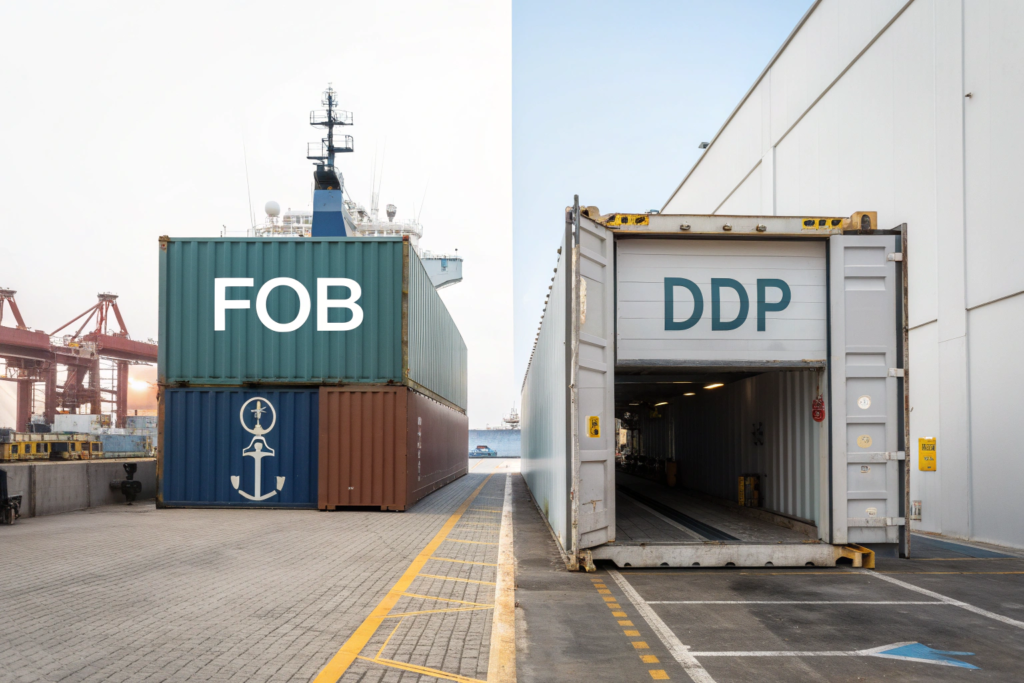
The difference between FOB and DDP pricing is a matter of responsibility and risk transfer. With FOB pricing you pay the factory only for the cost of the goods delivered to the port of origin and you assume all risk and cost from that point forward. With DDP pricing you pay a single all-inclusive price that covers the goods all freight all duties and all fees until the shipment arrives at your specified delivery address.
How to Build a Reliable FOB Cost Spreadsheet with All Variables?
If you choose to manage the logistics yourself using FOB terms you must build a comprehensive spreadsheet. You cannot rely on a rough estimate. Here is the exact structure I recommend to my clients based on a real 1,000kg shipment of knitwear from Shanghai to a warehouse in Dallas Texas.
| Cost Category | Line Item | Calculation Method | Example Cost (USD) |
|---|---|---|---|
| Factory Cost | FOB Shanghai Price | Per Unit Price x Quantity | $8,500.00 |
| Origin Charges | Export Clearance & Trucking to Port | Fixed Quote from Forwarder | $350.00 |
| Ocean Freight | Shanghai to Houston Base Rate | Rate per Cubic Meter or Container | $2,200.00 |
| Ocean Surcharges | Bunker Adjustment Factor & Low Sulfur Surcharge | Percentage of Base Freight | $480.00 |
| Insurance | Marine Cargo Insurance | 0.5% of 110% of Invoice Value | $46.75 |
| U.S. Destination Charges | Port of Houston THC & Chassis Fee | Fixed Port Tariff | $425.00 |
| Customs Clearance | Customs Broker Entry Fee | Per Entry Fee | $125.00 |
| U.S. Customs Duty | Duty Rate (e.g. 16.5%) | Rate x (FOB Value + Freight + Insurance) | $1,877.63 |
| Customs Fees | Merchandise Processing Fee | 0.3464% of Entered Value (Capped) | $39.85 |
| Inland Trucking | Houston Port to Dallas Warehouse | Per Mile Rate | $550.00 |
| Total Landed Cost | $14,594.23 |
If the brand owner had only looked at the FOB price of $8,500 they would have been under budget by over $6,000. This is why I cannot stress enough the importance of building this model before you set your retail prices. You must understand the total landed cost formula.
Why Does DDP Offer Better Cash Flow Predictability for New Brands?
DDP stands for Delivered Duty Paid. When you work with a factory like Shanghai Fumao on DDP terms we quote you a single per-unit price that includes every line item in that spreadsheet above. You know on day one that the garment will cost you $14.60 per unit delivered to your door. You can set your wholesale price and your retail price with complete confidence.
The value of this predictability is immense for a new brand. You do not have to hold a large cash reserve to cover a surprise demurrage bill. You do not have to spend hours on the phone with a freight forwarder in a different time zone. You do not have to learn the intricacies of customs bond types. You focus on selling apparel. We focus on delivering it.
We had a client in 2025 who launched a women's loungewear brand. She was terrified of logistics. We quoted her DDP terms. Her cost was fixed. She knew her margin exactly. She used that certainty to confidently invest in Facebook ads because she knew her unit economics were locked in. Her brand grew 200% in the first year. She told me recently "I would have quit in month three if I had to figure out customs clearance on my own. The DDP option saved my business." This is the power of transferring the logistics risk to a partner who manages it every single day.
How Can I Reduce Landed Costs Without Sacrificing Quality?
Everyone wants to pay less for shipping. That is natural. But the wrong way to reduce landed cost is to cut corners on fabric quality or to switch to a cheaper unreliable freight forwarder who will delay your shipment. The right way is to optimize the physical characteristics of your shipment and the timing of your orders. There are levers you can pull that reduce cost without touching the quality of the product.
You can reduce landed costs without sacrificing quality by optimizing carton dimensions to maximize container utilization by consolidating multiple smaller orders into a single larger shipment and by strategically timing your production to avoid peak shipping season surcharges. These methods reduce the per-unit freight and fee burden while the garment quality remains unchanged.
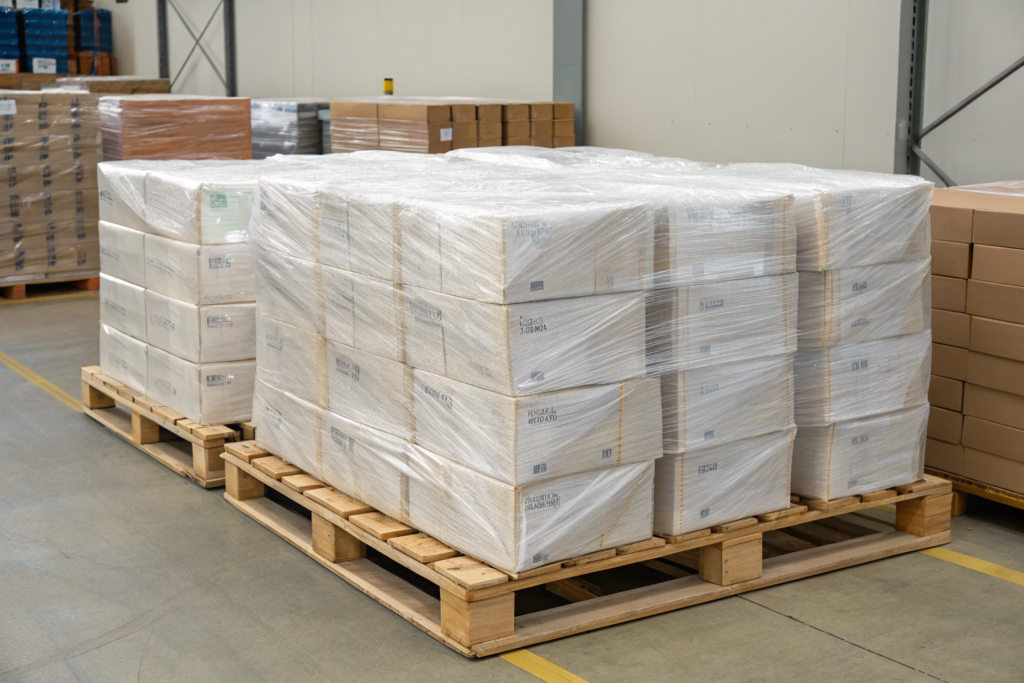
How Does Carton Packing Efficiency Affect Ocean Freight Rates?
Ocean freight for smaller shipments that do not fill an entire container is charged by volume. The freight forwarder looks at the cubic meters of your shipment. If your cartons are 20% empty space you are paying to ship air. That is a direct waste of money.
At Shanghai Fumao we work with our clients on carton optimization. We use a specific software that calculates the best way to fold and pack garments to reduce the carton height. For a shipment of 2,000 t-shirts reducing the carton height by just 2 centimeters per carton can reduce the total volume by 1.2 cubic meters. On a route where freight is $95 per cubic meter that saves $114.
We also advise on the number of pieces per polybag. If you pack 5 units per polybag instead of 1 unit you reduce the amount of plastic and you reduce the air inside the bag. This small change can increase the density of the carton significantly. Here is a real example from a shipment we handled in January 2026:
| Packing Method | Units Per Carton | Carton Dimensions (cm) | Volume Per Carton | Freight Cost Per Unit |
|---|---|---|---|---|
| Standard Fold | 60 units | 60x40x40 | 0.096 CBM | $0.152 |
| Optimized Flat Pack | 75 units | 60x40x38 | 0.091 CBM | $0.115 |
The difference of $0.037 per unit seems tiny. But on an order of 20,000 units that is a savings of $740. That is real money that goes back into your profit margin. The container optimization process is a service a good factory provides as part of their standard operating procedure.
Why Is Order Consolidation a Key Strategy for Small Batch Importers?
If you are a new brand you are probably not ordering a full 40-foot container. You are shipping LCL. LCL has a lower base ocean freight but it has higher fixed fees at the destination port relative to the size of the shipment. The best way to neutralize those fixed fees is to consolidate orders.
Let us say you have two separate styles. You could ship them two months apart as two separate LCL shipments. Each shipment would incur its own destination THC its own customs broker entry fee and its own trucking minimum charge.
Instead you can wait until both styles are finished and ship them together as one consolidated LCL shipment. You pay the THC once. You pay the entry fee once. You pay the trucking minimum once.
I helped a client in Seattle do this exact analysis last season. They had a spring delivery of 800 units and a summer delivery of 900 units. Shipping them separately would have cost $1,450 in combined destination fees. Shipping them together cost $790 in destination fees. They saved $660 by adjusting their production calendar slightly to align the completion dates. The key is communication with your factory. If you tell us your plan we can adjust the cutting schedule to make consolidation possible without delaying either delivery. This is the kind of strategic thinking that separates profitable brands from struggling ones. It requires a factory partner who thinks about your supply chain efficiency not just their own production output.
Conclusion
Calculating the landed cost of your imported garment orders is not a guessing game. It is a disciplined financial process that must be completed before you set a single retail price. If you rely on the FOB price alone you are building your business on a foundation of sand. The first time a shipment gets hit with demurrage or you discover the duty rate is 10% higher than you estimated your entire profit margin for that season could disappear.
You need to account for every hand that touches your goods. The terminal operator. The customs broker. The trucking company. The insurance underwriter. Each of these parties takes a small slice of the pie. Those small slices add up to a significant portion of your total cost structure.
The most successful brands I work with are not the ones with the most creative designs. They are the ones with the most accurate spreadsheets. They know their numbers cold. They know their duty rate by HTS code. They know their freight cost per cubic meter. They know their carton optimization factor. This financial discipline gives them the confidence to price their products correctly and to invest in growth.
If you want to take the guesswork out of this process we are here to help. Our team at Shanghai Fumao specializes in DDP solutions that give you a single predictable landed cost per unit. We manage the logistics so you can manage your brand. For a detailed landed cost estimate on your upcoming production run or to discuss how our DDP service can simplify your importing process please contact our Business Director Elaine. You can reach her directly at elaine@fumaoclothing.com.