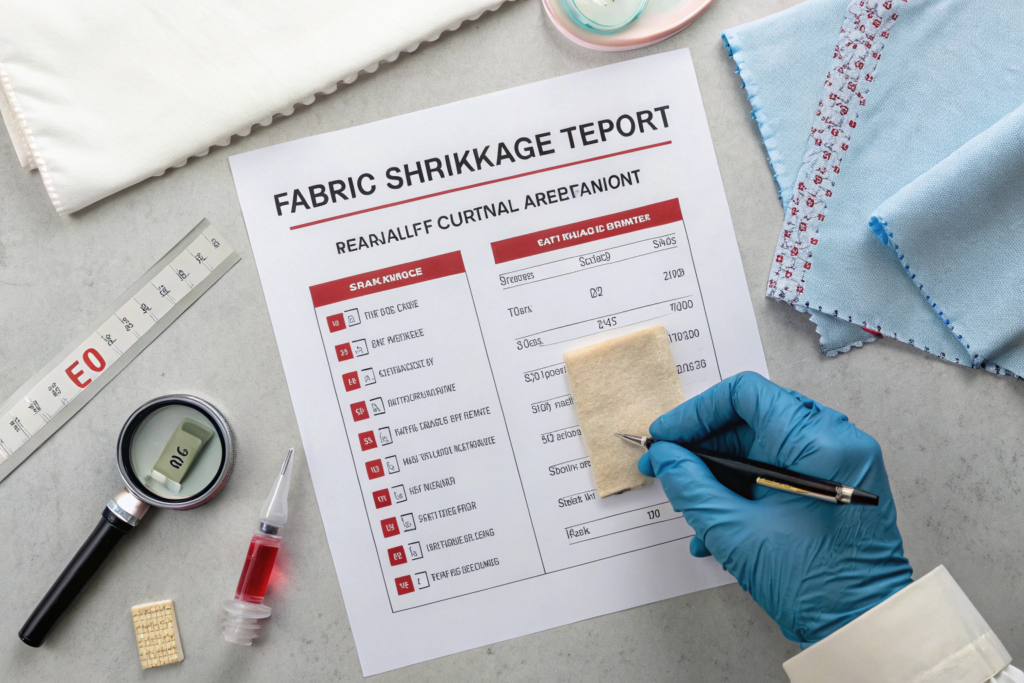
You have designed the perfect garment. The fit on the sample is impeccable. The customer loves it. Then, a few weeks later, the reviews start trickling in. "Shrank two sizes after one wash!" "It's a crop top now!" Your heart sinks. Your beautiful product is being returned, and your brand's reputation is taking a hit. A frustrated brand owner told me, "I thought shrinkage was just something you had to accept with natural fibers. I learned the hard way that it's a controllable, technical issue. I just didn't know the right questions to ask my factory."
Fabric shrinkage is primarily caused by the release of tension and the swelling of fibers when a garment is exposed to moisture and heat. There are two main types: 1) Relaxation Shrinkage, which occurs when the stresses introduced during the knitting, weaving, and finishing of the fabric are released during the first few washes, and 2) Felting Shrinkage, a permanent, progressive shrinkage specific to animal hair fibers like wool, caused by the scales on the fibers interlocking. Both can be prevented through a combination of proper fabric finishing, proactive pattern engineering, and rigorous wash testing.
At Shanghai Fumao, controlling shrinkage is a non-negotiable part of our quality control for both CMT and private label production. We know that a beautiful fabric that shrinks is a liability. Let me explain the science behind shrinkage and the specific, actionable steps a professional factory takes to ensure the garment your customer receives fits as perfectly as the sample you approved, wash after wash.
What Is the Science Behind Relaxation Shrinkage in Natural Fibers?
The most common type of shrinkage, especially in cotton, linen, and viscose, is relaxation shrinkage. It is not a defect in the fiber itself; it is a result of the intense mechanical stresses the fibers and yarns undergo during the manufacturing process. Think of it as the fabric having a "memory" of a more relaxed state, and the first wash is what finally allows it to return there. Understanding this mechanism is the first step to preventing it.
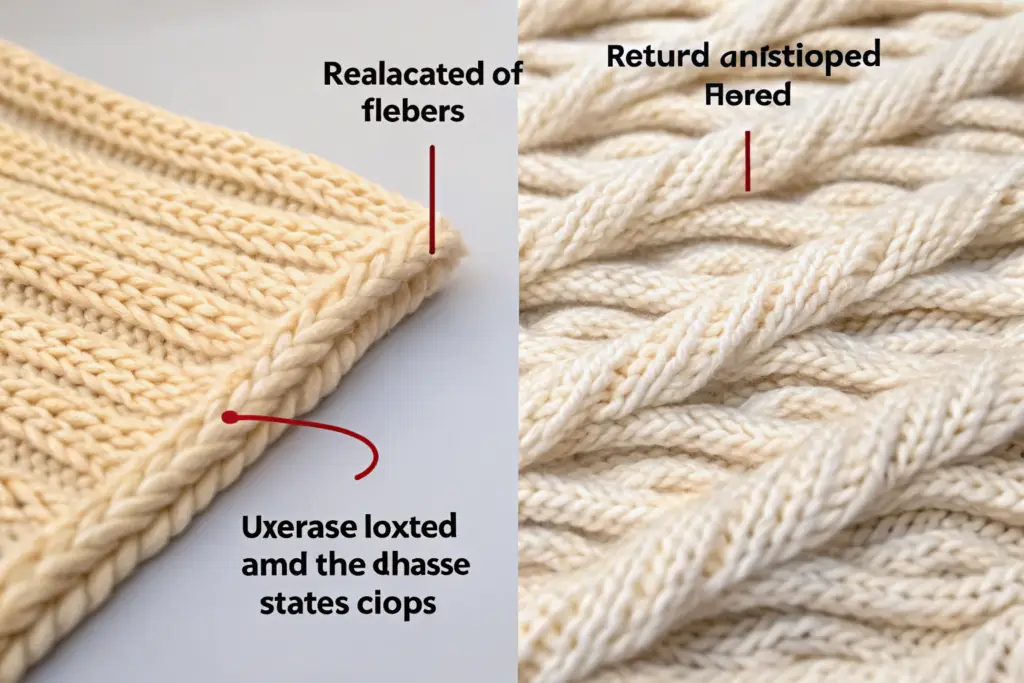
Relaxation shrinkage is caused by the release of manufacturing tensions. During spinning, knitting, or weaving, fibers and yarns are stretched under high tension. When the finished garment is washed, the water acts as a lubricant, and the heat provides energy. This allows the fibers and yarns to relax and try to return to their natural, unstressed state. The loops in a knit structure draw closer together, and the crimp in a woven yarn is released, causing the overall fabric dimensions to decrease. This is a one-time event, primarily occurring in the first few washes.
I recall a brand that launched a beautiful line of cotton jersey tops. The samples were perfect. The bulk order arrived, and customers loved them—until they washed them. The tops shrank a full size. The issue was a classic case of relaxation shrinkage. The mill had not properly "relaxed" the fabric after knitting. The tension was locked in the yarns. When customers washed the tops, that tension was released, and the garments shrank. The brand had to offer refunds. This painful lesson is why we only source fabrics that have been properly finished for shrinkage control. This is a key part of our fabric sourcing and vetting .
How Does Yarn Tension During Knitting or Weaving Cause Shrinkage?
Imagine pulling a spring tight. The metal has stored energy, and when you let go, it snaps back. Yarns are stretched in the same way during high-speed knitting and weaving. This "stretch" is locked into the structure of the fabric. When the fabric is wetted and heated, the fibers swell, the friction holding the yarns in place is reduced, and the stored energy is released, causing the yarn to shorten and the fabric to shrink.
Why Is This Type of Shrinkage Often a One-Time Event?
Once the manufacturing tensions are fully released (usually after 1-3 washes), the fabric reaches a state of equilibrium. It will not continue to shrink indefinitely with subsequent washes. The goal of a professional factory is to force this release before the garment is even cut, so the customer experiences no further dimensional change.
What Is Felting Shrinkage and How Is It Unique to Wool?
While relaxation shrinkage affects most natural fibers, animal hair fibers like wool have a second, more aggressive form of shrinkage called felting shrinkage. This is a permanent, progressive process that is unique to the physical structure of wool fibers. It is the same mechanism that is used to intentionally create felt fabric. Understanding this is critical for anyone working with wool.
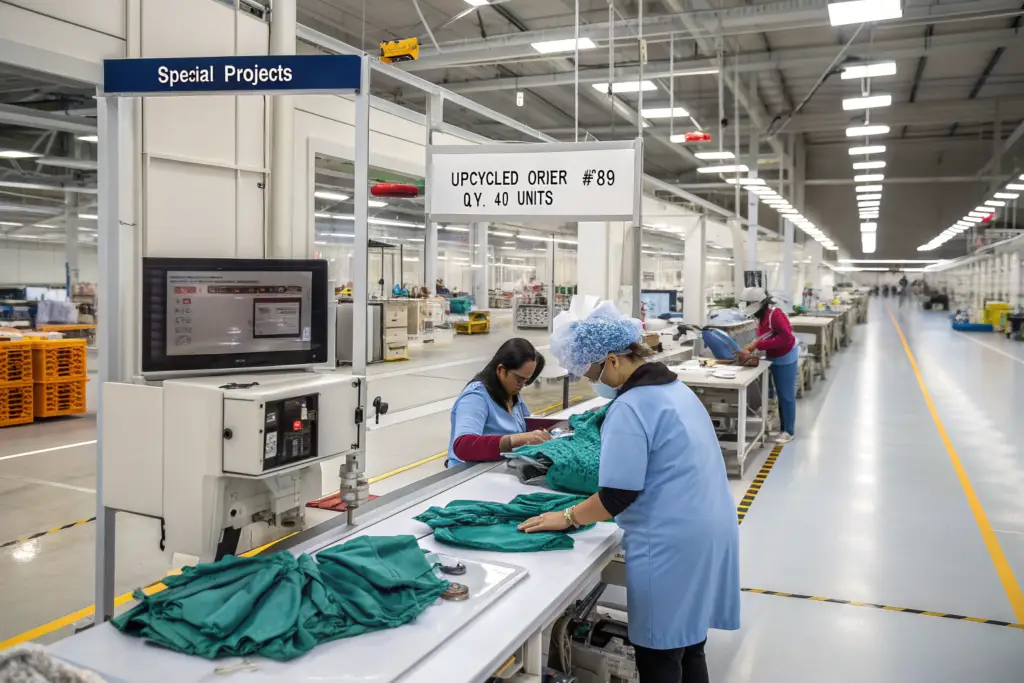
Felting shrinkage is unique to animal hair fibers like wool. It is caused by the microscopic, overlapping scales on the surface of the fibers. When wool is exposed to moisture, heat, and agitation (like in a washing machine), these scales open up, and the fibers migrate. The scales then interlock like a ratchet, causing the fibers to mat together permanently. This process is progressive and irreversible, meaning a wool garment can continue to shrink with each wash if not properly treated.
A brand we work with produces a line of premium merino wool sweaters. They learned the hard way that a standard wool that is not "Superwash" treated will felt and shrink drastically if a customer accidentally throws it in a warm wash. To prevent this, they use only Superwash-treated wool, which has had its scales either chemically removed or coated to prevent interlocking. This is a non-negotiable specification in their BOM. This is the kind of material expertise we share with our private label partners .
What Is "Superwash" Wool and How Does It Prevent Felting?
Superwash is a treatment applied to wool fibers to prevent felting shrinkage. It works in one of two ways: either by using a chemical process to gently remove the scales from the fiber surface, or by coating the fibers with a thin, smooth polymer resin. This prevents the scales from being able to interlock. It allows a wool garment to be machine-washed safely, dramatically improving its ease of care.
Can Felting Shrinkage Be Reversed?
No. Unlike relaxation shrinkage, which is largely a one-time release of tension, felting shrinkage is a permanent matting and interlocking of the fibers. Once a wool sweater has felted, it cannot be un-felted. This is why prevention through fiber selection and proper customer care instructions is absolutely essential.
How Can Factories Proactively Prevent Shrinkage Before Bulk Cutting?
The battle against shrinkage is won long before the sewing machine starts. A professional factory does not rely on hope or on the customer following perfect care instructions. It uses a combination of mechanical processes at the fabric stage and intelligent engineering at the pattern stage to neutralize shrinkage before it becomes a problem. This is the proactive, systematic approach.
The primary method is mechanical pre-shrinking, or "Compacting," of the fabric. The fabric is passed through a machine that uses steam, heat, and pressure to mechanically compress it lengthwise, forcing the yarns to relax and significantly reducing the potential for future relaxation shrinkage. After compacting, the factory must then cut a swatch from the bulk fabric, perform a standardized wash test (e.g., AATCC 135), measure the residual shrinkage, and then mathematically adjust the pattern to account for any remaining, predictable percentage.
At Fumao, this is our standard operating procedure. When we receive a new bulk fabric, even from a trusted mill, we do not assume it is stable. We cut a test swatch, measure it precisely, wash and dry it according to the care label, and measure it again. If the fabric shows a residual shrinkage of 3% in the length, our pattern maker digitally scales up the pattern by 3% in the affected dimensions. The finished garment is sewn slightly larger, and it shrinks perfectly to the target spec after the first wash. This is the science of a perfect, lasting fit. This is the value of our technical pattern making .
What Is a "Compacting" Machine and How Does It Work?
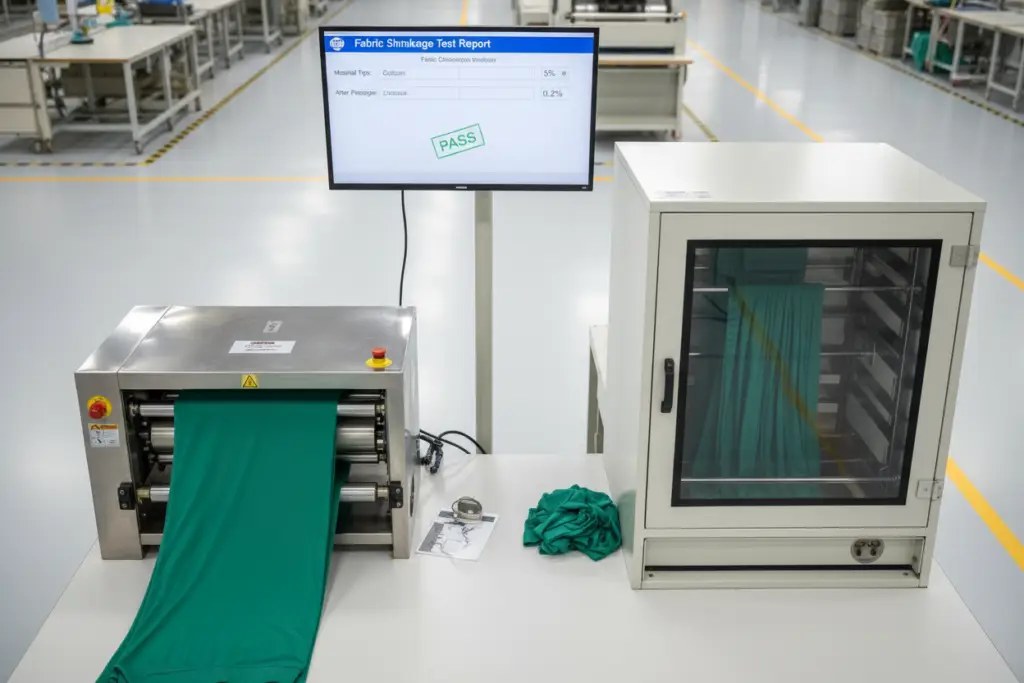
A compactor is a specialized finishing machine. The fabric is fed between rollers and a heated shrinking blanket. The blanket compresses the fabric lengthwise, forcing the yarns to move closer together. This mechanical action simulates the effect of multiple washes in a controlled environment, releasing much of the relaxation shrinkage potential before the fabric is ever cut. A properly compacted cotton jersey, for example, will have a residual shrinkage of less than 3%, compared to 5-8% for an un-compacted one. This is a non-negotiable standard for our quality fabrics .
How Do You Calculate the Correct Shrinkage Allowance for a Pattern?
It is a precise, data-driven process:
- Cut a Test Swatch: A precise square (e.g., 50cm x 50cm) from the bulk fabric.
- Wash & Dry: The swatch is laundered according to the garment's care label (e.g., AATCC 135 standard).
- Re-Measure: The swatch is measured again.
- Calculate Percentage: The difference is the residual shrinkage (e.g., shrank to 48cm in length = 4%).
That 4% is then added to the pattern's length measurements. This is a standard, non-negotiable step in our pre-production process .
How Does Final Wash Testing on a PP Sample Guarantee Customer Satisfaction?
Even with perfectly compacted fabric and a precisely adjusted pattern, the final proof is in a real-world test. You must verify, on a fully constructed garment made from the actual bulk production materials, that all the engineering has worked. This is the final, non-negotiable quality gate before committing to a full bulk production run. It is your ultimate insurance policy.
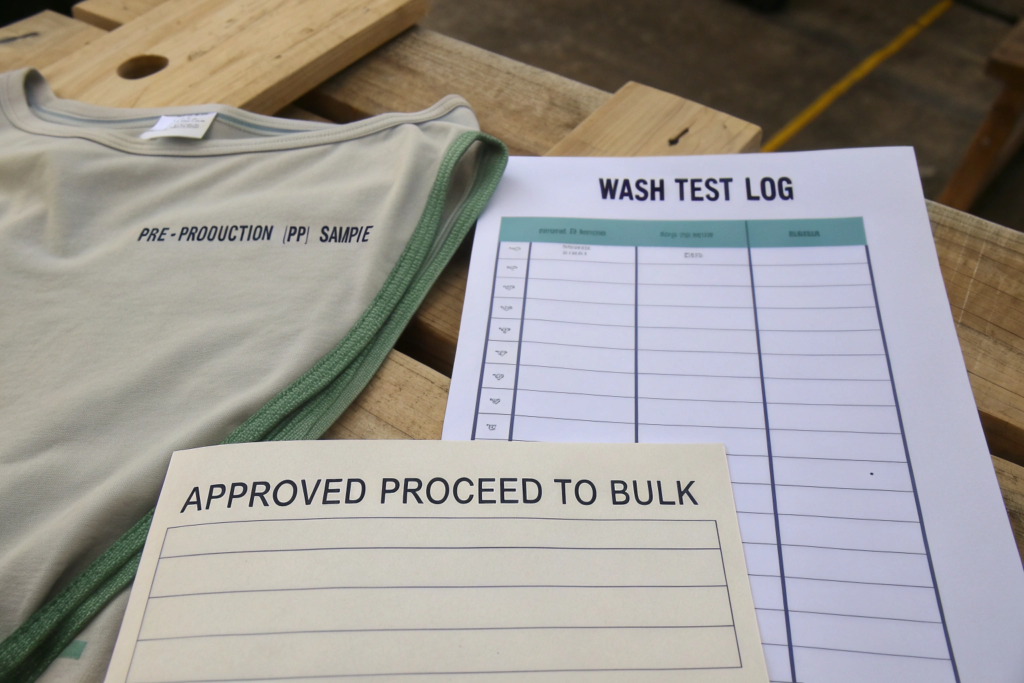
A wash test on the final Pre-Production (PP) Sample is non-negotiable. This sample, made from the actual bulk fabric with all correct trims, must be laundered according to the care label instructions for multiple cycles (usually 3-5). It is then measured against the final, approved spec sheet. This test verifies, in a real-world scenario, that the combination of fabric choice, pattern adjustments, and construction techniques has successfully controlled shrinkage. Only after a passed PP Sample wash test should bulk production proceed.
A brand we work with once approved a PP sample without a wash test because they were in a rush. The bulk order arrived. The tops fit perfectly out of the box. The customers washed them. The tops shrank. The brand had to issue refunds. They now have a strict, non-negotiable policy: No bulk production without a passed wash test on the PP sample. It is a simple rule that has saved them countless headaches. We fully support and enforce this policy. It is a standard part of our quality assurance for knits .
What Should You Do If the PP Sample Fails the Wash Test?
This is why we do the test! If the sample shrinks beyond the acceptable tolerance, we do not proceed to bulk. We immediately investigate the root cause. Was the fabric not properly compacted? Was the shrinkage allowance miscalculated? We work with the mill and our pattern team to identify the issue and correct it. This might require a new pattern or, in a worst-case scenario, a new fabric. Catching this on one sample is infinitely better than discovering it on 2,000 units.
How Many Wash Cycles Are Necessary for an Accurate Test?
A single wash cycle is not enough. Most relaxation shrinkage occurs over the first 3-5 washes. We always perform a minimum of 3 wash/dry cycles on the PP sample to ensure the fabric has reached a stable, equilibrium state. This provides a truly accurate prediction of how the garment will perform for the customer over time. This is the rigor of our quality control protocol .
Conclusion
Fabric shrinkage is not an unavoidable mystery; it is a predictable and preventable physical phenomenon. The main causes—the release of manufacturing tensions in natural fibers and the felting of animal hairs—are well understood. A professional factory uses a combination of proactive mechanical finishing, precise pattern engineering, and rigorous final wash testing to control and neutralize shrinkage, ensuring the customer's experience matches the designer's intent.
At Shanghai Fumao, this systematic approach to shrinkage control is embedded in our entire production process. From the sourcing of our fabrics to the final inspection of the finished garment, we protect your brand's fit and your customer's trust. We do not just make clothes; we engineer lasting satisfaction.
If you are looking for a manufacturing partner who treats shrinkage control as a non-negotiable science, let's talk. Our Business Director, Elaine, can walk you through our quality assurance process for fabric stability. Please email Elaine at: elaine@fumaoclothing.com.