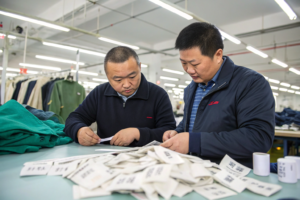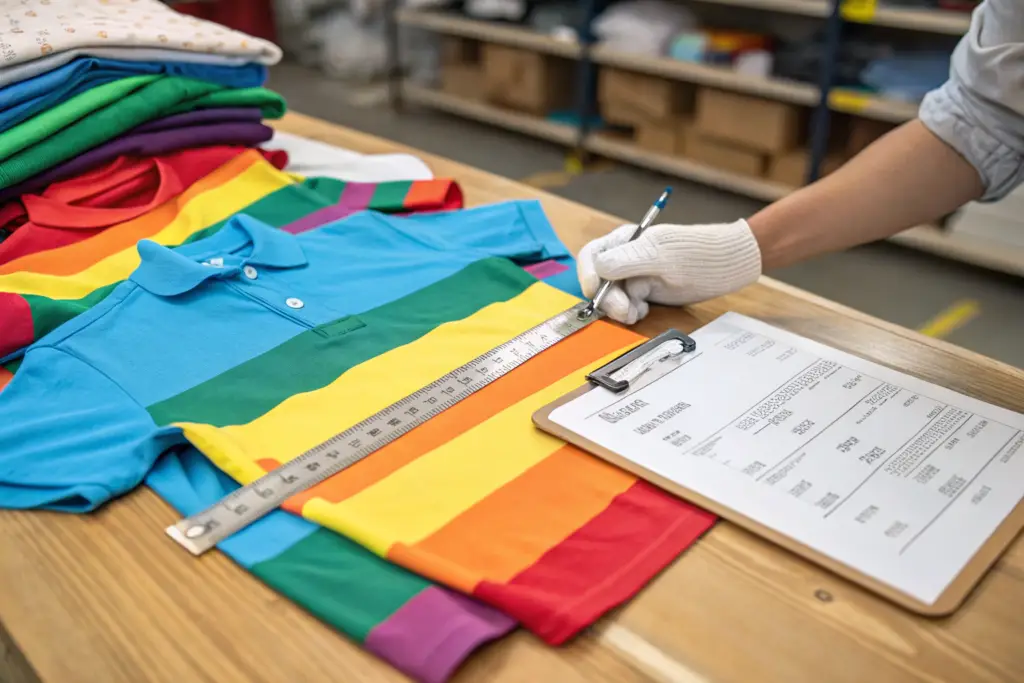
I have been exporting garments from Shanghai to the United States and Canada for over fifteen years. If there is one category that makes even experienced importers sweat, it is children's wear. And honestly, it should. The rules are not suggestions. They are federal law. I have seen entire containers of cute little dresses get seized at the Port of Long Beach because of a drawstring that was two inches too long. I have seen a promising brand go bankrupt because they failed to test their pajamas for flammability and faced a recall. This is not about fashion here. This is about safety and legal survival.
Importing kids' wear into North America requires strict adherence to the Consumer Product Safety Improvement Act (CPSIA) in the U.S. and the Canada Consumer Product Safety Act (CCPSA). These laws mandate specific tracking labels, third-party testing for lead and phthalates, and compliance with stringent flammability standards for sleepwear. Failure to meet these requirements can result in shipment destruction, fines, and legal liability.
Now, I know this sounds intimidating. But at Shanghai Fumao, we deal with these regulations every single day. Our production lines are set up to comply with these standards from the first stitch, not as an afterthought. Let me walk you through exactly what you need to know before you place that first order for rompers or hoodies.
What Are the Mandatory CPSIA Testing and Labeling Rules for U.S. Imports?
I had a client from New Jersey last spring. She had a beautiful line of organic cotton baby onesies. The fabric was soft. The designs were cute. But when I asked for her tracking label format, she looked at me blank. She had no idea that each piece of clothing for a child under 12 needs a permanent label telling where and when it was made. We had to stop the cutting and reprint thousands of labels. It cost her time, but it saved her from having the goods rejected at customs.
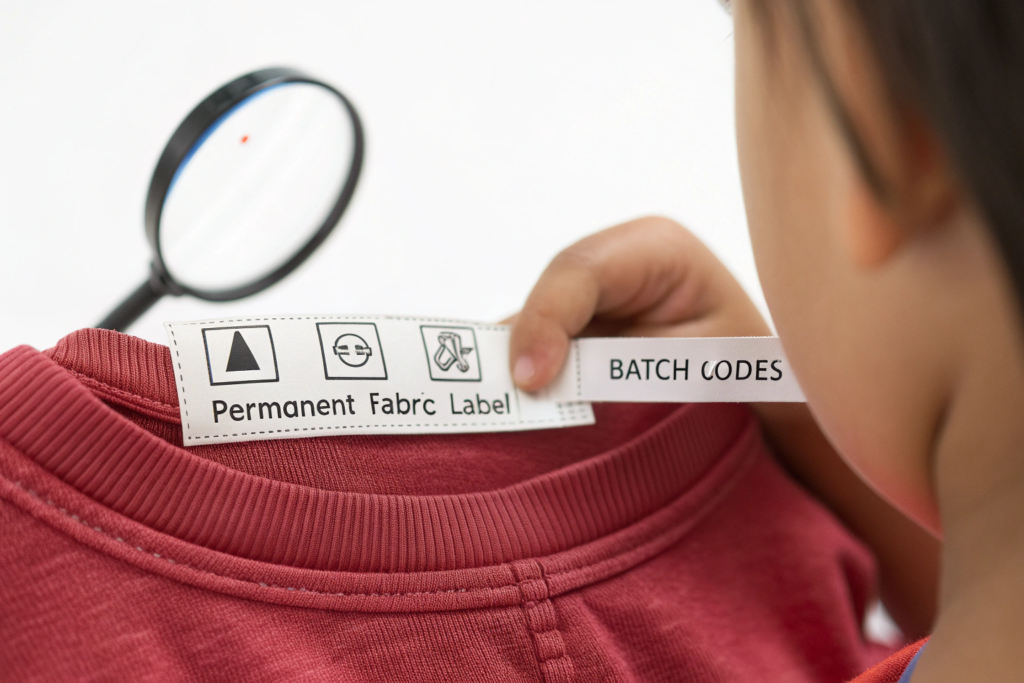
The Consumer Product Safety Improvement Act (CPSIA) is the cornerstone of U.S. compliance for children's products. It requires a Children's Product Certificate (CPC) backed by third-party testing from a CPSC-accepted lab, along with a permanent tracking label on every garment that identifies the manufacturer, production date, and batch number.
This is not optional paperwork. It is a legal admission ticket into the U.S. market. If you are a brand owner, you are the "Importer of Record." That means the legal buck stops with you, not with the factory in China or Vietnam.
How Does Third-Party Testing for Lead and Phthalates Actually Work?
The biggest shock for new buyers is the cost and scope of testing. You cannot just rely on the factory saying "it's safe." You need a piece of paper from a lab on the CPSC's accepted list. At Shanghai Fumao, we coordinate this process, but the cost is usually part of the development budget.
Here is what we test for in all kids' wear components:
- Total Lead Content: Must be below 100 ppm (parts per million) in surface coatings and substrates. We test the fabric dyes, the plastic snaps, and the zipper teeth.
- Phthalates: Certain plasticized components (like soft vinyl patches or screen print inks) cannot contain more than 0.1% of specific banned phthalates (DEHP, DBP, BBP). Last year, we had to reject a batch of cute rubber buttons for a women's wear line because they failed this test. We found an alternative that passed before production started.
It is a common misconception that only plastic parts need testing. Even the fabric dyes and the metal snaps on denim trousers require heavy metal screening. We work with labs like Bureau Veritas and SGS here in Shanghai. I tell my U.S. clients: budget about $300 to $500 per design for initial testing. It hurts the wallet upfront, but it protects the whole brand.
Why Is the Permanent Tracking Label Non-Negotiable?
I cannot stress this enough. This label is your insurance policy. The CPSIA requires this information to be permanently affixed to the garment:
- Manufacturer Name: This is Shanghai Fumao or your private label name.
- Location and Date of Production: City, State/Province, Country, and Month/Year.
- Batch/Lot Number: This connects the specific shirt to a specific roll of fabric.
I remember a case from 2023. A brand had a problem with snaps popping off a jacket. Because we had the tracking label with a unique batch code, we were able to isolate the problem to one day's production on Line 3. We replaced the affected units only. Without that label, they would have had to recall everything they sold that season. That is the difference between a minor headache and a bankruptcy filing. You must ensure the label is durable. It has to survive 50 washes. We use woven satin labels for this exact reason.
How Do U.S. Flammability Standards Differ for Children's Sleepwear?
This is the section that terrifies most of my new clients. It is complicated because the rules change based on what the item is called. A "play dress" has different rules than a "nightgown." Even if they look exactly the same to a parent. The Consumer Product Safety Commission (CPSC) is very strict on this because children have been seriously injured by fast-burning pajamas.
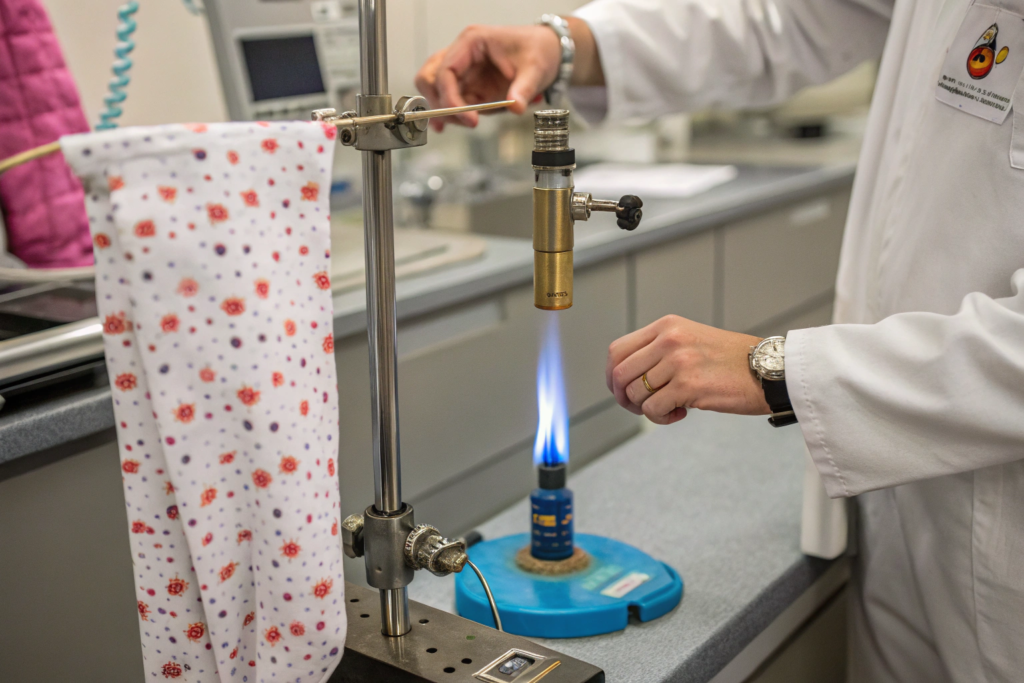
Children's sleepwear sized 9 months to 14 must meet the stringent flammability standards outlined in 16 CFR Part 1615 and 1616. These regulations require fabrics to be either inherently flame-resistant (like polyester treated with fire retardant) or snug-fitting and made of specific natural fibers. Failure to test and certify sleepwear correctly is one of the most common causes of CPSC recalls.
I always advise my brand partners: If it looks like a pajama, and it is made of a fuzzy or loose cotton fabric, we have a serious compliance problem to solve before we cut a single piece.
What Is the Difference Between Tight-Fitting and Loose-Fitting Pajamas?
This is where the law gets very specific. Most apparel brands want to use soft 100% cotton for babies. The law says cotton is dangerous in a loose shape because it burns quickly. So, the solution is to make it tight. But there is a legal definition of "tight."
Here is a comparison of the two compliance paths for sleepwear:
| Compliance Path | Fabric Requirement | Fit Requirement | Labeling Requirement |
|---|---|---|---|
| Tight-Fitting | Must meet specific max dimensions at chest, waist, thigh. No flammability test required if it fits the spec. | "Snug" fit per CPSC measurement charts. Must have permanent label: "WEAR SNUG-FITTING NOT FLAME RESISTANT." | Red and white hangtag warning is required. |
| Loose-Fitting | Must pass vertical flame test (16 CFR 1615/1616). Char length < 7.0 inches. | No fit restriction. | Label: "FLAME RESISTANT FABRIC." |
We use a precise grading system for children's patterns. I cannot just take a standard girls' blouse block and call it a pajama top. The armhole and waist must be scaled down. We have specific tech packs for "Snug Fit Sleepwear" that we have developed over years of exporting to North America. If a client wants a loose, flowing cotton nightgown, we tell them no. We will not make it unless they switch to an inherently flame-resistant polyester fabric. That is a hard line for Shanghai Fumao.
Why Are Drawstrings Banned in Certain Sizes?
While we are on the topic of safety, let's talk about drawstrings. This rule applies to outerwear, not just sleepwear. The U.S. has a mandatory standard (ASTM F1816) that bans drawstrings at the hood and neck area for children's sizes 2T to 12. I have seen a hoodie with a cute cord lock get flagged at the port. It is an automatic seizure.
Here is the quick guide we follow at the factory:
- Sizes 2T-12: Absolutely NO drawstrings around the hood/neck. Waist drawstrings must be short and stitched in place so they cannot be pulled out more than 3 inches.
- Sizes 0-18 Months: Better to avoid all functional drawstrings entirely. Use decorative flaps or snap closures instead.
I recall a specific shipment in 2022 for a boys' activewear set. We caught the issue during our pre-production sample review. The designer had a toggle on the hood. We removed it and stitched the ends of the cord down flat inside the hood lining. The hood looked the same from the outside, but it was 100% compliant and safe.
What Are the Specific Regulations for Importing Kids Wear into Canada?
Many American brands assume that if it's legal in the U.S., it's legal in Canada. That is a costly mistake. I ship containers to both countries from our warehouse in Shanghai, and the paperwork for Canada is a completely separate beast. The biggest difference is the language and the specific flammability testing for textiles.
Importing children's apparel into Canada requires compliance with the Canada Consumer Product Safety Act (CCPSA). Key differences from U.S. law include mandatory bilingual (English/French) labeling for fiber content and care instructions, stricter limits on certain heavy metals, and a unique requirement for flammability testing of all textile products, not just sleepwear.
If you ship a carton of t-shirts to Vancouver with only English labels, Canada Border Services Agency (CBSA) can hold your goods or order you to relabel them at your cost. We handle this in advance.

How Does the CCPSA Textile Flammability Test Differ from CPSIA?
In the U.S., flammability is primarily a sleepwear concern (16 CFR 1610 for general clothing is less strict). In Canada, under the Textile Flammability Regulations, most textile products must meet a specific flame spread time.
Here is what that means for you as a buyer:
- Test Method: Canadian standard CAN/CGSB-4.2 No. 27.5 uses a 45-degree angle flame test.
- The Rule: The flame spread time must be longer than 3.5 seconds for fabrics without raised fibers, and longer than 4.0 seconds for fabrics with a raised surface (like fleece or velvet).
I had a situation with a client who sold outerwear to a retailer in Montreal. They used the same polyester shell fabric for the U.S. and Canadian markets. The U.S. had no issue. Canada flagged the fabric because the pile of the fleece lining was slightly longer, causing a 3.9-second burn time. We had to change the lining supplier for the Canadian run. It was a small detail with big consequences. This is why working with a factory that understands both markets, like Shanghai Fumao, prevents these surprises.
What Are the Requirements for Bilingual Labels and Dealer Names?
The Canadian Textile Labelling Act is very clear. Every garment sold in Canada must have a permanent label with the following:
- Fiber Content: Stated in both English and French (e.g., "100% Cotton / 100% Coton").
- Dealer Identity: This is the brand's Canadian address or a registered CA Identification Number (CA Number). You cannot just put your U.S. address. You need a Canadian presence or registration number.
I usually advise my U.S. clients to apply for a CA Identification Number. It is a simple form with the Competition Bureau, and it costs nothing. It allows you to put "Imported by / Importé par: Brand Name, CA 12345" on the label. This satisfies the law without listing your home address on every shirt.
Additionally, Health Canada has strict limits on Surface Coating Materials. The lead limit for paint on children's products in Canada is even stricter than the U.S. It is 90 mg/kg (ppm), compared to the U.S. 90 ppm limit. We ensure all prints and buttons we source meet this lower threshold.
How Can You Manage Compliance Costs Without Sacrificing Quality?
I hear the frustration from small and medium-sized brand owners all the time. "Testing costs too much." "I can't afford to have a container seized." "My margins are tight." It is a real squeeze. But over the years, I have developed strategies with my clients to keep the brand safe without breaking the bank.
Managing compliance costs requires a proactive strategy centered on component consolidation, batch testing, and leveraging the factory's existing supply chain certifications. By planning production runs strategically and using pre-tested trims, brands can significantly reduce per-unit testing fees while maintaining full legal compliance for the North American market.
You do not need to test every single color of the same t-shirt if the base fabric is the same. There are ways to work smarter.

Can You Batch Test Garments to Save on Lab Fees?
Yes, but with careful rules. A CPSC-accepted lab will allow "batch testing" or "composite testing." This is where you group items that share identical materials and construction.
Smart Testing Strategies We Recommend:
- Color Palette Consolidation: If you have a customizable logo tee in five colors, but all use the same 100% combed cotton from the same mill, we can often test the white (bleached) and the black (heavy dye) only. This brackets the risk for the middle colors like light blue.
- Trim Reuse: This is the biggest cost saver. I keep a library of "Pre-Tested Trims" at the factory. These are snaps, zippers, and woven labels that we have already sent to the lab for lead and phthalates. If a client chooses from our library, they skip that component testing fee.
- Yearly Testing: If you produce the same school uniform shirt year after year with no changes, the CPC certificate is valid. You do not need to retest every shipment. You just need to maintain a record of a "Periodic Testing Plan."
I explain this to clients this way: You pay for the lab's time. If we send them 10 separate zippers, that is 10 invoices. If we send them one "composite sample" of ground-up plastic from all 10, that is one test. We save hundreds of dollars per style this way.
Why Does Good Recordkeeping Protect Your Business?
The CPSC does not just care about the test. They care about your paper trail. If a child gets injured and there is a lawsuit, the plaintiff's lawyer will ask for your "Reasonable Testing Program" documentation. If you cannot show emails, invoices, and certificates, you lose. It is that simple.
At Shanghai Fumao, we maintain a digital file for every PO.
- Mill Certificates: Proof of where the fabric came from.
- Lab Reports: The actual PDFs from SGS or Intertek.
- Inspection Photos: Pictures of the goods being checked against the AQL standard.
I once had a brand owner tell me that during an insurance audit, my detailed file saved him a 15% increase on his liability premium. The underwriter saw the level of detail and lowered his risk profile. Compliance is not just an expense. It is an asset that adds value to your brand.
Conclusion
Bringing children's wear into North America is not like bringing in men's wear or women's wear. The government has a zero-tolerance policy for mistakes because the end user is a child. The legal requirements span from the chemistry of the plastic buttons (lead and phthalates) to the physics of the fabric burning (flammability) to the language on the care tag (bilingual in Canada).
Ignoring these rules is not an option. A single recall can wipe out a small brand. I have seen it happen. But you can manage this risk. You do it by choosing a manufacturing partner who treats compliance as a standard operating procedure, not a premium add-on. You need a factory that will tell you "No, we cannot use that drawstring," or "Yes, we have tested that zipper before."
At Shanghai Fumao, we have built our reputation on navigating these exact hurdles for U.S. and Canadian brands. We do not just sew clothes. We help you build a legally defensible supply chain.
If you are planning a kids' line and feel overwhelmed by the alphabet soup of CPSC, CPSIA, and CCPSA, let's talk. You can reach out to our Business Director, Elaine. She knows the testing labs as well as the pattern makers. Her email is elaine@fumaoclothing.com. Tell her what you are dreaming up, and she will give you the straight story on what it takes to get it safely onto the shelves.