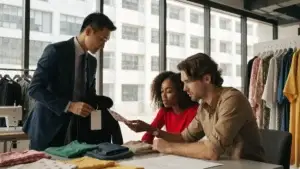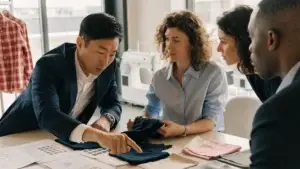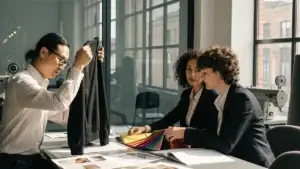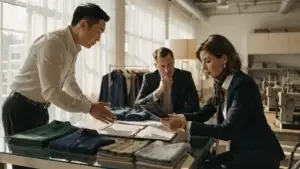
I received a panicked WhatsApp message from a client two summers ago. He was at a trade show in Las Vegas, walking the aisles, when he saw it. Hanging in another booth—not his—was a jacket. His jacket. The exact asymmetric zipper placement he had spent six weeks perfecting. The same contrast lining he had chosen from our swatch book. It was being sold by a trading company he had never heard of. The price was 30% lower than his wholesale price. His entire season was built around that one hero piece. He felt sick. He had trusted the wrong partner, and his design had leaked like water through a sieve.
Protecting intellectual property during overseas manufacturing requires a layered defense strategy that combines legal registration, physical supply chain compartmentalization, and contractual enforceability. It is not about finding a single magic document. It is about making your design too difficult and too risky for a factory or competitor to steal.
Many American brands think filing a U.S. copyright is enough. It is not. Your U.S. registration holds weight in a California courtroom, but it is a piece of paper in a factory town in another country. You need a system that protects the asset at the point of production. At Shanghai Fumao, we have worked with brands who have been burned before. They come to us because we understand that IP protection is a process, not just a clause in a contract. Let me walk you through the practical steps you can take right now to lock down your next collection.
What Legal Documents Are Essential For Overseas Apparel Production?
The first line of defense is paper. Not just any paper, but specific, well-drafted documents that establish the rules of engagement before a single yard of fabric is cut. Too many buyers skip this step because they are in a hurry to see samples. They send a sketch via WhatsApp and say, "Make this." That is an invitation for trouble.
The essential legal foundation consists of a strong Non-Disclosure Agreement (NDA) with teeth, a comprehensive Manufacturing Agreement that vests title in the brand, and a clear record of design ownership prior to disclosure.
These documents won't stop a criminal enterprise, but they will deter an opportunistic factory from "borrowing" your design for another client. They also give you leverage if a problem arises.
Why Is An NNN Agreement More Effective Than A Basic NDA In China?
This is a specific piece of advice that can save U.S. brands hundreds of thousands of dollars. You have probably heard of an NDA (Non-Disclosure Agreement) . It says, "You can't tell anyone my secrets." That is good.
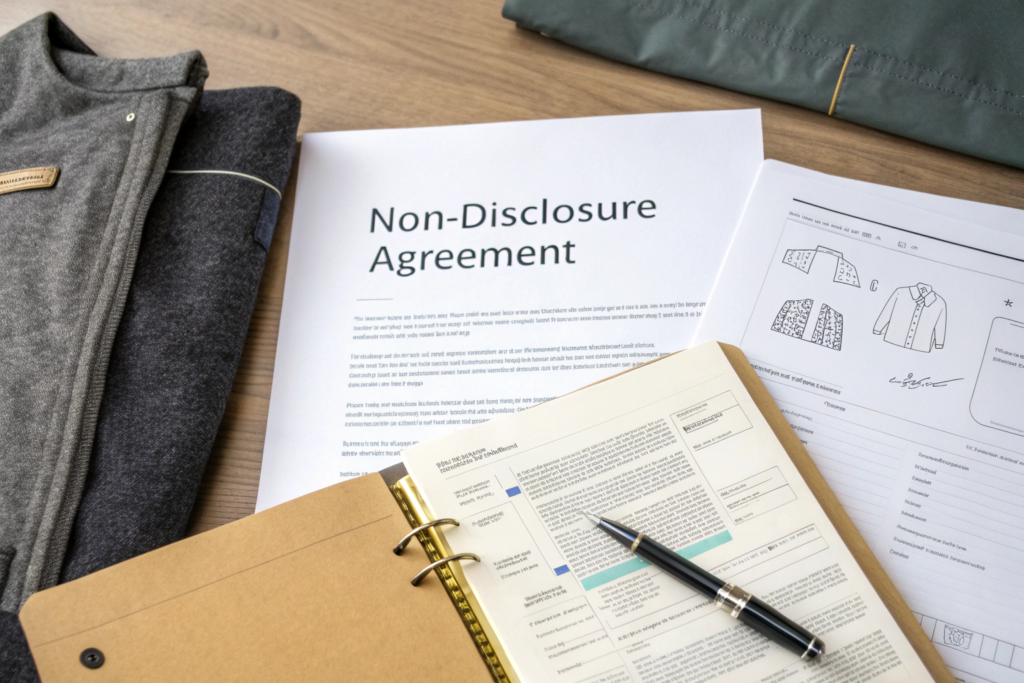
But in China, there is a more robust tool: the NNN Agreement. This stands for Non-Disclosure, Non-Use, and Non-Circumvention.
Here is the difference, based on my experience managing these documents for our clients:
| Document Type | Coverage | Weakness in Enforcement | Recommended For |
|---|---|---|---|
| Basic NDA | Prevents telling others | Does not prevent factory from using design internally | Initial sourcing discussions |
| NNN Agreement | Prevents telling, using, or going around you | Stronger deterrent; recognized in Chinese courts | All design development work |
| Mould Agreement | Prevents unauthorized use of custom hardware/tooling | Specific to physical assets you paid for | Custom buttons, zipper pulls |
An NNN agreement explicitly states that the factory cannot use your design, your pattern, or even your idea to make goods for anyone else, including themselves. It also includes a non-circumvention clause. This prevents the factory from contacting your fabric supplier directly to cut you out of the deal.
I insist that every new client at Shanghai Fumao signs a mutual NNN before we receive their first tech pack. It protects them, and frankly, it protects us by clarifying that we are a service provider, not a co-owner of the design. You can find more resources on protecting trade secrets in China through the U.S. Patent and Trademark Office.
How Does A Detailed Tech Pack Serve As Intellectual Property Proof?
Your tech pack is not just instructions for the sewer. It is a dated legal artifact. It proves that on a specific date, you had conceived of a specific combination of elements: a collar shape, a pocket placement, a stitch type.
I tell designers to treat their tech pack like a lab notebook for an inventor. Every page should be initialed or digitally watermarked with a date. If a dispute ever arises about who designed what first, the timestamp on that tech pack sent via email is your best evidence.
What makes a tech pack a strong piece of evidence?
- Specificity: "Blue thread" is weak. "Coats Moon Thread #S946, 40wt, 12 stitches per inch" is strong.
- Bill of Materials (BOM): Listing the exact zipper supplier (YKK #5 Antique Brass) makes it harder for the factory to substitute a cheaper knockoff without breaching the spec.
- Point of Measurement (POM) Diagram: A sketch with arrows showing exactly where the chest is measured.
If a factory copies a garment, they rarely copy it perfectly. They cut corners. If you have a detailed tech pack and a production sample, you can often prove the copy was derived from your work because the errors or unique tolerances are the same. You can learn more about creating effective technical design specifications from industry associations.
How Can You Physically Secure Designs During The Sampling Process?
Paperwork is the promise. Physical security is the reality. The sampling stage is where most IP theft actually occurs. You send a reference sample. The factory makes a counter-sample. That beautiful, finished sample sits on a shelf in the showroom. Then, another buyer walks in, sees it, and says, "I want that, but cheaper."
Securing designs physically means controlling the number of samples produced and ensuring that excess or rejected samples are destroyed rather than sold or displayed.
This is an area where the factory's culture matters more than the contract.
Why Should Brands Limit The Number Of Pre-Production Samples?
I once visited a factory (not ours) that had a "sample room wall of fame." It was covered in amazing, innovative garments from small, independent U.S. brands. The factory owner was proud of his work. I was horrified. He was showing me, a stranger, the intellectual property of his clients without their knowledge.
This is why we have a strict policy at our facility: Only the account manager and the pattern maker see the full design. The sewing line workers see only their specific operation. They do not see the finished garment assembled until the end of the line.
But more importantly, we limit the number of samples.
- Proto Sample: 1 piece. For fit check.
- Salesman Sample (SMS): Limited to exactly the number the brand requests (e.g., 3 pieces for showroom use).
We do not make "extra" samples for our archive. We do not make samples to "show other clients what we can do" unless we have express written permission to use the garment as a generic portfolio piece after it has been in the market for over a year. I advise brands to include a clause in the NNN agreement that states: "All samples, including defective units, remain the property of the Buyer and must be returned or destroyed with photographic proof." This prevents your pre-production work from ending up on a grey market website. You can review best practices for supply chain security from U.S. Customs.
What Is "Pattern Splitting" And How Does It Prevent Design Leakage?
This is a technique we use for high-stakes, "rare style" projects where the silhouette is the primary asset. Pattern splitting is simple: We do not give the entire pattern to one single subcontractor.
Let's say you have a jacket with a complex, sculptural sleeve. The sleeve is the IP. The body is standard.
- Our in-house pattern maker creates the full pattern.
- We cut the Body Panels in-house at Shanghai Fumao.
- We send the Sleeve Pattern and the cut body pieces to a specialized sewing contractor. They sew the sleeve and attach it to the body.
- The contractor never sees the full pattern. They only know how to assemble the pieces they are given.
This adds a layer of logistical complexity, but for a brand with a signature cut (think of a specific pant curve or a unique hood shape), it is worth the extra coordination. It prevents a subcontractor from running off with the complete "recipe" for your garment. This is a form of trade secret protection by compartmentalization.
This is the nightmare scenario. You place an order for 1,000 units. The factory makes 1,200. You pay for and receive your 1,000. The factory sells the remaining 200 units—with your label sewn in—to a discounter or on a third-party platform. Your brand is suddenly devalued, and you have no control over the pricing or presentation.
Preventing unauthorized runs requires a combination of controlled trim supply and end-of-run destruction oversight.
You cannot stop a determined thief. But you can make the leftover goods worthless to them.
How Does Trim Control Limit A Factory's Ability To Overcut?
Trim is the choke point. A factory can always source more black cotton jersey. They cannot easily source more custom-branded zipper pulls, buttons with your logo engraved, or woven neck labels with your specific font and color.
The most effective IP protection strategy I recommend is Trim Control. You, the brand owner, purchase the custom trims directly from the trim supplier (e.g., a label factory in Hong Kong or a button maker in Italy). You pay for them. You own them. You ship exactly the quantity needed for the order (plus a small, agreed-upon spoilage allowance of 2-3%) to the garment factory.
Here is the math:
- Order: 1,000 jackets.
- You ship: 1,030 zipper pulls.
- Factory must return: The 30 unused pulls or the 30 damaged garment cutouts showing the pulls were used.
If the factory makes an unauthorized run of 200 jackets, they will have no zipper pulls. They will be forced to use a generic zipper. That generic zipper is a giant red flag to customs and to your wholesale buyers. It proves the garment is not an authentic overrun; it is a counterfeit or unauthorized second. This is the single most effective physical deterrent we help clients implement. You can find reputable trim suppliers through the International Textile Manufacturers Federation.
Why Should Brands Demand Proof Of Excess Inventory Destruction?
This is an uncomfortable conversation for some buyers. They feel like they are accusing the factory of being criminals. But in the world of brand protection, it is standard operating procedure for any serious player.
The clause should be in the Manufacturing Agreement: "Upon completion of the Order, Manufacturer shall provide photographic or video evidence of the destruction of all excess branded trim, labels, and defective finished goods bearing Buyer's Marks."
What does this look like in practice?
- The production finishes. QC counts the units.
- There are 17 defective jackets with small stains or seam puckers.
- Instead of the factory selling these as "irregulars" at the local market, they cut out the brand labels and cut the jackets into rags.
- Our QC team takes a dated photo of the cut-up garments and the snipped labels. We email that photo to the client along with the final shipping documents.
This provides peace of mind. It ensures that a year from now, you won't find your "exclusive" jacket being sold for $19.99 at a flea market with the tags cut out. It protects your brand's equity.
How To Vet Overseas Manufacturers For IP Protection History?
You can have the best contracts in the world. If the factory owner has a moral compass that points only to "make money fast," your designs are not safe. Vetting the factory's character is just as important as vetting their stitching.
Vetting for IP protection involves checking a factory's client list for conflicts of interest and observing their operational discipline during a visit or video audit.
This is where you need to trust your gut, backed up by a few specific investigative steps.

What Red Flags During A Factory Visit Signal IP Risk?
When I walk into a factory as a buyer, I do not just look at the sewing machines. I look at the walls. I look at the desks. Here are the red flags that scream "IP Risk":
- The "Brag Board" Full of Current Season Goods: If you see a corkboard with photos of finished garments from various trendy brands that just launched this month, run. That factory is using client work as marketing collateral without permission.
- Open Sample Room Shelves: If the sample room is a free-for-all where any visitor can flip through the racks, your design is one curious glance away from being copied.
- Reluctance to Sign NNN: If the factory says, "Oh, we don't need that, we are honest people," that is a lie. Honest people are happy to sign a document that proves their honesty.
During a video audit, ask the factory manager to show you the Trim Inventory Cage. Is it locked? Is it organized by client name? Or is it a pile of ziplock bags on a shelf? A locked, organized trim cage shows that the factory respects the ownership of the materials. It is a sign of a professional manufacturing partner.
How Can Checking A Factory's Client Roster Prevent Conflicts?
This is a delicate but necessary question. I am always transparent with my clients about who we work with. You do not need to know their exact sales figures, but you need to know if we are making a direct competitor's product in the same category.
For example, if you are a high-end men's shirt brand, you do not want to use a factory that does 80% of its volume for a fast-fashion giant. The processes are different. The mindset is different. The risk of your slim-fit pattern accidentally ending up in a mass-market run is higher.
When vetting Shanghai Fumao, you can ask: "Are you currently producing for any other brands in the premium streetwear space?" I will give you a straight answer. If the answer is yes, we discuss how we physically and digitally separate the workflows. We use different cutting tables and different file servers for clients who compete in the same segment. If a factory is evasive about who else they make clothes for, assume the worst. You can also check import records through tools like ImportGenius to see a factory's shipping history. This gives you a data-driven view of their client base.
Conclusion
Protecting your intellectual property when manufacturing clothes overseas is a continuous act of vigilance, not a one-time legal filing. It requires a blend of smart lawyering and smarter factory management. You need the legal scaffolding of a strong NNN agreement to establish the rules. You need the discipline of a detailed tech pack to prove the creation date. You must control the physical flow of your most sensitive assets—the trims and the patterns—to make theft difficult. And you must enforce the end-of-life of your branded goods by demanding proof of destruction.
The goal is not to make the process adversarial. The goal is to build a partnership with a factory that understands your brand is your most valuable asset. We view our role as stewards of that asset. When you work with a partner like Shanghai Fumao, the systems we have in place—the locked trim storage, the limited sample policy, the transparent client roster—are designed to give you the confidence to innovate without fear.
If you have a new collection in development and you are worried about keeping it out of the hands of copycats, let's put a protection plan in place before you send the first sketch. Reach out to our Business Director, Elaine, at elaine@fumaoclothing.com. She can walk you through our standard IP protection protocols and our NNN agreement. Let's make sure your next great idea stays your idea.