You have designed the perfect women's knitted top. The fit on the sample is impeccable. The drape is beautiful. You ship the bulk order to your customers. Then the reviews start coming in. "Shrank two sizes after one wash!" "It's a crop top now!" Your heart sinks. Your beautiful design is being returned, and your brand's reputation is taking a hit. A brand owner told me, "I thought shrinkage was just something you had to accept with natural fibers. I learned the hard way that it's a controllable, technical issue. I just didn't know the right questions to ask."
Controlling shrinkage in women's knitted tops is a multi-step, proactive engineering process, not a matter of luck. It requires action at three critical stages: 1) Sourcing pre-shrunk or compacted fabric from the mill, 2) Incorporating the residual shrinkage percentage into the garment's pattern and measurements, and 3) Performing rigorous wash testing on pre-production samples to verify real-world performance. This is a non-negotiable part of quality control for any knit garment.
At Shanghai Fumao, we manufacture thousands of knitted tops for women's wear brands. We know that a beautiful fabric that shrinks is a liability. Our quality control system is built to prevent this exact issue. Let me explain the science of shrinkage and the specific, actionable steps we take to ensure the garment your customer receives fits as perfectly as the sample you approved, wash after wash.
What Causes Shrinkage in Knitted Fabrics Like Jersey and Rib?
To control shrinkage, you must first understand its cause. Shrinkage in knitted fabrics like jersey, interlock, and rib is not a mysterious curse. It is a predictable physical reaction primarily driven by the relaxation of tension that was introduced into the fibers and yarns during the knitting and finishing processes. This is especially pronounced in natural fibers like cotton and wool.
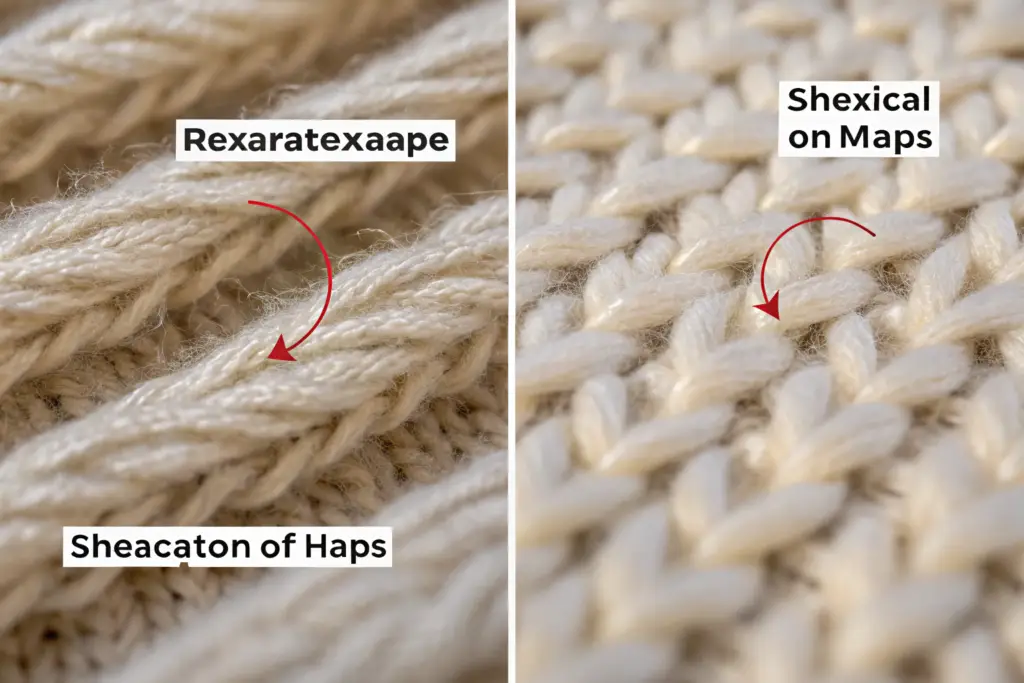
Shrinkage in knitted fabrics is primarily caused by the release of tension and the swelling of fibers. During manufacturing, yarns are stretched under tension. When the finished garment is washed and exposed to water and heat, the fibers absorb moisture, swell, and relax, trying to return to their natural, unstressed state. This causes the loops of the knit structure to draw closer together, resulting in the garment becoming smaller and tighter. This is often called "relaxation shrinkage."
I recall a brand that launched a beautiful line of GOTS organic cotton jersey tops. The samples were perfect. The bulk order arrived, and the customers loved them—until they washed them. The tops shrank a full size. The issue was traced to the mill. The fabric had not been properly compacted (a mechanical pre-shrinking process). The tension from knitting was still locked in the yarns. When the customers washed the tops, all that tension was released, and the garments shrank. The brand had to offer refunds and lost a season of sales. This was a painful, but entirely preventable, lesson in the importance of specifying pre-shrunk fabric. This is a key part of our fabric sourcing education for partners.
Why Are Natural Fibers Like Cotton More Prone to Shrinkage?
Natural fibers like cotton, linen, and wool are hydrophilic, meaning they absorb water. When they absorb water, the fibers swell in diameter. This swelling forces the yarns in the knit structure to take a longer path, which effectively shortens the overall length of the yarn, pulling the loops tighter together. Synthetic fibers like polyester are hydrophobic (do not absorb water) and are therefore much more dimensionally stable and resistant to this type of shrinkage.
What Is the Difference Between Relaxation Shrinkage and Felting Shrinkage?
- Relaxation Shrinkage: This is the primary type for cotton and most knits. It is the release of manufacturing tensions. It is largely reversible and happens mostly on the first wash.
- Felting Shrinkage: This is specific to animal hair fibers like wool. It is caused by the microscopic scales on the fibers interlocking when subjected to heat, moisture, and agitation. It is permanent and progressive.
Understanding the type of shrinkage helps determine the correct prevention strategy. For cotton knits, relaxation shrinkage is the main focus. This is the focus of our quality control for knits .
How Can You Prevent Shrinkage at the Fabric and Pattern Stage?
The battle against shrinkage is won before a single stitch is sewn. It is a proactive strategy that begins with the fabric mill and continues in the pattern-making room. Relying on the customer to follow perfect care instructions is a recipe for failure. You must build shrink-resistance into the product itself.
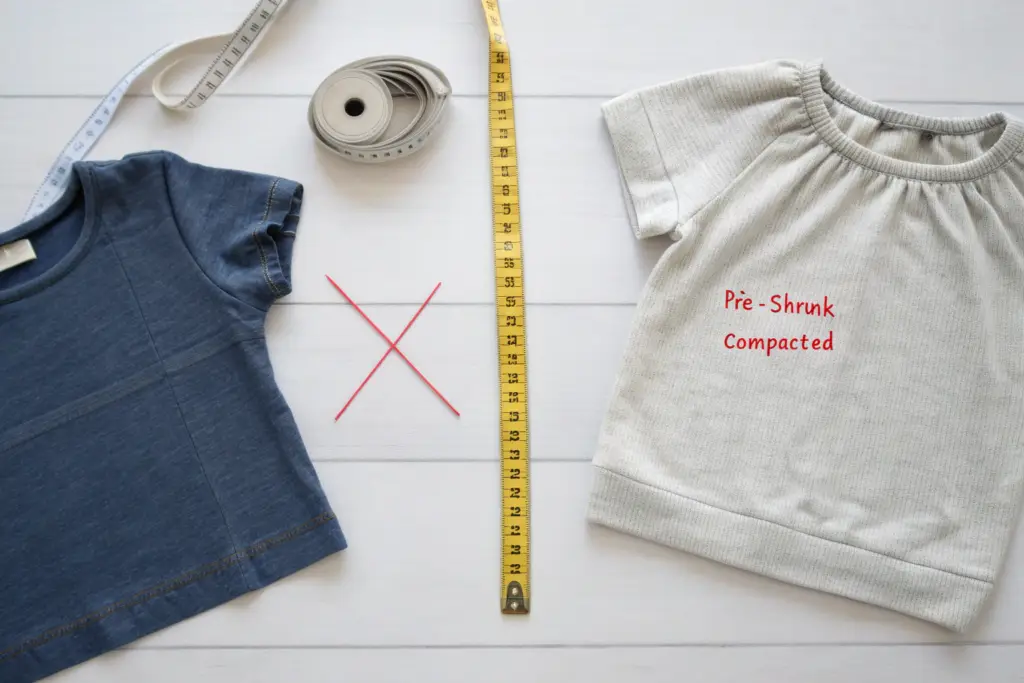
Shrinkage is prevented at two key stages: 1) Fabric Sourcing: Always specify "pre-shrunk," "compacted," or "relaxed" fabric from the mill. These processes mechanically remove much of the tension before the fabric is cut. 2) Pattern Making: A professional factory will conduct a shrinkage test on the approved bulk fabric and then mathematically adjust (scale up) the pattern pieces to account for the expected residual shrinkage. This ensures the garment shrinks to the intended size after washing.
A women's wear client of mine learned to always include a specific note on her fabric POs: "Must be compacted. Max residual shrinkage 3%." This simple line holds the mill accountable. She also relies on our pattern-making team. When we receive her bulk fabric, we cut a test square, measure it, wash and dry it according to the care label, and measure it again. We calculate the exact percentage of shrinkage. Our pattern maker then digitally scales up the pattern by that exact percentage. For example, if the fabric shrinks 4% in length, the pattern is made 4% longer. The finished garment is slightly oversized when new, but it shrinks perfectly to the target spec after the first wash. This is the science of a perfect, lasting fit. This is the value of a technically proficient CMT partner .
What Does "Compacted" or "Pre-Shrunk" Fabric Mean?
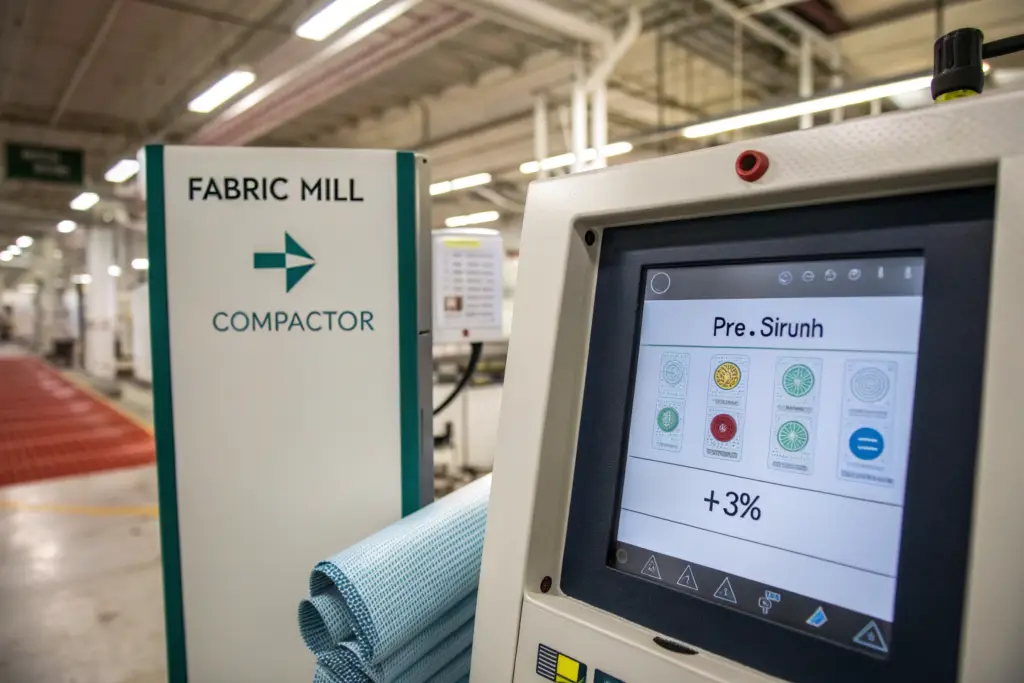
This is a critical textile finishing process. The fabric is passed through a compacting machine (or sanforizer for wovens). This machine uses steam, heat, and pressure to mechanically compress the fabric lengthwise, forcing the yarns to relax and "take up" the shrinkage before the fabric is rolled. A properly compacted cotton jersey will have significantly less residual shrinkage than an uncompacted one. This is a non-negotiable specification for us. This is a key part of our fabric standards .
How Do You Accurately Calculate the Shrinkage Allowance for a Pattern?
This is a precise, data-driven process:
- Cut a Test Swatch: A precise square (e.g., 50cm x 50cm) is cut from the bulk fabric.
- Measure and Mark: The square is measured and marked.
- Wash and Dry: The swatch is washed and dried according to the garment's care label instructions.
- Re-measure: The swatch is measured again.
- Calculate Percentage: The difference is calculated as a percentage (e.g., shrank to 48cm = 4% shrinkage).
That 4% is then added to the pattern dimensions. This is a standard, non-negotiable step in our pre-production process for all knit garments.
Why Is Wash Testing Your Pre-Production Sample Absolutely Essential?
Even with the best-laid plans—compacted fabric and an adjusted pattern—you must verify the results in the real world. The Pre-Production (PP) Sample wash test is the final, critical checkpoint. It is the only way to confirm that all the engineering has worked and that the garment will perform as expected for your customer. Skipping this step is a gamble you cannot afford to take.
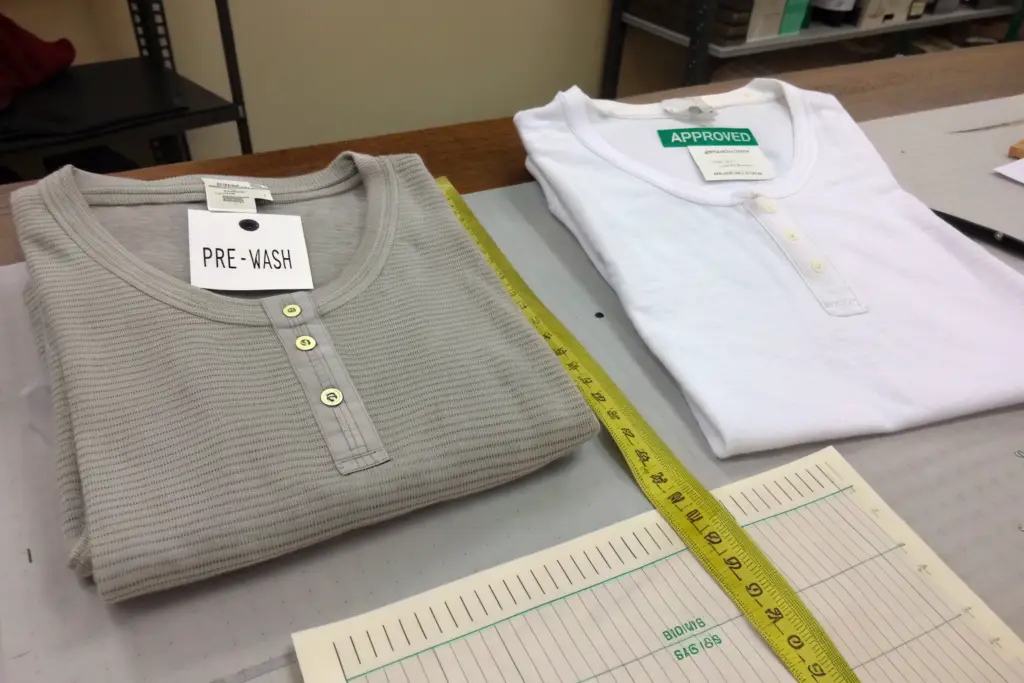
A wash test on the final Pre-Production (PP) Sample is non-negotiable. This sample, made from the actual bulk fabric with all correct trims, should be laundered according to the care label instructions. It is then measured against the final, approved spec sheet. This test verifies, in a real-world scenario, that the combination of fabric choice, pattern adjustments, and construction techniques has successfully controlled shrinkage. Only after a passed wash test should bulk production proceed.
A brand we work with once approved a PP sample without a wash test because they were in a rush. The bulk order arrived. The tops fit perfectly out of the box. The customers washed them. The tops shrank. The brand had to issue a flood of refunds. They now have a strict, non-negotiable policy: No bulk production without a passed wash test on the PP sample. It is a simple rule that has saved them countless headaches. We fully support this policy. It is a standard part of our quality assurance for knits .
How Should You Properly Wash Test a Knit Sample?
It must mimic the consumer's most likely behavior. We follow the care label instructions exactly. If the label says "Machine wash cold, tumble dry low," that is what we do. We use a standard home-style washing machine and dryer, not industrial equipment. We measure the garment before and after. We do this for 3-5 cycles, as most relaxation shrinkage occurs in the first few washes.
What Should You Do If the PP Sample Fails the Wash Test?
This is why we do the test! If the sample shrinks beyond the acceptable tolerance, we do not proceed to bulk. We immediately investigate the root cause. Was the fabric not properly compacted? Was the shrinkage allowance miscalculated? We work with the mill and our pattern team to identify the issue and correct it. This might require a new pattern or, in a worst-case scenario, a new fabric. Catching this on one sample is infinitely better than discovering it on 2,000 units.
How Does Fumao's Quality System Guarantee Shrinkage Control for Your Knits?
Shrinkage control is not a single action; it is a systematic discipline embedded in our entire workflow. From the moment we source a new fabric to the final inspection of the finished garment, we have checks and balances in place to ensure dimensional stability. This is the invisible engineering that protects our B2B partners' brand reputation.
Fumao's quality system guarantees shrinkage control through a documented, multi-step process. It begins with fabric-level testing of every new quality. It continues with our pattern makers' disciplined calculation of shrinkage allowances. It is verified with mandatory wash tests on all PP Samples. And it is monitored during bulk production with random wash tests on finished goods. This systematic approach ensures that the beautiful fit you approved is the fit your customer experiences, wash after wash.
A new brand founder was nervous about using a beautiful, slubby organic cotton jersey for her knit tops. She had heard "slub cotton shrinks like crazy." We assured her that our process would manage it. We sourced a compacted version from a trusted mill. We performed the fabric shrinkage test and adjusted the pattern. We wash-tested the PP sample three times. It was stable. Her collection launched, and the reviews praised the "perfect, lasting fit." She told us, "I was so worried about shrinkage. You made it a complete non-issue. That's the kind of partner I need." That is our goal. To make the complex, technical aspects of manufacturing invisible to our partners, so they can focus on their brand. This is the value of our end-to-end quality control .
What Documentation Do We Provide to Prove Shrinkage Control?
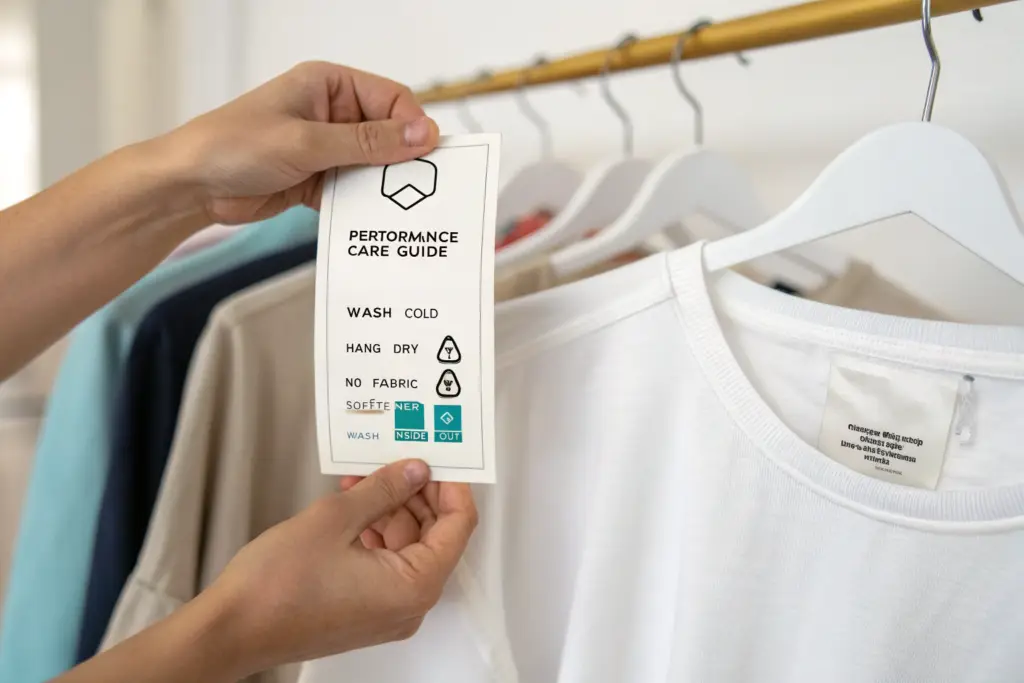
We provide a transparent paper trail. For clients who request it, we can provide:
- Fabric Shrinkage Test Reports: Showing the test results from the bulk fabric.
- PP Sample Wash Test Reports: Documenting the pre- and post-wash measurements of the approved sample.
This documentation provides peace of mind and is invaluable for brands who want to understand and verify their supply chain.
How Do We Handle Different Fiber Blends to Minimize Shrinkage?
Different blends require different approaches. A cotton/spandex jersey will behave differently than a 100% cotton jersey. Our team has deep experience with a wide range of knit fabrics and understands the nuances of each. We adjust our shrinkage allowances and testing protocols based on the specific fiber content and construction of the fabric. This deep technical knowledge is what sets a professional clothing manufacturer apart.
Conclusion
Controlling shrinkage in women's knitted tops is a hallmark of a quality-focused brand and a technically proficient manufacturer. It is not a matter of chance, but a predictable outcome of a disciplined, multi-step engineering process. From sourcing pre-shrunk fabric to making precise pattern adjustments and conducting rigorous wash tests, every step is essential.
At Shanghai Fumao, this process is embedded in our DNA. We understand that the perfect fit you approve on a sample is only valuable if it lasts. Our systematic approach to shrinkage control ensures that your garments maintain their size, shape, and beauty, wash after wash, building trust and loyalty with your customers. We take the worry out of the wash.
If you are looking for a manufacturing partner who treats shrinkage control as a non-negotiable science, let's talk. Our Business Director, Elaine, can walk you through our quality assurance process for knitted garments. Please email Elaine at: elaine@fumaoclothing.com.