I watched a client lose nearly $80,000 in potential profit last fall. Not because his women's wear collection was ugly. It was stunning. The problem was his warehouse. He had 1,200 units of a printed midi dress that sold out in four days. He ran out of stock by week two. Meanwhile, he had 900 units of a linen-blend blazer that nobody wanted. Those blazers sat on the clearance rack for months, eventually selling below cost. The money he made on the hot dress got eaten alive by the inventory carrying costs of the slow blazer. This is the silent killer in our industry.
Accurate apparel inventory forecasting hinges on combining historical sales data with real-time trend signals and a strict classification system for product lifecycle stages. It is not about predicting the future with a crystal ball. It is about managing risk and cash flow through disciplined open-to-buy planning and responsive supply chain adjustments.
Most brand owners I speak with treat forecasting like a guessing game. They order "a little more" of what worked last year and "a little less" of what didn't. This gut-feel approach works fine when you are doing $200,000 a year. It fails spectacularly when you scale past a million. At Shanghai Fumao, we work with distributors who order 5,000 to 50,000 units per season. For them, a 10% forecasting error is not just an inconvenience. It is a six-figure problem. Let me break down how we help partners avoid this trap through better data discipline and smarter production planning.
What Data Points Are Essential For Fashion Inventory Planning?
When a buyer tells me, "I just have a good feeling about this color," I get nervous. Feelings do not pay the freight bill. Data does. But the tricky part with apparel is that not all data is created equal. Selling sunscreen is easy; it correlates with the weather forecast. Selling a puff-sleeve top is harder; it correlates with TikTok.
Essential data points for planning fall into two buckets: Quantitative (hard numbers from your POS system) and Qualitative (soft signals from the market). The key is knowing how much weight to give each bucket based on where the style sits in its lifecycle.
Most small-to-mid brands make the mistake of looking only at last year's sales. They miss the context of why those sales happened.

How Should Historical POS Data Influence Open-To-Buy Budgets?
I worked with a men's wear distributor in Chicago who was convinced his polo business was flat. "We sold 10,000 units last June. Let's order 10,000 for next June." That logic almost sank his summer. When we dug into his point-of-sale (POS) data by week, we found a different story. He sold 2,000 units in the first week of June (great weather) and then 8,000 units in the last two weeks of July (deep 40% off clearance).
His full-price sell-through was terrible. He was ordering to fulfill a clearance demand, not a brand demand. This is a critical distinction. You should not forecast based on units shipped to customers. You must forecast based on full-price sell-through rate. Here is a simple matrix we use internally to coach clients:
| POS Metric | Tells You | Action for Next Season Forecast |
|---|---|---|
| Sell-Through Rate (Wk 1-4) | True initial demand | Increase core color depth; avoid overbuying fringe sizes |
| Discount Depth Required | Perceived value mismatch | Reduce order quantity OR re-engineer cost to hit lower retail |
| Size Curve Variance | Fit consistency of your brand | Adjust ratio of S-M-L vs. XL-XXL for specific cuts |
| Return Reason: "Not as pictured" | Fabric/Color accuracy issue | Tighten lab dip approval process with factory |
By adjusting his buy to prioritize full-price velocity, he reduced his total polo buy by 15% but increased his margin dollars by 22%. That is the power of using historical data critically. You can learn more about retail analytics benchmarks from the National Retail Federation.
Why Is Trend Analysis Unreliable Without Sell-Through Context?
I love looking at runway reports and trend forecasting services like WGSN. They are great for inspiration. But they are dangerous if used alone. I remember a buyer from California who was adamant that "Neon Green" was the color of the spring. The trend reports said so. We made her a beautiful neon green activewear set.
It flopped. Hard.
Why? Because her customer base was suburban women aged 40-55. They liked soft sage and dusty blue. The trend forecast was right for the market overall (Gen Z was buying neon), but it was wrong for her specific segment. This is where we connect trend data to inventory management reality. You must overlay the trend signal onto your existing customer's purchase history. If you have never sold a neon item before, your first order of a neon item should be a test buy, not a core commitment. We advise clients to allocate no more than 10-15% of Open-to-Buy to "trend tests." The remaining 85% should be in proven core styles with new colorways.
How Can MOQ Flexibility Mitigate Overstock Risk In Fashion?
One of the biggest lies in our industry is the "Minimum Order Quantity." I hear buyers sigh: "I love this fabric, but the MOQ is 1,000 pieces per color. I only need 300 to test it." They either walk away or they overbuy. Overbuying is the root of all inventory evil.
MOQ flexibility allows brands to align production quantities with actual demand signals. It shifts the risk from the brand owner's warehouse to the manufacturer's production floor.
At Shanghai Fumao, we do not just say "MOQ is 300." That is too simple. We structure MOQs based on how we source the raw material.
Can Staggered Production Runs Solve Seasonal Demand Uncertainty?
Let me give you a concrete example from a women's wear brand we work with on the East Coast. They had a jacket style they believed in, but the silhouette was new. Total forecast was 2,400 units for Fall/Winter. Instead of placing a PO for 2,400 units due August 1st, we set up a staggered production run.
- Run 1: 800 units. Cut and sewn. Shipped DDP by August 15th. This covered the initial floor set and gave them four weeks of early selling data.
- Run 2: 800 units. Fabric was pre-booked and dyed, but held as greige goods (undyed/unfinished). We waited for the Week 2 sell-through report.
- Run 3: 800 units. Fabric on reserve with the mill, but not yet woven.
The sell-through on Run 1 was soft. The jacket was getting likes online but not conversions. The client was able to cancel the fabric weaving for Run 3 entirely. They took delivery of Run 2 but in a different colorway (they switched from Olive to Black based on early feedback). Because we held the fabric in a flexible state, they avoided making 800 units of a jacket that would have gone to markdown. The cost of holding the greige goods was a fraction of the cost of marking down finished goods. This approach requires a factory with deep supply chain management capabilities and their own fabric sourcing team.
What Role Does Fabric Pre-Booking Play In Cash Flow Planning?
This is the financial secret most factories do not tell you. You do not have to pay for 5,000 yards of fabric upfront if you plan correctly. We allow clients to reserve mill capacity with a small deposit. Think of it like booking a venue for a wedding. You put down 20% to hold the date.
Let's say you forecast 10,000 yards of a custom cotton twill. You pay a reservation fee for the loom time. As we release cut tickets (POs for specific cuts), you pay for the fabric incrementally as it moves from greige to finished goods. This drastically reduces your cash-to-cash cycle. You are not sitting on a warehouse full of expensive, cut fabric waiting for the market to decide if it likes the style. You are holding the potential for fabric, not the fabric itself. This is only possible with factories that are vertically integrated or have exclusive partnerships with textile mills. It prevents the nightmare scenario of having to force production of slow sellers just to "use up the fabric."
Why Does Lead Time Accuracy Impact Seasonal Markdown Strategies?
Fashion is perishable. A winter coat in October is an asset. That same coat in February is a liability. The speed at which goods move from factory floor to retail floor determines whether you capture full price or clearance price. Many buyers focus on the cost of the garment. They should focus on the cost of time.
Accurate lead time forecasting is the single biggest lever you can pull to protect your gross margin. A two-week delay in delivery can erase 20-30% of a garment's profitable selling window.
We track this metric obsessively because a late shipment erodes trust faster than a quality defect.

How Do Port Congestion And Customs Holds Distort Forecasts?
I cannot control the Port of Long Beach. I cannot control U.S. Customs and Border Protection. But I can plan for their unpredictability. This is why I am a broken record about DDP (Delivered Duty Paid) shipping terms, as we discussed in previous conversations.
When you forecast inventory, you must factor in Buffer Stock. But many brands buffer the wrong thing. They order extra units to cover for delays. This is expensive. Instead, you should build a time buffer into your calendar.
Here is a realistic timeline for a custom cut-and-sew program from our factory in Shanghai to a warehouse in Dallas under DDP terms:
| Stage | Optimistic (Days) | Realistic (Days) | Pessimistic (Days) |
|---|---|---|---|
| Fabric Knitting/Dyeing | 14 | 21 | 28 |
| Cutting & Sewing | 18 | 22 | 26 |
| Finishing & Packing | 4 | 5 | 7 |
| Ocean Freight (Shanghai to LA) | 14 | 18 | 22 |
| US Customs Clearance & Drayage | 2 | 4 | 7 |
| Final Mile to Dallas | 4 | 5 | 6 |
| Total Calendar Days | 56 | 75 | 96 |
Look at the gap between 56 days and 96 days. That 40-day variance is the danger zone. If you tell your retail partners the goods will be on the shelf September 1st based on a 56-day lead time, you are almost guaranteed to miss that date. You will be forced to run a markdown optimization strategy you did not plan for. We always advise clients to plan their "In-Stock Date" using the Pessimistic Timeline. If goods arrive early, that is a happy surprise. If they arrive on time (Realistic), you hit your window. If they are late, you are still within the buffer.
Why Should Brands Use A "Never-Out-Of-Stock" Model For Core Items?
While we talk about forecasting seasonal fashion risks, we must also talk about the steady Eddie's of the line: the white t-shirt, the black legging, the classic chino. These are Core Basics. They are not "rare style" items, but they fund the rare style experiments.
For these items, the forecasting model should shift from "Seasonal Buy" to "Never-Out-Of-Stock (NOOS)". I help clients set up a simple reorder trigger. Let's say you stock 500 units of a best-selling white shirt. You sell 25 units per week. Instead of waiting until you have zero left and then waiting 75 days for a new shipment (which means 13 weeks of lost sales), you place a reorder when inventory hits 4 weeks of supply (100 units) .
Because we keep the pattern on file and can slot these basics into our production line quickly (often within 3-4 weeks for a reorder), we can refill the pipeline before the shelf goes empty. This requires the factory to be willing to accept smaller, more frequent POs for proven styles. It is a different way of working, but it ensures you capture every possible dollar of that basic, high-margin revenue. You can learn more about lean manufacturing principles that support this approach.
What Technology Tools Improve Apparel Demand Planning Accuracy?
I am a factory owner. I like sewing machines and fabric rolls. But I have learned that the software stack is just as important as the hardware. You cannot manage a modern apparel brand with a spreadsheet and a prayer. Well, you can, but you will lose money.
The right technology stack reduces the latency between a sale happening in New York and a production decision happening in Shanghai. It turns a lagging indicator (last month's sales) into a leading indicator (next month's demand).
We see two levels of technology adoption among our clients.
Can Excel Be Replaced By AI-Driven Inventory Software For SMBs?
I hear this pushback all the time: "I'm not Nike. I can't afford SAP or Blue Cherry." That is fair. But the gap between Excel and Enterprise software has been filled by a new generation of tools built for small-to-medium brands.
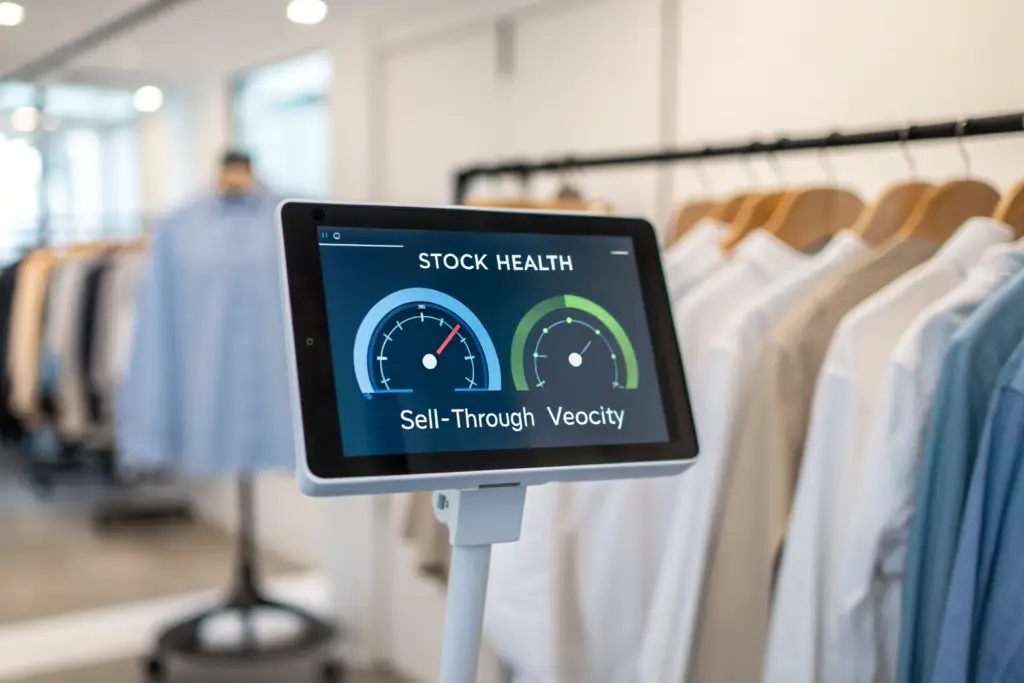
We recommend platforms like Inventory Planner or Cin7. These tools plug directly into your Shopify or WooCommerce backend. They do something Excel cannot do easily: they calculate Days of Inventory Outstanding (DIO) per SKU automatically and flag Dead Stock before it becomes dead.
One of our kids' wear clients switched from Excel to a cloud-based planner last year. The software flagged that they had ordered 200 units of a specific size 2T romper based on last year's ratio, but the current demographic trend of their email list showed a shift toward size 4T. They adjusted the cut ratio before we went into production. That small tweak saved them from a pile of too-small inventory.
AI is also getting better at Initial Allocation. Instead of guessing how many units go to the Chicago store versus the Miami store, AI looks at regional weather patterns and past zip code sales to suggest a smart split. You can explore more about retail AI applications from industry analysts.
How Does Real-Time POS Integration Shorten Production Reaction Time?
This is the holy grail for factories like Shanghai Fumao. When a client gives us read-only access to their POS sell-through data, we become proactive partners, not reactive vendors.
Here is how it works in practice. We had a women's wear client launch a new blouse style. We produced an initial run of 600 units in three colors: Cream (200), Navy (200), and Coral (200). By day three of the online launch, we could see in the POS feed that Coral was selling at 4x the velocity of Cream.
Because we had already pre-booked the greige fabric, we immediately pivoted the second production run. We canceled the Cream reorder and shifted all 400 units of the second run to Coral. The client did not even have to send an email. The data triggered the action. This reduced the "out of stock" window for the hot color from 10 weeks down to 4 weeks. In fashion, those 6 extra weeks of full-price selling are pure profit. It requires a level of trust between brand and factory, but that trust is built on shared, real-time data analytics.
Conclusion
Accurate inventory forecasting for the upcoming season is a discipline, not a talent. It starts with a brutal, honest look at your POS data, specifically separating full-price sales from clearance sales. It requires you to understand that trend reports are only useful when filtered through the lens of your actual customer's behavior. You cannot let a trend forecast convince you to buy 5,000 units of something your customer has never bought before.
The financial structure of how you buy matters just as much as the quantity. Using MOQ flexibility and fabric pre-booking strategies allows you to pull the emergency brake on slow sellers before they become clearance rack liabilities. You preserve cash and you preserve margin. And you must respect time. Building a realistic lead time calendar—one that includes the pessimistic view of customs and ports—will save you from the markdown death spiral that happens when goods arrive two weeks too late.
Technology is the glue that holds this all together. Moving from a static Excel sheet to a system that breathes with your daily sales data closes the feedback loop between your store and our factory floor. At Shanghai Fumao, we are structured to support this agile way of working. We want to help you buy fewer of the wrong things and more of the right things, faster.
If you are staring at a new season line plan and feeling that familiar knot in your stomach about quantities, let's talk numbers. Our Business Director, Elaine, can help you think through production phasing and realistic MOQ planning that aligns with your cash flow. Reach out to her at elaine@fumaoclothing.com. Let's make sure this is the season your inventory works for you, not against you.