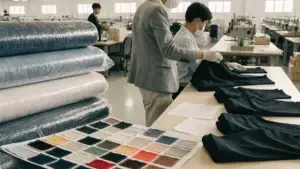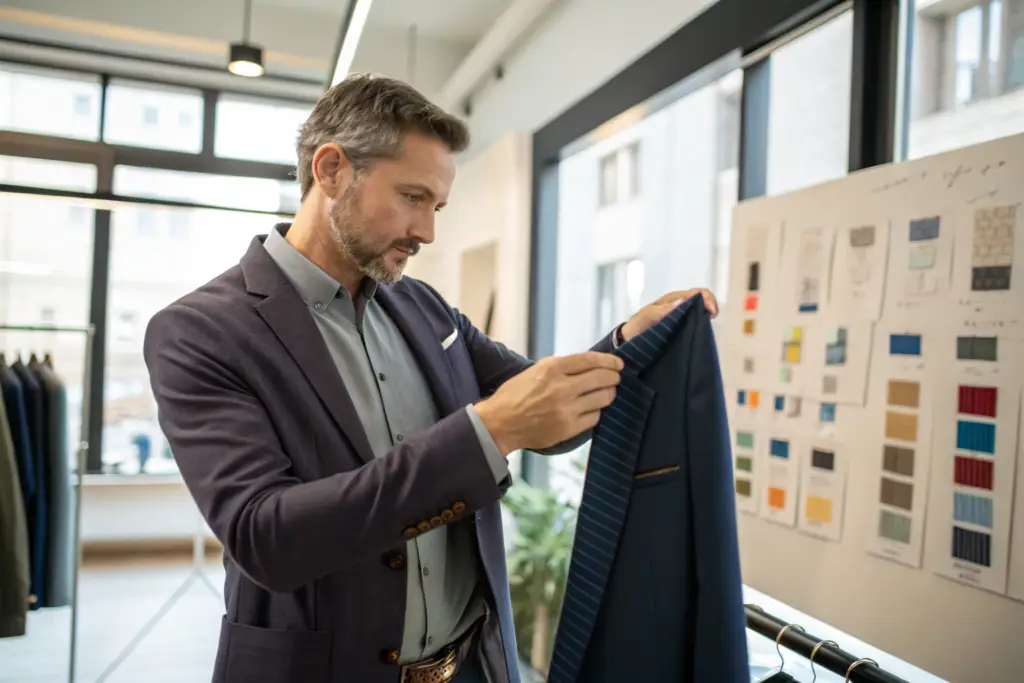
Every menswear buyer has the same nightmare. You place an order for 2,000 units of what you think is the next big thing. The fabric is premium. The fit is sharp. The price is right. Six months later, those 2,000 units are sitting on a clearance rack with a 60% off sticker. Meanwhile, some style you only ordered 300 units of sold out in two weeks. Your customers are emailing you for restocks. But the factory lead time is 90 days. By the time you get more inventory, the moment has passed. You lost the upside on a hit and got stuck holding the bag on a miss.
Predicting which custom menswear styles will sell out is not about having a crystal ball. It is about building a data-driven framework that combines three specific inputs: search trend velocity from Google and social platforms, fabric and silhouette signals from upstream textile mills, and real-time sell-through data from your own wholesale accounts. The brands and distributors who consistently get this right do not guess. They triangulate. They look for the moment when consumer interest is rising while production capacity is still constrained. That gap is where the sell-out happens.
I have been manufacturing custom menswear for American and European brands for over a decade. I have seen styles that I thought were ugly sell 50,000 units. I have seen styles that I thought were beautiful die on the vine. Over time, I stopped trusting my personal taste and started trusting a system. A system that anyone can use, whether you are a large distributor or a boutique brand owner. Let me walk you through exactly how we help our wholesale partners at Shanghai Fumao get ahead of the demand curve instead of chasing it.
Which Data Sources Actually Predict Menswear Demand Accurately?
Most buyers rely on lagging indicators. They look at what sold well last season and order more of it for next season. This is how you end up with too much inventory of a trend that is already cooling off. By the time a style is showing strong sales numbers in traditional retail reports, the early adopters have already moved on to something else. You need to look at leading indicators, the signals that show up months before the cash register rings.
The good news is that we have access to more real-time consumer behavior data than at any point in history. The challenge is filtering out the noise from the signal. Not every viral TikTok is a sustainable trend. Not every spike in Google searches translates to actual purchase intent. Let's break down the data sources that actually correlate with future sales.

Can Google Trends And Pinterest Data Forecast Seasonal Winners?
Yes, but only if you use them correctly. A common mistake is looking at a single keyword in isolation. You see that "linen pants men" is up 40% in March. Great. But was it up 80% last March? If the year-over-year growth is actually slowing, the trend might be peaking, not accelerating.
I work with a menswear distributor in Chicago who uses a simple but effective spreadsheet. He tracks a basket of 20 core search terms every Monday morning. He looks at two specific metrics:
- YoY Growth Rate: Is "Men's Knit Polo" growing faster this January than last January?
- Geographic Concentration: Is the search interest concentrated in trend-setting cities like Los Angeles, New York, and Miami, or is it already saturated in middle America?
In early 2025, his Google Trends data showed a sharp, sustained increase in searches for "Camp Collar Shirt" specifically coming from California and Texas. The national numbers were not huge yet. But the coastal signal was strong. He placed a modest pre-season order with us for 800 units of a custom rayon camp collar shirt in three exclusive prints. By the time the mainstream retailers had their versions on the floor in May, his customers had already bought them out. He re-ordered twice. He sold over 3,000 units of a style he had never carried before.
Pinterest is another underutilized tool for menswear. Pinterest users are planners. They pin outfits for upcoming vacations, weddings, and events months in advance. A sustained increase in pins for "Linen Suit Beach Wedding" in January is a reliable predictor of demand for lightweight tailoring in April and May. Use Pinterest Trends to identify these early planning signals.
Why Should You Monitor Fabric Mill Order Books For Early Signals?
This is an insider advantage that most small and medium brands completely overlook. The textile mills are six to nine months upstream from the retail floor. By the time you see a garment in a store, the fabric for that garment was ordered almost a year ago. If you can get visibility into what fabrics the mills are selling heavily right now, you get a six-month head start on the rest of the market.
At Shanghai Fumao, we source fabrics from major mills in China and Taiwan. We see which yarns and finishes are getting the biggest commitments from large global brands. I share this intelligence with my wholesale partners. Here is what we observed in Q4 2025 that informed Q2 2026 production planning:
| Fabric Category | Mill Order Volume Trend (Q4 2025) | Implication for Q2 2026 Menswear |
|---|---|---|
| Heavyweight Cotton Jersey | Up 22% YoY | Demand for premium, structured t-shirts and polos is rising. |
| Linen Blends (Linen/Cotton) | Up 35% YoY | Expect a strong season for breathable woven shirts and relaxed suits. |
| Recycled Poly Performance Knit | Flat (+1% YoY) | The activewear-driven "tech fabric" trend in casual menswear may be plateauing. |
| Textured Seersucker | Up 18% YoY | Preppy, vintage-inspired textures are making a comeback. |
This data does not tell you exactly which style will sell out. But it tells you which fabric categories will have constrained supply. If mills are running at full capacity on linen blends, and demand spikes in April, there will be a shortage. Factories will have to turn away late orders. The brands that booked their linen production in January will be the only ones with inventory in May. They will sell out. Everyone else will watch from the sidelines.
What Are The Core Silhouette Shifts Happening In Menswear Now?
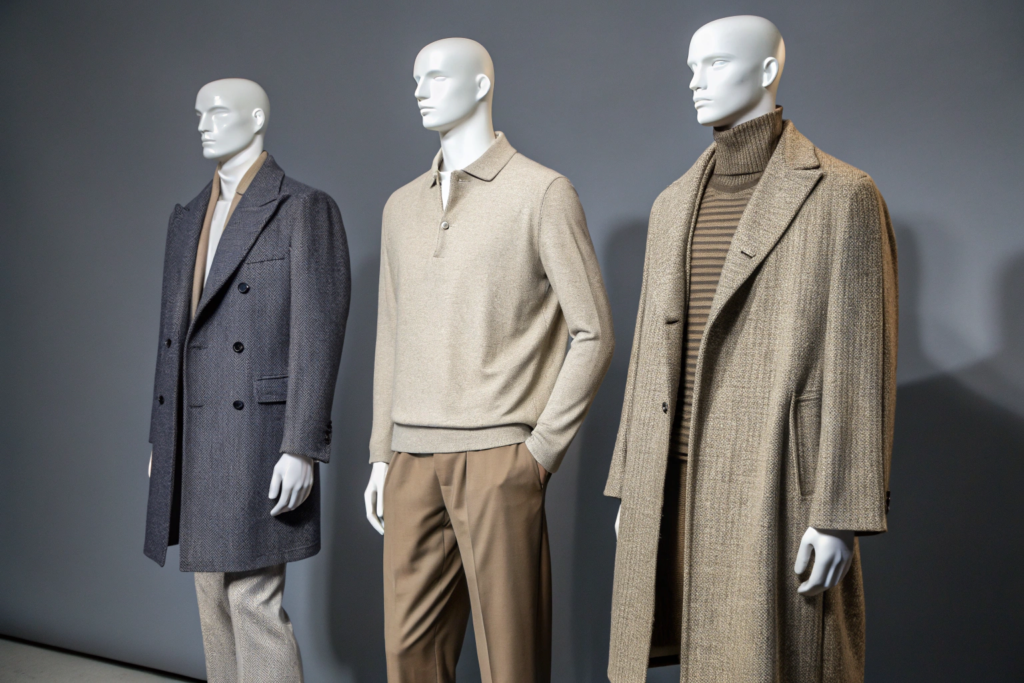
Menswear changes slowly. It does not have the wild, week-to-week swings of women's fast fashion. But when it does shift, the shift is seismic and lasts for years. We are currently in the middle of one of the biggest silhouette transitions in a decade. The era of the spray-on skinny jean and the shrunken suit jacket is over. The pendulum has swung back toward volume, comfort, and drape.
Brands that are still designing for the 2015 male body are struggling. Brands that have embraced the new proportions are selling out. Let's look at the two specific silhouette shifts that are driving sell-out velocity in custom menswear right now.
Are Relaxed Fits Replacing Slim Cuts In Woven Tops?
The data from our cutting floor says yes. In 2022, our standard block for a men's casual woven shirt had a chest ease of about 5 inches. That is a slim, trim fit. Today, the most requested fit block from our brand partners has a chest ease of 7 to 8 inches. That is a relaxed, classic fit. It is a fundamental change in how the garment hangs on the body.
This shift is driven by two factors. First, the post-pandemic consumer prioritizes comfort. He does not want a shirt pulling across his chest when he reaches for his coffee. Second, the dominant aesthetic on platforms like Instagram and TikTok has moved from the tailored "menswear influencer" look to a more effortless, drapey, workwear-inspired look.
I produced a run of Cuban Collar Shirts for a Los Angeles brand in February 2026. The design called for a boxy, cropped fit with a wide sleeve opening. It was the opposite of everything we made five years ago. The brand owner was nervous. He ordered 600 units. They sold out on his website in six days. He re-ordered 1,200 units. They sold out again. The consumers were not just buying a shirt. They were buying into a new proportion. They wanted that specific drape. The lesson here is that if your woven top program is still built entirely on slim fit blocks, you are missing the biggest demand pocket in the current market.
What Is Driving The Return Of The Pleated Trouser?
I will admit, when I first saw pleats coming back, I was skeptical. I associated them with the baggy, unflattering trousers of the 1990s. But the modern pleated trouser is different. It is cut with a higher rise, a wider leg, and a taper below the knee. It creates a clean, elongated line that is both comfortable and sophisticated.
Our production data shows that pleated trouser orders have increased by 40% year-over-year for our wholesale accounts. The single reverse pleat is the most popular entry point. The double pleat is for the more fashion-forward customer. The demand is strongest in fabrications like:
- Wool Flannel for fall and winter.
- Linen Blends for spring and summer.
- Cotton Twill with a garment wash for a soft, broken-in feel.
A distributor we work with in the Southeast US specializes in selling to independent menswear boutiques. He told me last month that his accounts are specifically asking for "Pleated Easy Pants." They do not want the flat front, five-pocket chino that was the uniform for the last fifteen years. They want a trouser with texture, drape, and a little bit of sartorial character. He placed a blanket order with us for 5,000 units across three colors in a Cotton/Modal Twill with a single pleat. He is confident they will be gone by October. Based on the re-order patterns we are already seeing from other brands, I agree with him.
How Can You Leverage Limited Production Runs To Drive Urgency?
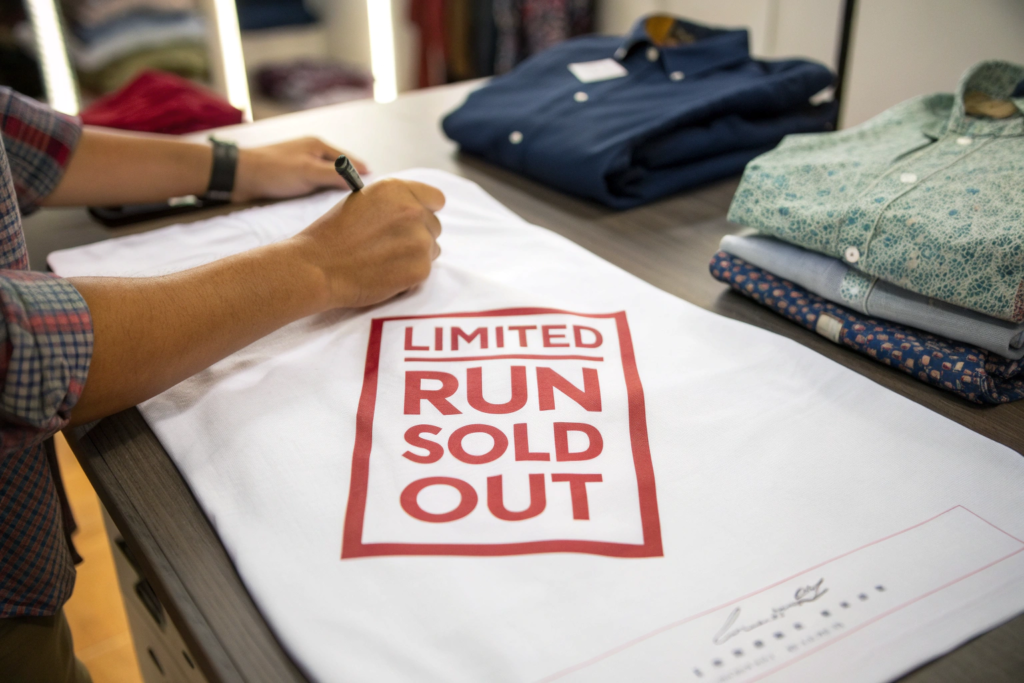
In a world of infinite choice on Amazon and Shein, scarcity is a superpower. Consumers have been trained to wait for a sale. They know that if they do not buy the navy chino today, it will probably be available next week, next month, or next year. That kills your margin and your cash flow. Limited production runs flip the psychology. They change the question from "Should I buy this?" to "Can I afford to miss this?"
This strategy works especially well for custom menswear because men are loyal to specific fits and fabrics once they find one that works. If a customer knows that the Japanese Selvedge Denim in his exact size and preferred cut is only available in a batch of 200 units, he is far more likely to buy immediately at full price. Let's look at how to structure these runs for maximum sell-through.
Why Do Small Batch Drops Create Higher Sell-Through Rates?
The math is simple. When you order a large quantity, you are forecasting demand months in advance. Your forecast is almost certainly wrong. You will have too much of some sizes and colors, and not enough of others. The leftover inventory sits in your warehouse, accruing storage fees and depreciating in value.
Small batch drops invert this risk. You order a quantity that you are highly confident you can sell, even if the trend cools off slightly. Let's use a real example. A menswear brand we partner with in New York wanted to test a Garment Dyed Oxford Shirt in a unique "Dusty Lavender" color. It was a risky color for menswear. In the old model, they would have ordered 800 units across four sizes and hoped for the best.
Instead, we produced a micro-run of 150 units. We used our digital printing and small-batch dyeing capabilities to make this financially viable. The brand marketed it as a "Studio Limited Color." It sold out in 48 hours. They collected a waitlist of over 300 emails. They then placed a second, slightly larger order of 250 units. That also sold out. They never had to put the shirt on sale. They never paid for storage. They captured full margin on every single unit. And they built a reputation for offering exclusive, hard-to-get product.
Here is the production reality that makes this possible. With modern manufacturing at Shanghai Fumao, we can handle these smaller batches efficiently because we have flexible production lines. We are not a 50,000-unit-per-style factory. We are built for brands that need 300 to 3,000 units per style. This is the sweet spot for the limited drop model.
Can Pre-Order Models Reduce Your Inventory Risk To Zero?
Pre-order is the holy grail of demand prediction. You do not guess what will sell. You let your customers tell you with their wallets before you commit to production. This model has traditionally been difficult for apparel because factory lead times are long and customers do not want to wait six weeks for a t-shirt.
But for custom, high-value menswear items, the pre-order model is thriving. A brand we work with that specializes in Made-to-Order Chinos runs a pre-order window for two weeks every season. They offer the chino in three new seasonal colors. The customer selects their waist size and inseam length. The brand collects the orders. They send us a single spreadsheet with the exact size breakdown. We cut and sew the exact number of units ordered. There is zero excess inventory. Zero waste. Zero markdowns.
This requires a factory partner who can execute with precision and reliability. The brand is making a promise to their customer based on our delivery date. If we are late, the brand's reputation is damaged. We have built our production scheduling around these pre-order windows. We block out capacity based on the brand's forecast. When the final numbers come in, we slot the order into the line and deliver within the promised 4-6 week window. For a brand owner, this model transforms your cash flow. You collect revenue from the customer before you pay the factory for the bulk of the production. That is a game-changing working capital advantage.
Which Fabrications And Textures Are Showing Strong Early Momentum?
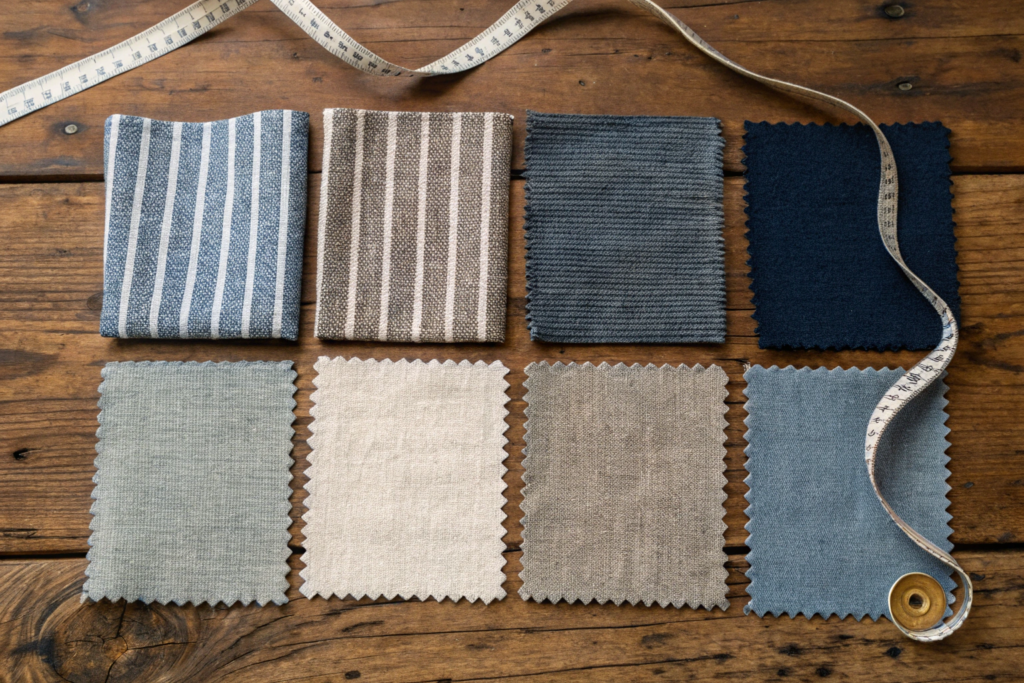
In menswear, the fabric often is the style. A button-down shirt is a button-down shirt. The difference between a shirt that sits on the rack and a shirt that sells out in a week is the hand feel, the visual texture, and the drape of the cloth. Men are tactile shoppers. They touch the fabric. They rub it between their fingers. If it feels special, they buy it.
Based on our production orders for the first half of 2026, we are seeing a clear shift toward fabrics with surface interest and natural texture. The days of the flat, smooth, wrinkle-free polyester blend are numbered for the premium menswear customer. He wants to feel something.
Is Garment Dyeing The Secret To The Perfect Faded Look?
Garment dyeing is a process where we sew the shirt or pant completely in a raw, undyed state. Then we wash the finished garment in a giant industrial washing machine with dye and softeners. This is different from piece dyeing, where the fabric roll is dyed before cutting.
The result of garment dyeing is a soft, broken-in feel and a unique, slightly uneven color that looks like your favorite shirt from five years ago. It has character. It also has a major production advantage for brands: color flexibility. Because we hold inventory of raw, undyed garments, you can decide on the final color much later in the production cycle. If "Dusty Blue" is trending on social media in March, we can garment-dye a batch of raw shirts in that color and ship them in April. You cannot do that with piece-dyed fabric.
One of our longest-running partners, a men's brand focused on elevated basics, has built their entire woven shirt program around garment dyeing. Their top-selling SKU is a Garment-Dyed Twill Camp Shirt. They offer it in six seasonal colors per drop. The fabric has a subtle slub texture. The dye gives it a lived-in look. The buttons are made from Corozo nut, which takes the dye differently than plastic and adds to the vintage feel. They sell this shirt for $118. They rarely put it on sale. It sells out because it feels and looks like nothing else in the customer's closet.
Why Are Textured Knits Outperforming Smooth Jersey This Year?
The standard men's t-shirt has been a smooth, 180gsm cotton jersey for as long as I can remember. It is a commodity. The market is flooded with them. The brands that are winning right now are the ones offering knitwear with visual texture.
We are running our knitting machines at full capacity on styles like:
- Slub Jersey: Yarn with intentional thick and thin variations creates a vintage, uneven surface.
- Thermal Knit: The classic waffle texture is back, not just for long johns, but as a fashion fabric for henleys and long-sleeve tees.
- Pique Knit: The polo shirt fabric is being used for full-zip jackets and relaxed sweaters.
- Pointelle and Rib Stitch: Open, airy knits for summer layering.
In March 2026, a client of ours launched a Slub Cotton Henley in three neutral colors. They ordered 400 units per color. The henley with a smooth jersey body would have been a basic restock item. The slub texture made it look premium and intentional. It sold out in ten days. The texture photographed beautifully on their website. The customer reviews mentioned the "unique feel" repeatedly. This is a simple lesson: if you are competing in a crowded category like men's knit tops, texture is your differentiator. It is the reason a customer picks your $68 tee over a $25 generic one.
Conclusion
Predicting which custom menswear styles will sell out is a discipline, not a lottery. It requires moving beyond gut instinct and building a systematic approach to reading the market. You must monitor search and social trend velocity to catch the wave as it builds, not after it crashes. You must pay attention to the upstream signals from textile mills to understand which fabric categories will be supply-constrained. You must embrace the current silhouette shift toward relaxed fits and textured fabrications, leaving the slim-fit era behind. And you must structure your production strategy around limited drops and pre-orders to reduce inventory risk and create the scarcity that drives full-price sell-through.
The brands that master this approach do not end up with warehouses full of discounted dead stock. They end up with waitlists. They end up with customers who check their website every Thursday morning for the new drop. They end up with healthier margins and stronger cash flow.
At Shanghai Fumao, we are more than just a factory. We are a production partner who helps you navigate these demand signals. Our flexible production lines and expertise in small-batch manufacturing make the limited drop model possible for brands of all sizes. We can help you react quickly when a style takes off, and we can help you manage risk when you are testing a new concept.
If you want to get ahead of the curve for the next selling season, let's talk about what is on your line plan. Our Business Director, Elaine, can walk you through our current capacity, fabric availability, and lead times for custom menswear production. Reach out to her directly at elaine@fumaoclothing.com. Let's make sure your next order is the one that sells out, not the one that goes on clearance.