I remember a phone call I had with a new brand owner from Texas about four years ago. He was thrilled. He had just negotiated a price of $3.85 per unit for a custom women's wear top. His landed cost calculation in Excel showed a healthy 65% margin. He was planning his next vacation. Then the shipment arrived. There was a customs exam fee. There was a port congestion surcharge. There was a trucking wait time fee. And then, he discovered that 3% of the units had loose buttons and needed local repairs. His 65% margin? It shrank to 22%. He did not take that vacation.
The sticker price of wholesale clothing from Asia is only the starting point. The real profit erosion happens through unplanned logistics fees, poor quality resulting in repair or markdown costs, and inefficient payment or shipping terms that hide financial leakage. Identifying and controlling these variables before production begins is the key to protecting your bottom line.
At Shanghai Fumao, I see my job as protecting your margin as much as protecting the stitching. I want to show you where the money hides and how to stop it from leaking out of your pocket.
What Are the Most Common Hidden Fees in International Apparel Shipping?
Freight is the jungle where money gets lost. You get a quote for "Ocean Freight: $2,500." But that is just the boat ride. That number does not include getting the container on the boat or off the boat. I have learned to list out every possible touchpoint cost for my clients before we book the vessel.
The most common hidden costs in international shipping include Terminal Handling Charges (THC) at both origin and destination, Documentation Fees, Customs Exam Fees, and Detention/Demurrage charges incurred when containers are not picked up or returned on time. These fees can add 15-25% to the base freight quote if not managed properly.
You cannot avoid all of these fees. Ports charge what ports charge. But you can plan for them and choose shipping methods that bundle them into one predictable price.
How Does DDP Shipping Protect Against Port and Customs Surprises?
This is why I strongly advocate for Delivered Duty Paid (DDP) shipping for my U.S. brand partners. When you buy FOB (Free on Board), you own the container the second it leaves my factory gate. That means you are on the hook for every surprise that happens between Shanghai and your warehouse.
Here is a breakdown of the cost visibility difference:
| Cost Category | FOB (Free on Board) | DDP (Delivered Duty Paid) with Shanghai Fumao |
|---|---|---|
| Ocean Freight | Variable. Subject to spot market spikes. | Fixed. We contract bulk rates. |
| Destination THC | Your freight forwarder bills you separately. Often $150-$300. | Included in our price. |
| Customs Bond | You must arrange and pay annually or per entry. | Included. |
| Customs Exam | You pay for the labor to unload/reload the container ($500-$1,000+). | We cover the risk or cap the exposure. |
| Trucking to Door | Subject to fuel surcharges and chassis splits. | Fixed quote. |
I had a client last year who insisted on using his own forwarder under FOB terms to save money. The forwarder quoted him $2,800 for the move. By the time the container was delivered to his warehouse in New Jersey, the final invoice was $4,700. There was a "Pier Pass Fee," a "Chassis Usage Fee," and a "Clean Truck Fee." He switched to our DDP mode for the next order. The price was slightly higher upfront, but it was the final price. No surprises. He could budget accurately.
Why Are Inland Transportation and Warehousing Costs Often Underestimated?
The boat docks at Long Beach. Great. Now how does the garment get to Kansas City? This leg of the journey has become the most volatile part of the supply chain in recent years.
Key Cost Drivers in Inland Logistics:
- Chassis Shortage Fee: The container needs a set of wheels. At peak season, there is a daily rental fee just for the trailer chassis.
- Fuel Surcharge: Fluctuates weekly.
- Drop Trailer Fee: If your warehouse cannot unload the container in the free time (usually 2 hours), the driver charges for "detention."
I remember a brand owner who ordered a large quantity of outerwear. The jackets were bulky, so the container was "cubed out" (full) before it hit the weight limit. He had planned for the ocean cost but not for the fact that the warehouse charged him extra for each pallet because they were tall and hard to stack. We now discuss pallet configuration before we pack the container. We try to keep carton heights uniform to save on warehouse put-away fees. It is a small detail that saves hundreds of dollars per shipment.
How Do Quality Control Gaps Translate into Real Financial Loss?
I have a rule in my factory: "We can spend $1 on prevention, or you can spend $10 on correction." The hidden cost of bad quality is not just the $0.50 refund per unit. It is the freight to return it. It is the labor to inspect it again. And worst of all, it is the lost customer lifetime value when a shopper receives a bad product.
The financial impact of inadequate quality control extends far beyond the factory's warranty credit. It includes reverse logistics costs for returns, chargebacks from retail partners, labor costs for local rework or re-bagging, and long-term brand erosion resulting in higher customer acquisition costs.
You must view quality assurance as an investment with a measurable ROI, not an expense line item.
What Is the True Cost of a 3% Defect Rate?
Let's do some math based on a real scenario I analyzed for a client in California. He was buying 10,000 units of men's wear shirts at $6.00 FOB per unit.
- Factory Price: $60,000
- Landed Cost (Freight/Duty): $15,000
- Total Investment: $75,000
He had a 3% defect rate (holes, stains, mislabeled sizes). That is 300 unsellable shirts.
- Lost Revenue: 300 units x $30 Retail = $9,000 opportunity cost.
- Hidden Costs: His team spent 40 hours sorting the shipment and filing a claim. That labor cost him another $1,000.
- Net Loss on Defects: $10,000 on a $75,000 investment.
That 3% defect rate wiped out 13% of his total project profit. When we started working with him at Shanghai Fumao, we implemented a stricter AQL 2.5 inspection paid for upfront. The inspection cost $450. It caught 280 of those defective units before they left Shanghai. We repaired or replaced them. His defect rate dropped to 0.5%. The $450 investment saved him over $9,000.
How Does Fabric and Trim Substitution Affect Your Margins?
This is a sneaky one. Some factories quote a price based on a certain weight of fabric or a certain quality of zipper. Then, when you re-order, they switch to a lighter, cheaper version to squeeze out more profit. You might not notice until the returns start coming in.
I had a client who sold a premium activewear hoodie. The first run used a 380gsm fleece. It was heavy and luxurious. The re-order came, and it felt like a 320gsm fleece. The price was the same, but the quality was not. The brand's reviews went from 5 stars to 3 stars with comments like "thinner than before."
To combat this, we keep a "Production Sealed Sample" for every client. It is a physical garment from the first bulk run signed by both me and the client. If you place a re-order, we match that sample exactly. If the fabric mill discontinues that weight, we tell you before we cut the order. We offer a lower price or a different fabric. We never substitute without permission. That transparency is how we protect your brand equity.
Why Are Payment Terms and Currency Fluctuations a Source of Leakage?
When you focus on the cost of the shirt, you forget about the cost of the money used to buy the shirt. I see brands lose 2-4% of their profit just on bank wire fees and exchange rate spreads. Over a $200,000 annual buy, that is $8,000 in pure, unnecessary cost.
Hidden financial leakage in sourcing occurs through high international wire transfer fees, unfavorable exchange rate margins applied by banks, and the opportunity cost of large upfront deposits. Optimizing payment methods and timing can yield immediate and recurring savings with zero change to the actual product cost.
You work hard to negotiate $0.10 off the unit price. Do not give that saving away to the bank.
How Can You Save Money on International Wire Fees?
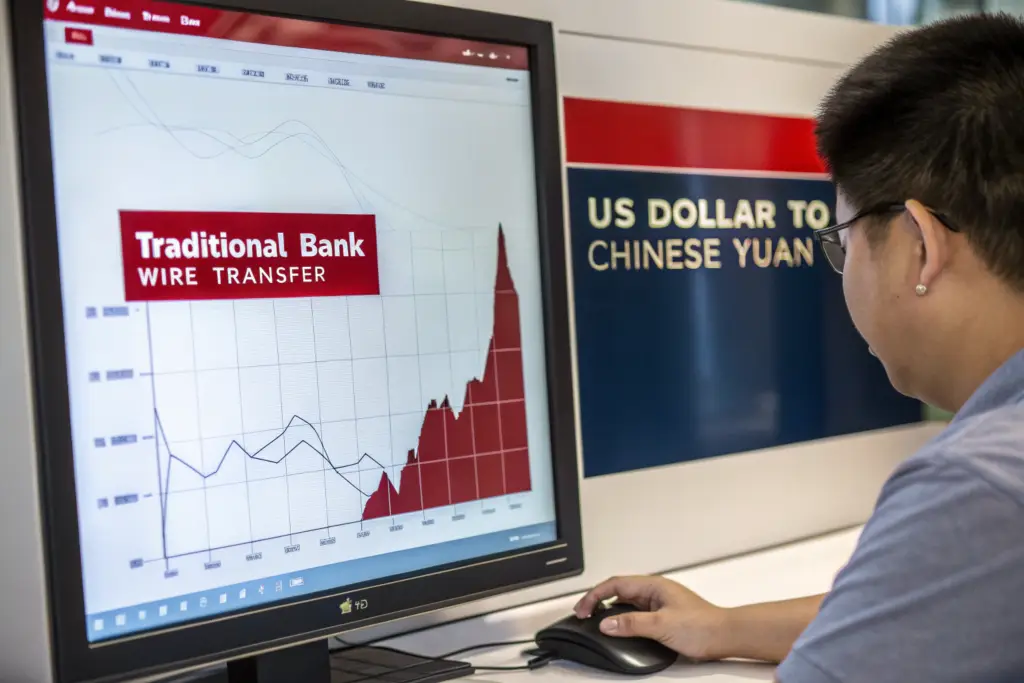
Most U.S. banks charge $25 to $45 for a single outgoing international wire. If you pay a 30% deposit and a 70% balance, that is two fees per order. If you place four orders a year, that is $360 just in fees to your bank.
Alternatives We Recommend to Our Clients:
- Wise (formerly TransferWise) : We accept payment through Wise Business. The fees are transparent and usually 0.5% to 1.0% lower than the bank exchange rate. For a $30,000 payment, that can save $300 instantly compared to a traditional bank wire.
- ACH / Veem: Some clients use Veem or similar platforms that offer flat-fee or no-fee international transfers by netting out transactions.
I do not care how you pay me, as long as it is legal and secure. But I do care that you are not wasting money that could go into your marketing budget. We work with clients to set up the most cost-effective payment rails.
Should You Lock in the USD/CNY Exchange Rate?
The U.S. Dollar goes up and down against the Chinese Yuan. A shift from 7.20 to 7.00 is a 2.8% change. That is huge. If you are quoting retail prices based on a 7.20 rate, and you pay at 7.00, your cost just increased.
I had a client who placed a large outerwear order in January. The dollar was strong. By the time the balance was due in April, the dollar had weakened. His profit margin shrank by $1,800.
Strategies for Managing Currency Risk:
- Quote in USD: We always quote in US Dollars. This pushes the exchange risk onto the factory (me) during the production window. Once the price is agreed in USD, your cost is fixed. You do not have to watch the forex charts.
- Pay Earlier (if safe) : If you see the dollar trending down, and you trust the factory, paying the balance slightly early can lock in the better rate.
- Use a Forward Contract: If your order is over $50,000, talk to your bank about a forward contract. You lock in today's rate for a payment due in 90 days.
By simply insisting on USD pricing, most of my clients eliminate currency anxiety entirely. It becomes my job to manage the Yuan volatility, not theirs.
How Does Production Planning Eliminate Rush Fees and Air Freight?
Air freight is the biggest hidden cost in the apparel industry. It is almost never planned. It is a tax you pay for bad planning. I have seen a $4,000 ocean freight bill turn into a $22,000 air freight bill overnight because someone forgot to approve a lab dip on time.
The most controllable hidden cost in sourcing is the premium paid for expedited shipping. By implementing a strict Time and Action (T&A) calendar and maintaining buffer days for approvals, brands can avoid the devastating financial impact of air freight and factory rush charges.
At Shanghai Fumao, we treat the calendar as a contract.

What Is a Time and Action Calendar and Why Does It Save Money?
A T&A Calendar is a shared spreadsheet or project plan that tracks every single step from sketch to shipping. It includes:
- Lab Dip Approval Date
- Bulk Fabric Arrival Date
- Cutting Start Date
- Sewing Finish Date
- Container Closing Date
I share this with my clients on Google Sheets. They can see, in real time, if we are Green (On Track) or Red (Delayed).
Last Spring, a client was late approving the customizable logo embroidery file. The T&A calendar automatically sent an alert. It showed that if the file arrived 2 days late, the container would miss the intended vessel by one week. The client had a choice: Send the file now, or pay $500 for a truck to rush the container to a different port with a later sailing. Because they saw the impact immediately, they prioritized the approval. We saved the $500 trucking fee. Without that calendar, they would have just been told "The ship left. You need air freight."
How Do Fabric Buffer Stocks Prevent Production Halts?
One of the biggest reasons for factory delays is a fabric mill delivering short or delivering flawed fabric. The factory has to stop cutting and wait for more fabric. This pushes the order into Air Freight territory.
I always recommend ordering 2-3% extra fabric upfront. Yes, it adds a tiny bit to the material cost. But it is an insurance policy.
Here is a real example:
- Order: 5,000 units of trousers.
- Cost of 3% Buffer Fabric: $450.
- Cost if we run short due to cutting waste: 150 units short shipped. Client loses $2,500 in retail sales. Or, we fly in 500 yards of fabric ($600 freight) and delay the order 10 days.
That $450 buffer saved the client's season. We always use the leftover buffer fabric to make extra stock or sample yardage, so it never goes to waste. It is a strategic inventory decision that protects the bulk delivery date.
Conclusion
Cutting hidden costs when sourcing from Asia is not about finding the absolute cheapest sticker price on Alibaba. That is a race to the bottom where you usually lose. It is about seeing the full picture of the supply chain. It is about understanding that the $0.20 you save on the unit price can be wiped out by a single $500 customs exam fee or a $2,000 air freight bill.
You protect your profit by choosing partners who offer transparent DDP shipping terms so you know the final cost upfront. You protect your profit by investing in third-party or factory-led quality inspections that cost pennies per unit but save thousands in returns. You protect your profit by managing the calendar aggressively so you never have to put a container of garments on a plane.
At Shanghai Fumao, we build our business around protecting your margins. We know that a successful brand partner means repeat orders for us. It is a shared interest. We do not want you to be surprised by a hidden fee any more than you do.
If you want to run the numbers on your next collection and see how much we can save you by controlling these hidden variables, let's connect. Our Business Director, Elaine, can walk you through a full landed cost analysis that includes the real costs, not just the unit price. Reach her at strong>elaine@fumaoclothing.com. Let's keep your money where it belongs, in your pocket.