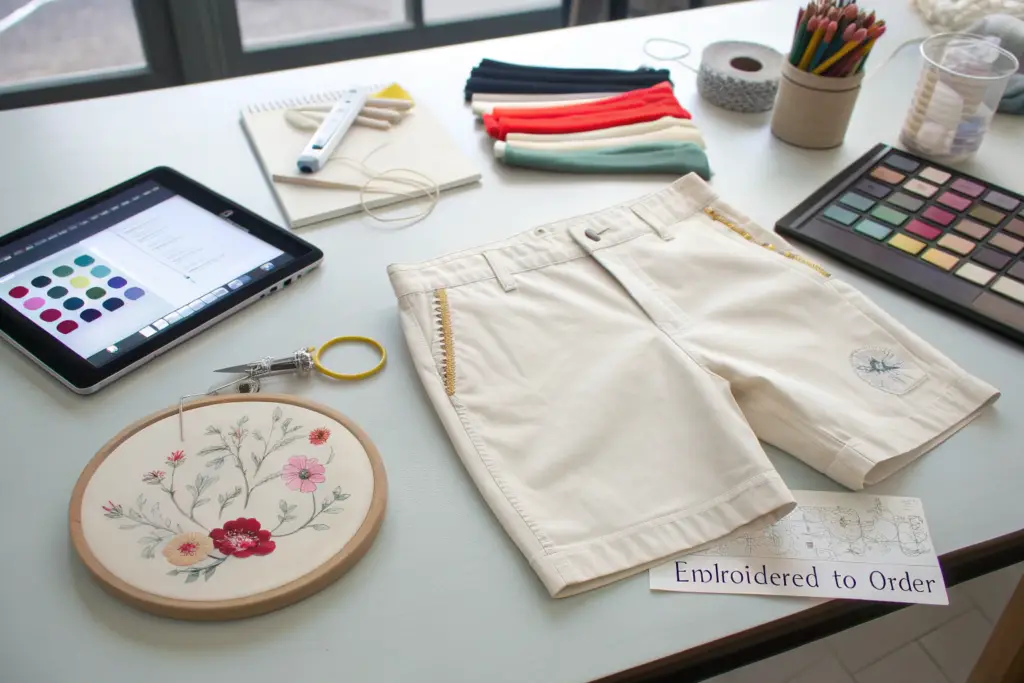
About eighteen months ago, a buyer for a chain of women's boutiques sat in my showroom, flipping through our standard line sheet. She paused on a page of our classic cotton twill shorts, available in eight colors. She looked up and asked a question that I have now heard in some form from dozens of buyers. "Can you embroider a small floral motif on the back pocket? Not a print. Actual embroidery. And can I offer my customers a choice of three designs?" We could. She placed an order for 2,400 units across six boutiques, with each store receiving a mix of the three custom embroidery designs. The shorts sold out in five weeks. She reordered twice. The embroidery program, which added approximately $2.50 to the FOB cost per unit, allowed her to sell the shorts at a $25 retail premium over our standard, unembroidered version. The embroidery did not just decorate the shorts. It transformed them from a commodity into a proprietary, boutique-exclusive product.
Classic embroidered shorts for women are emerging as a powerful new frontier for wholesale customization because embroidery addresses the fundamental challenge of wholesale apparel: differentiation, offering a customization technique that is perceived by the consumer as significantly more valuable, artisanal, and premium than digital printing, that carries a rich emotional and personalization-driven appeal particularly strong among the female consumer demographic, and that is now technically and economically viable at wholesale production volumes due to advances in multi-head computerized embroidery machines and efficient digitization workflows.
At Shanghai Fumao, I have built an embroidery program that serves wholesale brands and boutique chains. Embroidery is not new. It has existed for centuries. What is new is its emergence as a scalable, cost-effective customization technique for wholesale classic shorts. Let me walk you through why this is happening, how the economics work, and how to build an embroidery program that differentiates your product and protects your margin.
Why Is Embroidery Perceived as More Premium Than Printing?
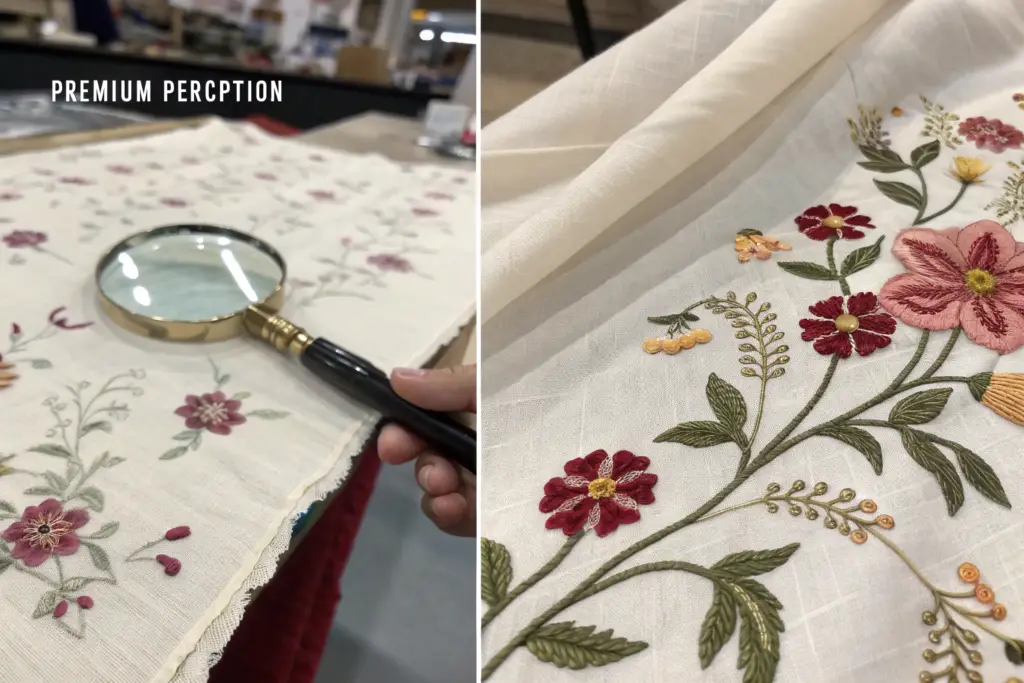
The customer knows the difference between a print and an embroidery. She may not know the manufacturing terms. She may not know the cost differential. But she knows, when she touches a printed design and an embroidered design side by side, that the embroidery is more expensive. The texture, the sheen of the thread, the weight of the stitches on the fabric, and the clean finish on the back all communicate craftsmanship, quality, and a higher price point. This perception is not manufactured by marketing. It is grounded in the physical reality of the two techniques.
Embroidery is perceived as more premium than printing because it is a physical, three-dimensional embellishment rather than a surface application of ink, with the raised texture of the stitches providing a tactile interaction that printing cannot replicate, the natural sheen of high-quality embroidery thread catching the light in a way that flat ink cannot, and the substantial, durable feel of the embroidered design communicating to the consumer that the garment has been invested with an additional, artisanal step of production, justifying a significantly higher retail price.
How Does the Physical Texture of Embroidery Create a Luxury Hand Feel?
A screen print or a digital print sits on the surface of the fabric. It is flat. It has no texture beyond the texture of the underlying fabric. The customer's fingers feel the fabric, not the design. The design is purely visual.
An embroidered design is a physical structure. Hundreds or thousands of individual stitches form a raised pattern on the fabric surface. The stitches are made from rayon or polyester embroidery thread, which has a natural sheen and a smooth, silky texture. When the customer runs her fingers over an embroidered design, she feels the texture of the stitches. She feels the slight resistance, the smoothness, the three-dimensionality. This tactile experience is inherently luxurious. It is the same sensory quality that distinguishes a printed invitation from an engraved one, or a printed book cover from an embossed one. The customer's fingertips tell her that this garment required more time, more skill, and more material to produce. Her brain translates that sensory input into a higher perceived value. This embroidery vs screen printing in garment decoration resource explains the tactile and visual differences between the techniques.
What Emotional Associations Do Women Consumers Have with Embroidery?
Embroidery carries cultural and emotional associations that printing does not. Embroidery is associated with heirloom textiles, with hand-crafted linens passed down through generations, with the monogrammed handkerchiefs and the personalized gifts of a pre-mass-production era. It communicates care, tradition, and individuality.
For the female consumer, these associations are powerful. A pair of shorts with a small, beautifully executed embroidered floral motif does not feel like a mass-produced garment. It feels like a found object, a vintage treasure, a piece with a story. The embroidery personalizes the shorts even when the design is the same across hundreds of units, because the nature of embroidery, with its slight, natural variations in stitch placement, makes each piece feel subtly unique. This emotional resonance is why embroidered details command such strong consumer preference and such significant price premiums. This psychology of embroidery and personalized fashion article explores the consumer psychology of personalized and embellished garments.
What Types of Embroidery Designs Work Best for Wholesale Shorts?
The design of the embroidery is the most important factor in the success of the program. An embroidery design that is too large, too complex, or too heavy will distort the fabric, add excessive cost, and potentially alienate the customer. An embroidery design that is too small or too simple will not deliver the perceived value premium that justifies the customization. The optimal embroidery design for wholesale classic shorts is one that is visually impactful, technically efficient, and scalable across an order of hundreds or thousands of units.
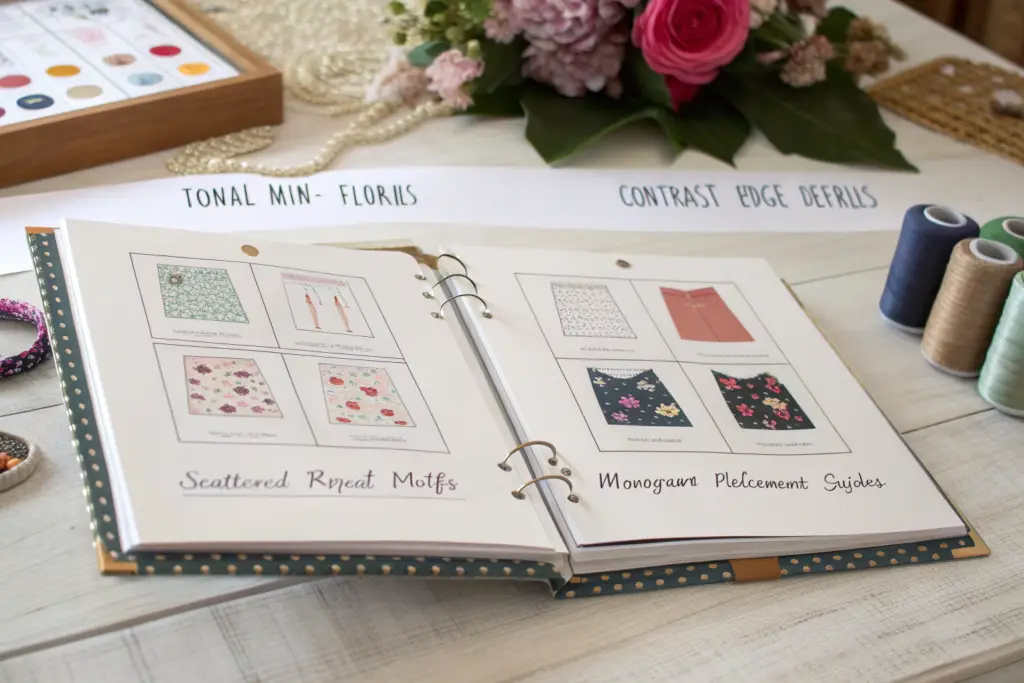
The most effective embroidery designs for wholesale classic shorts are tonal mini-florals, which use thread that closely matches the fabric color to create a subtle, textural embellishment that is noticeable upon close inspection but does not dominate the garment, contrast edge details, which place a simple, repetitive embroidery motif along the edge of a pocket, a hem, or a waistband for a framed, finished look, scattered repeat motifs, which use a small, simple shape repeated in a seemingly random pattern across the fabric for a whimsical, all-over effect, and monogram and initial placements, which tap into the powerful consumer desire for personalization and offer a scalable "made for me" experience.
How Do You Design an Embroidery File That Is Efficient to Produce?
The cost of embroidery is driven primarily by the stitch count. A design with 10,000 stitches costs more and takes longer to produce than a design with 3,000 stitches. The design must be digitized, a process where the artwork is converted into a file that the embroidery machine can read, specifying the type, direction, and sequence of every stitch.
An efficient design uses the minimum stitch count required to achieve the desired visual effect. It avoids large areas of solid fill, which are stitch-intensive and can make the fabric stiff. It uses running stitches and satin stitches, which are efficient and clean, rather than complex, multi-layered fills. It minimizes trims, the cutting of the thread between different elements of the design, which adds time to the production process. A well-digitized design can reduce the production time per unit by 30% to 50% compared to a poorly digitized design, directly impacting the cost and the feasibility of the wholesale program. This embroidery digitizing for apparel production guide provides best practices for creating production-efficient embroidery files.
What Placement Options Maximize Visual Impact and Minimize Distortion?
The placement of the embroidery on the short is a critical design decision. The wrong placement can distort the fabric, create an unflattering visual focal point, or be obscured when the short is worn. The right placement enhances the design of the short and creates a natural, intentional focal point.
The most effective placements for classic shorts embroidery are the back pocket, either centered on the pocket or placed on the lower corner, which is a traditional, expected location for embellishment on bottoms; the hem edge, a small, delicate motif placed at the outer hem on one or both legs, which creates a subtle, unexpected detail; the front waistband area, a small motif placed near the left or right hip, which is visible when the top is tucked in; and the side seam, a small motif placed near the hem on the side seam, which creates a subtle, lateral detail. Each placement offers a different aesthetic and a different level of visibility. The brand should test placements on samples and evaluate the visual effect before committing to a bulk order. This embroidery placement guide for garments provides standard placement specifications.
What Are the Minimum Order Quantities and Cost Structures for Wholesale Embroidery?
The economics of embroidery change significantly with volume. For a single custom piece, the digitization cost alone can make embroidery prohibitively expensive. For a wholesale order of hundreds or thousands of units, the digitization cost is amortized across the entire order, and the per-unit cost of the embroidery becomes quite modest. Understanding this cost structure is essential for pricing the program correctly and for setting appropriate minimum order quantities.
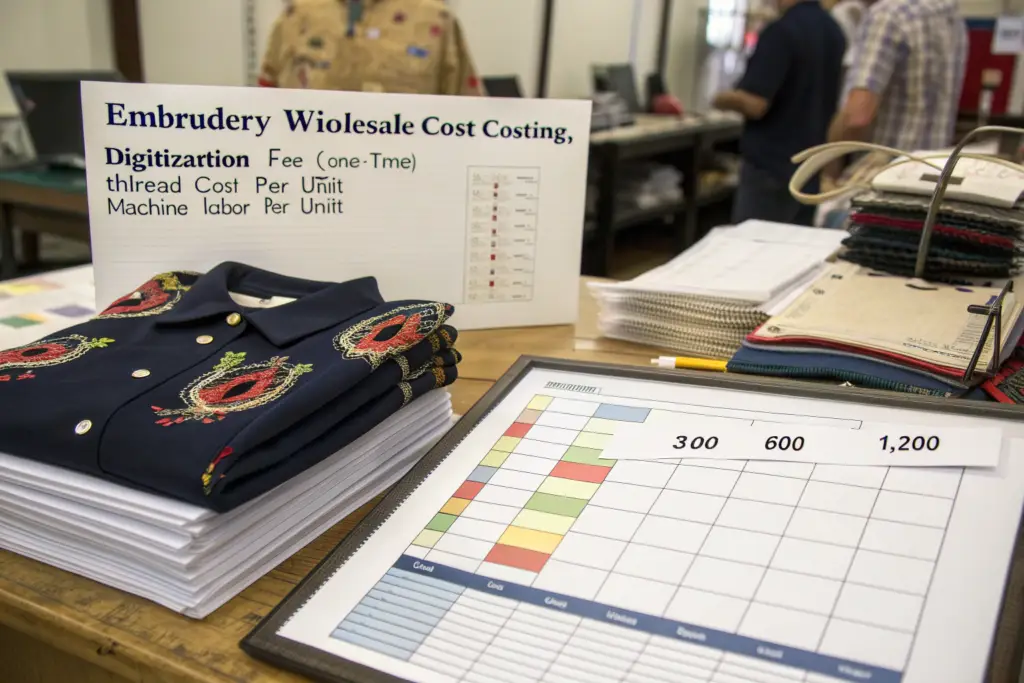
The cost structure for wholesale embroidery on classic shorts consists of a one-time digitization fee, typically $30 to $80 per design depending on complexity, a per-unit thread cost, and a per-unit machine labor cost based on the stitch count, with the digitization fee being amortized across the total order volume, meaning that the per-unit embroidery cost can decrease from approximately $4.00 to $6.00 per unit at an order quantity of 100 units, to as low as $1.50 to $2.50 per unit at order quantities of 1,000 units or more, making embroidery economically viable for wholesale programs with minimum order quantities of 300 to 500 units per design.
What Is the Digitization Process and Why Does It Have a Fixed Cost?
Digitization is the process of converting the artwork, the floral motif, the monogram, or the geometric pattern, into a digital file that the embroidery machine can read. A skilled digitizer uses specialized software to plot every stitch in the design. The digitizer determines the stitch type, the stitch direction, the stitch density, the underlay stitches that stabilize the fabric, and the sequence of operations.
This is a manual, skilled process. It takes time, typically one to three hours for a typical shorts embellishment design. The digitizer's work determines how the final embroidery looks, how well it wears, and how efficiently it can be produced. The digitization fee is a one-time charge. Once the design is digitized, the file can be used an unlimited number of times. The fee is the same whether the order is for 10 units or 10,000 units. This is why the per-unit embroidery cost decreases so significantly as the order volume increases. The fixed cost of digitization is spread across more units. This embroidery digitization cost guide explains the pricing for digitization services.
How Can You Offer Multiple Designs Without Fragmenting the Order?
A wholesale buyer may want to offer their customers a choice of designs. Three different floral motifs, for example, or a choice of monogram styles. If the buyer must order the full minimum order quantity for each design individually, the program becomes unworkable. The inventory risk is too high.
The solution is to run the shorts as a single production order of the base garment, and then split the order at the embroidery stage. The factory produces 900 pairs of the same short in the same fabric and color. At the embroidery station, 300 pairs receive Design A, 300 pairs receive Design B, and 300 pairs receive Design C. The total order quantity meets the minimum for efficient production. The buyer receives a mixed assortment of embroidered shorts without having to commit to a full minimum for each design. This production batching for custom apparel approach enables the multi-design customization program that is attractive to boutique buyers.
Conclusion
Classic embroidered shorts for women represent a genuine new frontier for wholesale customization. Embroidery offers a level of perceived value, tactile luxury, and emotional resonance that printing cannot match, and it is now technically and economically viable at wholesale production volumes. The digitization technology, the multi-head embroidery machines, and the efficient production workflows have brought the per-unit cost of quality embroidery down to a level where it can be a profitable customization option for brands and boutique chains.
The key to a successful wholesale embroidery program is thoughtful design. The embroidery motif must be designed for production efficiency, with a reasonable stitch count and minimal trims. The placement must be carefully considered to maximize visual impact without distorting the fabric. The order quantities must be sufficient to amortize the digitization cost and bring the per-unit embroidery cost into the target range. And the production must be managed so that multiple designs can be offered without fragmenting the order into uneconomical sub-batches.
At Shanghai Fumao, we have built our embroidery program specifically for wholesale. We have the multi-head machines, the skilled digitizers, and the production workflows to execute embroidery programs efficiently at volumes from 300 to 10,000 units. If you are a brand or a boutique chain looking to differentiate your classic shorts with custom embroidery, contact our Business Director, Elaine, at elaine@fumaoclothing.com. Let's design an embroidery program that transforms your shorts from a commodity into a proprietary, high-margin product.