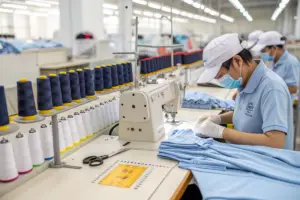
Three seasons ago, a brand owner I have worked with for years called me in a state of controlled desperation. His container of 12,000 classic shorts had been scheduled to arrive in Savannah on May 10th. A port congestion cascade, a vessel diverted to another terminal, a chassis shortage, and a customs hold pushed the actual delivery to his warehouse to June 28th. He had missed the entire peak selling window. His wholesale accounts had cancelled their orders and filled the shelf space with a competitor's product. His website had been running "Coming Soon" banners that were now a liability. He was sitting on a container of beautiful, high-margin shorts that were now worth a fraction of their value. He asked me the bluntest question a factory owner can hear. "What do I do with twelve thousand pairs of shorts that arrived four weeks too late?"
When a classic shorts shipment misses the vital June selling season, the brand must immediately pivot from the original sell-through plan to a triage strategy that evaluates three parallel paths: the aggressive discount path, which liquidates the inventory quickly through flash sales and off-price channels to recover cash and avoid storage costs; the strategic storage path, which warehouses the goods for a mid-winter resort release, a next-season early launch, or a Southern Hemisphere market opportunity; and the geographic diversion path, which reroutes the shipment to regions or channels where the selling season is still active, with the optimal strategy often combining elements of all three depending on the brand's cash position, storage capacity, and the product's trend sensitivity.
At Shanghai Fumao, I have helped brand partners navigate late-shipment crises more times than I want to count. A missed season is a serious blow, but it does not have to be a fatal one. The difference between a brand that survives a missed season and a brand that is destroyed by it is the speed and clarity of the response. Let me walk you through the decision framework and the specific actions that can salvage value from a shipment that arrived too late.
How Should You Assess the Damage and Categorize the Inventory Immediately?
The moment the shipment arrives, the clock starts. Every day the shorts sit in the warehouse without a plan, they lose value. The first action is not to start discounting. The first action is to assess exactly what you have, categorize it by its salvage potential, and build a plan that maximizes recovery across the different categories. A knee-jerk reaction, fifty percent off everything, will destroy more value than a calm, segmented approach.
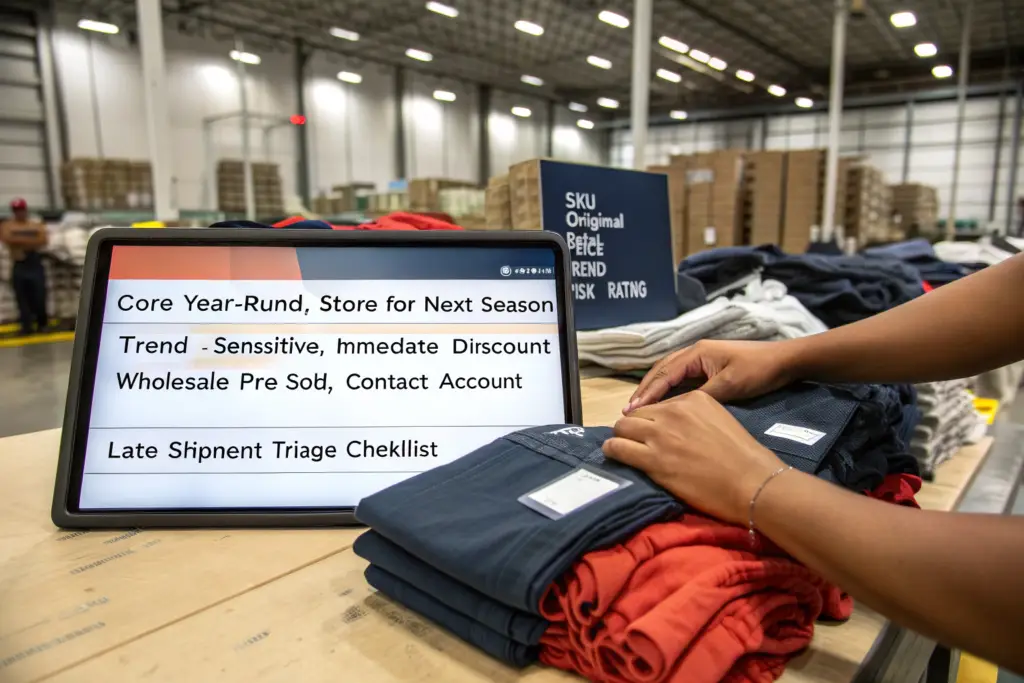
The immediate post-arrival assessment must categorize every SKU in the late shipment into one of three tiers based on its seasonality risk: core year-round styles in neutral colors such as khaki, navy, and stone that can be stored and sold next season with minimal markdown risk; trend-sensitive styles in seasonal colors or patterns that will lose significant value if stored and must be liquidated quickly; and pre-sold wholesale units that were ordered for specific accounts, where the first call should be to the account to see if they will accept late delivery at a negotiated discount before the goods are diverted to other channels.
How Do You Determine Which Shorts Can Survive Storage Until Next Year?
A classic khaki chino short in a standard fit is a core year-round style. It will be just as saleable next March as it would have been this June. The customer who buys a khaki short is not buying a seasonal fashion item. She is buying a wardrobe staple. The risk of storing this short until next season is minimal, limited to the storage cost and the cost of capital tied up in the inventory.
A coral pink linen short with a seasonal embroidery, by contrast, is a trend-sensitive style. Its value is tied to a specific season and a specific trend cycle. By next summer, the trend may have moved on. The risk of storing this short is high. The brand may recover nothing next year and will have paid storage costs in the interim. The categorization decision should be based on the historical sell-through data for each style, the trend sensitivity of the color and pattern, and the projected demand for the style in the following season. This seasonal inventory categorization discipline must be applied SKU by SKU, not at the shipment level.
What Is the First Communication You Should Have with Wholesale Accounts?
The wholesale accounts that pre-ordered the shorts are the most important relationships to protect. The first communication to these accounts should not be an email informing them that their order is cancelled. It should be a phone call.
The brand owner or sales manager calls the buyer directly. The message is honest and accountable. "Our shipment was delayed. The shorts arrived on June 28th. I know your selling window for this product has largely passed. I want to work with you on a solution that makes you whole." The buyer is offered options. Accept the late delivery at a negotiated discount, typically 15% to 30% off the original wholesale price, to account for the shortened selling window. Roll the order to next season, with the brand holding the inventory and shipping it next March under the same terms. Cancel the order, with the brand absorbing the loss and offering a credit toward a future order. The buyer's choice is respected without pressure. The relationship is prioritized over the transaction. This wholesale account recovery late delivery approach preserves the long-term revenue stream even as it absorbs a short-term loss.
What Are the Financial Trade-offs of Discounting Versus Storing?
The decision between discounting now and storing for later is fundamentally a financial calculation. It is not an emotional decision. The brand owner who says "I refuse to discount my product" and stores everything may lose more money than the brand owner who takes a deep breath, takes the discount, and recovers cash. The calculation requires estimating the net recovery under each path and comparing them objectively.
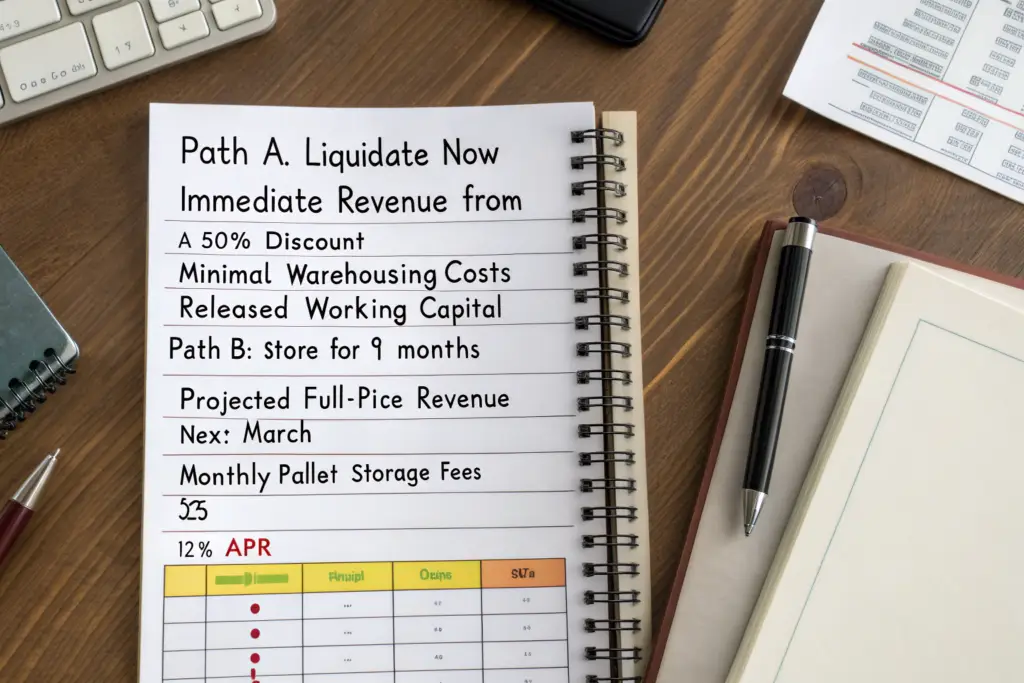
The financial analysis for a late shipment must compare the net cash recovery from liquidating the inventory now at an aggressive discount, typically 30% to 50% off the original retail price, against the net cash recovery from storing the inventory for nine to ten months and selling it at full or near-full price next season, with the storage scenario subtracting the warehousing cost per pallet per month, the cost of capital tied up in the inventory, the risk of additional markdowns next season if the styles do not sell through, and the risk of product degradation or obsolescence during storage, with the result often showing that discounting now is the financially superior choice for trend-sensitive styles, while storing is superior for core basics.
How Do You Calculate the Net Recovery for Each Path?
The liquidation path calculation is straightforward. Take the expected sell-through percentage at the planned discount level. Multiply by the discounted retail price. Multiply by the gross margin at that discounted price. Subtract any additional costs, the flash sale marketing spend, the additional shipping costs. The result is the net cash recovery.
The storage path calculation is more complex. Start with the expected sell-through at full or near-full price next season. Subtract the storage cost. Pallet storage in a third-party warehouse typically costs $15 to $25 per pallet per month. A container of 12,000 shorts might occupy 20 pallets. Nine months of storage at $20 per pallet is $3,600. Add the cost of capital. If the inventory value is $150,000 at landed cost, and the brand's cost of capital is 12% annually, nine months of carrying cost is $13,500. Subtract these costs from the projected gross margin next season. Then apply a risk discount, a percentage reduction to account for the uncertainty that the styles will sell at full price next season, that some units may be damaged in storage, that the market may have shifted. This inventory carrying cost calculation should be performed for each tier of inventory.
What Are the Hidden Risks of Long-Term Storage?
Warehouse storage has risks beyond the monthly invoice. The shorts must be stored in a climate-controlled environment. Heat and humidity can damage cotton fabric, cause mildew, and degrade elastic components. The shorts must be stored in their original packaging to protect against dust, light, and pests. They should be stored off the floor on pallets.
There is a risk of obsolescence. A style that was current this season may look dated next season, particularly in colors or patterns. The brand may change its logo, its labeling, or its packaging, making the stored inventory inconsistent with the new brand presentation. There is a risk of damage from handling. Every time a pallet is moved, there is a chance of damage. There is a risk of inventory counting errors. Goods in storage for nine months can be miscounted, misplaced, or forgotten. These risks must be factored into the storage decision. This warehouse storage best practices for apparel is not simply a matter of finding the cheapest pallet space.
How Can You Pivot to Markets Where the Season Is Still Active?
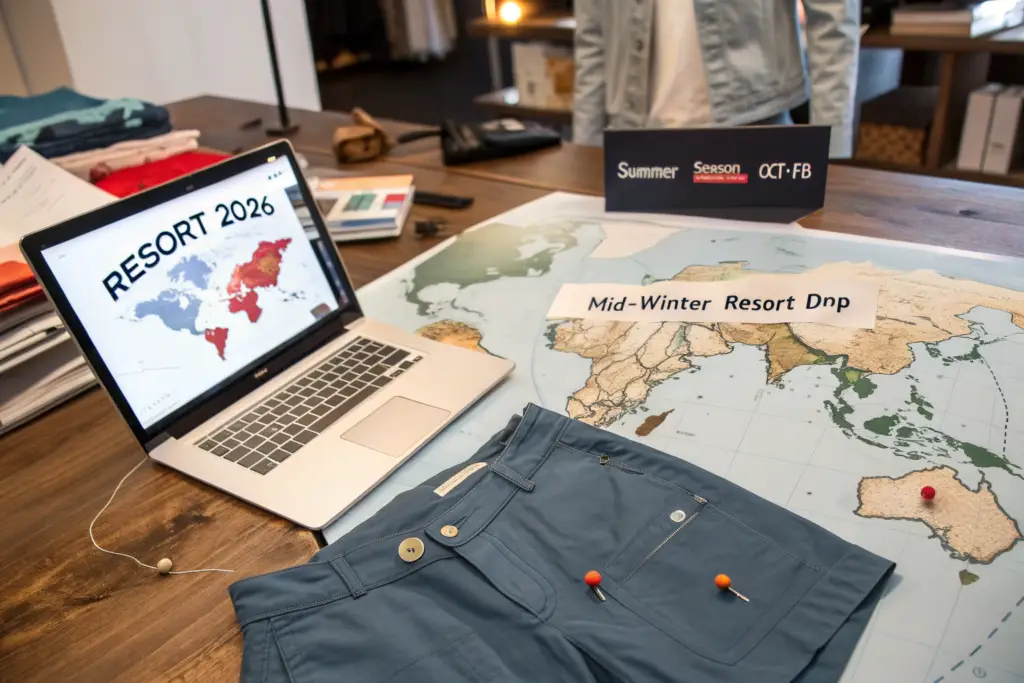
The June selling season is a Northern Hemisphere phenomenon. When summer ends in North America and Europe, it is just beginning in Australia, New Zealand, South Africa, and South America. A shipment that arrives too late for the American summer has not missed the global summer. It has only missed the Northern Hemisphere summer. For brands with international shipping capability or a willingness to explore new markets, the late shipment can be an opportunity to test geographic diversification.
Redirecting a late classic shorts shipment to Southern Hemisphere markets requires a rapid assessment of the brand's international shipping and payment infrastructure, a targeted marketing campaign aimed at English-speaking Southern Hemisphere consumers in Australia, New Zealand, and South Africa where the summer season runs from October to February, and a product presentation adjustment that positions the shorts as a current-season item for the Southern Hemisphere market rather than as a past-season clearance item, potentially recovering near-full retail pricing rather than the deep discounts required in the Northern Hemisphere off-season.
Which Southern Hemisphere Markets Are Most Accessible for US Brands?
The most accessible Southern Hemisphere markets for a US-based brand are Australia, New Zealand, and South Africa. These are English-speaking markets with strong e-commerce penetration, familiar payment systems, and established shipping routes from the United States. A brand that sells online can begin shipping to these markets with relatively minor website adjustments.
The Australian summer runs from December to February, with the selling season beginning in October. A shipment that arrives in the US in late June can be transshipped to an Australian fulfillment center or shipped directly to Australian consumers from the US warehouse. The shipping cost is higher, but the product can be sold at full or near-full retail price because it is arriving at the beginning of the selling season, not the end. The brand should adjust its website to display Australian dollars, calculate shipping costs and delivery times to Australian addresses, and run targeted social media advertising to Australian audiences. This selling to Australian consumers from the US market entry does not require a physical presence.
How Should You Position the Product for a Mid-Winter Resort Release?
An alternative geographic strategy is not to ship the product to another country, but to market it to a different consumer need within the domestic market. A pair of classic shorts that missed the summer season can be repositioned as a resort or cruise wear item for the winter months.
Affluent consumers in cold climates travel to warm destinations during the winter. They need shorts for these trips. A "Mid-Winter Resort Drop" marketed in December or January, featuring the shorts styled with light sweaters and resort accessories, can capture this demand. The product is the same. The marketing frame is different. The shorts are not last season's clearance. They are this season's vacation essential. This resort wear marketing strategy reframing can recover a significant portion of the original retail price by connecting the product to a different consumer need.
What Preventative Measures Stop This Crisis from Happening Again?
The best response to a missed season is to ensure it never happens again. A late shipment is rarely an unpredictable act of fate. It is usually the result of a supply chain that was not designed with adequate buffers, adequate contingencies, or adequate visibility. The brand that survives a missed season and learns nothing from it is doomed to repeat the experience. The brand that uses the crisis as a catalyst for supply chain improvement emerges stronger.
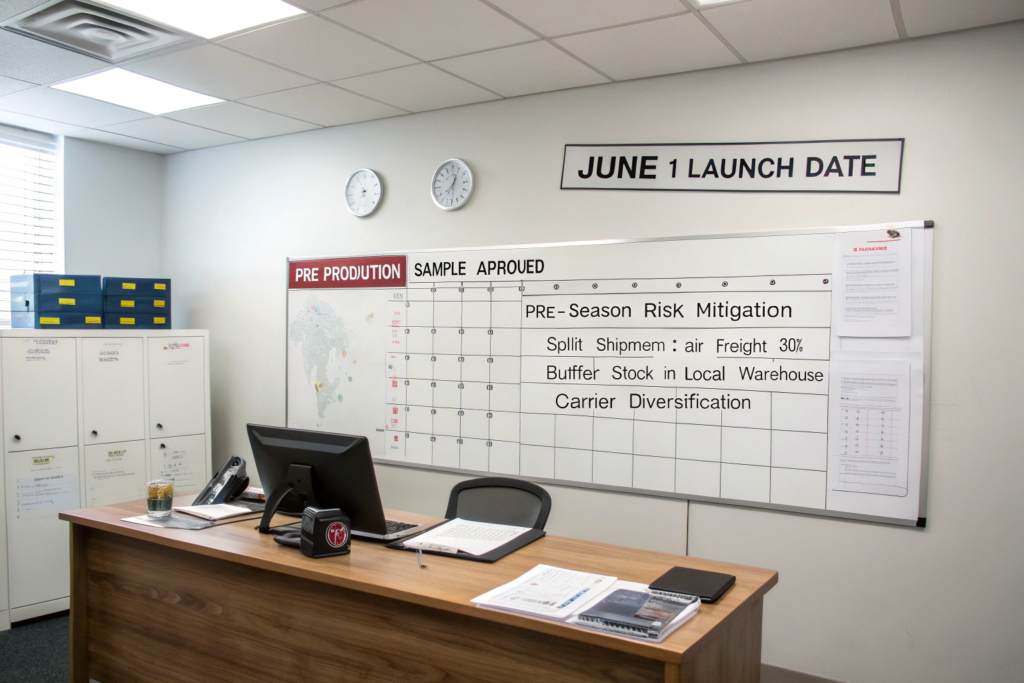
Preventing a future late-shipment crisis requires implementing three structural changes to the brand's supply chain: a buffer stock strategy, where a percentage of the seasonal order, typically 20% to 30%, is shipped by air freight or produced early to arrive a month before the main shipment, providing insurance against delays; a carrier and port diversification strategy, where the brand avoids reliance on a single shipping line or a single port of entry, reducing exposure to localized disruptions; and a supplier production visibility strategy, where the brand has real-time access to the factory's production schedule and can identify delays weeks before they affect the shipping date, enabling proactive intervention rather than reactive panic.
How Does a Split Shipment Strategy Provide Insurance?
A single container carrying the entire seasonal order is a single point of failure. If that container is delayed, the entire season is at risk. A split shipment strategy divides the order into two or more shipments, sent at different times, by different carriers, or through different ports.
The most common split is a small air freight shipment, typically 20% to 30% of the total order, that arrives two to three weeks before the main sea freight shipment. The air freight portion covers the launch quantities, fills the initial wholesale orders, and ensures that the brand has product available for the first weeks of the selling season. If the sea freight portion is delayed, the brand is selling through the air freight inventory while it waits, rather than staring at an empty website. The air freight cost premium is an insurance premium against a missed season. This split shipment logistics strategy is standard practice among experienced brands.
What Production Visibility Tools Allow Early Intervention?
Most late shipments are late long before the container misses the vessel. The delay began weeks earlier, when the fabric mill delivered late, or the cutting room fell behind schedule, or the sewing line was reallocated to a larger order. The brand did not know about the delay because the factory did not communicate it.
A production visibility tool, ranging from a shared spreadsheet updated weekly to a cloud-based production tracking platform, gives the brand real-time visibility into the status of their order. The brand can see that cutting is three days behind schedule. The brand can intervene, working with the factory to reallocate resources, expedite the cutting, or adjust the shipping plan, while there is still time to recover. This supply chain visibility and production tracking capability transforms the brand from a passive victim of delays to an active manager of the production timeline. At Shanghai Fumao, we provide all brand partners with a live production tracker that shows the real-time status of every order.
Conclusion
A classic shorts shipment that misses the vital June selling season is a financial blow, but it is not a fatal one. The key is to replace panic with process. Assess the inventory immediately, categorize every SKU by its seasonality risk, and build a segmented recovery plan. For core basics, storage for next season is often the optimal path. For trend-sensitive styles, aggressive discounting now recovers more value than storing and hoping. For wholesale accounts, a direct, honest conversation that prioritizes the relationship over the transaction preserves the long-term revenue stream. For brands with the capability, a geographic pivot to Southern Hemisphere markets or a marketing pivot to mid-winter resort positioning can recover near-full retail pricing.
The crisis should also serve as a catalyst for supply chain reform. A split shipment strategy, a diversified carrier and port plan, and a production visibility system are the structural changes that prevent the next late shipment from becoming the next missed season.
At Shanghai Fumao, we work with our brand partners to build supply chains that are resilient, transparent, and responsive. If you are dealing with a late shipment now, or if you want to ensure your next shipment arrives on time, contact our Business Director, Elaine, at elaine@fumaoclothing.com. Let's build a plan that gets your shorts to your customers when they want them.