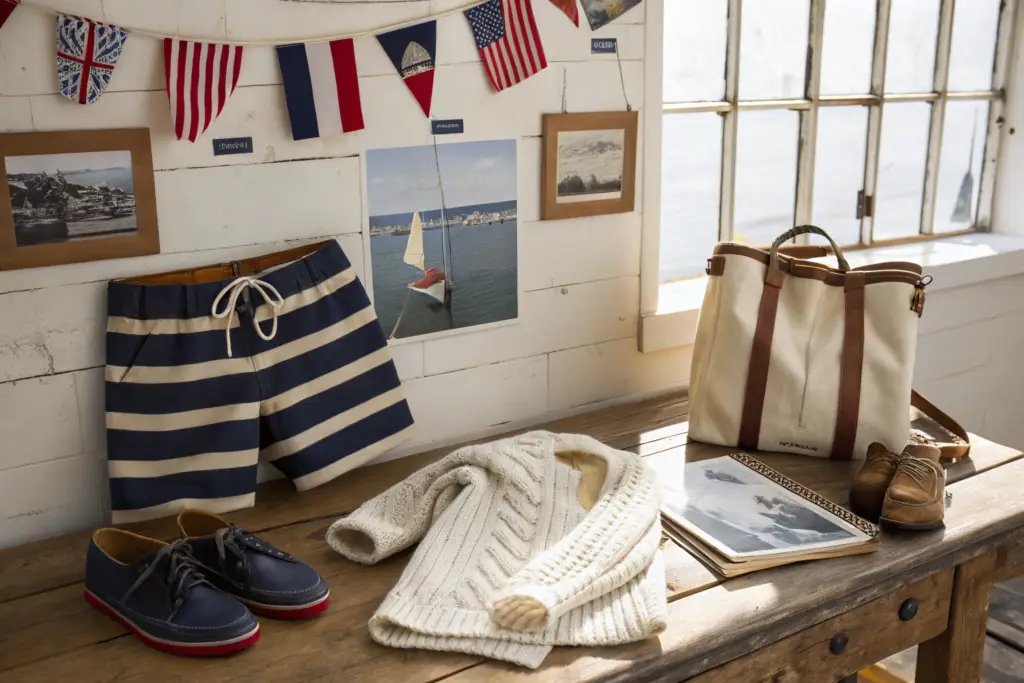
I remember a conversation with a brand owner in Charleston about four years ago. He had built a successful coastal lifestyle brand around a Southern, preppy aesthetic. His spring and summer collections were anchored by solid chino shorts in the usual colors, khaki, navy, stone, and olive. He wanted to introduce something different, something that immediately communicated "nautical" without a logo, without a graphic, without a word of explanation. He showed me a swatch of a classic navy and cream striped fabric and asked if I thought a striped short would sell. I told him that a well-executed striped short is not just a solid bet for a nautical collection. It is arguably the defining piece, the one garment that anchors the entire theme and gives the collection its identity. He ordered cautiously. The striped short became his number two SKU that season, behind only the navy solid.
Classic striped shorts for men are an exceptionally solid bet for a nautical-themed collection because the stripe pattern, particularly the Breton stripe, the awning stripe, and the seersucker stripe, functions as an immediate and universally recognized visual signifier of maritime heritage, coastal leisure, and timeless warm-weather style, making the striped short both the thematic anchor of a nautical collection and a commercially proven category that reliably attracts the customer who is shopping the nautical aesthetic.
At Shanghai Fumao, I have manufactured striped shorts for brands across the spectrum, from traditional menswear labels to coastal lifestyle brands to contemporary streetwear lines. The stripe is a pattern with a specific history, specific manufacturing requirements, and specific commercial characteristics. Let me walk you through why it works so powerfully in a nautical context, and how to execute it correctly.
What Stripe Patterns Are Most Associated with Nautical Style?
The stripe is not a single pattern. It is a family of patterns, each with its own historical origin, its own cultural association, and its own commercial characteristics. For a nautical-themed collection, the pattern selection is the most important design decision. The right stripe communicates the nautical theme instantly and authentically. The wrong stripe communicates a different theme entirely, or communicates nothing at all, just noise. The brand that understands the specific stripes that carry maritime meaning can use them intentionally.
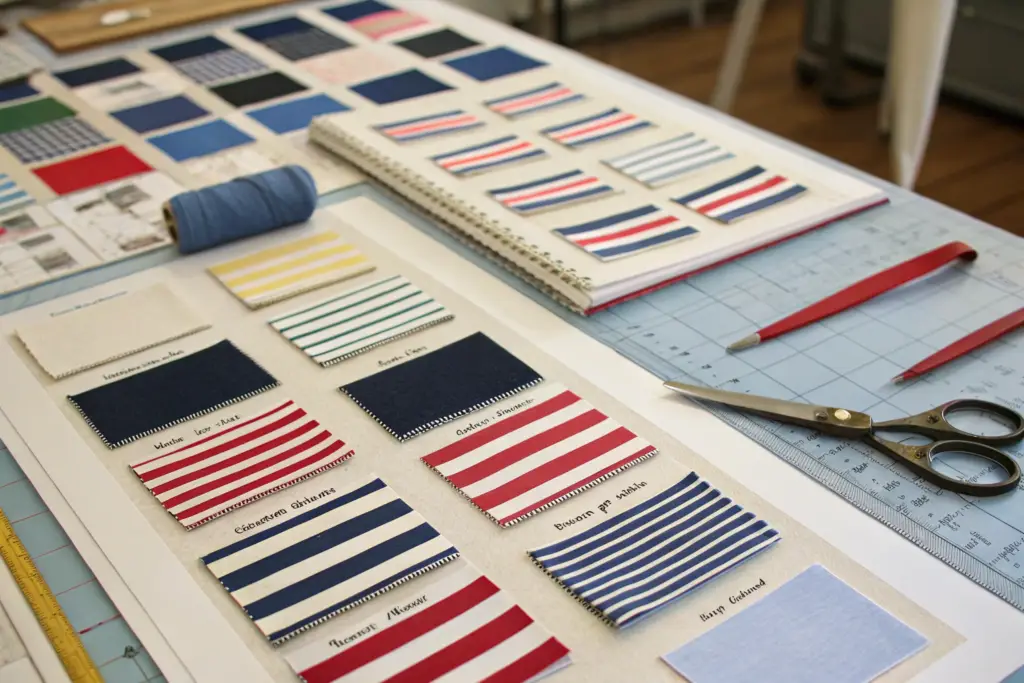
The stripe patterns most strongly associated with nautical style and therefore most commercially effective for a nautical-themed shorts collection are the Breton stripe, originating from the French Navy uniform and characterized by narrow, evenly spaced horizontal stripes on a cream or white ground, the awning stripe, a bolder, wider stripe inspired by the canvas awnings of seaside resorts and yacht clubs, the seersucker stripe, a puckered cotton stripe fabric associated with warm-weather tailoring in the American South and coastal New England, and the ticking stripe, a fine, tightly spaced stripe derived from the durable cotton ticking fabric used for maritime mattresses and pillows.
Why Is the Breton Stripe the Definitive Nautical Pattern?
The Breton stripe has a specific, documented origin that directly connects it to maritime history. In 1858, the French government issued a decree establishing the official uniform for the French Navy. The uniform included a knitted cotton shirt with narrow indigo blue stripes on a white ground. The original specification called for twenty-one stripes, one for each of Napoleon's naval victories. The shirt was designed to make sailors who fell overboard more visible against the sea.
This military maritime origin gives the Breton stripe an authenticity that no marketing campaign can replicate. The pattern was adopted by Coco Chanel for her early resort collections, by Pablo Picasso as part of his personal uniform, and by generations of artists, intellectuals, and style icons as a signifier of coastal, creative, and effortlessly sophisticated taste. A pair of Breton stripe shorts carries this entire cultural history. The consumer may not know the specific date of the French Navy decree, but she recognizes the pattern as nautical, classic, and authentic. This Breton stripe history is the foundation of its commercial power. At Shanghai Fumao, we can produce Breton stripe fabric to any stripe width and color combination specification.
How Do Awning and Ticking Stripes Create Different Nautical Moods?
The Breton stripe is the foundation. The awning stripe and the ticking stripe are the variations that allow a brand to expand the nautical theme across different moods and price points. Each carries a distinct association.
The awning stripe is bolder and more graphic. It originated from the painted or woven canvas awnings that shaded the windows of seaside hotels, yacht clubs, and beachfront pavilions in the late nineteenth and early twentieth centuries. An awning stripe short in wide bands of navy and white communicates a more assertive, preppy, and socially-oriented nautical mood. It is the stripe of the yacht club deck, not the artist's studio. The ticking stripe is finer and more subtle. It originated from the tightly woven cotton ticking fabric used for mattress and pillow covers on ships and in coastal homes, a fabric chosen for its durability and its ability to contain feather filling. A ticking stripe short in narrow blue and cream stripes communicates a quieter, more rustic, and more utilitarian nautical mood. It is the stripe of the coastal cottage, not the grand hotel. These nautical stripe patterns guide distinctions allow a brand to build a striped shorts collection that covers multiple aesthetic territories within the broader nautical theme.
What Manufacturing Considerations Are Unique to Striped Shorts?
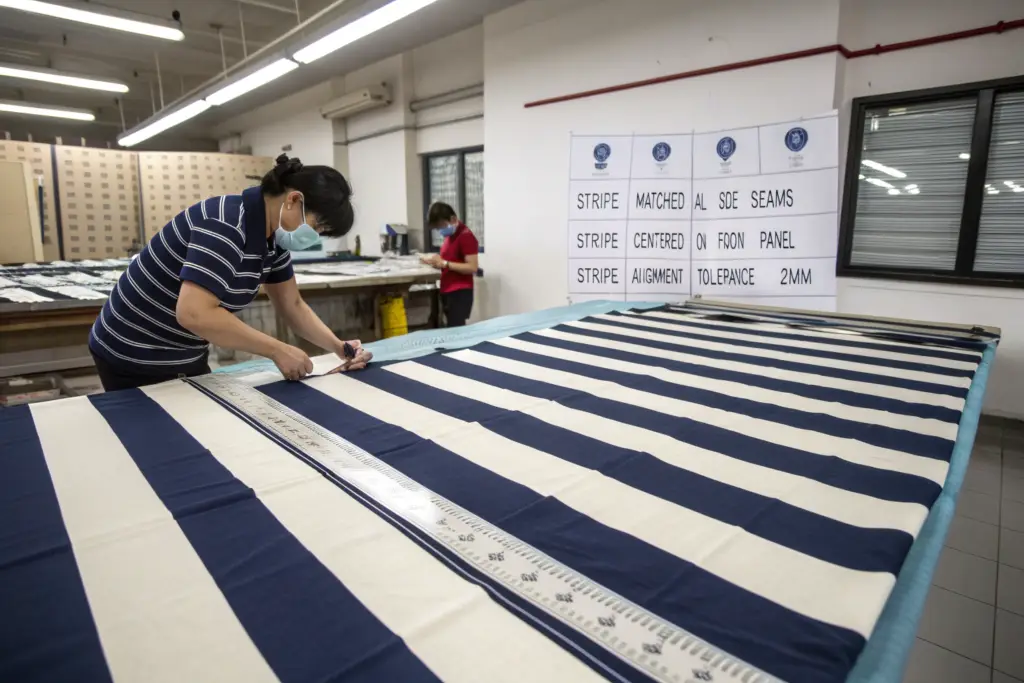
Striped fabric is the most demanding pattern category to manufacture correctly. Unlike a plaid, which requires matching in both directions, a stripe requires matching in one direction, which sounds easier. But unlike a solid, where misalignment is invisible, a mismatched stripe is immediately, glaringly obvious. A pair of striped shorts with the stripes misaligned at the side seam by even a quarter of an inch looks cheap, regardless of the fabric quality or the construction quality. The manufacturing process must be specifically adapted.
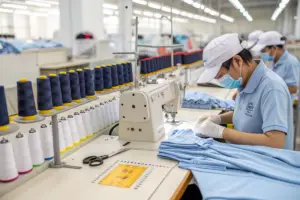
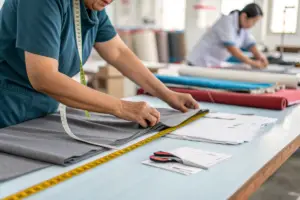
Manufacturing striped shorts to a premium standard requires a specialized cutting process where the fabric is laid up in single plies or small stacks with each ply aligned to the stripe pattern rather than the selvedge, pattern pieces are positioned individually so that the stripes match at all visible seams and are centered on the front panels, and the sewing process includes a stripe alignment check before each seam is stitched, with the result that striped shorts typically consume ten to twenty percent more fabric and require two to three times more cutting labor than solid shorts of the identical pattern.
How Does Stripe Matching at Seams Affect Production Cost?
The stripe matching requirement increases fabric consumption because the pattern pieces cannot be nested as tightly on the fabric as they can on a solid. Each piece must be positioned relative to the stripe pattern, not just relative to the adjacent pieces. The space between pieces is larger. More fabric falls as waste.
The specific cost impact depends on the stripe width and the complexity of the garment. A narrow stripe with many repeats per inch provides many possible alignment points, reducing waste. A wide stripe with few repeats forces specific positioning of each piece and increases waste. A simple short pattern with few seams has fewer matching points than a complex pattern with many seams. On average, a striped short consumes twelve to eighteen percent more fabric than an equivalent solid short. The cutting labor also increases because each piece is handled individually rather than in a stack, and the stripe alignment must be verified for each piece. These costs must be built into the FOB price and reflected in the retail price. At Shanghai Fumao, we provide transparent cost breakdowns that show the fabric consumption and labor differential for striped versus solid production.
Why Is Stripe Placement on the Front Panel a Critical Design Decision?
The front panel of a pair of shorts is the most visible single surface. The placement of the stripe pattern on that panel determines the visual balance of the entire garment. A stripe that is off-center, or that creates an awkward partial stripe at the edge, draws the eye and communicates poor quality.
The standard practice for premium striped shorts is to center the dominant stripe on the front panel. On a Breton stripe with equal navy and cream stripes, either stripe can be centered. The choice is aesthetic. On a stripe with a dominant and a background color, the dominant stripe is typically centered. The left and right front panels should mirror each other, with the stripe pattern symmetric across the center front. The pocket placement should be considered relative to the stripe. A pocket that interrupts the stripe pattern in an awkward way looks like an afterthought. A pocket that is positioned to align with the stripe pattern looks intentional and integrated. These design decisions should be made at the pattern development stage and specified in the tech pack. This stripe pattern matching garment construction attention to detail separates a premium product from a commodity product.
How Should Striped Shorts Be Styled for a Nautical Collection Lookbook?
The styling of striped shorts for a nautical collection lookbook is the bridge between product and purchase. The consumer sees the lookbook image and decides whether she wants to look like the person in the photograph. The styling choices, the tops, the footwear, the accessories, the setting, determine whether the nautical theme feels fresh and aspirational or stale and costume-like. The most effective nautical styling honors the tradition without being trapped by it.
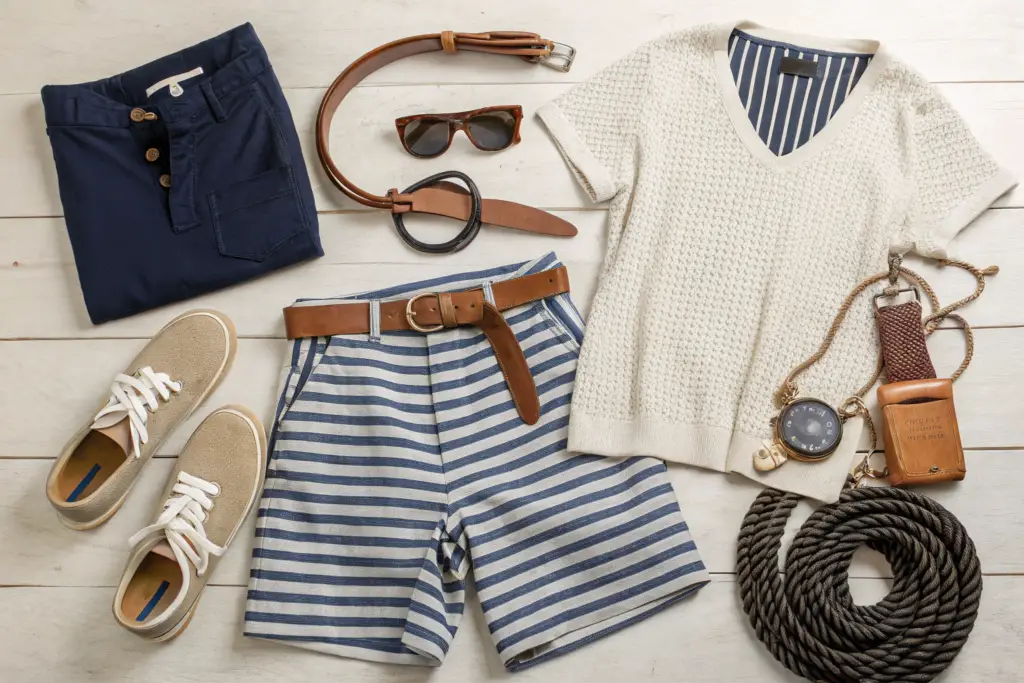
Effective nautical lookbook styling for striped shorts balances authentic maritime references with contemporary relevance by pairing the stripe with solid, textured tops in natural fibers that do not compete with the pattern, selecting footwear that grounds the outfit in a specific nautical context, from boat shoes for a yachting look to espadrilles for a Mediterranean resort look to minimalist sneakers for a modern coastal casual look, and using accessories sparingly and intentionally, a braided leather belt, a canvas watch strap, a pair of tortoiseshell sunglasses, to reinforce the theme without tipping into costume.
What Tops and Footwear Best Complement Striped Shorts?
The striped short is the dominant visual element of any outfit. The top and footwear must support it without competing. A patterned top paired with a striped short creates visual noise. A solid top in a color drawn from the stripe creates visual harmony.
For a Breton stripe short in navy and cream, the complementary tops are a cream or white linen button-down, a navy cotton polo, a grey marled crewneck sweater, or a chambray work shirt. The fabric texture provides visual interest without pattern competition. The footwear anchors the outfit in the nautical context. Leather boat shoes in brown or navy are the traditional choice. Canvas espadrilles in a neutral color are the Mediterranean resort choice. Minimalist white leather sneakers are the modern coastal casual choice. Each footwear option positions the outfit on a spectrum from traditional to contemporary. The lookbook should show multiple footwear options to demonstrate versatility. This nautical style guide menswear approach helps the consumer visualize the shorts in her own life.
How Do You Avoid the "Costume" Trap in Nautical Styling?
The nautical theme has a well-known risk. It can tip from authentic and aspirational into costume-like and gimmicky. The consumer who feels like she is wearing a sailor costume will not buy the shorts. The consumer who feels like she is channeling a timeless coastal aesthetic will.
The difference is in the restraint. A striped short paired with a navy blazer with gold buttons, a captain's hat, and a nautical flag pin is a costume. A striped short paired with a rumpled linen shirt, a pair of worn-in boat shoes, and a simple leather belt is an outfit. The nautical references should be genuine, the fabric, the stripe, the colors, but the overall effect should be effortless. The lookbook should show the model in natural, relaxed poses, not stiff, posed stances. The setting should be authentic, a real dock, a real beach, a real coastal town, not a studio backdrop. This avoiding costume in themed fashion principle applies to all themed collections but is particularly important for nautical because of the strong cultural associations.
What Retail Price Point and Margin Structure Works for Striped Shorts?
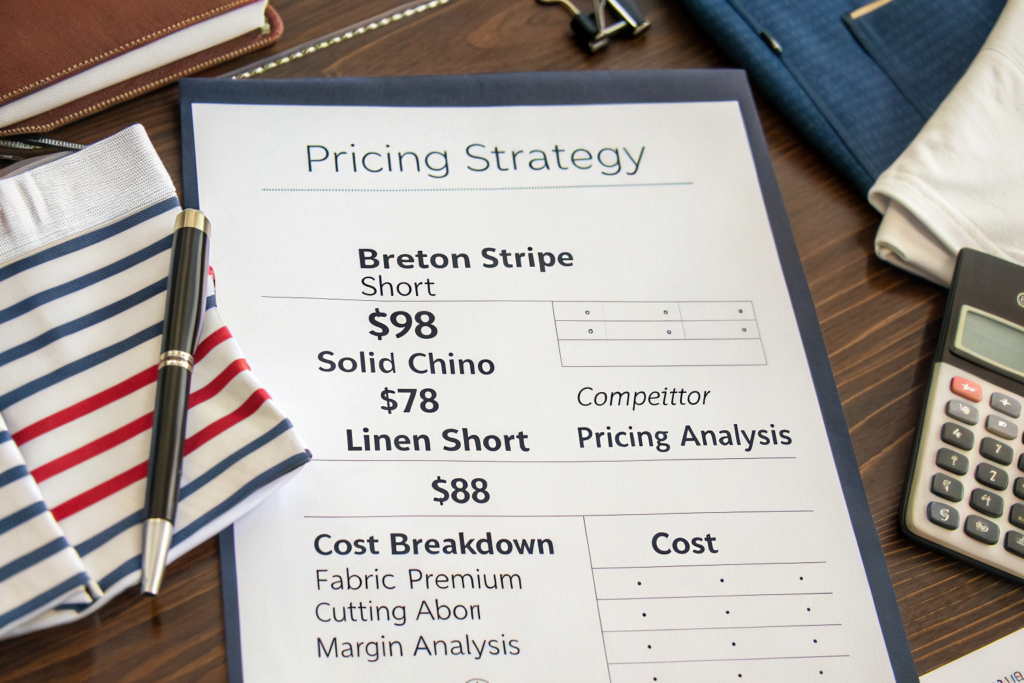
The manufacturing cost premium for striped shorts, the additional fabric consumption and cutting labor, is real. The brand has two choices for how to handle it. It can absorb the premium, reducing the margin on the striped short relative to the solid short but maintaining a consistent retail price across the collection. Or it can pass the premium through to the retail price, positioning the striped short as a premium product within the collection. The right choice depends on the brand's positioning and the role of the striped short in the collection.
Striped shorts in a nautical collection should typically be positioned at a retail price ten to fifteen percent higher than the equivalent solid short, reflecting both the higher manufacturing cost and the design value of the stripe pattern, with the price premium communicating that the striped short is a special, collection-defining piece rather than a basic commodity, while the solid shorts in the collection provide the entry price point and the volume driver.
Why Does a Higher Price Point Enhance the Perceived Value of Striped Shorts?
The psychology of pricing for patterned versus solid garments is well-established. A solid garment is evaluated on its fit, its fabric, and its construction. A patterned garment is evaluated on those same criteria plus the design value of the pattern. The consumer intuitively understands that a pattern is a design element that adds value, and she expects to pay a premium for it.
A striped short priced identically to a solid short raises an unspoken question. If the stripe is special, why is it the same price? Is the stripe cheaply printed rather than woven? Is the fabric lower quality to compensate? The price premium answers these questions before they are asked. It communicates that the stripe is a genuine design feature, executed with care, and worth the additional cost. The $10 to $15 price differential is a small absolute amount but a powerful perceptual signal. This fashion pricing strategy patterns vs solids principle applies across categories and brands. At Shanghai Fumao, we provide our brand partners with recommended retail pricing ranges based on the specific manufacturing cost of each style.
How Should Inventory Be Allocated Between Striped and Solid Shorts?
The striped short is the collection hero, the piece that defines the nautical theme and attracts attention. But it will not outsell the solid navy short. The solid short is the volume driver, the safe choice, the garment that the customer buys after being drawn in by the stripe.
The inventory allocation should reflect these different roles. The striped short should be ordered in a quantity sufficient to create visual impact in the lookbook, on the website, and in wholesale showrooms. It should be prominently featured in marketing. The solid shorts, in navy, khaki, and stone, should be ordered in larger quantities to meet the demand that the collection generates. A typical allocation for a nautical collection with a single striped SKU and four solid SKUs might be twenty percent of total units to the stripe and eighty percent to the solids. The stripe generates the margin premium. The solids generate the volume. This inventory allocation themed collections strategy balances the financial objectives of the collection.
Conclusion
Classic striped shorts for men are not just a solid bet for a nautical-themed collection. They are the foundation upon which the collection is built. The stripe, in its various forms from the Breton to the awning to the ticking, is the most efficient and authentic visual signifier of maritime heritage available to a designer. No logo, no graphic, and no color palette alone communicates nautical as immediately and as credibly as a well-executed stripe.
The execution, however, requires care. The stripe pattern must be selected intentionally for its specific nautical associations. The manufacturing must be done by a factory that understands stripe matching and is willing to invest the additional fabric and cutting labor required. The styling must balance authentic maritime references with contemporary relevance to avoid the costume trap. And the pricing and inventory strategy must reflect the striped short's role as the collection hero and the margin driver.
If you are planning a nautical-themed collection and want to anchor it with classic striped shorts that are manufactured to the pattern-matching and construction standards that the category demands, we are ready to help. At Shanghai Fumao, we have the stripe-cutting expertise, the fabric sourcing relationships, and the minimum order flexibility to bring your nautical vision to market. Contact our Business Director, Elaine, at elaine@fumaoclothing.com. Let's put a stripe in your collection that your customers will recognize as the real thing.