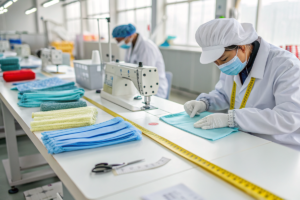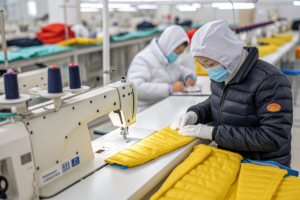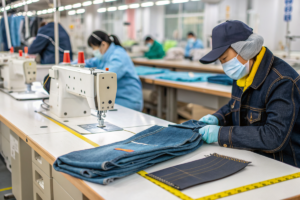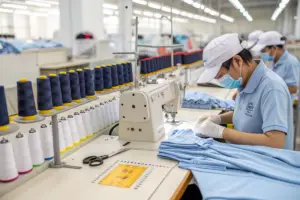
A Texas-based heritage menswear brand once placed a $150,000 order for "premium Japanese selvedge denim jeans" with an overseas factory that had sent them a beautiful sample. The bulk shipment of 4,000 pairs arrived with crotch seams that ripped under moderate squatting stress, pocket bags that tore open after three months of carrying a wallet, and copper rivets that oxidized into a greenish patina that stained the denim fabric. The factory had used lightweight 8-ounce denim instead of the specified 13-ounce. They had sewn the crotch with a single-needle lockstitch at 7 stitches per inch instead of the required double-needle felled seam at 10 stitches per inch. The rivets were cheap zinc alloy coated to look like copper. The brand's entire Fall season was destroyed, and their wholesale accounts—high-end men's boutiques with discerning customers—cancelled all future orders after the returns flooded in. Premium denim is not a fabric choice. It is a structural engineering discipline where every stitch, rivet, and ounce of fabric weight is specified, measurable, and non-negotiable.
To produce durable men's denim jeans for export, you must build the garment on a foundation of heavyweight 12-15 ounce 100% cotton denim with a minimum of 3% elastane only if the design requires stretch, construct the primary stress seams—inseam, outseam, and seat—using a felled seam construction with a minimum of 10 stitches per inch of ISO 301 lockstitch, reinforce the crotch point with a bar-tack or a full safety stitch that distributes pulling force across a concentrated stress zone, install genuine copper or brass rivets with a flat washer backing at all pocket stress points, and finish the jeans with an industrial enzyme wash that removes surface starch and softens the hand without weakening the cotton fiber's tensile strength.
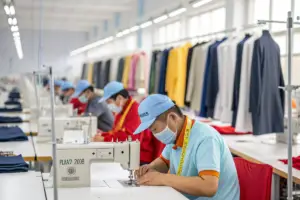
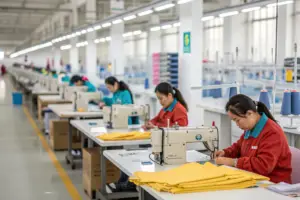
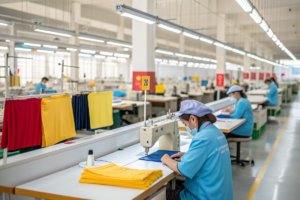
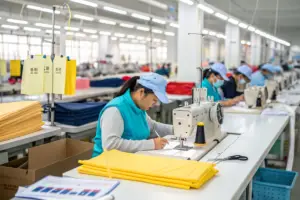
At Shanghai Fumao, I treat men's denim jeans as a structural textile engineering project. A pair of jeans must survive the seated stress of a 200-pound man sitting in a truck for eight hours, the abrasion of a wallet in a back pocket, and the tensile pull of bending and squatting, all while maintaining seam integrity through 50 or more industrial wash cycles. This level of durability is not achieved by accident.
Why Is 12-15 Ounce Selvedge or Raw Denim the Absolute Minimum Foundation for Export-Quality Durability?
An Australian workwear brand once ordered "denim jeans" from a factory that quoted an attractively low FOB price. The factory used a lightweight 8.5-ounce denim that looked acceptable in product photos but physically could not withstand the abrasion of a construction worker's tool belt or the tension of a farmer squatting to repair a fence. The jeans developed holes at the front thigh within eight weeks of wear. The brand's entire value proposition—"tough, durable workwear"—was undermined by the fabric's physical inadequacy.
12-15 ounce raw or selvedge denim is the absolute minimum foundation for export-quality durability because the fabric weight, measured in ounces per square yard, directly determines the jean's abrasion resistance, tensile strength, and structural integrity under repeated stress, with a 13-ounce denim providing a yarn count dense enough to achieve a Martindale abrasion score exceeding 40,000 cycles compared to a lightweight 8-ounce denim that will begin to show visible surface fiber degradation at approximately 15,000-20,000 cycles.
Denim fabric weight is not a stylistic preference. It is a direct, measurable predictor of how many months of daily wear the jeans will survive before a hole appears at a stress point.
How Does a "Ring-Spun" Versus "Open-End" Yarn Construction Affect the Denim's Long-Term Abrasion Score?
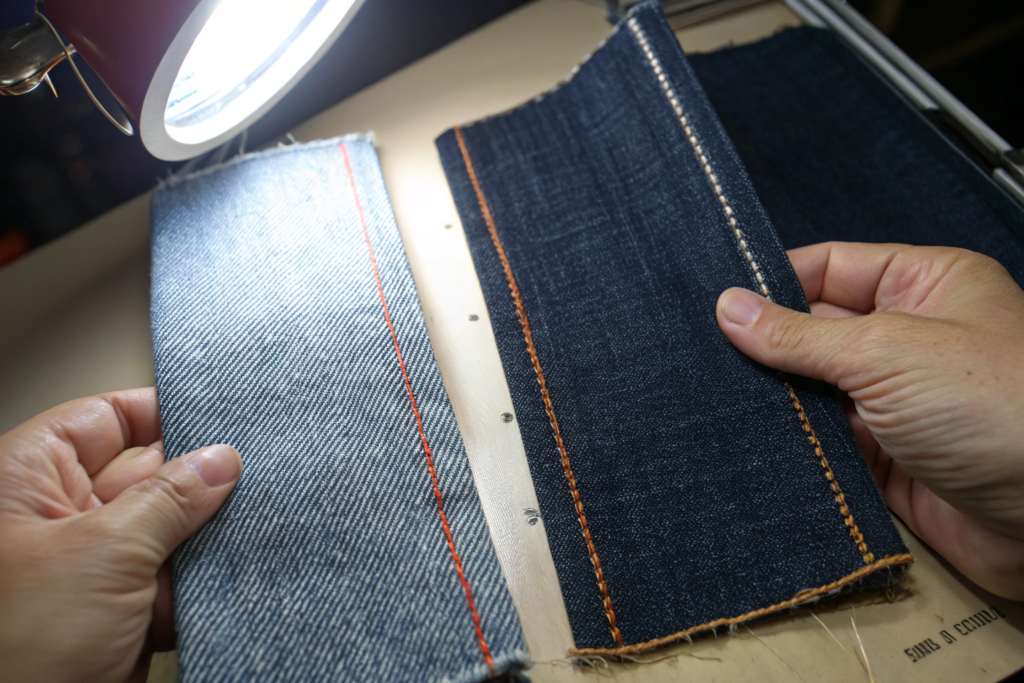
Ring-spun yarn is produced by a slower, traditional spinning method that twists the cotton fibers into a tighter, more cohesive yarn with a characteristic irregularity that creates the desirable "slub" texture. Open-end yarn is produced by a faster, cheaper method that creates a more uniform but weaker yarn with more protruding fiber ends. Ring-spun denim achieves approximately 25-30% higher Martindale abrasion scores than open-end denim of the same ounce weight.
Why Does a "3/1 Twill" Weave Construction Outperform a "2/1 Twill" in Crotch Seam Longevity?
In a 3/1 twill, the weft yarn passes under three warp yarns and over one. This creates a longer float on the fabric surface, distributing abrasion force across a wider area. In a 2/1 twill, the shorter float concentrates friction on fewer yarns, leading to faster wear-through at high-friction zones like the inner thigh and crotch.
What Specific Seam Construction Technique Prevents the Catastrophic Crotch Blowout?
A Canadian men's denim brand suffered a 12% return rate on a single batch of jeans, with every single return citing the same failure: the crotch seam burst open after two months of wear. The factory had used a standard, single-needle lockstitch at the crotch intersection with no reinforcement. The seam was aesthetically clean but structurally incapable of handling the multi-directional tensile stress of a man sitting, squatting, and walking.
The specific seam construction that prevents the catastrophic crotch blowout is a fully felled inseam and seat seam, where the raw fabric edges are enclosed and double-stitched for maximum tensile strength, combined with a heavy bar-tack at the critical crotch intersection point, using a minimum of 28 densely packed zigzag stitches that spread the pulling force from the seated posture across a reinforced area of approximately 1.5 square inches, preventing the single-point seam rupture that standard single-needle construction fails to stop.
The crotch seam is the single most stressed point on any pair of jeans. A standard lockstitched seam concentrates all pulling force onto a single line of thread perforations. When one stitch breaks, the adjacent stitches take the increased load, and the seam unzips sequentially. A bar-tack prevents this catastrophic chain reaction.
How Does a "Felled Seam" Differ Structurally From a Standard "Overlocked and Topstitched" Seam?
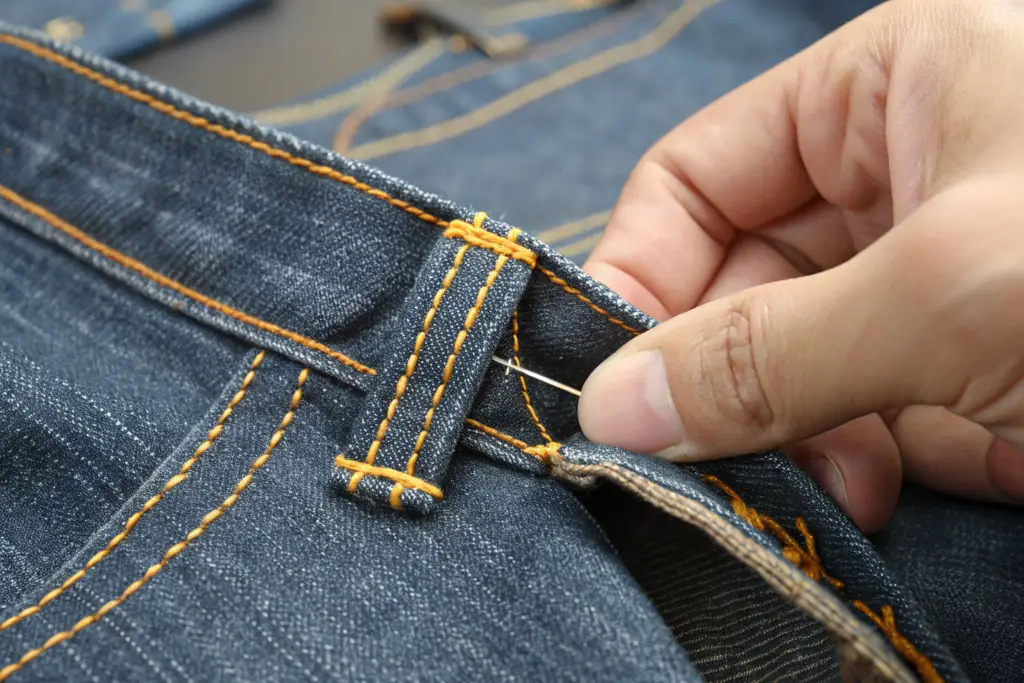
A standard overlocked seam finishes the raw edge but leaves the seam allowance exposed on the inside. A felled seam folds the seam allowance flat against the fabric, encloses the raw edge, and is topstitched down with two rows of stitching. The result is a seam that is stronger because the load is distributed across four layers of fabric and two rows of stitching rather than two layers and one row.
What Is the Exact Stitch Density Specification for a Denim Crotch Seam Destined for Heavy-Duty Use?
For heavy-duty men's denim, the crotch seam should be sewn with a minimum of 10 stitches per inch, using a heavy-duty 100% polyester core-spun thread with a tensile strength of no less than 8 pounds. Lower stitch densities or weaker cotton thread will fail under the repeated loading of a seated, moving wearer.
Why Are Genuine Copper Rivets and Heavy-Duty YKK Zippers Non-Negotiable Components?
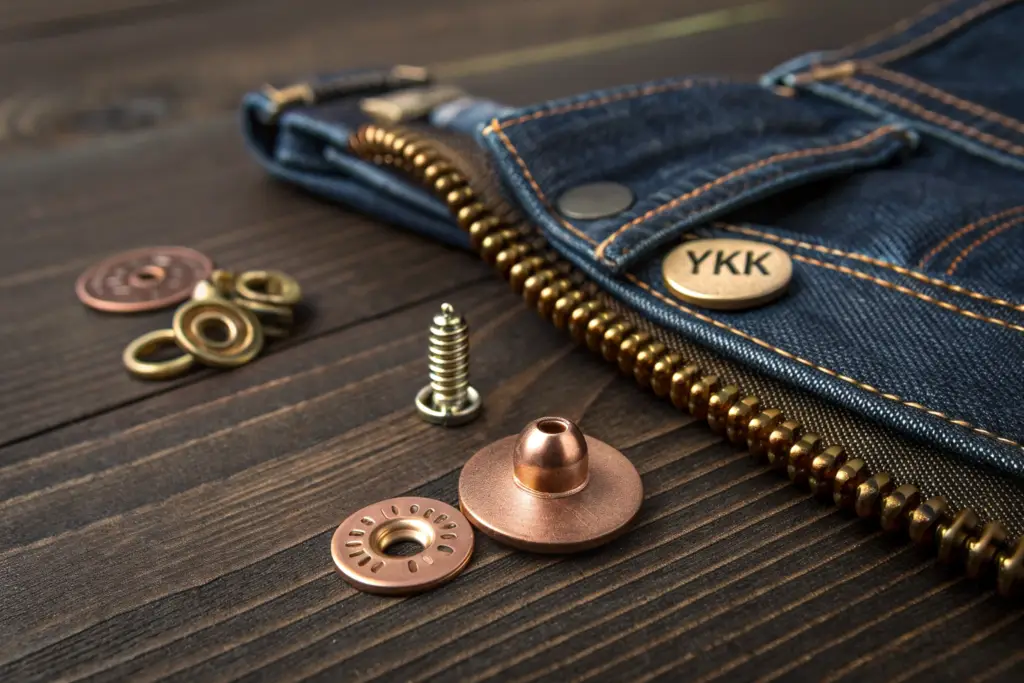
A New York premium denim label once discovered, after shipping 5,000 pairs, that the copper rivets on their back pockets were leaving green oxidation stains on the denim after the first wash. The rivets were not solid copper; they were cheap zinc alloy with a thin copper electroplating that corroded immediately upon contact with water and laundry detergent. Simultaneously, the front zipper—a generic, unbranded model—began failing after approximately thirty cycles of opening and closing, with the slider teeth skipping and the tape fraying.
Genuine copper rivets and heavy-duty YKK zippers are non-negotiable components for export-quality men's denim because solid copper rivets with a flat washer backing provide permanent, corrosion-free reinforcement at the highest-stress pocket corner points without oxidizing or staining the surrounding fabric, and a genuine YKK #5 or #8 brass zipper, specified by the exact model number, undergoes a minimum of 2,000 opening and closing cycles in its rated lifespan compared to unbranded zippers that often fail after 300-500 cycles.
A zipper failure renders the entire pair of jeans unwearable. A rivet that stains the fabric ruins the aesthetic of a premium garment. These components are not accessories; they are functional load-bearing elements.
How Can a Simple "File Test" Verify a Rivet Is Solid Copper and Not Electroplated Zinc?
A genuine solid copper rivet, when scratched deeply with a metal file, reveals the same warm, reddish copper color throughout the scratch depth. An electroplated zinc rivet reveals a bright, silvery-grey base metal beneath a thin copper surface layer. This test takes five seconds and prevents a $50,000 component substitution error.
Why Does a YKK "Universal" Zipper Outlast a Generic Zipper by 5 Times the Operation Cycles?
YKK zippers are manufactured to tighter tolerances with precisely shaped, individually locked zipper teeth that interlock securely and release smoothly. Generic zippers often use stamped, less precisely formed teeth that jam, skip, and wear down the tape fabric. The YKK internal testing standard rates their #5 brass zipper for over 2,000 cycles; generic equivalents rarely specify a rated lifespan.
How Does an Industrial Enzyme Wash Increase Perceived Softness Without Destroying Tensile Strength?
A UK-based premium denim brand once demanded their factory achieve an "extremely soft hand feel" on their raw denim jeans. The factory, lacking proper enzyme wash controls, over-processed the jeans in a heavy stone-wash cycle with aggressive pumice stones. The jeans emerged beautifully soft but with cotton fibers so physically abraded and weakened that the crotch seam areas developed holes after minimal wear.
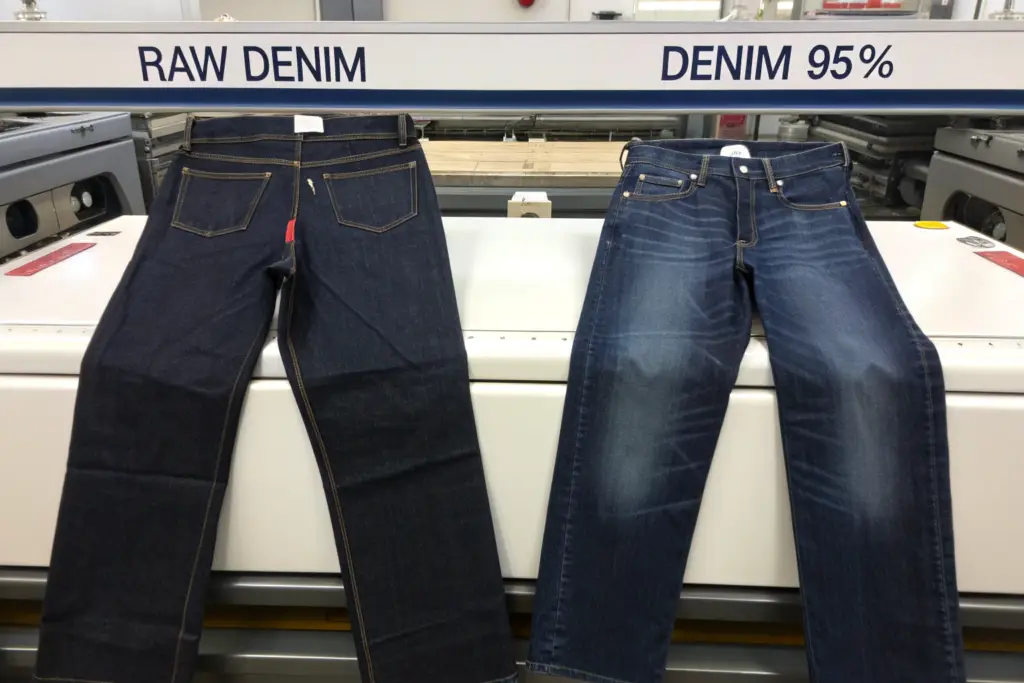
An industrial enzyme wash increases perceived softness without destroying tensile strength by using a precisely dosed, neutral cellulase enzyme solution that selectively degrades the microscopic surface fuzz and protruding fiber ends on the denim yarn surface, achieving a soft hand feel while retaining 92-96% of the fabric's original tensile strength, compared to aggressive stone-washing or heavy chemical bleaching that can reduce tensile strength by 25-40% through indiscriminate fiber degradation.
Enzyme washing is a targeted, biological process. Stone washing is a blunt, physical beating. The difference in retained fabric strength is the difference between a jean that lasts five years and a jean that develops holes in six months.
How Is the Cellulase Enzyme Concentration and Wash Duration Calibrated for a 13-Ounce Denim?
The enzyme wash is calibrated using a sample testing protocol. A 13-ounce denim might require a 0.5% concentration of liquid neutral cellulase enzyme at 55 degrees Celsius for 25-35 minutes. The wash is stopped at the precise moment the fabric achieves the target surface softness without a measurable loss of tensile strength. This calibration is done on a sacrificial test batch before the bulk wash.
What Is the "Tensile Strength Retention Percentage" Test That Validates the Enzyme Wash Was Not Over-Applied?
A tensile testing machine grips a strip of the enzyme-washed denim and pulls it until it ruptures. The force at rupture, in Newtons, is compared to the rupture force of the identical raw denim before washing. A properly enzyme-washed denim retains a minimum of 92% of its raw tensile strength.
Conclusion
Producing durable men's denim jeans for export is a layered discipline of material selection, seam engineering, component specification, and finishing process control. The 13-ounce, ring-spun, 3/1 twill denim provides the foundational fabric durability. The felled seam with a 28-stitch bar-tack at the crotch point prevents the catastrophic structural failure that destroys a jean's wearable life. The solid copper rivets and the YKK #5 brass zipper provide permanent, corrosion-free reinforcement at stress points and a closure system rated for thousands of cycles. The controlled enzyme wash softens the hand without sacrificing the tensile strength that is the denim's core value.
At Shanghai Fumao, I produce men's denim jeans with these exact specifications for export brands that sell to customers who expect their jeans to last for years, not months. Every denim order goes through our inline fabric weight verification, our seam strength pull-test, our rivet file-test, and our post-wash tensile strength retention test.
If you are a brand owner developing a men's denim line for export and you want the technical specification package, the hardware sourcing contacts, and the enzyme wash calibration data that guarantee your jeans survive real wear, contact my Business Director, Elaine. She can send you our full denim construction specification sheet and a physical sample of our 13-ounce ring-spun denim with the YKK zipper and copper rivet specifications. Reach Elaine at: elaine@fumaoclothing.com. Build a jean that outlasts the warranty, not one that triggers the return.