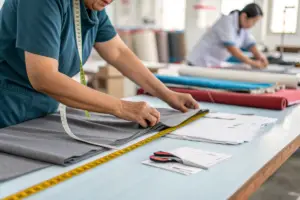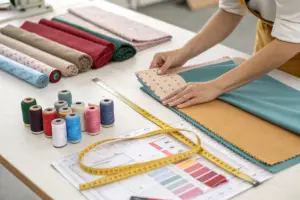
A veteran apparel buyer for a major US department store chain once told me a story that has shaped my entire approach to quality control. Early in her career, she approved a shipment of 12,000 rayon blouses from a new supplier. The pre-shipment sample was flawless. She signed off. When the blouses hit the retail floor, the nightmare began. The side seams split open when customers tried them on. The buttonholes were too small for the buttons, so women forced them through, ripping the fabric. The dye was not colorfast, and the blouses stained other garments in customers' washing machines. The return rate exceeded 30%. The department store fined her company, cancelled all future purchase orders, and delisted the brand permanently. Her career almost ended because of a single unchecked shipment. She learned that day that a beautiful sample and a signed certificate mean nothing. Only a statistically valid, physically destructive, independently verified quality control process means anything.
Professional and experienced apparel buyers heavily insist on absolute strict quality control because a single failed shipment does not just generate returns and refunds—it triggers a cascading commercial catastrophe of chargeback fees exceeding $15 per disputed transaction, permanent delisting from wholesale platforms with blacklisted vendor IDs, brand reputation erosion that destroys multiple seasons of consumer trust, and personal career liability for the buyer who approved the shipment, all of which combined can erase an entire year's profit margin on a single purchase order.
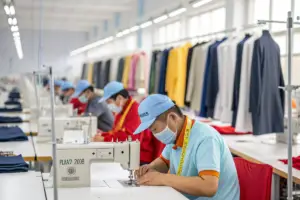
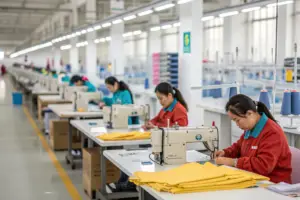
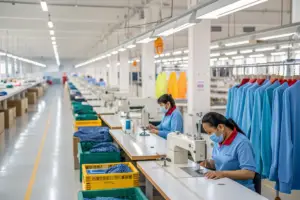
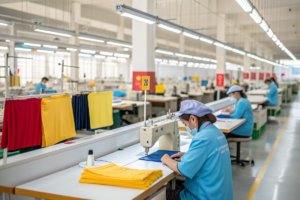
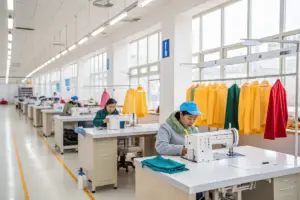
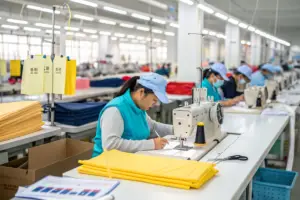
At Shanghai Fumao, I do not view quality control as a final checkpoint. I view it as the factory's central nervous system, embedded in every single production station from raw material receiving to final carton sealing.
What Is the Exact Financial Cascade That a Single Defective Shipment Triggers for a Wholesale Buyer?
A Nashville-based boutique wholesaler once called me in a quiet, defeated voice. Her factory had shipped a batch of 2,500 printed cotton dresses where the print was slightly off-registration—a subtle misalignment of the screen-printing screens that caused a faint white edge to appear next to every colored shape. It looked like a minor aesthetic flaw. It was not. Her retail accounts refused the shipment upon arrival. She had to refund the wholesale price to twelve different boutiques simultaneously. The chargeback fees from her credit card processor began accumulating at $15 per disputed transaction. The freight to return the rejected goods from stores across the country cost more than the goods were worth. The warehouse storage fees for the unsellable inventory began clocking at $1,200 per month.
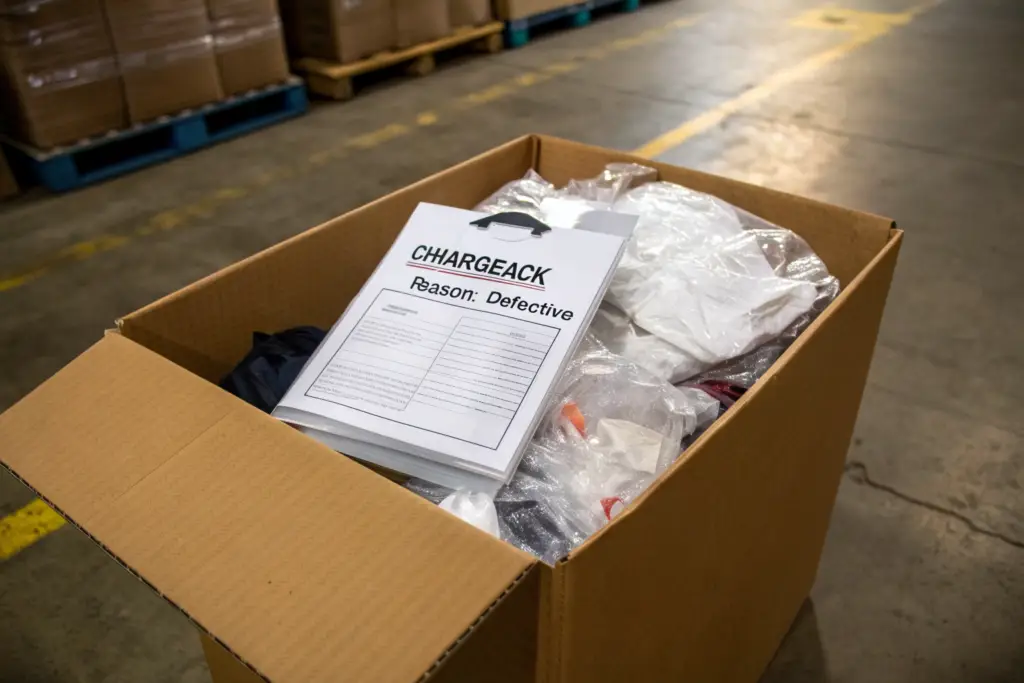
The exact financial cascade of a single defective shipment starts with the wholesale refund of the full FOB value multiplied by the returned unit count, adds the cumulative chargeback fees of $15-$25 per individual retail transaction processed through the payment gateway, adds the outbound and return shipping costs which on heavy garments can exceed the unit manufacturing cost, adds the long-term warehouse storage fees for quarantined unsellable inventory typically accruing at $15-$25 per pallet per month, and culminates in the permanent loss of the wholesale account's future purchase order volume which often represents 60-80% of the brand's annual revenue.
The defective garment itself is often the smallest cost in the cascade. The logistics of rejection, the payment processor penalties, and the lost future revenue are the true destroyers of margin.
How Does a Credit Card Chargeback Fee of $15 Per Transaction Turn a $3 Defect Into a $21 Loss?
A customer who buys a $55 dress and discovers a broken zipper files a chargeback with her credit card company. The merchant is charged a $15 non-refundable chargeback fee. The merchant must also refund the full $55. The merchant lost the $12 wholesale cost of the dress, the $3 original shipping cost, and now pays a $15 penalty. The $3 zipper defect has generated a $30 total cash loss. If 200 customers file chargebacks on a 2,500-unit batch, the chargeback fees alone consume $3,000.
Why Does a Single Quality Failure Cause a Permanent Delisting From a Major Wholesale Platform?
Wholesale platforms track vendor performance metrics automatically. A vendor whose defect rate exceeds a threshold—often 3-5%—is flagged by the platform's algorithmic quality monitoring system. Once flagged, the vendor's product listings are suppressed in search results, their "Featured Vendor" status is revoked, and in severe cases, their seller ID is permanently blacklisted. Rebuilding a seller reputation to the pre-blacklist sales volume can take eighteen months or prove impossible.
How Does an AQL 1.5 Statistical Sampling Plan Work in a Real Factory Inspection Environment?
A Seattle-based outdoor apparel brand once relied on a factory's internal "100% inspection" promise. The factory claimed every single garment was individually checked before packing. The brand believed them and skipped the third-party AQL audit. When the shipment of 4,000 fleece jackets arrived, the brand's own receiving team conducted a random AQL audit and discovered a 6.2% major defect rate—broken zipper pulls, twisted sleeve seams, and inconsistent hem lengths. The factory's "100% inspection" had either been a lie or been performed by workers incentivized to pass defective units to meet production quotas.
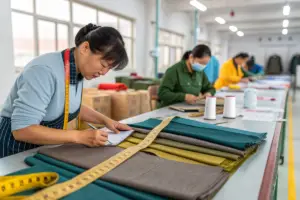
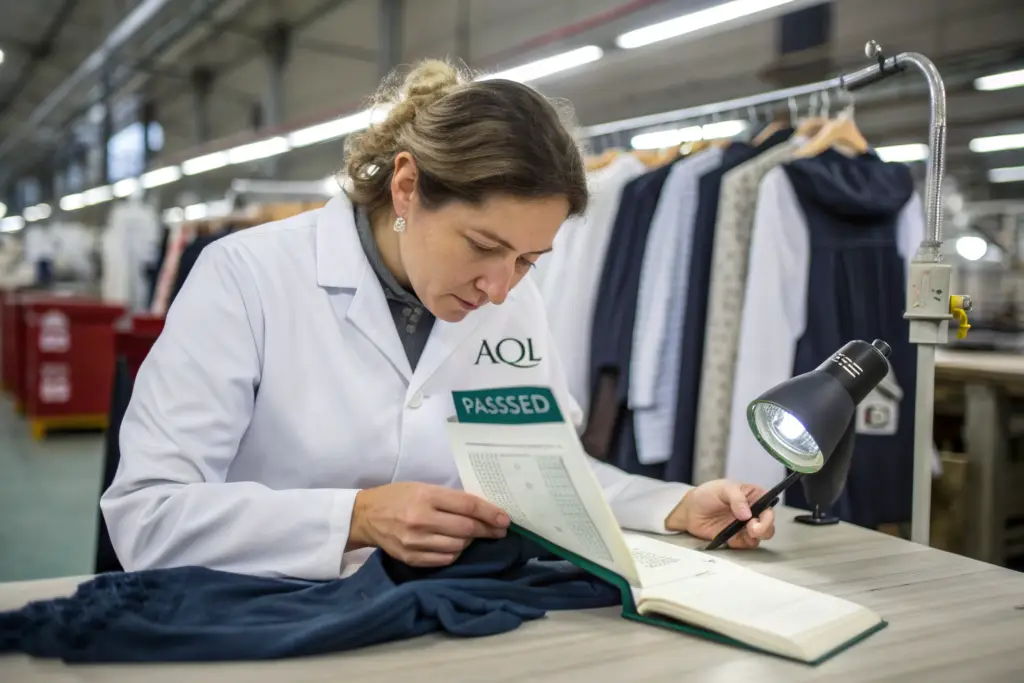
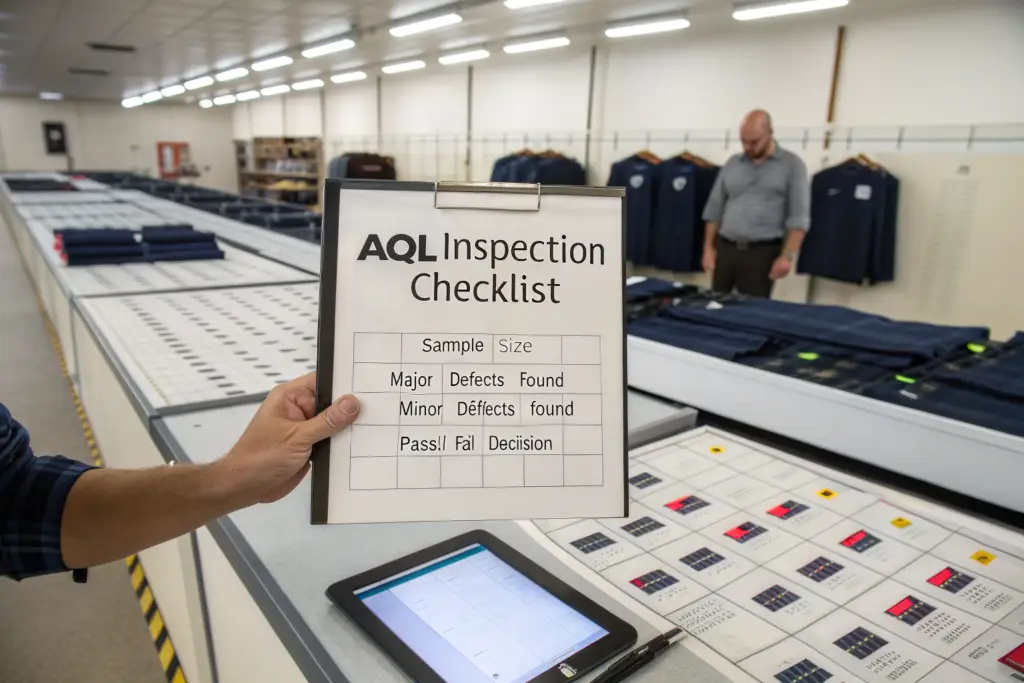
An AQL 1.5 statistical sampling plan works by randomly selecting a statistically determined sample size from the total batch—for a 5,000-unit order, typically 200 units—and then inspecting each sampled unit against a predefined list of critical, major, and minor defects, with the entire batch rejected if the number of major defects found exceeds the acceptance number of 7 units, providing a mathematically valid, 95% confidence level assessment of the total batch quality without requiring a physically impossible inspection of every single unit.
AQL stands for Acceptable Quality Limit. The 1.5 figure means the buyer accepts that no more than 1.5% of the batch contains major defects, and the sampling plan provides the statistical framework to verify this threshold.
What Is the Distinction Between a "Critical," "Major," and "Minor" Defect in an AQL Inspection?
A Critical defect renders the garment unsafe or illegal—a sharp needle fragment left in a seam, a children's garment with a drawstring violating safety regulations. Any single Critical defect fails the entire batch, regardless of sample size. A Major defect renders the garment unsellable at full price—a broken zipper, a hole in the fabric, a noticeable shade variation. A Minor defect is a deviation from spec that a consumer might not notice—a slightly uneven stitch line, a loose thread. The AQL 1.5 sampling plan is applied to Major defects.
How Does a "Random Number Generator" Selection Prevent the Factory From Preparing a "Golden Carton"?
A corrupt factory might prepare a specific set of perfect cartons, knowing the inspector always samples from cartons numbered 1 through 5. An AQL audit requires the inspector to use a random number generator to select the exact carton numbers from the entire pallet range. This randomization prevents the factory from isolating defective units in cartons they know will not be sampled.
Why Is Inline QC During Sewing Radically More Effective Than Final Random Inspection Alone?
A Melbourne-based womenswear brand once rejected a final shipment of 3,000 blouses because the AQL final inspection revealed a 5.8% major defect rate—specifically, the collar points on the blouses were blunted and asymmetrical. The entire 3,000 units had already been sewn, finished, and packed. The factory had to unbox all 3,000 units, re-cut and re-sew the collars, re-press, and re-pack. The rework cost exceeded the original sewing labor cost. The root cause was a single collar-turning machine that had drifted out of calibration on day two of the ten-day production run, and no one caught it until day ten.
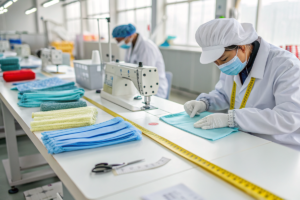
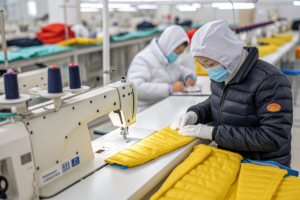
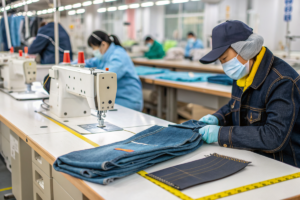
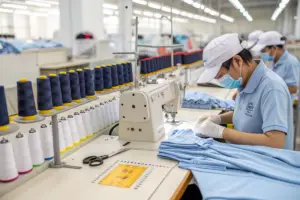
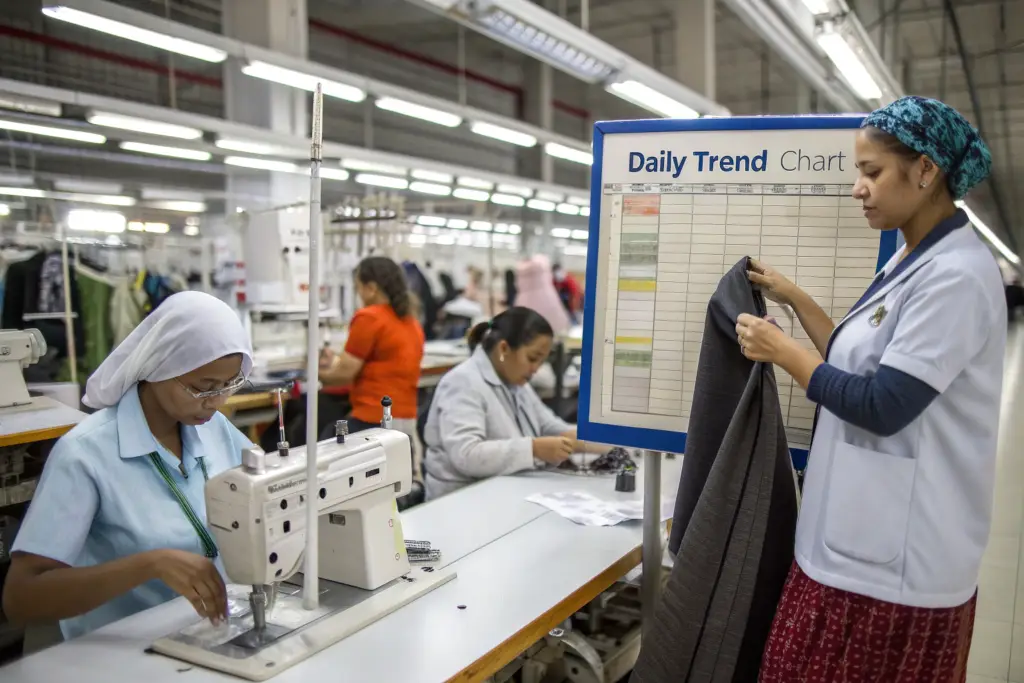
Inline QC during sewing is radically more effective than final random inspection alone because it places a dedicated inspector at the production line itself, checking units at the "Station Zero" first piece stage and then continuously at 20-unit intervals throughout the shift, catching a systemic defect like a mis-calibrated machine or a wrong thread tension within the first 20 units produced rather than after 2,000 defective units have already been sewn, packed, and sealed in cartons.
Final inspection finds the problem when the cost of correction is at its maximum. Inline inspection finds the problem when the cost of correction is at its minimum—a simple machine adjustment and a small rework of only 20 units.
How Does a "First Piece Off the Machine" Check Prevent a 2,000-Unit Defect Cascade?
When a sewing operator starts a new batch, the inline QC inspector takes the very first finished piece from that operator's machine and performs a full dimensional and visual check against the Golden Sample. If the tension is wrong, the seam allowance is off, or the collar point shape is incorrect, the machine is recalibrated immediately. Only 20 defective units exist, not 2,000.
What Machine Calibration Data Does an Inline Inspector Log for Every Single Sewing Head?
The inspector logs the thread tension dial setting, the presser foot pressure, the differential feed ratio, and the stitch density per inch for each machine head at the start of each shift and after any adjustment. If a defect pattern emerges, the logged data pinpoints exactly which machine and which setting was responsible.
How Does a Third-Party External Lab Test Protect a Buyer From Invisible Chemical Contamination?
A German baby clothing brand once faced a mandatory recall because their factory had used a textile softener containing a phthalate compound above the EU legal limit. The fabric was certified organic cotton. The stitching was flawless. The garment was physically beautiful and dimensionally perfect. But the chemical contamination was invisible to the eye and touch. The factory had no idea the softener was contaminated, because they had never commissioned a third-party chemical extraction test on their bulk production.
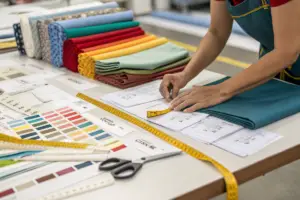
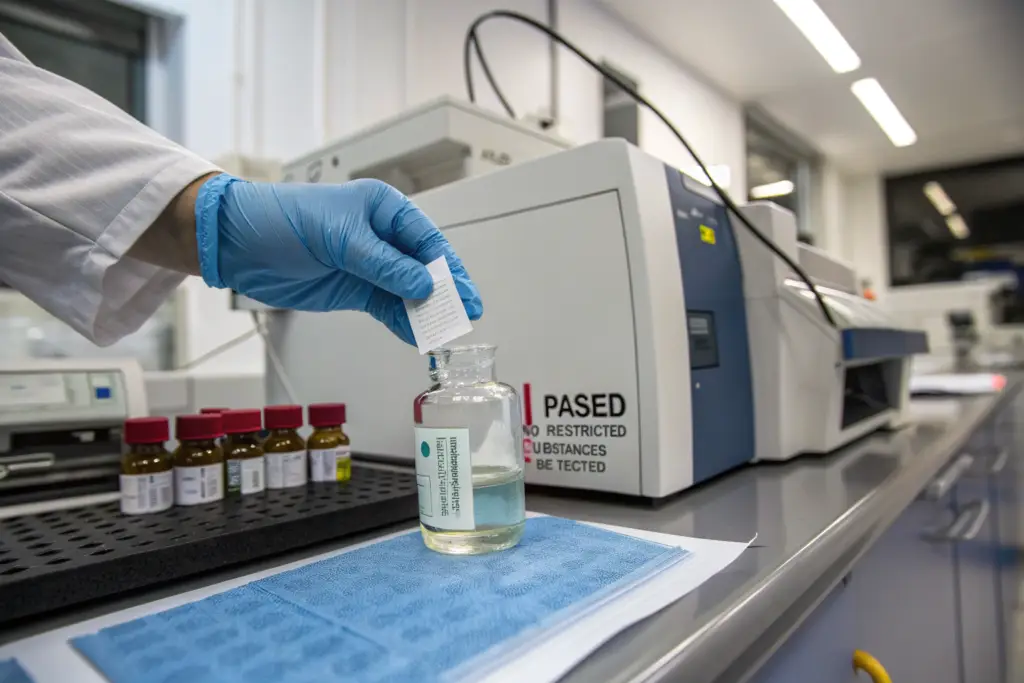
A third-party external lab test protects a buyer from invisible chemical contamination by performing a gas chromatography-mass spectrometry (GC-MS) or inductively coupled plasma (ICP) analysis on a random sacrificial sample from the actual bulk production, detecting restricted azo dyes, formaldehyde, phthalates, heavy metals like lead and cadmium, and allergenic disperse dyes at concentrations as low as 20 milligrams per kilogram, which is far below the threshold of human sensory perception but well within the detection range of regulatory enforcement laboratories.
The human eye cannot see a phthalate molecule. A human nose cannot smell 20 milligrams of lead per kilogram of fabric. Only a calibrated spectrometer can detect these contaminants, and only a third-party lab with no financial incentive to pass the goods can provide an audit-proof report.
Why Does an "Extraction Under Simulated Sweat" Test Matter More Than a Simple Fabric Surface Scan?
A fabric surface scan might not detect a chemical that is deeply bound inside the dye molecule and only releases when exposed to warm, acidic human sweat. The simulated sweat extraction test immerses the fabric in a precise chemical solution mimicking sweat at 37 degrees Celsius for a specified duration, then analyzes the extract. This test reveals hidden contaminants that surface testing misses.
How Does a "Random Batch Sampling" Protocol Prevent a Factory From Submitting a Specially Prepared "Clean" Swatch?
A dishonest factory could prepare a small, specially cleaned swatch and submit it for testing. The third-party lab protocol should require the lab technician to randomly select the test sample from the actual bulk cartons at the factory, or the brand should courier a randomly selected garment from the received shipment directly to the lab without the factory's involvement.
Conclusion
Professional and experienced apparel buyers insist on absolute strict quality control not because they are difficult or demanding, but because they understand the terrifying mathematics of a single failed shipment. A $3 broken zipper generates a $15 chargeback fee, a $12 return shipping label, and a permanently lost customer whose lifetime value was $200. An unchecked dye lot shade variation causes a wholesale account delisting that destroys 60% of annual revenue. An invisible phthalate contamination triggers a mandatory government recall that bankrupts the brand. Quality control is not a cost center. It is the insurance premium that protects the business against these mathematically predictable, commercially catastrophic cascades.
At Shanghai Fumao, I have embedded quality control into every operational layer: the AQL 1.5 final audit, the inline Station Zero check, the machine calibration data log, and the third-party OEKO-TEX chemical extraction test. These four layers are not optional "add-on services." They are the standard operating procedure for every single order.
If you are a brand owner or a professional buyer who wants to see our full QC layer documentation—the AQL sampling plan template, the inline inspection log format, the external lab test report for your specific fabric composition—contact our Business Director, Elaine. She can walk you through exactly how we would structure the quality architecture for your next bulk production run. Reach Elaine at: elaine@fumaoclothing.com. Buy with the confidence that someone checked every seam.