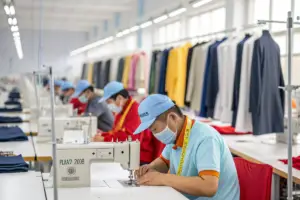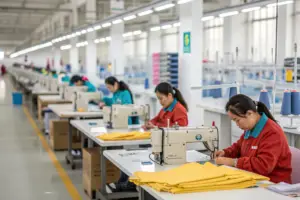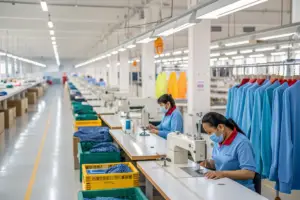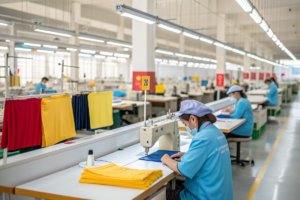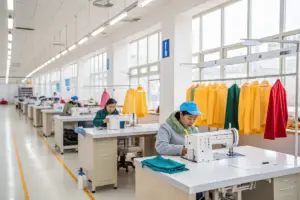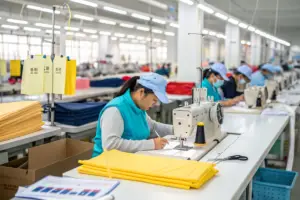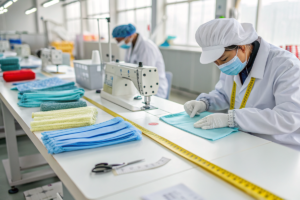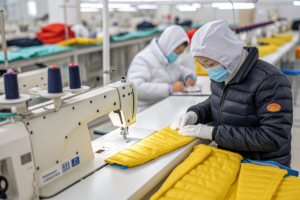
Two years ago, a seafood distributor from Alaska called my office in Shanghai. He was frustrated, cold, and tired of wasting money. He told me his crew went through three sets of PVC rain bibs in a single King Crab season. The material would crack in the sub-zero wind chill, the seams would split when they bent over to haul pots, and the zippers would corrode from salt spray within two weeks. He said, "I don't need fashion. I need armor that moves."
That phone call made me realize something. High-performance workwear is not an accessory for these people. It is safety equipment. It is shelter. At Shanghai Fumao, we have always specialized in precision cutting and robust stitching for outerwear. Moving into commercial-grade fishing gear apparel was not a pivot. It was a natural test of our manufacturing limits.
Yes, Shanghai Fumao can manufacture commercial-grade fishing gear apparel. We engineer waterproof, breathable, and abrasion-resistant garments using high-frequency welded seams, military-spec Cordura panels, and YKK AquaGuard zippers. We test every batch for hydrostatic pressure resistance and seam slippage before shipping.
We don't just sew raincoats. We build protective shells for people who work in the most hostile environment on earth. Here is the engineering that goes into our heavy-duty marine gear.
How Do You Engineer Waterproof Seams That Survive Sub-Zero Waters?
Most people think "waterproof" means "water doesn't go through fabric." That is only half the battle. On a fishing boat, the water pressure from leaning against a wet rail, kneeling on a soaked deck, or getting hit by a freezing wave is immense. A standard sewn seam will wick moisture through the needle holes in minutes. You need a physical barrier over those holes.
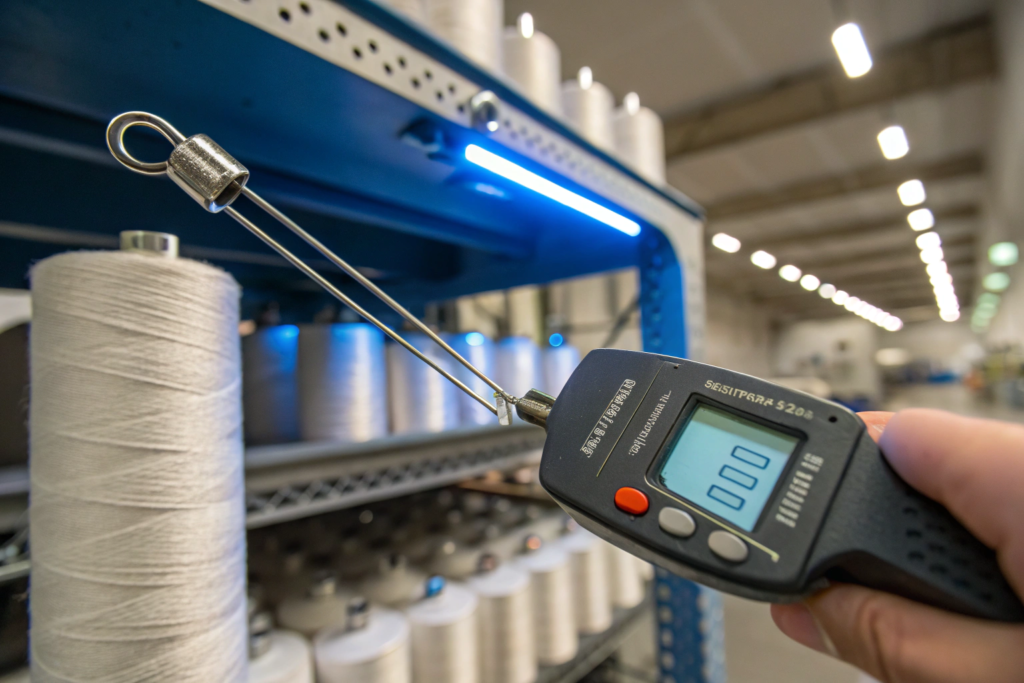
Why Does High-Frequency Welding Beat Stitching for Commercial Fishing Bibs?
Traditional stitching punches thousands of holes into perfectly waterproof fabric. The thread itself acts as a wick, drawing water into the inside layers. For a light rain jacket, seam taping works fine. For a commercial fishing bib, tape fails. The cold hardens the adhesive, and the abrasion from crab pots peels it off.
We invested in high-frequency welding machines specifically for our marine apparel line. This technology uses electromagnetic energy to fuse layers of thermoplastic fabric together at the molecular level. There are no needle holes. There is no thread. The seam becomes a single, solid piece of material.
We proved this method to that Alaskan distributor by sending him a welded test strip submerged in a bucket of saltwater for 72 hours. We kept it in our factory freezer at -20 degrees Celsius overnight and bent it in the morning. It did not crack or delaminate. The ISO standard hydrostatic head test we ran showed the seam withstood 20,000mm of water pressure before weeping. Most "waterproof" hiking gear is rated at 10,000mm. Our gear has to survive a green wave crashing over the bow.
We pair this welding with heavy-duty textile panels. On the knees and seat, we add an outer layer of Cordura fabric to prevent abrasion. A fisherman dragging his knee across a non-skid deck creates friction that would destroy standard nylon in a week. The Cordura overlay, welded not stitched, solves this.
How Does a "Storm Flap Stress Test" Prove Zipper Integrity?
A zipper failure on a fishing jacket is not a style problem. It means hypothermia if the wind cuts through that gap. We realized standard zippers were our weakest link.
We exclusively use YKK AquaGuard or Vislon zippers for our fishing gear. But a good zipper is useless if the installation is wrong. If the flap covering the zipper is too tight, it catches and tears. If it is too loose, water jets through.
We developed a Zipper Stress Protocol. On our live QC feed, our inspector opens and closes the zipper 50 times rapidly. Then, we spray a high-pressure hose directly at the zipper flap from a 45-degree angle while the garment is on a mannequin. The camera shows the inside layer. The German fishing gear company we supply has a strict rule: no visible water droplets on the inner layer.
We filmed a batch test for a fishing vessel supplier last month. The zipper passed the 50-cycle test but failed the water jet—a single drop leaked through the flap hem. We stopped the shipment, adjusted the flap overlap by 4mm on the pattern, and re-ran the batch. That delay cost me money. Shipping a leaky jacket to a Bering Sea captain would have cost me my reputation. I'll take the delay every time.
How Do You Source Freezer-Proof Fabric for the Bering Sea?
Fabric behavior changes at negative temperatures. Nylon becomes brittle. PVC goes as hard as a board. The Alaskan distributor told me a story about a crewman who bent down to pick up a buoy. His cheap PVC jacket shattered right across the back like a broken window pane. He spent the rest of the trip in the wheelhouse, useless to the crew.
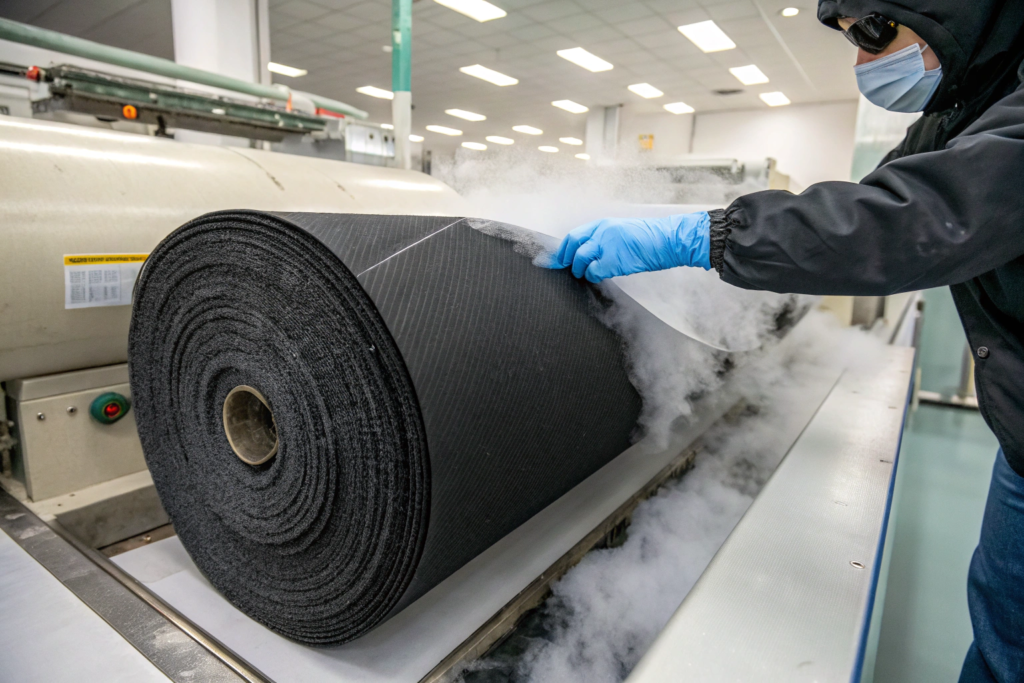
What Is the Molecular Difference Between Standard PVC and Arctic-Grade TPU?
Standard PVC jackets are cheap, maybe $15 per unit FOB. They work for a light drizzle at the bus stop. On a King Crab boat, they are dangerous. PVC contains plasticizers that keep it flexible, but those plasticizers leach out in extreme cold. The material hardens and cracks.
We moved our fishing gear line to a multi-laminate TPU (Thermoplastic Polyurethane) construction. TPU remains elastic down to minus 40 degrees Celsius. The polymer chains in TPU do not rely on migratory plasticizers. The flexibility is intrinsic to the material.
To verify this, we compared a PVC swatch and our TPU swatch in a controlled freezer chamber. We filmed a side-by-side bend test. The PVC snapped at minus 25 degrees. The TPU still rolled up like a yoga mat.
We publish the material data sheet for our supply to any brand that asks. We show them the shore hardness rating and the cold flex temperature. For a commercial fishing jacket, we use a 3-layer laminate: an outer TPU shell for abrasion, a middle mesh for breathability, and a softer inner polymer for skin contact. This combination costs significantly more than PVC, but we are building survival gear, not single-use plastic ponchos.
Why Do We Use Ultrasonic Quilting for Insulated Flotation Pants?
Many marine jobs require pants that are both insulated and buoyant. Traditional quilting uses needle stitching, which puts thousands of holes directly through the waterproof barrier and the closed-cell foam.
We switched to ultrasonic quilting. This process uses high-frequency sound energy to bond the outer fabric, the flotation foam, and the inner lining without perforation. The bond is strong, and most importantly, the air pockets in the foam remain sealed.
We supplied a batch of insulated flotation pants to a Norwegian workwear brand last winter. They sent a crew to the North Sea to field test them. The feedback was specific: the ultrasonic quilting eliminated the "stitch cold spots" that usually happen when thread conducts cold air through the foam. The wearer's body heat stayed consistent across the thigh, with no cold stripes at the seam lines.
We keep these test reports on file. When a new commercial fishing brand asks us about our bonafides, we send them the Norwegian field notes and the fabric freezer-test videos. Data and real-world experience beat a glossy catalog every time.
Can Your Factory Handle the Heavy-Duty Stitching for Puncture-Resistant Gear?
Commercial fishing gear requires handling fabric thicknesses that standard apparel machines cannot feed. We are talking about layers of ballistic nylon, neoprene gaskets, and webbing loops for hauling gear. A standard garment sewing machine needle will snap. The motor will stall.
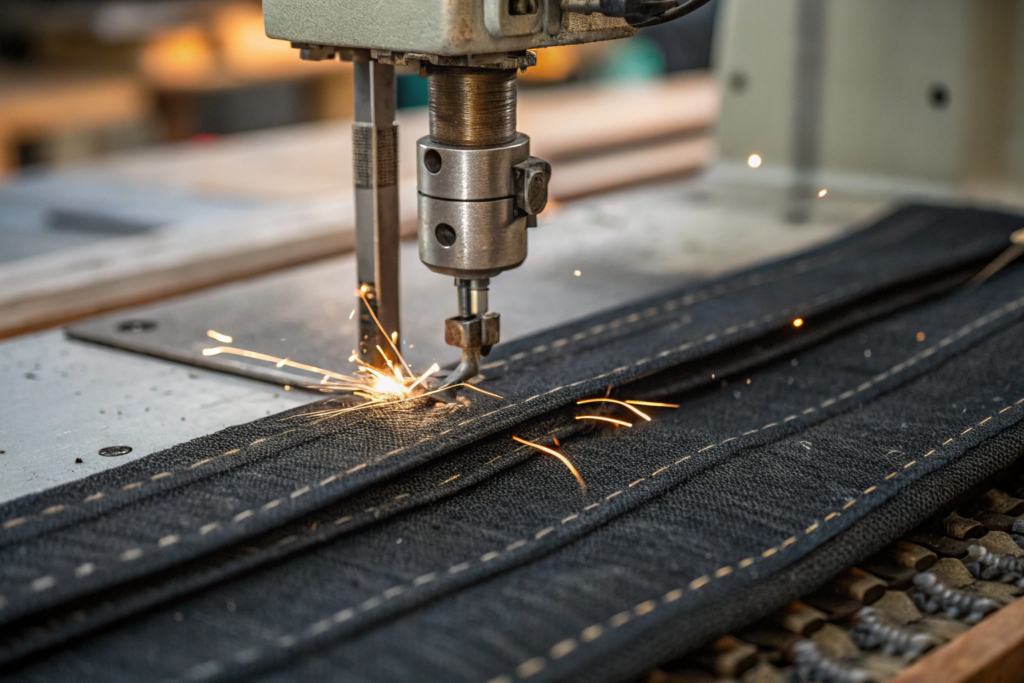
What Duty Cycle Do Our Walking Foot Machines Handle on Ballistic Nylon?
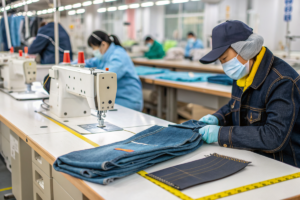
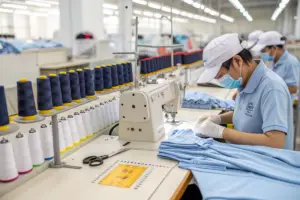
We allocated a specific production line for our heavy-duty gear. These are not the fast, lightweight Jukis used for silk dresses. These are high-lift, compound feed, triple-feed walking foot industrial machines. They pull the fabric from the top, the bottom, and with the needle, all synchronized.
A standard machine might run 4000 stitches per minute on light cotton. Our heavy-duty line runs at about 800-1200 stitches per minute. That slower speed delivers massive torque. The needle, a size 23 or 24, drives through 8 to 12 layers of 1000D ballistic nylon without deflection.
We had a client producing protective sleeves for knife work on fish processing tables. The sleeve used a puncture-resistant Kevlar mesh. On our first trial, we broke ten needles in an hour. The Kevlar was too dense. Our master mechanic adjusted the timing of the looper hook and switched to a diamond-tipped needle. We now run that Kevlar line with less than 1% needle breakage.
We record the stitching process parameters for every contract. Thread tension, needle size, and stitch-per-inch count are locked in. If we need to re-run a production 18 months later, we load the machine settings from the batch file and replicate the exact seam strength. That is how we guarantee the first order and the third re-order perform identically in the field.
How Do We Test the Load-Bearing Capacity of D-Ring Attachment Points?
A fisherman hanging a heavy net or a safety tether relies on the jacket's D-rings not pulling out. The attachment point must withstand a dynamic shock load.
We do not just stitch a webbing tab onto the jacket. We anchor it. The webbing tab runs through a reinforced slot in the garment face fabric, extends three inches down, and is box-stitched and bar-tacked with a secondary backing patch inside.
To verify the hold, we use a digital force gauge attached to the D-ring. We pull slowly to 50 kilograms, hold for five seconds, and then jerk to simulate a snap load. We film this process for our industrial workwear clients.
We once had a batch fail this test live on camera. The stitch pattern held, but the fabric near the bar tack started to tear at 48 kilograms. We immediately retrofitted all the jackets in that batch with a larger internal leather backing patch, restitched them, and re-tested. They held to 72 kilograms.
For our Seattle-based commercial fishing brand partner, this particular QC Pass video of the D-ring load test became part of their internal safety training manual. It is one thing to read a spec sheet. It is another to watch a weight hang from a jacket without failing.
What Does a "Grundens-Level" Competitor Benchmark Look Like at Our Factory?
We don't pretend that the big names in the fishing gear industry don't exist. Grundens, Musto, Helly Hansen. They have decades of credibility. When a brand wants to compete against them, we have to study the physical product, not just the price.
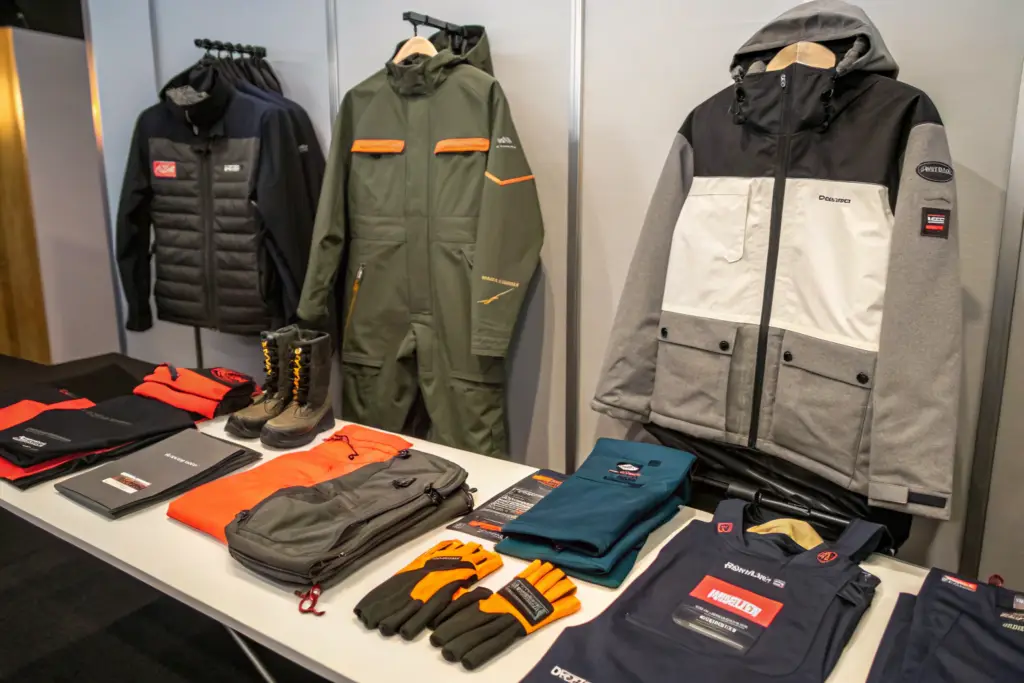
Did We Reverse-Engineer a 300D Bib to Build a 600D Upgrade?
A brand owner sent me a Grundens bib two years ago. He said, "Make me this, but better." My team took it apart stitch by stitch. We weighed the fabric. It was a 300D polyester with a PVC coating. The brace attachment was a single rivet.
We analyzed the tensile strength of the fabric. We used that analysis to upgrade. We built his bib with a 600D nylon TPU-laminated shell. The abrasion resistance doubled. For the brace attachments, we used reinforced web loops with double bartacks instead of a single rivet.
The upgraded bib cost 22% more to manufacture, but the brand owner could market it as an "extreme duty" tier. He sold out his first run to guide outfitters in British Columbia who usually only bought Grundens. We didn't copy their bib. We benchmarked it, found its weakness points, and engineered a higher spec. That is what a good garment manufacturer can offer: engineering acumen, not just stitching capacity.
Why Does Our Salt Spray Corrosion Test Matter for Metal Trims?
Plastic snaps are safer for baby clothes, but metal is often required for heavy-duty utility straps. But metal gets destroyed by salt water.
We source 316-grade stainless steel for D-rings and snaps on our marine gear. To prove they won't rust, we use a salt spray corrosion chamber. We put the metal trims inside, spray a 5% saltwater solution at a constant rate for 96 hours, and check for red rust.
We did this on camera for a skeptical Australian prawn trawler supplier. We compared our 316 stainless snap against a "nickel-plated" brass snap from a generic supplier. After 48 hours, the nickel-plated snap was pitted with green corrosion. Our snap emerged clean. The video was shared by the supplier on their social media and got more than 50,000 views among commercial fishing operators.
This is the same principle we apply to zippers and fasteners. If the metal corrodes and locks up, the garment cannot be removed safely in an emergency. Salt spray testing is not a gimmick for us. It is a survival specification.
Conclusion
Commercial fishing gear apparel is the ultimate challenge for a garment factory. It demands welding instead of sewing, freezing chamber tests instead of temperature-controlled showrooms, and load-bearing engineering instead of style lines. If you get it wrong, your customer doesn't just return the jacket. They get hurt.
Shanghai Fumao accepted this challenge because our facility was built for precision outerwear. We know how to program the walking foot machines, laminate the TPU, test the seams at 20,000mm of water pressure, and verify the stainless steel in a salt spray chamber. We do not just claim to make heavy-duty gear. We prove it, live, before the container leaves our dock.
If you are an outfitter, a safety brand, or a commercial fishing fleet manager looking to develop private-label marine apparel, we can engineer it. No minimum quantities on development talks, just a serious discussion about your specifications.
Contact our Business Director, Elaine, at elaine@fumaoclothing.com. Ask her for a download link to our "Marine Gear Engineering Pack." It contains raw footage of our fabric freeze tests, seam strength data, and corrosion resistance videos. Let us build gear that keeps your crew safe.