You have spent weeks perfecting the exact shade of "Burnt Ochre" for your custom-dyed linen fabric. The bulk fabric arrives, and it is perfect. You are thrilled. Then you see the production sample. The topstitching on the collar is sewn with a thread that is a slightly brighter, more yellow shade. The entire garment looks cheap. Your heart sinks. A seasoned designer told me, "I used to think thread was an afterthought. Then a whole season's worth of beautiful shirts was ruined by a 'close enough' thread match. I learned that thread is not a detail; it's a statement of quality."
Perfectly matching thread colors to your custom-dyed fabrics requires moving beyond a subjective "eyeball" method to a precise, data-driven, and multi-stage verification process. The key steps are: 1) Use a spectrophotometer to objectively measure the exact color of your bulk fabric and generate a target Delta E (ΔE) value for the thread, 2) Source thread from a supplier who offers professional color-matching services against your physical fabric swatch, and 3) Always conduct a final, real-world verification by laying the approved thread against the bulk fabric under a standardized D65 lightbox before production begins. A true match is invisible; a poor match is the first thing the customer notices.
At Shanghai Fumao, we obsess over these invisible details because we know they are the difference between a garment that looks expensive and one that looks like a mistake. Our quality control process for color is a science. Let me show you the exact protocols we use to ensure the thread on your garments is a flawless, invisible extension of your beautiful custom fabric.
How to Use a Spectrophotometer for Objective Color Communication?
The single biggest mistake in color matching is relying on subjective human language. Telling a supplier you need a "burnt ochre" thread is a recipe for frustration. Every screen, every set of eyes, sees color differently. The first step to a perfect match is to translate the subjective "color" into an objective, measurable set of numbers. This is the job of a spectrophotometer . It is the universal translator of color.
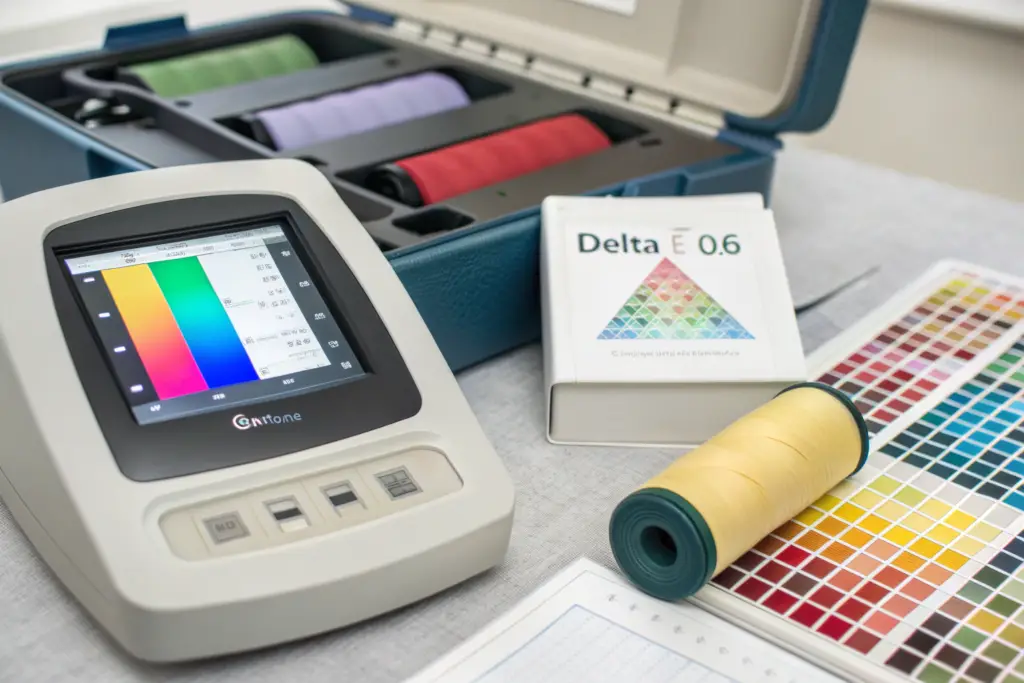
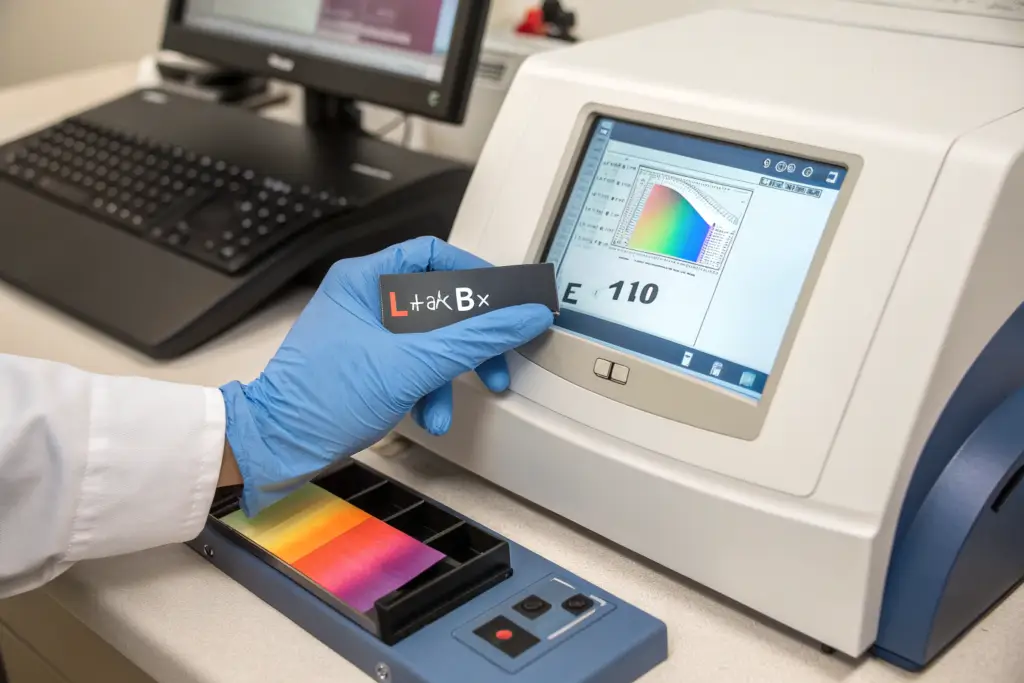
A spectrophotometer is the essential tool for objective color communication. It measures the exact amount of light reflected by your bulk fabric and generates a unique color "fingerprint" in a standardized digital color space (like CIE Lab*). This provides an objective set of coordinates that precisely define the color. You can then provide this data, along with a physical swatch, to your thread supplier, and set a clear, measurable tolerance for the match using a Delta E (ΔE) value. A ΔE of less than 1.0 is considered a perfect, invisible match to the human eye.
A brand we work with was having a recurring issue with their "Navy" thread looking slightly purple against their custom wool coating. We started using our in-house spectrophotometer. We measured the bulk fabric and the thread sample. The data showed the thread had a higher reflectance in the red spectrum, causing the purple cast. We provided the thread supplier with the exact Lab* coordinates of the fabric and requested a new match with a ΔE < 1.0. The new thread was a flawless match. The problem was solved with data, not opinions. This is the power of objective color measurement .
What Is Delta E (ΔE) and Why Is a Value Under 1.0 the Gold Standard?
Delta E (ΔE) is a single number that represents the mathematical difference between two colors. It is the standard metric for color accuracy. A ΔE of 0 is a perfect match. A ΔE of 1.0 is a just-noticeable difference to the trained eye. For a thread-to-fabric match to be truly invisible, especially on topstitching, you must demand a ΔE of less than 1.0 from your thread supplier. This is the objective standard we use in our color quality control .
How Do You Communicate a Spectrophotometer Reading to a Thread Supplier?
You send them the data file. A professional report will include the *CIE Lab values (L for lightness, a for red/green axis, b for yellow/blue axis) and the spectral reflectance curve. You also send a physical swatch of the bulk fabric as their ultimate reference. The data tells them where to aim; the physical swatch confirms it. This is the standard of our color communication protocol** .
What Is the Best Process for Sourcing and Approving a Matching Thread?
Once you have your objective color data, you need a reliable supplier who can execute the match. This is not a job for a generic, catalog thread. You need a supplier who offers a professional dye-to-match (DTM) service. The process involves sending them both your data and, critically, a physical swatch of the exact bulk fabric to be used in production. This is the only way to account for the subtle interplay of fiber, texture, and sheen.
The best process is to use a thread supplier's professional Dye-To-Match (DTM) service. You send them a physical swatch of your approved bulk fabric, along with any spectrophotometer data you have. The supplier will dye a sample of polyester or cotton thread specifically to match your material. They will send you back a "thread wrap"—a small sample wound around a card—for your approval. You must then verify this match against your bulk fabric under a standardized D65 lightbox. Never approve a match from a photo.
A men's wear client who produces top-stitched, tailored trousers is obsessive about his thread matches. He always requests DTM service from his thread supplier. When he receives the thread wrap, he does not just glance at it. He takes it to our lightbox, lays the thread across his bulk wool suiting, and examines it from multiple angles. He checks how the thread's sheen interacts with the fabric's texture. He knows that a perfect match under one light can look off under another. This is the level of scrutiny required for premium quality. We facilitate this entire process for our CMT partners .
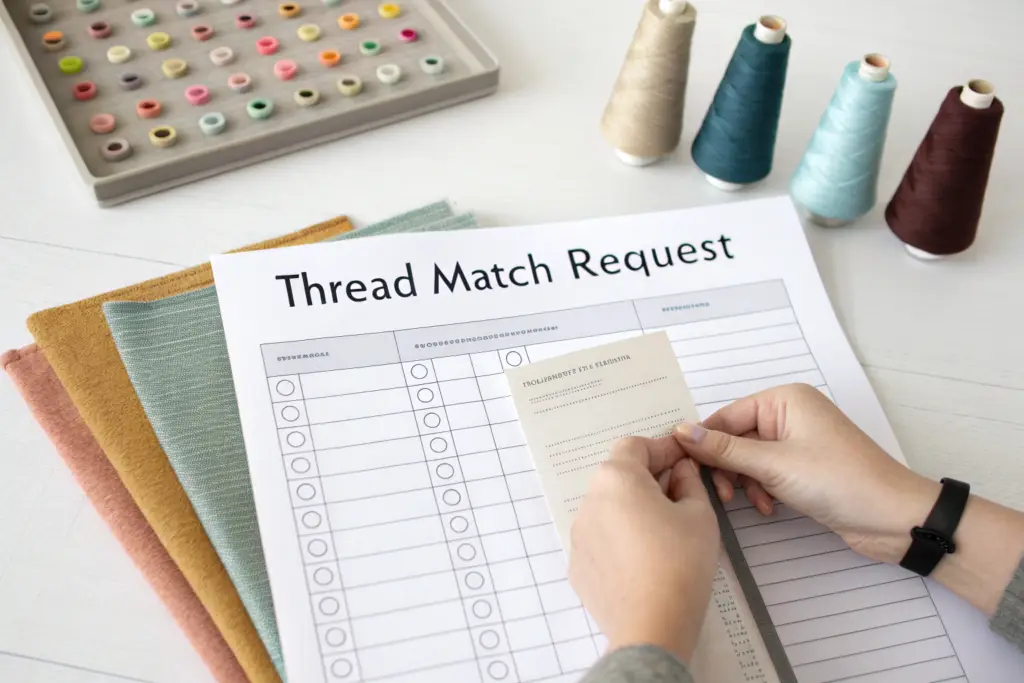
What Is a "Thread Wrap" and How Should You Evaluate It?
A thread wrap is a small sample of the dyed thread wound around a card. To evaluate it correctly, you must lay several strands of the thread side-by-side on your bulk fabric . A single strand will look lighter than it appears when sewn as a stitch line. You must also evaluate the match under a D65 (daylight) lightbox . Different light sources (fluorescent, incandescent) can make colors appear differently, a phenomenon called metamerism. The D65 lightbox provides the standardized, objective reference.
Why Is Sheen as Important as Color for an Invisible Topstitch?
A thread's sheen—whether it is matte, semi-dull, or bright—affects how it catches the light. A color-perfect match with the wrong sheen can still look visibly different. A matte thread on a shiny fabric will look flat and chalky. A bright thread on a matte fabric will stand out like a beacon. Matching the sheen to the fabric's natural luster is critical for a truly invisible seam. This is the level of detail we sweat in our premium manufacturing .
How to Conduct the Final Pre-Production "Thread Lay Down" Test?
You have approved the thread wrap. The bulk spools of thread have arrived at the factory. Now, the final, most critical verification must happen: the Pre-Production Thread Lay Down Test. This is the last line of defense before thousands of stitches are sewn into your beautiful garments. It is a simple, physical check that confirms the bulk thread is identical to the approved sample and pairs perfectly with the actual bulk fabric.
The Final Pre-Production Thread Lay Down Test is non-negotiable. Before the sewing line starts, the factory's QC team must take the actual bulk thread and the actual bulk fabric roll and physically lay the thread across the fabric under a D65 lightbox. This confirms three things: 1) The bulk thread matches the approved thread wrap, 2) The bulk thread is a perfect visual match to the specific bulk fabric roll being used, and 3) The sheen and texture are harmonious. This simple, 60-second check prevents a catastrophic, batch-wide mismatch.
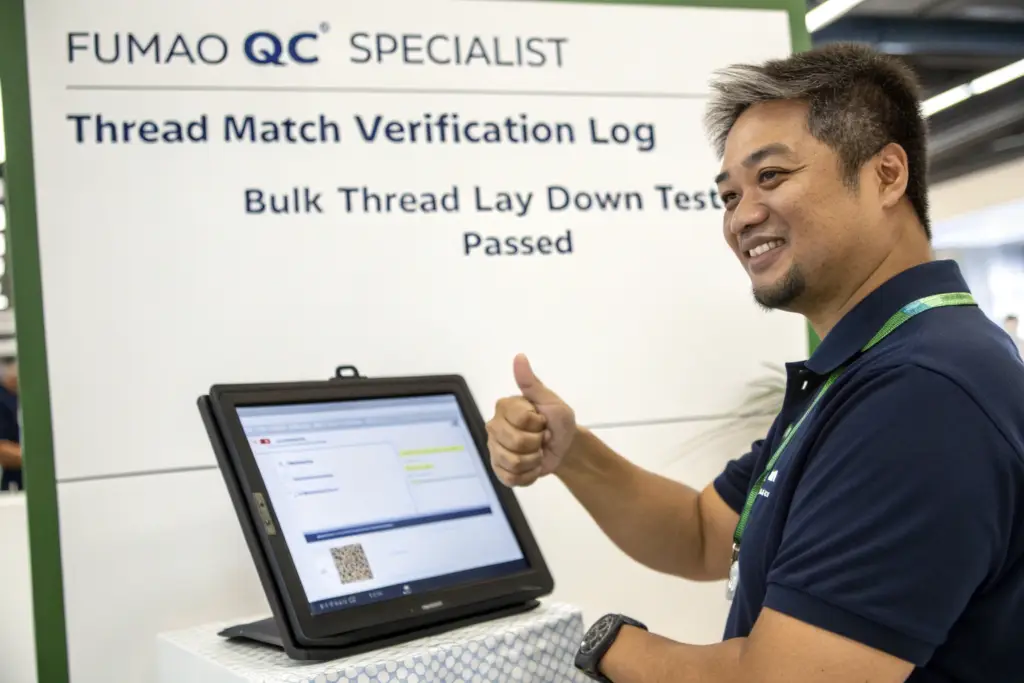
At Fumao, our QC team performs a Thread Lay Down Test for every single color and style before the bundle hits the sewing line. The supervisor signs off on it. We once caught a bulk thread shipment that was subtly off-color from the approved wrap—a batch error from the supplier. Because of this simple test, we rejected the thread before a single stitch was sewn, saving our client from a major quality disaster. This is the power of a disciplined, final physical check. This is the standard of our pre-production quality control .
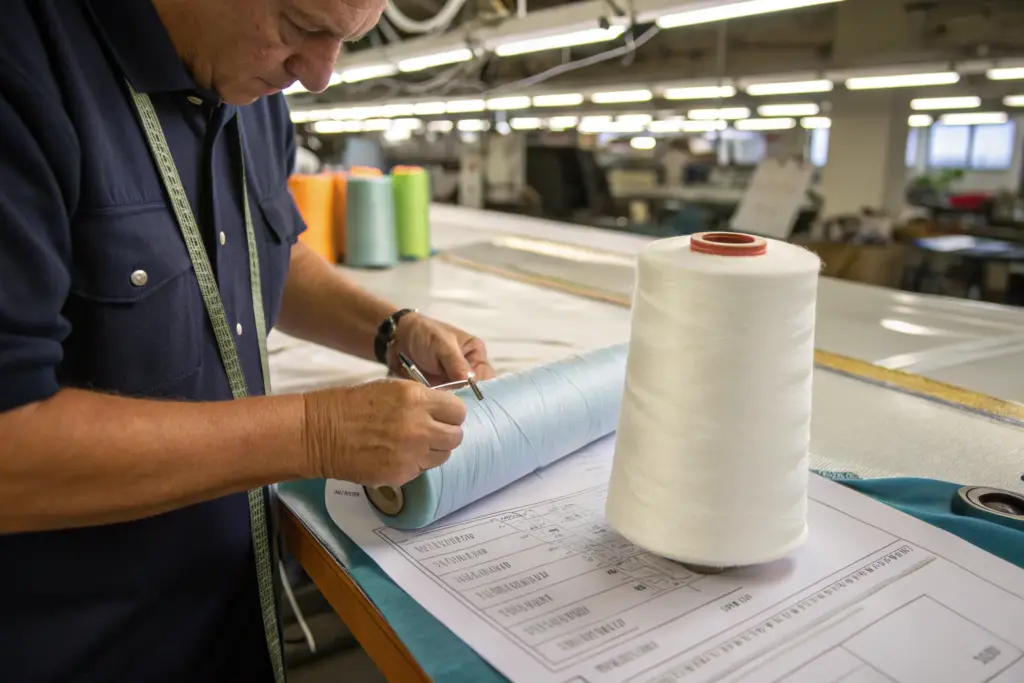
What Is the Difference Between Checking Under a Lightbox and Checking Under Ambient Factory Light?
Ambient factory light is inconsistent and can have a strong color cast (often yellow or green). A color that looks like a perfect match under this light might look completely wrong in natural daylight—which is where the customer will wear it. The D65 lightbox provides a standardized, calibrated simulation of noon daylight. This is the only acceptable light source for a final color verification. This is our standard for accurate color assessment .
Who Should Be Responsible for This Final Check at the Factory?
This should be a formal responsibility of the factory's Quality Control (QC) department, not just the sewing operator. It should be a documented step in the production process, with a sign-off sheet. This ensures the check is always performed with rigor and accountability, regardless of the operator or the production schedule. This is a core part of our QC workflow .
How Does Fumao's Color Management System Guarantee a Flawless Match?
A flawless thread match is not an accident; it is the predictable outcome of a disciplined, multi-stage system. Our process combines objective digital measurement, professional supplier sourcing, and rigorous physical verification. This system is built to protect your brand's reputation for quality and ensure that the invisible details are executed with perfection.
Fumao's color management system guarantees a flawless thread match by combining data, professional sourcing, and rigorous physical checks. We can provide you with the spectrophotometer data for your bulk fabric. We manage the DTM process with our trusted thread suppliers. And our QC team performs the final, non-negotiable Thread Lay Down Test under a D65 lightbox before any production begins. This systematic approach eliminates the risk of a visible mismatch.
A new brand partner, who had been burned by bad thread matches in the past, was amazed by our color matching protocol. "You didn't just ask me what color thread I wanted," she said. "You sent me the data from your spectrophotometer, managed the DTM sample, and then sent me a photo of the final lay-down test against my actual fabric roll. I've never felt so confident in a detail before." That is our goal. To provide a level of color precision that gives our partners complete peace of mind. This is the value of a detail-obsessed manufacturing partner .
How Do We Handle Thread Matching for Complex Multi-Color Prints?
For a fabric with a multi-color print, the general rule is to match the thread to the dominant ground color of the fabric, not to a specific element in the print. This ensures the stitching blends into the overall background and does not visually "pull" one color out. Our team provides expert guidance on this, but the final aesthetic decision always rests with the client.
What If a Perfect DTM Match Is Not Achievable?
It is rare, but sometimes a perfect DTM match is not possible due to fiber limitations (e.g., matching a bright neon). In these cases, we do not ship a bad match. We communicate the limitation to the client and present the closest possible alternatives. Often, the next best choice is to go a half-shade darker. A slightly darker thread is almost always less noticeable than a lighter one. We guide our partners through this decision. This is our commitment to honest, transparent communication .
Conclusion
Perfectly matching thread to your custom-dyed fabric is a science of precision, not an art of approximation. It requires moving from subjective opinion to objective spectrophotometer data, partnering with professional DTM thread suppliers, and conducting a rigorous final physical verification before production. It is an invisible detail that screams quality when it is right, and screams "mistake" when it is wrong.
At Shanghai Fumao, our systematic color management process ensures that this critical detail is flawlessly executed on every garment we produce. We protect the integrity of your design and the premium quality of your brand by sweating the smallest details.
If you are ready to work with a partner who obsesses over the invisible details of quality, let's talk. Our Business Director, Elaine, can walk you through our color matching process. Please email Elaine at: elaine@fumaoclothing.com.