For any apparel brand selling in the U.S., speed is currency. The market moves fast. Trends come and go in weeks, not months. When a buyer asks me about our turnaround times, I know what they are really asking. They want to know if we can help them capture a trend before it peaks. They want to know if a late shipment will ruin their relationship with a major retailer. They want to know if they can test a new style without committing to a six-month lead time.
I have run Shanghai Fumao for over a decade. In that time, I have learned that streamlining the supply chain is not about cutting corners. It is about building systems that eliminate waiting. It is about transparency between the buyer and the factory. When we work together as partners, we can compress timelines without compromising quality. The key is to identify where the bottlenecks happen and remove them systematically.
What Are the Biggest Hidden Delays in Apparel Production?
When a shipment is late, the blame often falls on the factory. But in my experience, the delay usually starts long before the fabric is cut. The biggest time-wasters are hidden in the communication gap between the buyer and the factory. I have seen projects sit idle for weeks just waiting for a simple approval.
The Sample Approval Loop
This is the number one delay I see. A brand sends a tech pack. We make a sample and send it. The brand reviews it and sends back comments. We make a second sample. This cycle can take 8 to 12 weeks. Every time the sample goes back and forth across the Pacific, we lose at least 7 to 10 days.
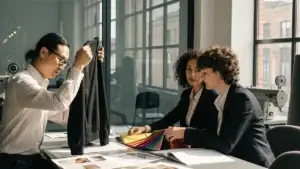
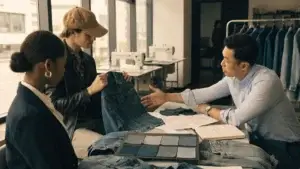
Last year, we worked with a New York contemporary brand. They wanted to launch a new knit dress for the holiday season. Their previous factory had taken 14 weeks just to approve the sample. We asked them to schedule a video call for the first sample review instead of waiting for emails. We put the sample on a mannequin, walked through every measurement, and discussed the fit in real time. We made the adjustments in 3 days. The sample approval took 2 weeks total. That project shipped 6 weeks faster than their previous vendor.
Raw Material Sourcing Delays
Another hidden delay is fabric and trim sourcing. A buyer might approve a specific fabric from a specific mill. But if that mill has a 6-week lead time, the whole project is stuck. I always advise buyers to be open to alternative mills or to order "greige goods" (unfinished fabric) early.
In 2022, a Los Angeles activewear brand wanted a custom-milled fabric for a new legging line. The mill quoted 8 weeks. That timeline would have made them miss their launch. We presented three alternative fabrics from our existing inventory that had similar hand-feel and performance. The buyer tested them, approved one, and we started cutting fabric within 10 days. By being flexible, they saved 6 weeks.
How Does Poor Tech Pack Accuracy Impact Production Schedules?
A tech pack is the blueprint for the garment. When it is incomplete or inaccurate, the factory has to make assumptions. Assumptions lead to wrong samples. Wrong samples lead to more sampling rounds. Each round adds 7 to 10 days.
I remember a project for a menswear brand in Chicago. Their tech pack for a woven shirt did not specify the stitch type for the armhole. Our team had to email and ask. The buyer took 3 days to reply. Then we had to wait for their designer to confirm. That small missing detail added 5 days to the sampling phase. If the tech pack had been complete, we could have started cutting the sample pattern immediately.
A good tech pack includes:
- Flat sketches with all measurements in inches or centimeters
- Specification sheet with tolerances for each measurement
- Construction details like stitch type, seam width, and topstitching locations
- Bill of materials listing all fabrics, trims, and their sources
When buyers send us complete tech packs, we can often approve samples in the first round. This saves weeks of back-and-forth.
Why Does Fabric Inventory Management Cause Bottlenecks?
Fabric is the heart of any apparel order. If the fabric is not ready, nothing moves. Many factories order fabric only after they receive the buyer’s purchase order. This is a safe approach, but it is slow.
At Shanghai Fumao, we take a different approach. For our regular clients, we maintain a list of "approved" fabrics that we stock or can source quickly. When a buyer wants to test a new style, we can pull fabric from our inventory and cut samples immediately.
We had a situation with a California-based streetwear brand. They wanted to add a new hoodie style to their fall collection. They were worried about the timeline because they had to order custom-colored fleece fabric. We checked our inventory and found 2,000 yards of a similar fabric from a canceled order. The color was slightly different, but we offered to dye it to their specification. We completed the dyeing in 10 days. They approved the sample, and we started bulk production in 3 weeks. If we had waited for a mill to produce the fabric from scratch, that phase alone would have taken 6 weeks.
How Can Vertical Integration Cut Production Lead Times in Half?
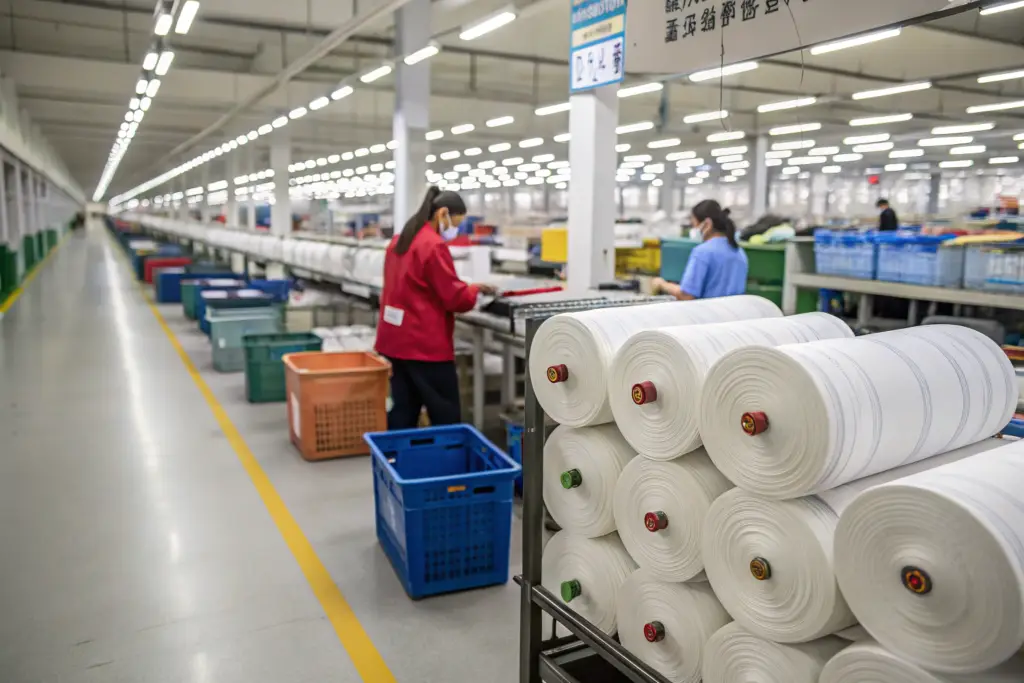
Vertical integration means the factory controls multiple stages of production under one roof. For apparel, this often includes fabric knitting or weaving, dyeing, cutting, sewing, and finishing. When a factory is vertically integrated, it removes the waiting time between suppliers.
No Transportation Delays
When a factory buys fabric from an external mill, there is shipping time. The fabric might be in a different city or a different country. If the fabric is defective, the delay is even longer because the factory has to negotiate with the mill for replacement.
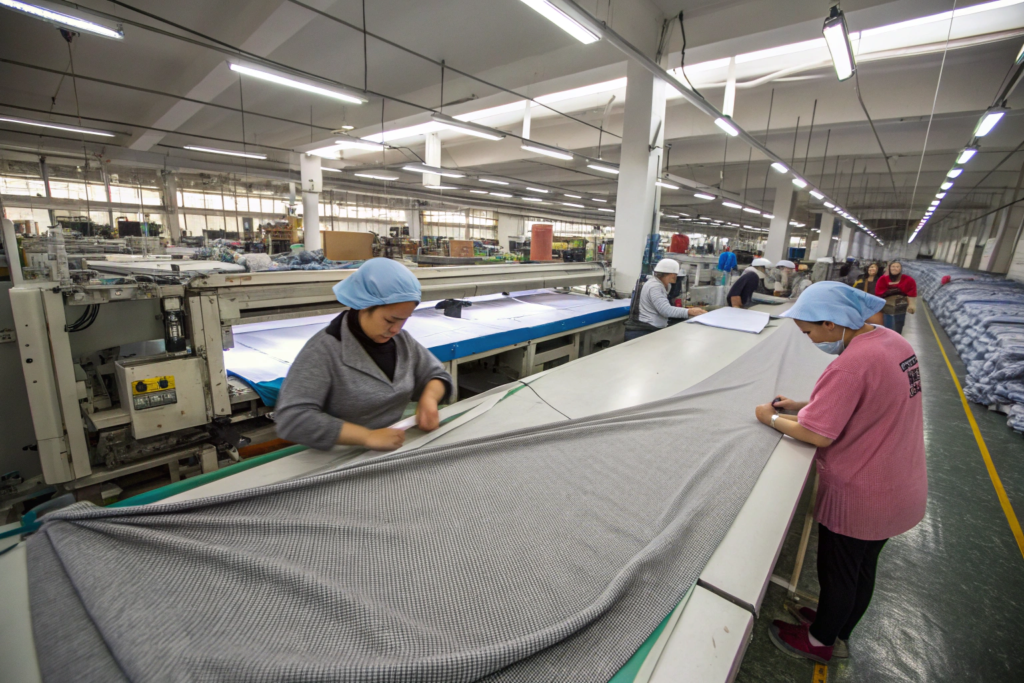
When we handle our own fabric production, the fabric moves from the knitting machines to the dyeing vats to the cutting tables in days, not weeks. We can see quality issues immediately and correct them without waiting for a supplier’s response.
Flexible Production Scheduling
A factory that buys fabric externally often has to compete with other buyers for the mill’s production slots. If the mill is busy, your fabric gets delayed. When we produce our own fabric, we control the schedule. We can prioritize a rush order for a key client without asking another supplier for a favor.
In 2023, a European brand approached us with a very tight timeline. They needed 8,000 polo shirts for a corporate event in 9 weeks. The normal lead time for this type of order was 14 weeks. Because we produce our own knit fabric, we were able to schedule the fabric production immediately. We also had the dyeing capacity to match their specific color within 5 days. We shipped the order in 8 weeks. The brand’s event was a success, and they have been a regular client since.
What Is the Difference Between a Full-Package Supplier and a CMT Factory?
Understanding the difference between these two models is important for any buyer looking to speed up their supply chain.
CMT (Cut, Make, Trim)
In this model, the buyer sources all the raw materials. The factory only cuts the fabric, sews the garment, and trims the threads. This is the traditional model. It puts a lot of work on the buyer. The buyer has to manage fabric suppliers, trim suppliers, and the factory. If any material is late, the factory cannot start. This model is slower because the buyer is the central coordinator.
Full-Package (or OEM/ODM)
In this model, the factory sources all the materials and manages the entire production process. The buyer provides the design or a sample. The factory does everything else: sourcing fabric, sourcing trims, making samples, producing bulk, and shipping.
For a buyer, full-package is much faster. Instead of managing 5 different suppliers, you manage one partner. We act as that partner. Our sourcing team knows which mills can deliver quickly. Our quality team checks incoming materials. Our production team schedules the cutting and sewing.
A New York-based children’s wear brand switched to our full-package service in 2021. Before that, they were using a CMT factory. They told us they used to spend 15 hours a week chasing fabric suppliers and trim makers. After switching to us, they spent 3 hours a week on production. Their turnaround time from sample approval to shipment dropped from 12 weeks to 7 weeks.
How Does In-House Fabric Dyeing Reduce Minimum Order Quantities?
One common barrier to fast turnaround is the fabric mill’s minimum order quantity (MOQ). Many mills require large orders for custom colors. For a brand testing a new style, buying 2,000 yards of fabric is a big risk.
When a factory has in-house dyeing, the MOQ problem changes. We can buy undyed "greige" fabric in bulk. This fabric is neutral and can be dyed later to match any color. We store the greige fabric in our warehouse. When a buyer wants a specific color for a small test run, we dye exactly what we need, sometimes as little as 500 yards.
This flexibility allows brands to launch new styles faster and with less financial risk. They do not have to commit to massive fabric orders months in advance. They can test the market with a smaller run, and if the style sells well, we can dye more fabric quickly because we already have the greige goods in stock.
For a Los Angeles-based swimwear brand, this was a game-changer. They wanted to test 5 new prints each season. Traditionally, they had to order each print from a mill with a 4-week lead time and a high MOQ. We offered to print their designs on our greige fabric in our facility. We delivered the printed fabric in 10 days with a much lower MOQ. They were able to test more styles and respond to sales data faster than ever before.
What Technology Can Help You Track Orders and Avoid Miscommunication?
I have seen many strong partnerships fail because of poor communication. A buyer sends an email asking for a status update. The sales rep does not check the production floor. The rep gives an optimistic answer. The buyer plans their marketing around that date. Then the real date slips, and trust is broken.
To solve this, we invested in a production tracking system that our clients can access. This system shows real-time data. It is not a marketing tool. It is a practical solution to a common problem.
Transparency Builds Trust
When a buyer can log in and see that their fabric has arrived, that cutting is 50% complete, and that sewing will start on Monday, they do not need to email us for updates. They have the information themselves.
We have a client in Texas who runs a large online boutique. Before we gave them access to our system, they were sending us 20 to 30 emails a week asking for updates. After we set up their account, those emails dropped to 5 per week. They told us they felt more in control and less stressed. They knew exactly where their orders stood at all times.
Catching Problems Early
The system also helps us catch problems early. If a production line is falling behind schedule, the system flags it. We can investigate why and take action before the delay becomes critical.
Last year, we had an order for 5,000 jackets. The system showed that the sewing line for that order was only at 40% of the daily target after two days. I went to the floor and discovered that a batch of zippers was defective. We had to replace them. Because we caught it on day two, we only lost two days. If we had waited for the buyer to ask for an update at the end of the week, the delay would have been much worse.

Not every factory has a fancy online portal. But any good factory should be able to share certain data points with you on a weekly basis. When a buyer asks for this data, it shows they are serious about managing timelines.
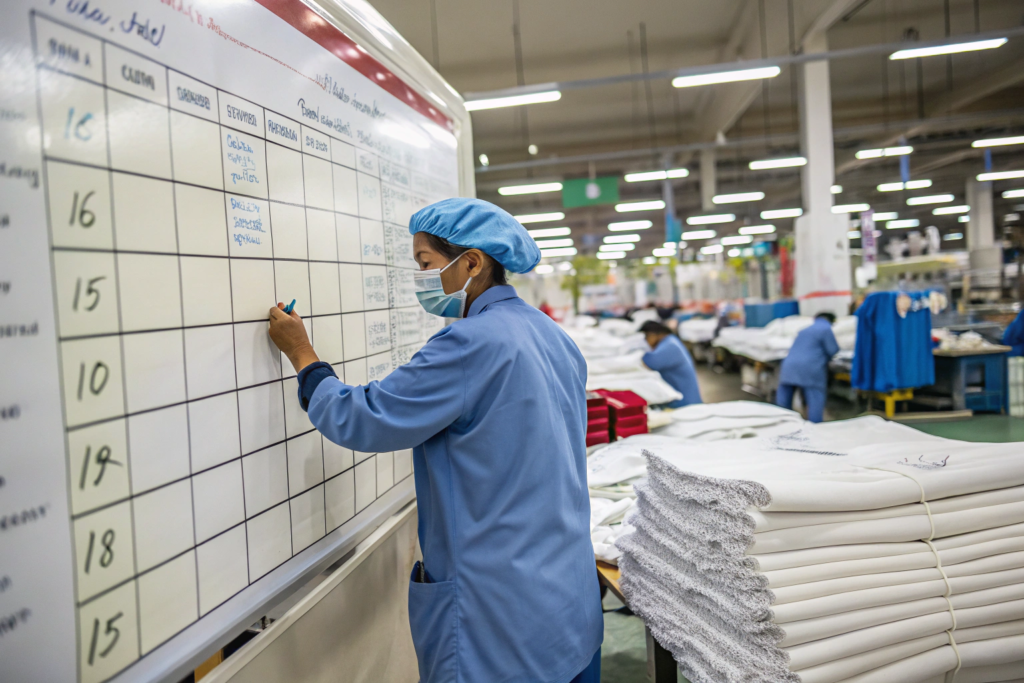
Here is the data we share with our clients every week:
| Data Point | What It Tells the Buyer |
|---|---|
| Fabric Status | Has all fabric arrived? Is any fabric being held for quality issues? |
| Cutting Progress | Percentage of the order that has been cut. This confirms the factory has started. |
| Sewing Progress | Percentage of garments sewn. This is the core of the production timeline. |
| First-Pass Yield | Percentage of garments that pass quality inspection on the first try. A low number means there is a production problem. |
| Estimated Ship Date | A rolling estimate based on current progress. This number should be updated weekly. |
When a buyer asks for this data, it creates accountability. The factory knows they will be measured against these numbers. It also gives the buyer early warning signs. If cutting progress is slow in the first week, you know there might be a problem before it is too late.
How Can Video Calls Replace Weeks of Email Back-and-Forth?
Email is slow. A message sent at 9 AM in New York arrives at 9 PM in Shanghai. The reply comes the next day. A simple question about a seam placement can take 48 hours to resolve.
Video calls collapse this timeline. We encourage our clients to schedule regular video calls during the sampling and production phases. A 30-minute call can resolve more issues than 50 emails.
I had a client in Boston who was very detail-oriented. They wanted to see the fabric color under different lighting. We set up a video call. I walked them through our factory. I held the fabric sample next to the approved lab dip. I showed them the production line where their order was running. They could see the color, the stitching, and the work-in-progress with their own eyes. They approved everything on the call.
That entire approval process took 20 minutes. If we had done it by email, it would have taken at least a week. The buyer later told me that video calls made them feel like they were in the factory. It built a level of trust that email could never create.
What Role Does Early Supplier Involvement Play in Faster Turnarounds?
The traditional model is linear. The brand designs a collection. They send it to the factory. The factory makes it. This model is slow because feedback only flows one way, and only after the brand has invested months in design.
We have seen that the fastest projects are the ones where the brand involves us early. When a buyer shares their ideas with us during the design phase, we can provide input that saves time later.
Feasibility Feedback
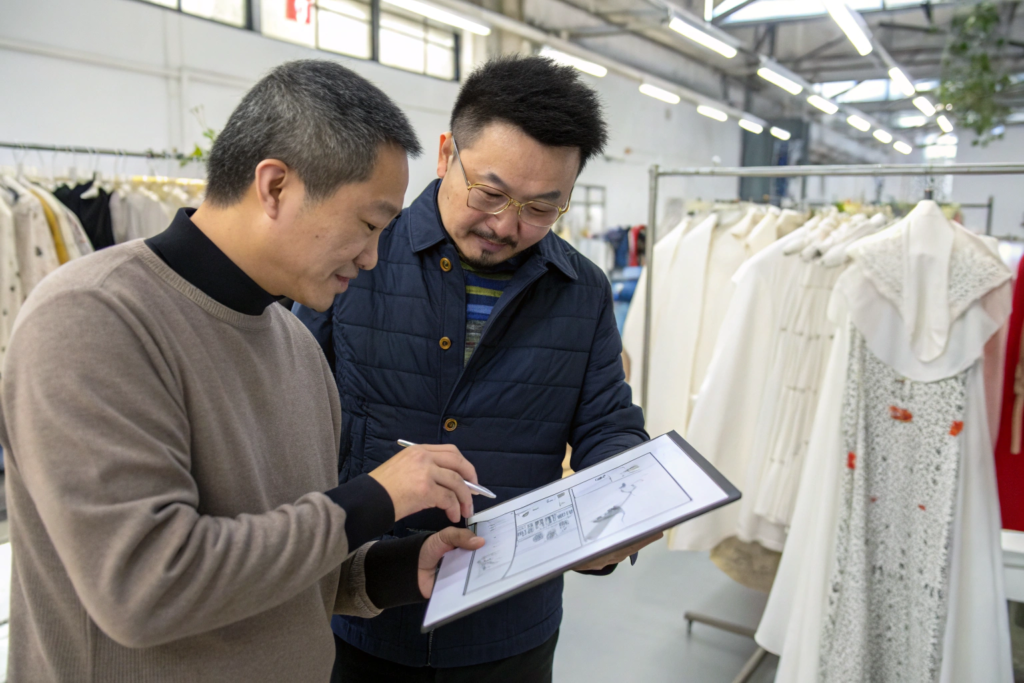
A designer might sketch a complicated seam that requires a special machine. If they send us the sketch after the design is finalized, we have to tell them we need 3 weeks to source the machine. If they involve us early, we can say, "This seam is complex. If you change it slightly, we can use our standard machines and save 3 weeks."
This is not about limiting creativity. It is about designing for manufacturability. A good factory can help a brand achieve their vision in a way that is efficient.
Fabric Sourcing in Parallel
When a brand involves us early, we can start sourcing fabric while the design is still being finalized. Instead of waiting for the final tech pack, we can identify potential fabric sources and request samples from mills. By the time the design is ready, we have fabric options on hand.
In 2023, a Canadian outdoor brand asked us to help them develop a new softshell jacket. They involved us at the concept stage. We sourced three different fabric options while they were still refining the pattern. When they finalized the design, we had the fabric samples ready for testing. The sampling phase was completed in 3 weeks. The brand told us this was half the time it usually took them.
How Can a Factory Help You Consolidate Orders to Save Time?
For brands with multiple styles or SKUs, consolidation is a big opportunity to save time. If you order 5 styles from 5 different factories, you have to manage 5 different shipments. Some will be late, and you will have to wait for the last one to arrive before you can ship to your customers.
When you work with one factory that can produce all your styles, we can consolidate everything into one shipment. This simplifies logistics and reduces the risk of partial shipments.
We do this for a menswear brand in Chicago. They order shirts, pants, and jackets from us. We manage all the production lines. When all styles are ready, we pack them together in one container. The buyer receives one shipment with all their inventory. They do not have to track 3 different containers from 3 different suppliers.
This consolidation also saves on freight costs. One full container is much cheaper per unit than three partial containers. For the brand, this is a direct cost saving and a simplification of their logistics process.
What Is the Ideal Timeline for a Rush Order?
Rush orders are stressful for both the buyer and the factory. But with the right systems, they are possible. I have learned that the key is to understand what is realistic.
For a standard woven garment, a normal lead time is 90 to 120 days from sample approval to shipment. This includes fabric sourcing, cutting, sewing, and finishing.
For a rush order, we can compress this to 45 to 60 days. But this requires cooperation from both sides. Here is what a rush order timeline looks like with Shanghai Fumao:
| Phase | Normal Timeline | Rush Timeline | Requirements |
|---|---|---|---|
| Fabric Sourcing | 4-6 weeks | 1-2 weeks | Use in-stock fabric or greige goods |
| Sampling | 2-4 weeks | 1 week | Video call approvals, no shipping samples |
| Cutting | 1 week | 3-5 days | Dedicated cutting line |
| Sewing | 3-5 weeks | 2-3 weeks | Dedicated sewing line, overtime shifts |
| Finishing | 1 week | 3-5 days | Priority in finishing department |
| Shipping | 1 week | Expedited | DDP with air freight or priority sea freight |
We executed a rush order for a streetwear brand in Los Angeles in 2022. They needed 3,000 hoodies for a celebrity collaboration. The timeline was 50 days. We used fabric from our greige goods inventory. We dyed it to their color in 5 days. We ran the order on a dedicated line with overtime. We shipped via priority sea freight. We hit the 50-day deadline. The collaboration sold out in 48 hours.
Conclusion
Streamlining your apparel supply chain is not about finding a magic solution. It is about building a partnership with a factory that has the systems, the experience, and the commitment to move fast. From my years at Shanghai Fumao, I have seen that the fastest turnarounds come from collaboration, not confrontation.
The hidden delays are often in the communication gaps. Incomplete tech packs, slow sample approvals, and waiting for fabric mills all add weeks to your timeline. These delays can be eliminated. Vertical integration helps because it removes the waiting between suppliers. Full-package service helps because it reduces the number of partners you need to manage. Technology helps because it replaces guesswork with data.
When a buyer involves us early, we can provide input that saves time during production. When a buyer is flexible on fabric choices, we can use our inventory to start production faster. When a buyer trusts us with DDP logistics, we can consolidate shipments and reduce complexity.
The goal is simple. We want to help you bring your products to market faster so you can capture the trends, satisfy your retail partners, and grow your business. Speed is not just about being first. It is about being reliable. It is about hitting your deadlines so you can hit your sales targets.
If you are looking for a manufacturing partner who understands the value of time, we are ready to talk. Reach out to our Business Director, Elaine, at elaine@fumaoclothing.com. Let us discuss how we can streamline your supply chain and help you turn your designs into delivered goods faster than ever.