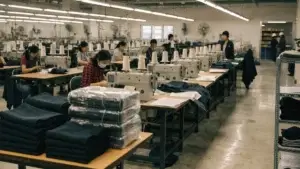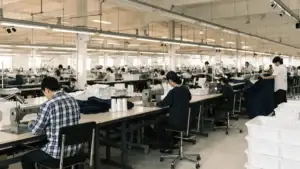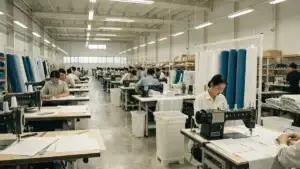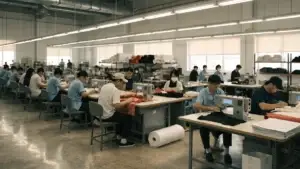
When I first started visiting trade shows in Asia over 20 years ago, I thought I had found a goldmine. A buyer would show me a jacket, and a supplier in China would quote me a price of $8.50. I'd do the math in my head: sell it in the U.S. for $45.00, and I'm making a killing. It seemed simple. But after the first shipment arrived, the numbers on my profit and loss statement told a different story. That $8.50 jacket ended up costing me nearly $14.00 by the time it hit my warehouse. I was losing money on every unit and didn't even know it until it was too late.
The true cost of manufacturing clothes overseas is not just the factory's quoted price. It's the sum of the factory price, raw material waste, logistics fees, customs and duties, quality control failures, and the soft cost of your team's time fixing problems. To accurately calculate it, you must build a comprehensive "Landed Cost Model" that accounts for every step from the factory floor in Shanghai to your customer's doorstep in Denver.
I’ve been on both sides of this table. As the owner of Shanghai Fumao, I’ve seen how easily American buyers can get their numbers wrong. I've also been that buyer myself, staring at disappointing quarterly reports. The difference between a profitable season and a financial disaster often comes down to knowing exactly what you're paying for. Let’s break down the real costs, line by line, so you can make informed decisions and protect your margins.
Most buyers start with the FOB price. It's the baseline. But FOB, which stands for "Free On Board," is just the starting line, not the finish line. I remember a buyer from Chicago who called me a few years back, furious that his "profitable" deal had gone sour. He had negotiated our FOB price down to the bone, celebrating a huge win. He forgot to account for the fact that the fabrics he wanted were a special order for us, requiring a minimum quantity we barely met, which added a surcharge. He also overlooked the ocean freight spike that summer and the fact that his freight forwarder charged a hefty "documentation fee" he hadn't budgeted for.
The costs hidden in an FOB price usually include raw material surcharges (like minimum order quantities), bank transaction fees, export packing charges, and terminal handling fees at the port of loading. A true FOB price covers getting the goods on the ship, but it does not include getting them to your warehouse.
To truly understand the cost, you need to look past the headline number. The quoted FOB price from us at Shanghai Fumao, or any other factory, covers the cost of the goods, our profit, and getting them onto the vessel at the port in China. Everything after that is on you. This includes the freight forwarding fees in China (documentation, customs clearance for export), the ocean or air freight itself, and insurance. These fees can easily add 15% to 30% on top of your FOB price, depending on the season and fuel costs. I always advise my clients to build a buffer of at least 20% for these logistical variables when they are first starting out.
How do I account for fabric waste and second-quality items in my costing?
This is a trap I see new importers fall into constantly. You order 5,000 pieces, expecting 5,000 sellable units. But the factory can't control 100% of the cutting and sewing process. There is always a "cutting waste" percentage, and there are always a few units that fail the final quality inspection.
At Shanghai Fumao, we usually factor in a standard industry waste factor of 3% to 5% for fabrics, depending on the complexity of the pattern. For example, a simple t-shirt might have low waste, but a complex dress with many pattern pieces can have higher waste. You must ask your supplier for their estimated fabric consumption and add a percentage for waste when you calculate your raw material costs.
Second-quality items are another hidden cost. If you have a quality control process, which you absolutely should, some goods will fail. Who pays for those? If the failure is the factory's fault, they should replace them. But this takes time and can delay your shipment. If you're in a rush, you might be tempted to accept the flawed goods at a discount and sell them as seconds. You need to decide beforehand what your tolerance is and factor in the potential lost revenue from these units. For a recent project for a high-end activewear brand, we agreed on a 2% allowance for minor defects, and anything above that was re-made at our cost.
What are the typical inspection and compliance costs I should expect?
You can't just take a factory's word for it. You need to verify the quality and the working conditions. I learned this the hard way 15 years ago when a shipment arrived with the wrong labels because I trusted a verbal confirmation. Now, we at Shanghai Fumao encourage third-party inspections at every stage.
You should budget for several types of inspections. First, there's the raw material inspection, where the fabric is checked before cutting. Then there's the in-line inspection, during production. Finally, there's the final random inspection (often called "AQL" inspection) before the goods are packed. A reputable third-party company like SGS or Bureau Veritas charges for these visits. You can expect to pay anywhere from $300 to $600 per man-day for an inspector, and most inspections take one or two man-days.
Don't forget compliance audits. Many large U.S. brands require factories to have social compliance audits like BSCI, Sedex, or WRAP. If your factory isn't certified, you might have to pay for a special audit just for your order, or you could face delays at U.S. customs if they question the origin or labor conditions. We maintain our BSCI certification specifically to save our clients this extra step and cost.
Why does choosing the wrong Incoterm double my landed cost?
I once had a client, a savvy guy from New York, who insisted on an EXW (Ex Works) price. He thought he was saving money by controlling the shipping himself. He booked a freight forwarder, but his forwarder's agent in Shanghai couldn't get a truck for three days because of a local holiday. The container missed the ship, sat at the port for two weeks, and racked up demurrage charges that wiped out all his "savings." He called me, frustrated, and said, "I thought I was being smart." I told him, "You were being smart about the price, but not about the process."
Choosing the wrong Incoterm shifts responsibility and risk at the wrong time. EXW puts all risk on you from the factory door, while DDP puts all risk on the seller. The 'safest' Incoterm for most first-time or mid-volume buyers is FOB, as it provides a clear handoff point at the port of origin.
Incoterms are the rules of the road for international shipping. They define who pays for what and who is responsible for the goods at each step. EXW might seem cheaper because the factory gives you a rock-bottom price, but you are then responsible for every single thing: trucking in China, export customs, freight, import customs, and trucking in the U.S. One mistake in that chain, and you are paying for it.
On the flip side, we offer DDP (Delivered Duty Paid) to many of our North American clients. With DDP, we handle everything. We ship the goods, pay the duty, and deliver them to your warehouse. For you, it's simple. You get one invoice, and the goods show up. The "cost" here is that you pay a premium for that convenience and risk transfer. The price might look higher, but when you calculate the cost of your time, the headaches avoided, and the financial risk of a shipping mishap, DDP can actually be the more profitable choice. It's about matching the Incoterm to your internal logistics capability.

How does DDP shipping simplify total cost calculation for U.S. buyers?
DDP, or Delivered Duty Paid, is like the all-inclusive resort of garment manufacturing. You pay one price, and everything is taken care of. For a busy brand owner like you, this is a powerful tool. When we provide a DDP quote from Shanghai Fumao, it includes the product cost, our profit, all shipping, insurance, and U.S. import duties. The only thing you pay after that is the bill from your trucking company to take it off the delivery truck into your warehouse.
This completely eliminates the guesswork. You know your exact cost before we even start production. There are no surprise invoices from freight forwarders three weeks later. There's no frantic calling to find out why your goods are stuck in customs. We handle it all because we have established relationships with freight forwarders and customs brokers. For a client in Texas who was scaling his brand rapidly, switching to our DDP service saved him roughly 15 hours a week of administrative work—time he could then spend on designing and marketing. That's a soft cost saving that has a real impact on your bottom line.
What are the financial risks of using EXW for large clothing orders?
EXW, or Ex Works, puts the full weight of the world on your shoulders. It means you, or your forwarder, are coming to our factory in China to pick up the goods. You are responsible from the moment we say, "They're ready." The financial risks here are substantial, especially for large orders.
First, you have the risk of shipping delays. If your nominated freight forwarder in Shanghai is unreliable, your goods sit at the factory, racking up storage fees. Second, you face the risk of export customs holds. We can clear export customs easily, but if your forwarder makes a mistake in the paperwork, the shipment is seized. The cost to fix this is yours. Third, you have the risk of port congestion and demurrage. If your goods arrive at the port and your ship is delayed, you pay for the container to sit there. I've seen demurrage bills run into the thousands of dollars. While EXW gives you maximum control, it also gives you maximum exposure to logistical failure. For large, complex orders, this risk often outweighs the perceived cost savings.
What are the real costs of delays and missed shipping seasons?
The absolute worst phone call I ever received was from a long-time client in early November. He was expecting a shipment of heavy winter coats for the holiday season. They were supposed to arrive in September. A series of miscommunications with his previous supplier—a wrong zipper, a fabric that wasn't actually in stock, and then a missed sailing—meant the goods were only just leaving Asia. They would arrive after Thanksgiving. The season was lost. He told me, "I've already paid for the inventory, but now I have to store it for a year, hoping next winter is cold." The cost of that delay wasn't just the shipping; it was the entire value of the inventory sitting dead for 12 months.
The real cost of a missed shipping season is the total value of your inventory multiplied by your cost of capital, plus the lost profit from those sales, plus the potential damage to your brand's reputation for being out of stock. This often exceeds the production cost of the goods themselves.
Cash flow is the lifeblood of any business. When your cash is tied up in inventory that you can't sell for another year, it's dead money. You can't use it to develop your next line, pay your team, or invest in marketing. This is the "opportunity cost" of a delay. It's one of the hardest costs to calculate, but it's often the most damaging.
This is why at Shanghai Fumao, we are fanatical about schedules. We build buffers into our production timeline for exactly this reason. We know that fabric dyeing can take an extra day, or that a typhoon can close the port. We build these "what ifs" into the schedule from day one so that if something small goes wrong, the final delivery date doesn't move.

Bad communication is a cancer on profit margins. It creates a hidden cost that I call "management bleed." This is the cost of your time, and your team's time, spent chasing answers instead of building your business.
I've heard horror stories from brands who worked with suppliers where the salesperson barely spoke English, or was just an order-taker. The brand would send an email asking for an update on the fabric strike-off. A week later, no answer. Another email. Another week. Finally, after three weeks, they get a reply: "Fabric is late." Now it's a crisis. The brand's designer has to scramble to find a backup fabric. The product manager has to call the logistics company to see if they can expedite the shipping. This chaos costs money. It burns team morale.
In contrast, when you work with us, our account managers are trained to give you proactive updates. We don't wait for you to ask. We send you photos of the fabric being cut. We send you a video of the first sample coming off the line. We tell you, "We're on schedule" or "We hit a small snag with the buttons, but we've already fixed it and we're still on track." This proactive communication eliminates your "management bleed." You can trust that the job is getting done and focus on your real job: selling clothes.
What is the financial impact of using substandard materials without your knowledge?
This is the nightmare scenario. The shipment arrives, it looks okay from the outside. You pay the factory. You ship it to your retail partners. Then, a customer buys a shirt, wears it once, washes it, and the seams pucker or the color fades. Now you have a returns crisis. You have to deal with angry customers, process refunds, and worse, your brand's reputation takes a hit.
The cost here is astronomical. It's not just the cost of the returned shirt. It's the cost of customer service time, the cost of shipping the return, and the loss of that customer's future business. If the problem is widespread, you might have to issue a recall, which can be financially devastating. A few years ago, a brand we know had a supplier in another country swap out the high-quality down filling for a cheaper synthetic mix without telling them. The jackets lost their warmth. The brand had to refund thousands of customers. They nearly went out of business.
This is why at Shanghai Fumao, we are obsessive about raw materials. We source fabrics from certified mills. We provide our clients with fabric test reports from accredited labs. We invite you to send a third-party inspector to verify the materials before we cut a single piece. It's about building a system of transparency. When you partner with us, you aren't just buying a product; you're buying the assurance that the materials inside that product are exactly what we agreed upon.
How can I accurately compare quotes from Vietnam, China, and India?
I travel to textile hubs across Asia. I've been to the mills in Vietnam, the weaving clusters in India, and, of course, the massive factories in China. When a buyer gets a quote from a supplier in each country, they often just look at the bottom-line FOB price. They see Vietnam is $7.50, China is $8.75, and India is $7.00. The choice seems obvious. But this surface-level comparison is a trap. You're comparing apples to oranges if you don't understand the infrastructure, logistics, and specialization of each country.
To accurately compare quotes, you must go beyond the unit price and evaluate the supplier's specific material sourcing capabilities, their vertical integration, the reliability of their local logistics infrastructure, and their experience with U.S. compliance standards. A cheaper unit price often hides a more expensive and riskier supply chain.
Let's take a real-world example. India might have a great price for a hand-embroidered garment because they have the artisan labor. But if you need that garment on a hanger in New York in six weeks, the labor advantage disappears because their port infrastructure might not be as efficient as Shanghai's. Vietnam has become a powerhouse for activewear and knits, but for certain types of complex woven fabrics, they still rely on importing the raw materials from China, which adds time and cost.
China, specifically at Shanghai Fumao, has a unique advantage: the entire supply chain is often within a few hours' drive. The fabric mill, the button factory, the trim supplier, and the sewing line are all nearby. This proximity allows for speed and flexibility that is hard to match. If a color is wrong, we can fix it in days. In other countries, you might have to wait weeks for a new shipment of fabric to arrive from a different country.
Which country offers the best balance of quality, speed, and price for my product?
This is the million-dollar question. The answer always depends on your product. For highly complex, fashionable women's wear that requires a lot of hand-finishing and quick turns, I believe China still offers the best balance. The ecosystem here is unmatched. If my designer needs a specific type of sequin, I can have five samples on my desk tomorrow. That speed to market is a form of cost-saving because it reduces the lead time and allows you to react to trends.
For basic, stable products like plain t-shirts or simple trousers, Vietnam or Bangladesh can be incredibly competitive on price. Their labor costs are lower, and they have built massive efficiencies for these high-volume, low-complexity items. However, you must factor in the longer lead times and the potential for less flexibility. If you want to change the neckline on that t-shirt three weeks into production, it's much harder to do in a factory optimized for running one style for six months straight.
For a client who was launching a "fast fashion" line, we did a comparative analysis. Vietnam was 12% cheaper on the garment cost, but the lead time was four weeks longer. We calculated that being in the market four weeks earlier, at a slightly higher cost, actually resulted in a 20% higher overall profit margin because they captured the trend at its peak. The cheapest garment isn't always the most profitable product.
What role do local supply chains play in the true cost of manufacturing?
The local supply chain is the unsung hero of cost and speed. Imagine you are making a denim jacket. You need denim fabric, denim thread, metal buttons, rivets, and a specific washing process. If all those components are sourced within a 50-mile radius of the factory, the process is smooth. The truck bringing the buttons can come tomorrow if you need them.
But if the denim comes from China, the buttons from India, and the thread from Korea, you are now managing a global logistics puzzle just for one jacket. Any delay in any one of those components stops your entire production line. You have to pay for the factory workers to sit idle, or you have to air-freight a missing component, which is incredibly expensive. This is a hidden cost that many buyers don't see. They see the low price of the buttons from India, but they don't see the risk and potential delay of shipping them. At Shanghai Fumao, one of our biggest value propositions is our deeply integrated local supply chain. It minimizes risk and maximizes speed, which ultimately protects your bottom line.
Conclusion
Calculating the true cost of manufacturing clothes overseas is not a simple math problem. It is a strategic exercise that requires you to look at the entire picture, from the fiber in the fabric to the moment the customer tears open the package. I've learned over two decades that the cheapest quote is often the most expensive mistake. The real profit lies in partnerships built on transparency, reliability, and shared goals. It's about finding a supplier who communicates clearly, who owns their supply chain, and who treats your deadlines as their own.
When you are ready to move beyond price shopping and start building a profitable, reliable supply chain, I invite you to talk to us at Shanghai Fumao. We don't just make clothes; we help protect your margins by eliminating the hidden costs and risks that eat away at your profits. If you have a new collection in mind or just want to run a landed cost analysis with a team that understands the U.S. market, reach out to our Business Director, Elaine. You can email her directly at elaine@fumaoclothing.com. Let's build something profitable together.