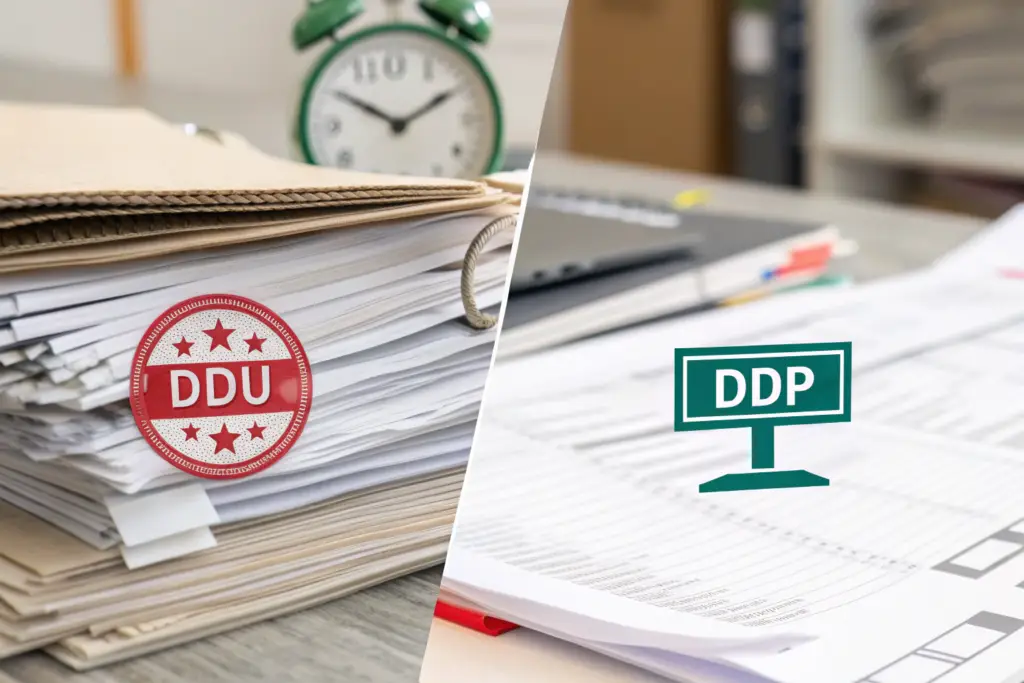
I used to hate shipping. Not the idea of it. The actual paperwork. The surprise fees. The angry emails from clients who got a bill from FedEx for $400 in "Customs Clearance Fees" two weeks after they received their T-shirts. Those were the worst emails. The client thought the price we quoted was the final price. They felt tricked. I felt helpless. I was losing clients not because of my quality or my price, but because of a three-letter acronym: DDU. That stands for "Delivered Duty Unpaid." It is the default way most factories ship. It is also the fastest way to destroy a good relationship with an American buyer.
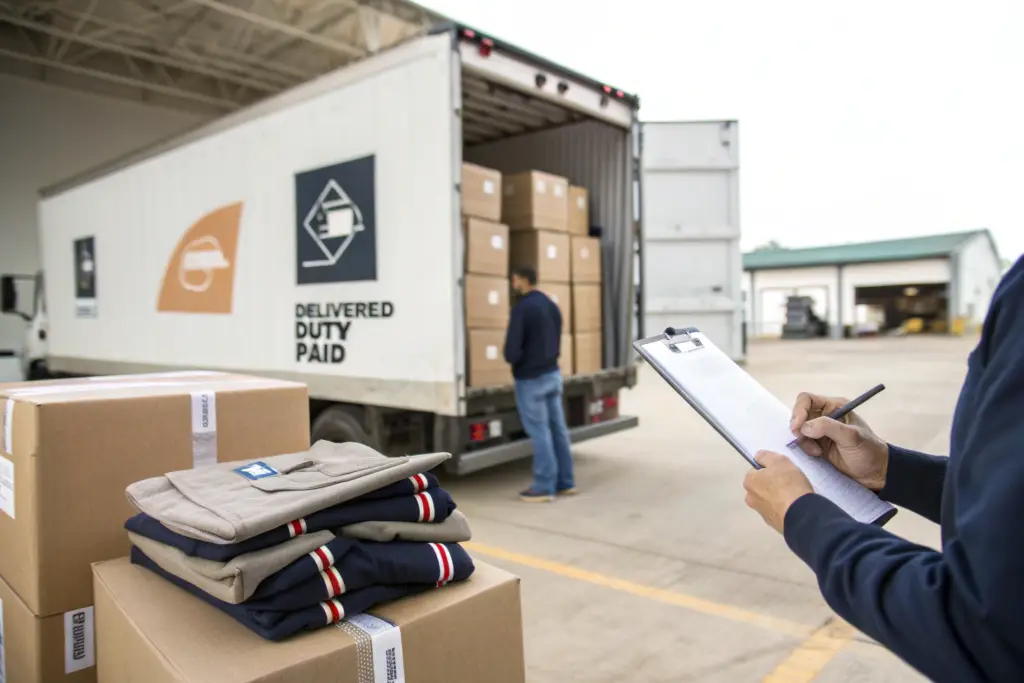
DDP (Delivered Duty Paid) shipping is the most cost-effective choice for US apparel buyers because it eliminates the “Hidden Second Invoice.” When the factory ships DDP, the factory is responsible for all transportation costs, customs duties, brokerage fees, and import taxes right up to the buyer’s warehouse door. The buyer pays one single, predictable price. This not only reduces administrative headaches but also lowers the actual landed cost by avoiding surprise brokerage fees and port storage charges that often plague DDU shipments.
This is not just a convenience. It is a financial strategy. After switching 90% of our clients at Shanghai Fumao to DDP terms, I saw their reorder rate jump. They were happier. They could budget accurately. Let me show you exactly how DDP works and why it saves you real money, not just time.
What is the Real Difference Between DDP and DDU for US Importers?
Most buyers do not know the difference until they get burned. They ask for a shipping quote. The factory says, “Shipping is $1.50 per unit.” The buyer thinks, “Great, that is my landed cost.” Then the box arrives at JFK airport. And the nightmare begins.
The core difference is the transfer of risk and responsibility. Under DDU (Delivered Duty Unpaid), the factory’s responsibility ends when the goods arrive at the US port or airport. The buyer is then responsible for clearing customs, paying duties, paying the broker, and arranging final delivery. Under DDP (Delivered Duty Paid), the factory (or their forwarder) acts as the Importer of Record. They handle everything from the factory floor in China to your loading dock in Dallas. The buyer simply receives the package.
What “Hidden Fees” Disappear When You Switch to DDP?
This is where the cost-effectiveness argument is won. The DDU price looks cheaper on the quote sheet. But the final bank statement tells a different story. Here are the fees that appear like magic on DDU shipments.
| Fee Type | DDU Scenario (You Pay) | DDP Scenario (Factory Handles) | Typical Cost for a Small Parcel |
|---|---|---|---|
| Customs Bond | Required for imports over $2,500. You pay for a Single Entry Bond. | Included in factory’s annual bond. | $50 – $100 per entry. |
| Brokerage Fee | FedEx/UPS charges this to file paperwork for you. | Included in forwarder’s DDP rate. | $15 – $50 or 0.5% of value. |
| Merchandise Processing Fee (MPF) | 0.3464% of shipment value (Min $29.66). | Included in DDP calculation. | $30 minimum. |
| Harbor Maintenance Fee (HMF) | 0.125% of value (Ocean freight only). | Included in DDP calculation. | Varies. |
| Port Storage / Demurrage | If you don’t clear customs immediately, you pay $100+/day for the container sitting there. | Factory’s forwarder clears it before it arrives, avoiding these fees. | $0 vs. Potential $500+ |
The Total Hidden Cost of DDU:
On a $5,000 shipment of wholesale apparel, the surprise DDU fees can easily add $250 to $450. That is 5% to 9% of the invoice value. You just lost that margin. You could have paid a slightly higher unit price for DDP and actually saved money because you avoided the fixed fees.
At Shanghai Fumao, we use a DDP service that consolidates shipments. This allows us to spread those fixed fees (like the Customs Bond) across multiple clients. You get the benefit of a large-scale importer’s pricing even if you are just ordering 200 units.
Why is the “Importer of Record” Designation So Important?
This is a legal detail with huge financial consequences. When a shipment is DDU, You (The Buyer) are the Importer of Record (IOR) .
The Risk of Being the IOR:
- Customs Audits: If US Customs decides to audit your shipment, they come to you. You have to provide the factory invoices, the proof of fabric content, and the safety test reports. If you cannot provide them, you pay a fine.
- Liability: If the product is later found to violate a patent or a safety standard, the IOR is the first point of legal liability.
The Benefit of DDP:
Under DDP terms, the factory or their designated freight forwarder acts as the Non-Resident Importer of Record. They take on that legal and administrative burden. For a small or mid-sized brand, this is massive. It allows you to import goods without having a full-time compliance department and without registering for a Continuous Customs Bond (which costs $500+ per year).
This is a service we provide specifically because we know our US clients want to focus on selling clothes, not filling out CBP Form 7501. We handle the entry summary so you do not have to.
How Does DDP Shipping Actually Lower Your Total Landed Cost?
I know it sounds too good to be true. How can the factory pay for everything and still save you money? The answer is scale and efficiency. We ship hundreds of containers a year. We have negotiated rates with forwarders that you, as a single brand, cannot get. More importantly, we are experts at tariff engineering.
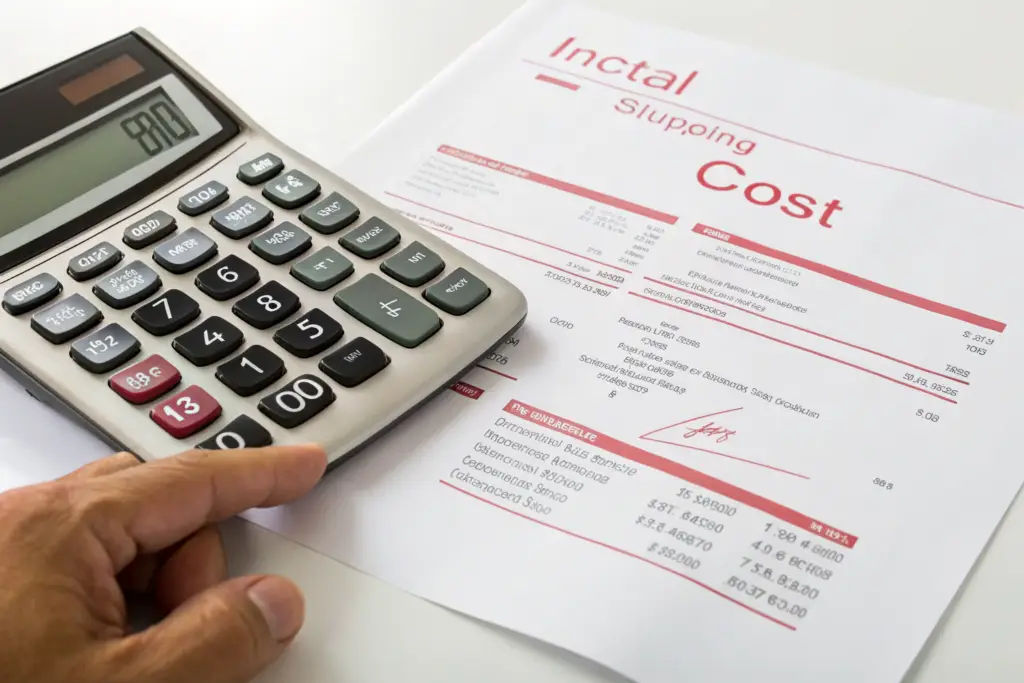
DDP lowers total landed cost by leveraging the factory’s shipping volume discounts and by correctly applying the Harmonized Tariff Schedule (HTS) codes. Factories that specialize in DDP shipping have dedicated logistics teams that know exactly which HTS code results in the lowest duty rate for specific apparel items. A misclassified garment can result in a 32% duty rate instead of 16%. That difference alone pays for the DDP service many times over. Additionally, by avoiding port storage and last-mile surcharges, the final bill is almost always lower than a DDU shipment plus unexpected fees.
How Can Tariff Engineering Reduce Your Duty Rate from 32% to 16%?
This is the secret sauce. The US tariff schedule is a maze. A women’s woven blouse might have a 26.9% duty if it is made of cotton. But a very similar blouse made of man-made fibers (like rayon or polyester) might have a duty rate of 16% .
The Mistake on DDU:
You ask the factory for a “Cotton Blouse.” They ship it. Customs classifies it as HTS 6206.30 (Cotton). Duty = 26.9%. You pay the bill because you are the IOR.
The Proactive DDP Strategy:
At Shanghai Fumao, our shipping team looks at the fabric blend before we ship. If the fabric is 55% Cotton and 45% Polyester, it is classified as “Man-Made Fibers” because polyester is the chief weight by value in most cases. We can legally use HTS 6206.40. Duty = 16% to 26% (depending on exact subheading, but lower than 32%).
The Math on a $10,000 Order:
- DDU (Misclassified Cotton): Duty Bill = $2,690.
- DDP (Correct Classification): Duty Bill = $1,600.
- Savings: $1,090.
That $1,090 saving covers the entire cost of air freight on a reorder. The buyer never sees this calculation. They just see the final DDP price and think, “This is fair.” They do not realize we just saved them a thousand dollars by knowing the rules.
This is why you want a factory with deep experience in US import regulations. We stay updated on changes like the Section 301 Tariffs and de minimis thresholds. It is a full-time job.
What is the Cost of “Inexperienced Forwarder Delays” on DDU?
This is a cost that is hard to quantify but easy to feel. You use a cheap freight forwarder found on Google. The goods arrive in LA. The forwarder sits on the paperwork for three days. Then they realize the packing list is wrong. They email you. You are asleep. You reply 12 hours later. The container sits.
The DDU Delay Spiral:
- Day 1-3: Container at port (Free time).
- Day 4-7: Container in Demurrage ($150/day).
- Day 8: Chassis fee (Truck trailer waiting) ($50/day).
Suddenly, you owe the port $600 just to get your goods out. You have no choice but to pay it.
The DDP Advantage:
Our forwarder partners in China work with their US brokerage team to pre-clear the shipment. We send the documents electronically 5 days before the vessel arrives. By the time the ship hits the dock, customs is already cleared. The truck is booked. The container is picked up on Day 1. Zero demurrage. Zero storage.
That is the hidden efficiency of a DDP supply chain. It is not just about paying the duty. It is about the velocity of the shipment. Time is money. Every day a box sits at the port is a day you are not selling those clothes.
How Does DDP Simplify Inventory Planning and Reorder Forecasting?
Running a clothing brand is hard enough. You have to predict what people will want to wear six months from now. You should not also have to predict what the US Customs officer will decide about your shipment. DDU shipping introduces a variable of 3 to 10 days into your timeline. You never know exactly when the box will clear.
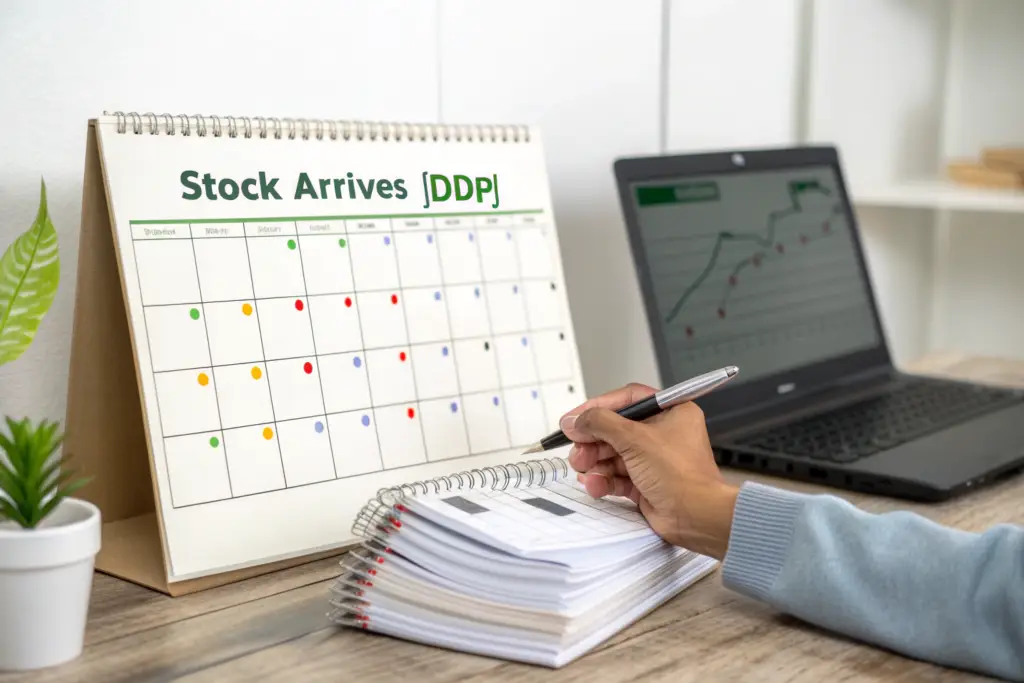
DDP simplifies inventory planning because it provides a predictable, door-to-door transit time. The factory quotes a date: “Delivered to your door on June 15th.” You can plan your marketing emails, your warehouse staffing, and your retail deliveries around that date with 95% confidence. This predictability reduces the need for “safety stock” (extra inventory you hold just in case the shipment is late). Holding less safety stock means tying up less cash in inventory, which improves your overall return on investment.
Why is “De Minimis” (Section 321) a Game Changer for Small Batch DDP?
If you are a smaller brand ordering smaller quantities, DDP combined with Section 321 entry is the most cost-effective method in existence.
What is Section 321?
Shipments valued at $800 or less (per person, per day) can enter the US Duty Free and Tax Free. They require minimal customs clearance.
How We Use It for Wholesale:
Instead of shipping one big pallet worth $5,000 (which requires formal entry and duty), we can split the shipment into multiple boxes, each under $800, shipped on consecutive days.
The Math:
- One Pallet ($5,000 value): Formal Entry. Duty = $800. Broker Fee = $75. Total Cost = $875 + Shipping.
- Six Boxes ($800 value each): Section 321 Entry. Duty = $0. Broker Fee = $0.
The Requirement:
The boxes must be addressed to different names (e.g., Attn: Marketing, Attn: Sales) or different days. This is a legal, widely used strategy called “consolidated manifesting.” We do this for several of our boutique clients. They pay for the DDP service, but we save them the duty cost entirely on the smaller runs.
This is how we helped a client launch a new print. She ordered just 80 units to test the market. DDP via Section 321 meant she paid zero duty. She sold out in four days. She placed a reorder for 800 units (which did pay duty). The initial test cost her nothing in customs fees.
How Does Predictable DDP Transit Time Reduce Your “Cash Conversion Cycle”?
The Cash Conversion Cycle is how long your money is tied up in inventory. From the day you pay the factory deposit to the day you sell the shirt and get paid.
DDU Scenario:
- Day 1: Pay Deposit.
- Day 60: Pay Balance. Goods Ship.
- Day 85: Goods Arrive US Port. Unknown Delay Begins.
- Day 92: Goods Clear Customs.
- Day 95: Goods Delivered.
- Total Days Money Tied Up: 95+ days.
DDP Scenario:
- Day 1: Pay Deposit.
- Day 60: Pay Balance. Goods Ship. Pre-Cleared.
- Day 82: Goods Delivered to Door.
- Total Days Money Tied Up: 82 days.
The 13-Day Advantage:
That 13-day reduction in the cycle is pure profit. It means you can turn your inventory into cash almost two weeks faster. Over the course of a year, if you do four seasons, that is 52 extra days of liquidity. You can use that cash to fund an extra sample round or run a Facebook ad campaign.
This is why I tell my clients that DDP is an investment in speed. Speed is the ultimate currency in fashion. At Shanghai Fumao, we track our DDP transit times closely. Our average door-to-door from Shanghai to the US West Coast is 12-14 days via air and 22-25 days via ocean. And we hit that window 98% of the time.
What Are the Common Misconceptions About DDP Pricing?
The biggest misconception is that DDP is a premium service only for rich brands. That is false. It is a logistics strategy. The second misconception is that the factory is “hiding” fees in the DDP price. Let me be transparent about how we build a DDP quote.
The common misconceptions about DDP pricing are that it is always more expensive than DDU and that the factory is overcharging for shipping profit. In reality, a competitive DDP quote includes exact components: Freight Cost + Duty Rate (Fixed % by HTS) + Broker Fee ($35 flat) + Last Mile Delivery. Because the factory does not want to lose money on miscalculations, the quote might be 3% higher than the raw DDU freight estimate. However, that 3% buffer is usually less than the 10-15% surprise fees the buyer would pay on a DDU shipment.
How to Compare “DDP Price” vs. “FOB Price + Estimated DDU”?
This is the math you need to do before you choose a shipping method.
Factory A (FOB Shanghai):
- Unit Price: $10.00 x 500 units = $5,000
- Ocean Freight Estimate: $600
- Estimated Duty (20% of $5,000): $1,000
- Broker & Handling Estimate: $150
- Total Estimated Landed Cost: $6,750
Factory B (DDP to Dallas):
- Unit Price (includes everything): $13.50 x 500 units = $6,750
They look identical. But here is the catch. What if the duty rate is actually 27% because of the fabric content? Factory A’s bill just went up by $350. What if the port is congested and storage fees hit? Factory A’s bill goes up another $200. Factory B’s price is fixed. It stays $6,750 no matter what happens at the port.
The Verdict:
If the DDP price is within 5% of your estimated DDU total cost, take the DDP deal. You are buying insurance and predictability. The few dollars you might “save” on DDU are not worth the stress and the potential for a much larger bill.
Why is “Duty Drawback” Not Your Problem with DDP?
This is an advanced topic, but it explains why factories like DDP. When we import fabric into China to make your clothes, we pay Chinese import duty. When we export the finished garment, we can apply for a Duty Drawback (a refund of those import duties).
The Benefit to You:
Because we handle the US import duty, we can sometimes offset the US duty cost with our Chinese export duty refund. This allows us to offer a DDP price that is surprisingly low. You, as a DDU importer, cannot access this refund. You just pay the US duty and that money is gone.
This is a complex piece of global trade finance that most small brands never see. It is one of the reasons why a factory that owns the DDP process can be more cost-effective than a factory that just hands the goods to a forwarder and says “Good luck.”
Conclusion
DDP shipping is not just a different way to fill out a form. It is a fundamentally more cost-effective approach to sourcing apparel from China. It eliminates the surprise fees that erode your margins. It reduces your legal exposure as the Importer of Record. It accelerates your cash conversion cycle by providing predictable delivery dates. And it allows you to leverage the factory’s scale and tariff expertise to pay lower duties than you would pay on your own.
The choice between DDU and DDP is really a choice between uncertainty and certainty. In the apparel business, certainty is rare and valuable. Knowing exactly when your goods will arrive and exactly what they will cost allows you to run a tighter, more profitable operation.
At Shanghai Fumao, we have made DDP our standard shipping model for the US market because we have seen it work better for our clients. It removes the friction from the final mile of the supply chain. It allows you to focus on what you do best: designing and selling.
If you are tired of surprise customs bills and want to explore a true door-to-door solution, our Business Director Elaine can provide a sample DDP quote for your next project. She can show you exactly how the landed cost compares to your current method. Reach out to her at elaine@fumaoclothing.com. Let’s take the guesswork out of getting your clothes to America.