A certificate is just a piece of paper. I learned that lesson in the most painful way possible. About six years ago, a potential client asked me for our BSCI audit report. I had never heard of BSCI. I told him we were "in the process" of getting it. That was a lie. I was stalling. I scrambled to find out what it was. I eventually got the audit and the certification, but I lost that client. He went with a factory that had the paperwork ready on Day One. That was the day I realized that certifications are not just marketing fluff for tree-huggers. They are the keys that unlock the doors to serious wholesale buyers in America and Europe. If you cannot prove your factory is compliant, you do not exist to the big brands.
Verifying clothing factory certifications requires a three-step process: First, you must know which certifications actually matter for your specific product category and market. Second, you must use the official online databases to validate the certificate number, not just rely on a PDF attachment. Third, you must cross-reference the scope of the certificate to ensure it covers the specific factory address and product type you are ordering. A fake or expired certificate is worse than no certificate at all because it signals active deception.
As a factory owner who has gone through the grueling process of getting and maintaining these credentials, I want to show you exactly how to spot the fakes and how to confirm the real ones. This is the due diligence that separates professional buyers from amateurs.
Which Certifications Actually Matter for US Apparel Wholesale Orders?
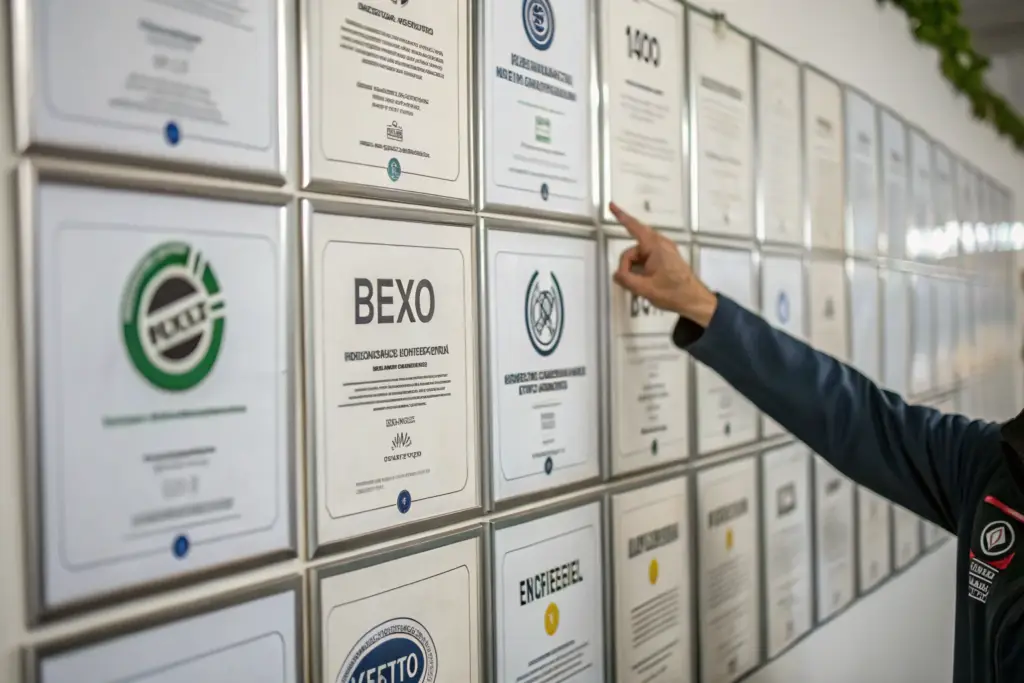
Walk into any factory office in China and you will see a wall of certificates. Some are real. Some are bought from a guy on WeChat for $200. Some are real but expired. Some are real but for the wrong building. You need to know which logos actually protect your brand from liability and which ones are just wallpaper.
The certifications that matter for US wholesale orders fall into three buckets: Quality & Safety (Oeko-Tex, GOTS), Social Compliance (WRAP, BSCI, SMETA), and Environmental Process (bluesign, ISO 14001). For general apparel, Oeko-Tex Standard 100 is the baseline requirement to prove the product is free from harmful chemicals. For organic claims, GOTS is the gold standard. For labor practices, WRAP is the most recognized certification specifically for apparel manufacturing in the US market.
What is the Difference Between a “Product” Certificate and a “Factory” Certificate?
This is the most common confusion I see from new buyers. You ask for a certificate. The factory sends you something. But you need to know what you are looking at.
| Certification Type | What It Covers | Example | What It Looks Like |
|---|---|---|---|
| Product Certificate | The specific fabric or garment you are buying. | Oeko-Tex Standard 100 | Has a unique License Number. Lists the specific fabric composition tested. |
| Factory Certificate | The building and management system. | WRAP, BSCI, ISO 9001 | Has a Certificate Number and the Factory Address. Expires annually. |
The Critical Check:
A factory might show you an Oeko-Tex certificate. Great. Now check the Scope or Product Class. If the certificate says “Product Class I (Baby Items)” but you are buying Polyester Jackets for adults, the certificate is NOT VALID for your order. The fabric used for the jacket was never tested. I see this trick all the time. A factory gets a cheap certification for a simple cotton fabric and then uses that same PDF to “prove” their whole factory is certified. It is not.
At Shanghai Fumao, we maintain separate certificates for our different production lines. Our knitwear line has one Oeko-Tex license. Our woven line has another. This is the correct and expensive way to do it. When you see a factory with one certificate covering everything, be suspicious.
Why is WRAP Often Preferred Over BSCI for US Buyers?
This is inside baseball, but it matters for your supply chain transparency reports. You will see both WRAP (Worldwide Responsible Accredited Production) and BSCI (Business Social Compliance Initiative) mentioned.
- WRAP: Founded by the American Apparel & Footwear Association. It is a factory-specific certification. The audit focuses heavily on the apparel sewing floor. US customs and major retailers like Walmart and Costco recognize it immediately.
- BSCI: A European system. It is a shared audit platform. One audit can be viewed by many different European brands.
For a US wholesale brand selling to independent boutiques or even mid-tier department stores, WRAP is often the stronger signal. It is harder to fake and it is specifically designed for the risks found in garment factories (needle guards, fire exits, overtime hours).
The Verification Hack:
Both WRAP and BSCI have public databases.
- WRAP: Go to the WRAP Compliance Portal. Enter the factory name. If the factory is “Gold” or “Platinum” certified, you will see the exact address and expiry date. If it says “Certificate Inactive,” run away.
- BSCI: The buyer needs to be a member of Amfori to view the full audit report. But you can ask the factory to download the “BSCI Audit Report Summary” from their portal and share it with you. It has a unique DBID number you can cross-check.
I once had a buyer ask me for my WRAP certificate number. I gave it to him on a Tuesday. He verified it online. He placed the order on Wednesday. He told me later that two other factories had sent him fake numbers that did not show up in the portal. That one check saved him $30,000 in potential inventory from a non-compliant sweatshop.
How to Use Official Databases to Validate Certificate Authenticity?
The most dangerous phrase in sourcing is: “Trust me.” The second most dangerous is: “See attached PDF.” A PDF can be edited in Photoshop in about five minutes. I could take my neighbor’s certificate, change the factory name to “Shanghai Fumao,” and send it to you. You would never know the difference by looking at the file. You must go to the source.
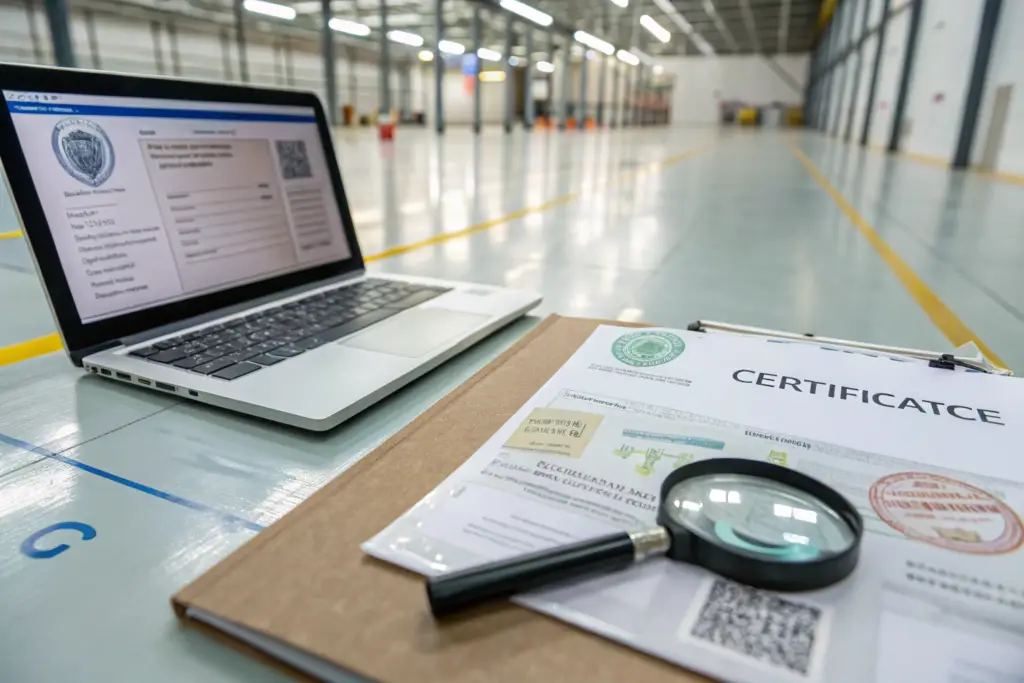
Validating certificate authenticity requires using the official online registry maintained by the certification body. Every legitimate certification standard (Oeko-Tex, GOTS, WRAP, bluesign) has a public-facing or member-facing database. You input the Certificate Number or License Number exactly as it appears on the document. The database will return the company name, the scope of certification, and the expiration date. If the data does not match exactly, the certificate is either fake, expired, or belongs to a different factory.

How to Verify an Oeko-Tex Standard 100 Certificate Step-by-Step?
This is the one you will see the most. Here is the exact process I walk my own clients through.
Step 1: Get the Certificate PDF.
Ask for the full document, not just a screenshot of the logo.
Step 2: Find the License Number.
It is usually a string of numbers like: 12.0.12345 or SH123 456789.
Step 3: Go to the Official Label Check.
Do not use Google to search for “Oeko-Tex Check.” Go directly to the official website: Oeko-Tex Label Check.
Step 4: Enter the Number.
Type the number exactly as it appears.
Step 5: Read the Results Carefully.
The result page will show:
- Company Name: Does it match Shanghai Fumao Garment Co., Ltd. or whatever the legal entity is? If it says “ABC Dyeing Mill,” then the factory is just showing you their supplier’s certificate, not their own.
- Product Class: Does it match your product? (Class I = Baby, Class II = Direct Skin Contact, Class III = No Skin Contact, Class IV = Home Textiles).
- Valid Until: Is the date in the future?
Red Flag Alert:
If the factory says, “We use Oeko-Tex certified fabric.” That is NOT the same as “We are an Oeko-Tex certified factory.” The first means they bought the fabric from a certified mill (good). The second means their own cutting and sewing processes are certified for chemical management (better). Be clear on which one you are getting.
How to Confirm GOTS Certification Scope and Validity?
GOTS (Global Organic Textile Standard) is the strictest certification in textiles. It covers both the organic fiber and the social/environmental processing. Because it is so strict, it is also one of the most faked.
The GOTS Verification Process:
- Find the License Number. It looks like: CU 123456 or ECOCERT 123456.
- Go to the GOTS Public Database: GOTS Certified Supplier Search.
- Search by Company Name or License Number.
The Critical Scope Check for GOTS:
Look at the “Scope of Certification.” You will see a list of activities like:
- “Manufacturing of Woven Apparel”
- “Trading of Knitted Fabrics”
- “Dyeing and Finishing”
If you are ordering finished T-shirts, the factory’s scope MUST include “Manufacturing” or “Production.” If it only says “Trading” or “Export,” they are a middleman. They bought GOTS fabric from someone else, but the sewing factory is not audited. This is a loophole used by many agents. They can legally sell you a “GOTS Product” because the fabric is certified, but the sewing floor might have poor working conditions.
At Shanghai Fumao, our GOTS scope explicitly states “Manufacturing of Garments.” This distinction costs us more in annual audits, but it means when you put a GOTS hangtag on your dress, you are fully protected if the FTC or a consumer watchdog questions you.
What Are the Red Flags That a Factory Certificate Might Be Fake?
Before you even open the database, you can spot many fakes just by looking at the paper or the PDF. Counterfeiters are lazy. They rely on buyers who just want to see a logo and move on. Here is what my QC manager looks for when she reviews supplier documents.
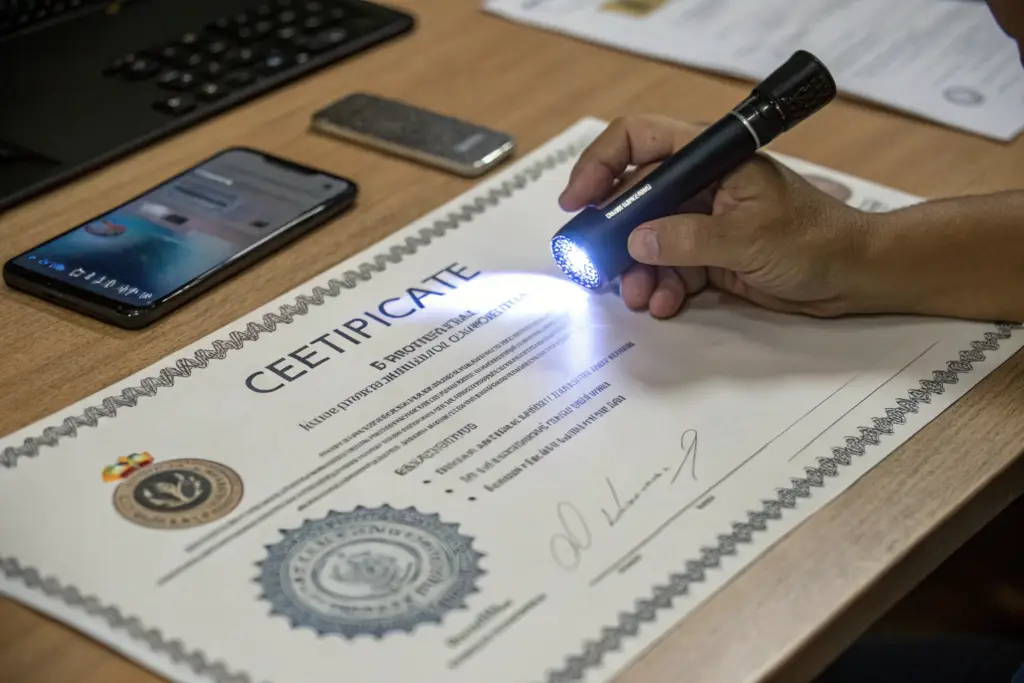
Red flags for fake certificates include mismatched dates, blurry logos, and missing audit body information. A real certificate will always list the specific, accredited third-party auditor (e.g., SGS, Intertek, Bureau Veritas, Control Union). It will have a specific issue date and an expiry date exactly one or three years later. If the dates look like they were typed in a different font, or if the logo is pixelated, the document has been altered. Also, check the factory address. If it is a PO Box or a virtual office, it is a trading company, not a manufacturer.
Why is the “Issue Date” and “Audit Cycle” So Important?
Certifications expire. A factory that was great in 2021 might be a disaster in 2026. You need to know the cycle.
The Timeline Check:
- WRAP: Certificates are valid for one year (Platinum) or six months (Gold) from the date of the audit decision.
- BSCI: Audits are valid for two years.
- GOTS: Certificates are issued annually after a successful audit.
The Trick:
A factory shows you a WRAP certificate. It says “Expires: December 2026.” Today is April 2026. That seems fine. But you look closer. The “Issue Date” is January 2024.
The Problem:
WRAP Platinum is only valid for one year. A certificate issued in January 2024 expired in January 2025. The expiry date of December 2026 is a lie. The factory probably altered the PDF. They have not been audited in over two years. You have no idea what conditions are like in that factory right now.
Always check that the expiry date aligns with the known validity period of the specific standard. Here is a quick reference table I keep handy.
| Standard | Validity Period | Renewal Requirement |
|---|---|---|
| WRAP | 6 months or 1 year | Full re-audit required. |
| BSCI | 2 years | Full re-audit required. |
| GOTS | 1 year | Annual surveillance audit. |
| Oeko-Tex | 1 year | Annual product testing and renewal. |
| ISO 9001 | 3 years | Surveillance audits in years 1 and 2. |
What Does a Missing “Accreditation Body” Tell You?
A real certification is not issued by the standard owner (like GOTS or WRAP). It is issued by an independent, accredited Certification Body (CB) .
Legitimate Example:
“Certificate issued by: SGS Hong Kong Ltd. “
“Certificate issued by: Control Union Certifications “
Fake Example:
“Certificate issued by: [Factory Name] Compliance Department”
“Certificate issued by: China Inspection Services” (No logo, no website)
The standard bodies have strict lists of who is allowed to audit on their behalf.
- For GOTS: Check the list of Approved Certification Bodies.
- For WRAP: Only WRAP staff or specific approved monitors conduct the audit.
If the certificate does not clearly state the name of a globally recognized third-party auditor, it is a self-assessment. A self-assessment is worthless. I could write on a napkin that Shanghai Fumao is the “Best Factory in the World.” It means nothing.
How to Integrate Certification Verification into Your Standard Sourcing Process?
You should not verify certifications just once when you find a new factory. You should verify them every time you place an order. Factories change. Their compliance status changes. A fire exit gets blocked. A certificate expires. The factory that was compliant in the Spring might have failed a surprise audit in the Fall.
Integrating certification verification into your standard sourcing process means creating a recurring calendar task. Before you sign a new Purchase Order, you check the online databases. You also include a clause in your manufacturing agreement that requires the factory to notify you immediately if any of their certifications are suspended or revoked. This shifts the burden of transparency onto the factory and gives you legal recourse if they ship goods under a false claim.

What is a “Certificate Maintenance Calendar” and How Do You Use One?
This is a simple spreadsheet that will save you from the embarrassment of selling “GOTS Certified” clothes that are not actually certified anymore.
How to Build It:
- List Your Factories: Row for each supplier.
- List Their Certs: Column for WRAP, GOTS, Oeko-Tex.
- Input Expiry Dates: The date the certificate actually runs out (remembering WRAP is short).
- Set Reminders: Set a calendar alert for 45 Days Before Expiry.
| Example Entry for Shanghai Fumao: | Factory | Certification | License Number | Expiry Date | Reminder Alert |
|---|---|---|---|---|---|
| Shanghai Fumao | GOTS | CU 844321 | 2026-08-15 | Alert: July 1, 2026 | |
| Shanghai Fumao | Oeko-Tex | 12.0.56789 | 2026-11-01 | Alert: Sept 15, 2026 |
When the alert pops up, you send a one-line email: “Team, can you send the updated certificate for the upcoming season?”
If they send it, great. If they stall, you have a problem. You should not cut the next PO until you see the new certificate. This is how you protect your brand’s integrity. I have a client who does this religiously. He told me it is the best 15 minutes he spends every quarter. It gives him peace of mind that his “Sustainable Collection” marketing is legally defensible.
How to Handle a Factory That Resists Providing Verifiable Certificates?
Sometimes you find a factory with a great price and beautiful samples. But when you ask for the WRAP certificate number, they get weird. They give excuses:
- “The certificate is in renewal.”
- “Our auditor has the file, we will send later.”
- “We only share with customers after order.”
The Hard Truth:
Walk away. I know it is painful. I know you love the price. But a factory that is evasive about compliance is hiding something. It could be minor, like a paperwork delay. It is more likely to be major, like a failed fire safety inspection or a child labor issue. Is your brand worth that risk?
The Professional Response:
“Thank you for the update. We are very interested in working with you. We will hold the Purchase Order until the renewed certificate is available for verification. Please let us know as soon as the audit is complete. We will keep this slot open for 30 days.”
This does two things:
- It shows you are serious and professional.
- It puts pressure on them to fix their compliance issue if they want the business.
If they really are a good factory, they will come back with the certificate. I have been on the other side of this. I once had a BSCI audit delayed because of a typhoon. I told my client honestly: “The audit is rescheduled for October 15. I will send the report on October 20. I understand if you need to delay the order.” He waited. We shipped. He trusted me more after that than before. Honesty about the process builds trust. Evasion destroys it.
Conclusion
Verifying clothing factory certifications is not about being paranoid. It is about being professional. It is about protecting the business you have worked so hard to build. In a world where consumers can scan a QR code on a hangtag and see your supply chain, you cannot afford to take a factory’s word for it. You need to see the database entry. You need to check the scope. You need to check the date.
The tools are free. The databases are public. The process takes less than ten minutes per order. Those ten minutes can save you from a container seized by customs, a lawsuit from a consumer watchdog, or a PR disaster on social media.
At Shanghai Fumao, we welcome this scrutiny. We keep our certificates current. We keep our portal listings accurate. We do this not because we have to, but because we want our partners to sleep well at night knowing their products are made the right way. We are transparent about our audit reports and we are happy to walk you through the verification steps on a video call if you want to see the live database entry.
If you are looking for a manufacturing partner who makes compliance easy, I encourage you to reach out to our Business Director Elaine. She can provide our current certificate package with all the necessary numbers for your verification records. Her email is elaine@fumaoclothing.com. Let’s build a supply chain you can trust completely.