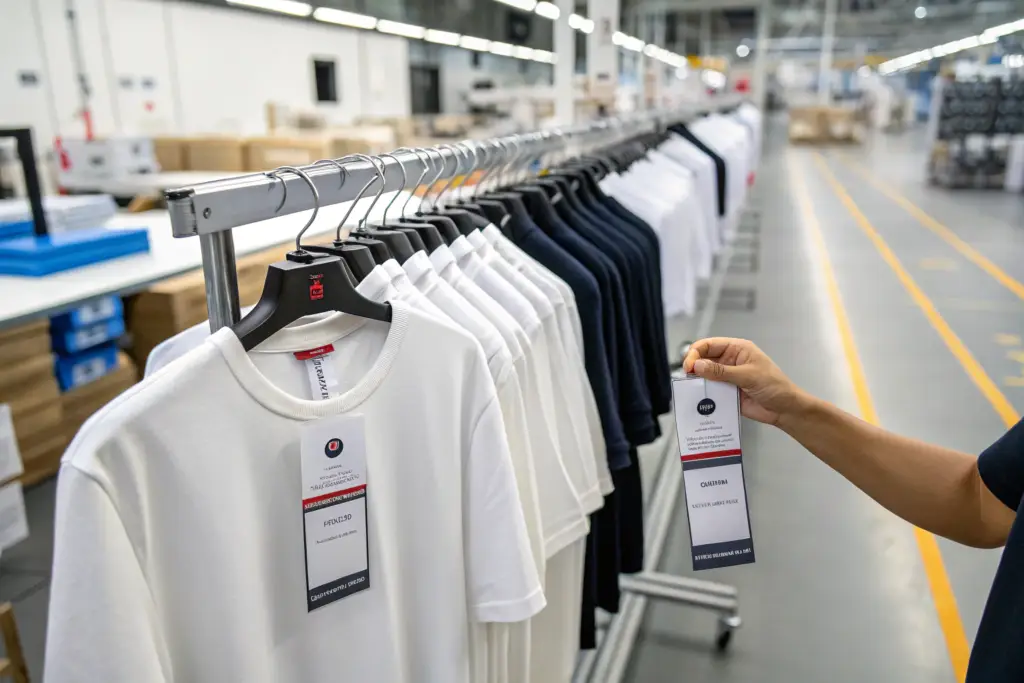
I want to tell you about a phone call I got three years ago. It was from a man in Florida. He had built a nice little business selling unbranded yoga wear on Amazon. He was making money. But he was tired of being a commodity. He wanted to build a brand. He wanted his logo on the waistband. He wanted his own hangtag. He wanted a custom fit that made his leggings better than the other ten thousand black leggings online. He asked me: "Can you help me stop being invisible?" I said yes. Today, that brand does over $5 million a year. The product is still made in our factory. The only difference is that we helped him rebrand it.
Chinese clothing manufacturers are the best option for brand rebranding because they offer an unmatched combination of vertical integration and customization flexibility. Unlike factories in Vietnam or Bangladesh that focus on high-volume, low-variation orders, Chinese factories excel at “small batch customization.” This means you can change the label, adjust the fit, modify the fabric blend, and create custom packaging all under one roof. This allows a brand owner to take a generic garment and turn it into a unique, proprietary product without having to manage five different suppliers.
Rebranding is not just about slapping a new logo on an old shirt. It is about creating a defensible product that customers cannot find anywhere else. China is the only place where the supply chain is deep enough to do that profitably for small and mid-sized US brands.
How Does Vertical Integration Speed Up the Rebranding Process?
Rebranding requires changes. You need a new woven label. That label needs to be sewn into the collar. That requires a different sewing machine setup. You want custom buttons with your logo. That requires a mold. You want a specific shade of “Millennial Pink” for your hangtag. That requires printing. If you are managing a factory in one country, a label supplier in another, and a packaging company in a third, you are a logistics coordinator, not a brand owner.
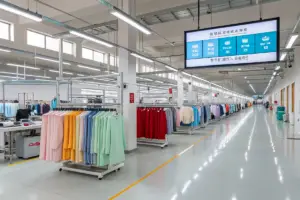
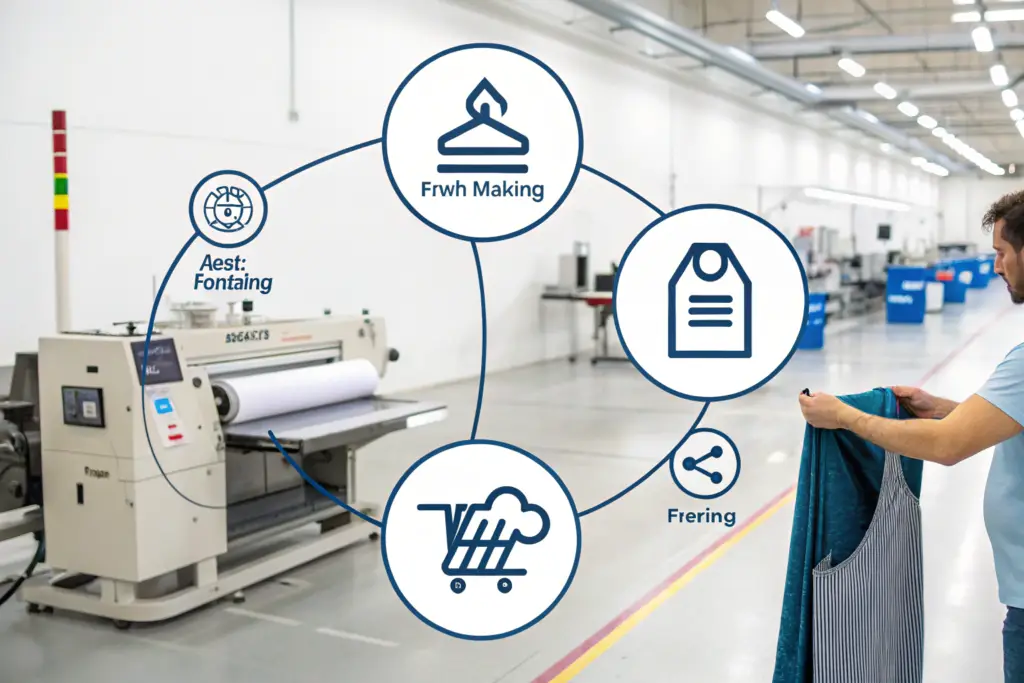
Vertical integration speeds up rebranding because the factory controls the entire production ecosystem. In China, a full-service factory has relationships with the yarn mill, the dye house, the label printer, and the packaging supplier all within a 50-mile radius. When you want to change the neck label from a printed tag to a woven damask label, the factory manager walks over to the trim department and gets it done in 48 hours. This integration collapses the timeline for rebranding from months to weeks.
What Customization Options Are Only Possible with In-House Control?
This is where China separates itself from other sourcing destinations. In Vietnam, if you want to change the fit of a sleeve, the factory might say “No” because they are set up for one specific pattern for a giant brand. In China, factories are more agile.
| Rebranding Element | Outsourced Model (Other Countries) | Vertically Integrated Model (China) |
|---|---|---|
| Woven Labels | 4-6 weeks lead time. 10,000 pcs MOQ. | 7-10 days lead time. 1,000 pcs MOQ. |
| Custom Hangtags | Separate vendor. Mismatched color risk. | Coordinated with fabric color in-house. |
| Button/Zipper Molds | Expensive. Requires large volume. | Affordable for 500-1,000 units. |
| Fit Adjustments | Difficult. Factory uses standard block. | Easy. In-house pattern maker adjusts daily. |
| Fabric Dyeing | Limited to stock colors. | Custom Pantone matching for just 200 yards. |
I had a client who wanted to rebrand his men’s shirt line with a distinctive contrast chambray inside the collar and cuff. It was a small detail. It made the shirt look like a $120 shirt instead of a $40 shirt. We sourced the chambray from a mill two hours away. We cut the small pieces. We sewed them in. The whole process added $1.20 to the cost. That detail alone doubled his perceived value. You cannot execute that kind of detail easily if your supply chain is fragmented across Southeast Asia.
At Shanghai Fumao, our ability to control these small details is what attracts brands looking to elevate their product. We keep a library of trim options and have a dedicated sample room just for testing rebranding concepts.
How Does “Sample Room Proximity” Reduce Iteration Time?
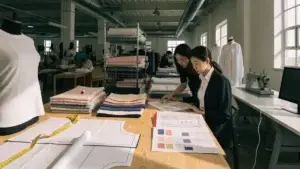
Rebranding means sampling. You will need to see the new label. You will need to feel the new fabric. You will need to check the new fit. The speed of this feedback loop determines how fast you can launch.
The Broken Model:
- You are in New York.
- Factory is in Vietnam.
- Label printer is in Hong Kong.
- Sample shipped to you: 14 days.
- You approve: 2 days.
- Revision made: 14 days.
- Total Cycle Time: 30 days per round.
The Shanghai Fumao Model:
- You are in New York.
- Factory, Sample Room, and Label Printer are all in Shanghai.
- We make the change in 4 hours.
- We ship via DHL Express: 3 days.
- Total Cycle Time: 5-7 days per round.
This speed allows you to do three rounds of sampling in the time it takes another factory to do one. The result is a more polished, more dialed-in final product. In the world of brand building, the details matter. The space between the buttons. The softness of the hangtag string. These things take iteration. Chinese manufacturing gives you the time to iterate.
Why is China Unmatched for Low Minimum Order Quantities on Custom Details?
This is the single biggest reason why American brand owners choose China for rebranding. When you are building a brand, you do not need 10,000 units of a custom zipper. You need 500. You need to test the market. You need to preserve cash. Factories in other countries are built for scale. They want to run one style for three weeks straight. Chinese factories, especially in the private sector, are built for variety.
China is unmatched for low MOQs on custom details because the supporting infrastructure of small-batch suppliers exists there. There are hundreds of small label mills that will run 500 pieces. There are button factories that will do short runs. There are screen printers who will print 100 hangtags. This ecosystem allows the main garment factory to source custom trims without forcing the brand to buy a lifetime supply. This reduces the upfront cash required for a rebrand and allows the brand to test new logos or packaging concepts without massive financial risk.
How to Rebrand a Garment with Just 200 Units Per Style?
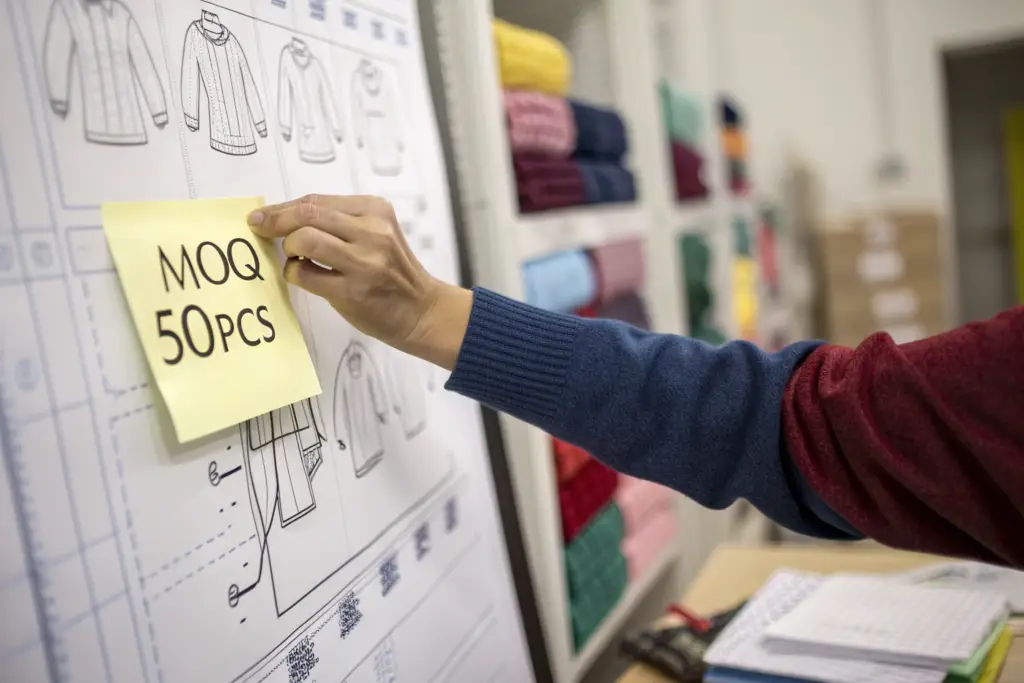
Many factories will tell you 200 units is a “sample order.” They will charge you a premium. Or they will refuse. Here is how we structure it at Shanghai Fumao to make it profitable for both sides.
The “Group Cut” Strategy:
We take your 200 units of a specific fabric and we “group” it with other clients using the same base fabric. You get the benefit of bulk fabric pricing even though your order is small.
| The Customization Tiers for 200 Units: | Customization Level | What You Can Do | MOQ Feasibility |
|---|---|---|---|
| Level 1: Label Swap | Sew in your own woven neck label. Remove factory tag. | Yes, 200 pcs is fine. | |
| Level 2: Hangtag & Packaging | Custom printed hangtag. Custom polybag sticker. | Yes, 200 pcs is fine. | |
| Level 3: Trim Change | Switch standard buttons to custom logo buttons. | Possible. Need to pay mold fee ($80-$150). | |
| Level 4: Fit Block Change | Adjust sleeve length or body width slightly. | Yes. We grade from our base block. | |
| Level 5: Custom Print/Embroidery | Add your logo to chest or sleeve. | Yes. Screen setup fee applies ($40-$60). |
I have a client who launched a golf apparel brand with just 150 units across three styles. We did Level 1, 2, and 5 for him. The total cost per unit was about $18. He sold them for $68. He sold out in two weeks. He used the profits to order 1,000 units. That is the ladder. Chinese manufacturing lets you climb it rung by rung.
What is the “Trim Library” Concept and How Does It Save Money?
This is an insider secret. When a factory has been in business for a while, they accumulate a “Trim Library.” These are custom molds for buttons, zipper pulls, and rivets that previous clients paid to develop and then abandoned.
How It Works:
You want a custom metal button with a shank. You describe the look. We check our library. We might have a mold that is 90% similar to what you want. The mold already exists.
The Cost Difference:
- New Mold: $300 setup fee. (You pay).
- Library Mold: $0 setup fee. (We just charge for the actual buttons).
This is only possible in a manufacturing hub where thousands of custom projects have been run before. I showed a client a library button last month. It was a brushed gold shank button with a subtle rim. It was exactly the “quiet luxury” look she wanted. She used it on her cardigans. She saved $300 and two weeks of lead time. This is the invisible advantage of working with an experienced Chinese factory.
How Does China’s Expertise in “Private Label” Protect Your Brand Identity?
I know the fear. You have a great idea. You share it with a factory. You worry they will steal it and sell it on Alibaba for half the price. That fear keeps many brands from sourcing in China. But the reality of the modern Chinese manufacturing industry is different than it was 15 years ago. The factories that survive today are the ones that protect their clients’ IP.
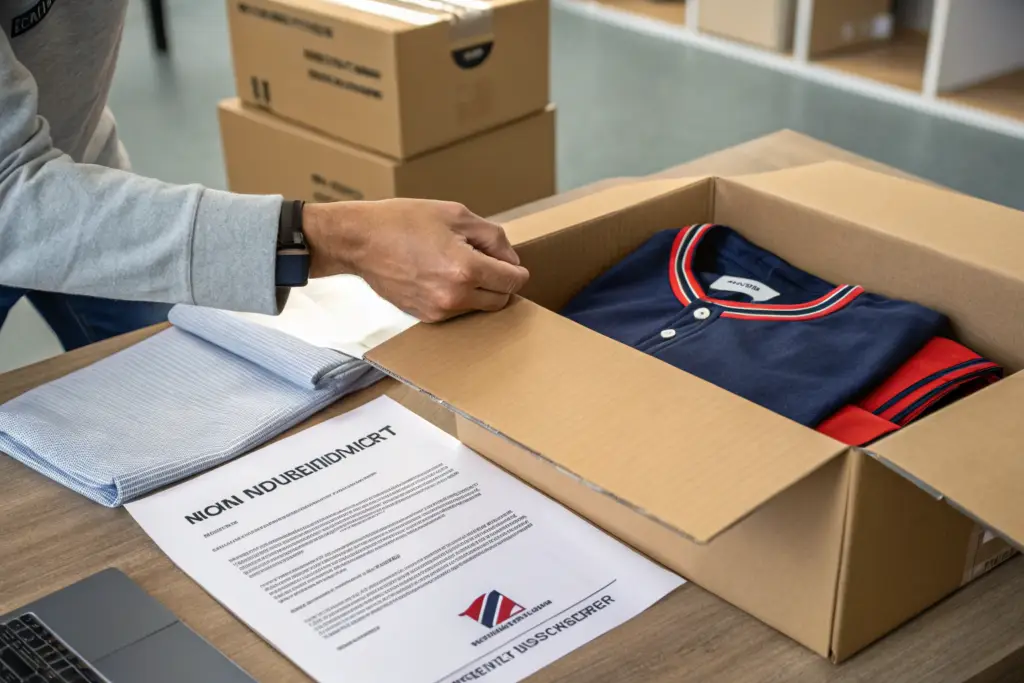
China’s expertise in private label manufacturing protects brand identity through established legal and cultural practices around Non-Disclosure Agreements (NDAs) and production segregation. Reputable factories understand that their long-term survival depends on trust. They do not mix client A’s custom fabric with client B’s order. They keep proprietary patterns locked in the sample room. Moreover, the Chinese legal system has specific “Trade Secret” protections that are enforceable, especially in major manufacturing hubs like Shanghai. A factory caught stealing a design faces not just a lawsuit, but a complete loss of reputation in the tight-knit sourcing community.
What Should a “China-Ready” NDA Include to Be Effective?
A generic NDA downloaded from the internet is often useless in a Chinese court. You need specific language.
The Key Clauses for a China-Ready NDA:
- Bilingual Document: It must be in English AND Chinese. Both versions equally valid.
- Specific Definition of “Confidential Information”: Do not just say “designs.” List exactly: “Tech Pack #SF-2025-01, Fabric Reference #A112, Custom Button Mold #B334.”
- Governing Law: Specify arbitration in a neutral location like Hong Kong International Arbitration Centre (HKIAC) or Shanghai International Arbitration Center (SHIAC) . This is much faster and more enforceable than a local court.
- Consequences: State a specific liquidated damages amount (e.g., “Breach shall result in payment of $50,000 USD”).
At Shanghai Fumao, we sign these bilingual NDAs as standard practice. We have a corporate chop (stamp) that makes it legally binding. We also have an internal policy: “One Brand, One Room.” The cutting patterns for Brand A are stored in a separate cabinet from Brand B. This is a physical barrier, not just a legal one.
How to Use “Trade Dress” Protection in Manufacturing?
You cannot patent a T-shirt. But you can protect the look and feel of your brand. This is called Trade Dress.
Example:
You sell a dress with a very specific contrast stitching on the hem. That stitching is not functional. It is decorative. It identifies the dress as yours.
How We Help Protect It:
- Documentation: We provide you with dated, stamped photos of the first sample development. This creates a “Paper Trail” of creation.
- Exclusivity Agreement: We sign an agreement that we will not use that specific contrast stitching pattern for any other client for a period of 24 months.
This is a common practice among professional Chinese factories. It is how we build long-term relationships. I have a client who does a specific “reverse seam” detail on his hoodies. It is his signature. We have turned down work from other brands who asked for the same detail. Why? Because the long-term value of my relationship with that one client is worth more than a quick one-off order from a copycat. That is the calculus of a mature factory.
Why is the “DDP + Rebranding” Combination a Cash Flow Powerhouse?
We already discussed why DDP is great for shipping. But when you combine DDP shipping with a rebranding strategy, the financial impact is amplified. You are not just saving on logistics. You are creating a product with a much higher perceived value.
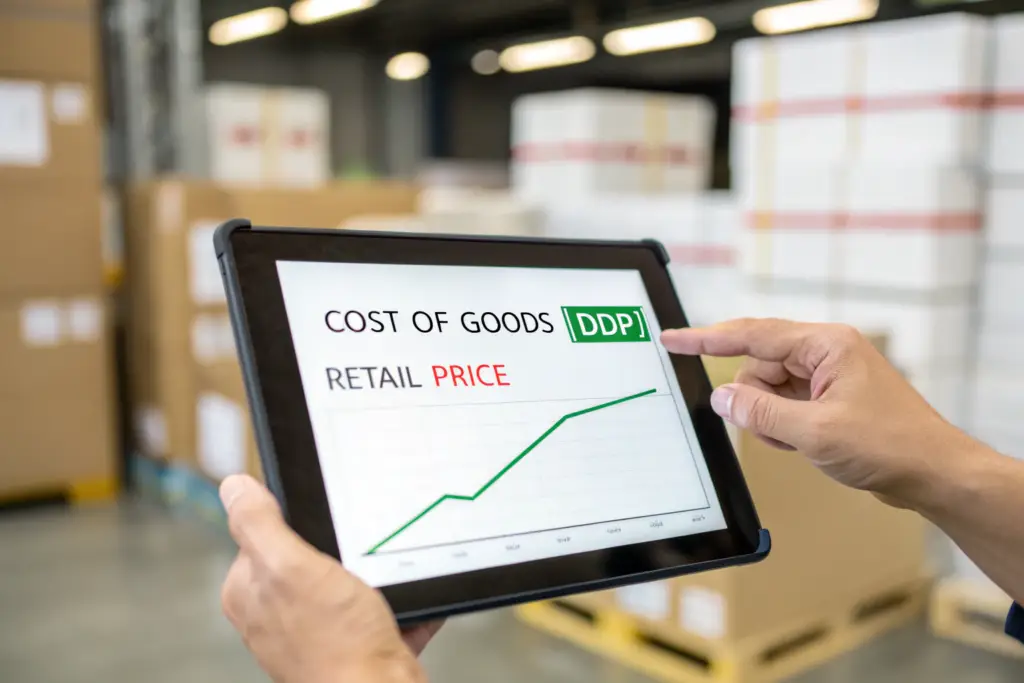
The “DDP + Rebranding” combination is a cash flow powerhouse because it fixes your Landed Cost while simultaneously increasing your Average Selling Price (ASP). DDP gives you a predictable, all-in cost per unit. Rebranding allows you to charge 2x to 4x more than the generic version of the same garment. When you know exactly what the product will cost delivered to your door, and you know you can sell it for a premium because of the custom details, your profit margin becomes highly predictable and scalable.
How Much Value Does a Simple “Label Swap” Actually Add?
Let’s look at a real-world example from our production line at Shanghai Fumao. We make a high-quality Women’s French Terry Sweatshirt.
Scenario A: Generic Wholesale (No Rebrand)
- Factory Cost (FOB): $8.50
- DDP Shipping to USA: $1.50
- Total Landed Cost: $10.00
- Wholesale Price (To Boutiques): $18.00
- Your Gross Margin: $8.00 per unit
Scenario B: Private Label Rebrand
- Factory Cost (FOB with custom label & hangtag): $9.20 (+$0.70)
- DDP Shipping: $1.50
- Total Landed Cost: $10.70
- Wholesale Price (Branded, Custom Fit): $28.00
- Your Gross Margin: $17.30 per unit
The Result:
You spent an extra $0.70 per unit. You increased your selling price by $10.00. You more than doubled your profit per unit. And more importantly, the boutiques are happier. They are not selling a generic sweatshirt that their customers can reverse-image search on Amazon. They are selling a branded sweatshirt that is unique to their store.
How to Structure “Tiered Rebranding” to Scale Your Business?
You do not have to do everything at once. In fact, it is smarter to phase it in as your cash flow grows.
Year 1: Foundation (The Soft Launch)
- Action: Label Swap + Custom Hangtag.
- Goal: Establish brand presence. Test fit.
- Investment: Low ($200 for labels/tags).
- At Shanghai Fumao: We use stock fabrics and trims.
Year 2: Differentiation (The Unique Touch)
- Action: Custom Fit Adjustment + Custom Buttons/Zippers.
- Goal: Create a product competitors cannot easily copy.
- Investment: Medium ($500 for pattern work and mold fees).
- At Shanghai Fumao: We adjust the pattern block based on Year 1 feedback.
Year 3: Vertical Ownership (The Moat)
- Action: Custom Milled Fabric + Exclusive Packaging Suite.
- Goal: Build a defensible brand moat.
- Investment: Higher (Fabric minimums).
- At Shanghai Fumao: We work with the mill to develop a unique slub texture or color.
This is the roadmap I have seen dozens of successful US brands follow. They start with the low-hanging fruit of rebranding in China. They use the increased margins from Year 1 to fund the investment for Year 2. By Year 3, they are a real brand, not just a reseller.
Conclusion
Chinese clothing manufacturers offer the best ecosystem for brand rebranding because they provide the three things a growing brand needs most: Speed, Flexibility, and Integration. You can move fast because the entire supply chain is within a few miles of the factory. You can start small because the minimum order quantities for custom details are accessible. You can build a defensible product because you have control over the fit, the fabric, and the finishes.
Rebranding is the single most profitable activity a clothing entrepreneur can undertake. It is the difference between being a middleman earning 20% margins and being a brand earning 70% margins. And there is simply no other country on earth that has the density of suppliers and the depth of technical skill to support this process for small and mid-sized brands.
At Shanghai Fumao, we have made rebranding a core part of our service offering. We understand that you are not just buying a shirt. You are building an identity. We protect that identity. We nurture that identity. And we help it scale.
If you are ready to stop selling someone else’s product and start building your own brand, I encourage you to reach out to our Business Director Elaine. She specializes in helping brands navigate the rebranding process from the first label design to the final DDP delivery. Her email is elaine@fumaoclothing.com. Let’s make your brand visible.