You have negotiated the FOB price with the factory. You have factored in the shipping and the duty. You have built a beautiful margin projection. You are a genius. Then, the invoices start trickling in after the goods have been delivered. An unexpected sampling fee. A customs exam bill. A chargeback from a retailer for a labeling error. Your beautiful margin is eroding before your eyes. A brand owner told me, "I thought I had my costs locked in. Then the 'phantom fees' appeared. I felt like I was bleeding money from a thousand tiny cuts."
The hidden costs in private label clothing production fall into four main categories: Development & Sampling Fees (unbudgeted iterations, lab dip charges, shipping costs), Logistics & Compliance Surprises (demurrage, customs exams, unexpected duty rate changes), Quality Failure Costs (in-house rework, customer returns, retail chargebacks), and Time & Opportunity Costs (the value of your own labor spent managing complex vendor relationships).
At Shanghai Fumao, we believe in radical cost transparency. Our B2B partnerships are built on ensuring our clients understand the total landed cost and the full financial picture before they commit. Let me shine a light on the most common and costly "phantom fees" that eat away at private label margins, so you can budget accurately and protect your profit.
What Development and Sampling Fees Are Often Overlooked?
The FOB price you negotiate is for a finished, approved, bulk-ready garment. It does not include the journey to get to that point. The sampling phase is often treated as a sunk cost of doing business, but unmanaged, it is a significant and unpredictable drain on startup capital. Many new brands are shocked by the cumulative cost of getting a design "just right."
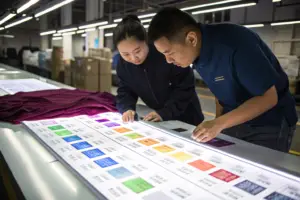
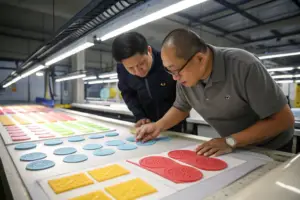
Overlooked development costs include: Lab Dip and Strike-Off Fees (often $50-$150 per color match attempt), Multiple Sample Iterations (each costing CMT + fabric + shipping), International Courier Fees ($50-$100+ per sample shipment), and Pattern Making and Grading Fees (if not explicitly included in the initial quote). These can easily add $1,000 - $3,000+ to the development cost of a single collection.
I recall a women's wear designer who was meticulous about color. She went through six rounds of lab dips for a specific shade of "Terracotta." Each round cost $75. That was $450 just to get the color right on one fabric. She also had three fit samples for a tailored blazer. The sample CMT was $120 each, plus $60 shipping each time. That was another $540. Before she had ordered a single unit of bulk production, she had spent nearly $1,000 on development. She was aghast. Now, we counsel all new partners on these costs upfront. We provide a Development Cost Estimate as part of our private label onboarding process. Forewarned is forearmed.
Why Are Lab Dips and Strike-Offs Not Free?
A lab dip is a small swatch of fabric dyed to match your color. A strike-off is a sample of your custom print. These sound like free services, but the dye house and print mill incur real costs: machine time, dyes, chemicals, and labor. They charge for this. A factory that says "lab dips are free" is either burying the cost in a higher bulk fabric price or using a low-quality vendor. It is a legitimate, pass-through cost. Expect to pay $50-$100 per lab dip attempt.
How Do Sample Shipping Costs Add Up Quickly?
You are shipping a physical garment via express courier (DHL, FedEx) from China to the US or Europe. This is expensive. A single sample shipment can cost $50-$80. If you have three styles and each goes through two rounds of samples, that is 6 shipments x $60 = $360 in shipping costs alone. This is a pure cost of development. One way to mitigate this is to consolidate sample shipments when possible, but the cost is largely unavoidable for remote product development.
What Logistics and Customs Fees Surprise First-Time Importers?
You have budgeted for ocean freight. The factory quoted you $2,800 for the container. You think you are done. Then the container arrives at the Port of Los Angeles. And the real invoices start arriving. These are the Accessorial Charges and Port Fees that are not included in the standard freight quote and are a constant source of surprise and frustration for new importers.
Common hidden logistics fees include: Demurrage (daily storage fee at the port after "free days" expire), Detention (fee for holding the carrier's container too long at your warehouse), Chassis Fees (renting the wheels to move the container), Customs Exam Fees (if CBP selects your container for X-ray or physical inspection), and various Port Infrastructure Fees (PierPass, TMF). These can easily add $500 - $2,000+ to a single shipment.
A distributor client of ours received a $1,800 Demurrage bill because his previous factory had mislabeled the cartons, and the trucker couldn't find the right pallet. The container sat at the port for 10 days accruing daily fees while they sorted out the mess. He had to pay the bill to get his goods. He was furious. This is why we advocate so strongly for DDP shipping . When we control the door-to-door process, we absorb the risk of these fees. We are incentivized to clear customs fast and deliver efficiently. For FOB buyers, this is a minefield of hidden costs.
What Is the Real Cost of a US Customs Exam?
You hope it never happens, but statistically, 3-5% of containers are flagged. The costs vary wildly:
- VACIS (X-Ray): Non-intrusive. Cost is often minimal, but there is a fee for the scan ($50-$150) and potential delay of 1-2 days.
- Tailgate Exam: They open the doors and inspect the first few cartons. Fee: $300-$600 + trucker waiting time. Delay: 3-5 days.
- Intensive Exam: The container is taken to a Centralized Examination Station (CES) and completely unloaded. Fee: $1,000 - $3,000+ for the exam, labor, and reloading. Delay: 7-14 days.
A factory that provides meticulous, accurate documentation (packing lists, invoices, fabric certificates) significantly reduces the chance of an intensive exam. This is an invisible value of working with an experienced clothing manufacturer.
How Do "Split Shipments" Double Your Costs?
Your order is 10,000 units. The factory says, "We can ship 6,000 now, and 4,000 in two weeks." This sounds helpful. It is a trap. You just turned one consolidated shipment into two. You will now pay double for documentation fees, port charges, and trucking delivery. The per-unit cost for logistics on the 4,000-unit tail-end shipment is astronomical. It is almost always better to wait for the full container. We always advise clients against split shipments unless the cost of lost sales from waiting is demonstrably higher than the doubled logistics cost.
How Do Quality Failures Create a Cascade of Hidden Costs?
The goods arrived. They are mostly okay. But you find 50 units with broken zippers. And 100 units with a stain on the sleeve. You do not return the whole shipment. You "make it work." But the cost of these defects is far higher than just the wholesale value of those 150 units. It sets off a chain reaction of hidden costs.
The hidden costs of quality failures include: Internal Rework Labor (paying a local seamstress or your own team to fix issues), Customer Returns and Refunds (which include outbound and return shipping costs, restocking labor, and the lost opportunity to sell that unit at full price), Customer Service Time (staff hours spent handling complaints), and the most insidious cost: Brand Damage and Lost Future Sales.
I worked with a men's wear brand that had a consistent issue with buttons falling off their shirts. They had a 4% return rate attributed to "missing buttons." They thought, "It's just a button." But the average cost of processing a return (shipping, inspection, repackaging) was $14. For 5,000 units sold, that was 200 returns. That was $2,800 in direct costs, plus the lost opportunity to sell those 200 shirts at full price. Over a year, this "minor" issue cost them over $15,000. This is why our quality control system is so obsessive about details like button attachment security. Prevention is the only cure.
What Are Retailer Chargebacks and How Do They Erode Profit?
If you sell wholesale to major retailers, this is the single biggest hidden cost. A Chargeback is a fine deducted from your invoice for violating the retailer's strict vendor compliance manual. Common violations include:
- Late Delivery: $500 - $5,000 fine or 3-5% of invoice value.
- Incorrect Labeling: Barcode doesn't scan? Fine. Missing hangtag? Fine.
- Poor Packaging: Wrong carton size? Wrong polybag thickness? Fine.
I have seen a brand lose 12% of their invoice value to chargebacks because their factory used a generic carton that didn't meet the retailer's specific requirements. The factory had saved $0.40 per carton. It cost the brand $6,000 in fines. This is the definition of penny wise, pound foolish. We maintain a library of Retail Compliance Manuals to prevent exactly this. This is a core service for our large company buyers .
What Is the True Cost of a Single Customer Return?
Let's do the math on a single returned $48 dress that had a loose thread.
- Refund: -$48 Revenue
- Outbound Shipping: -$8 (cost you paid)
- Return Shipping: -$8 (label you provided)
- Warehouse Labor: -$5 (to process and inspect)
- Lost Opportunity: -$24 (you can't resell it at full price)
- Total Cost of That One Return: ~$93
You lost money on that sale. Preventing that one loose thread in the factory costs pennies. Failing to prevent it costs nearly a hundred dollars. This is the economic reality that drives our quality assurance obsession at Shanghai Fumao.
What Are the "Time and Opportunity" Costs of a Fragmented Supply Chain?
This is the most overlooked cost of all, and often the most expensive. It is the value of your time. As a founder, your time is your most precious and limited asset. Every hour you spend managing a freight forwarder, chasing a trim supplier, or fixing a customs document is an hour you are not spending on high-value activities that grow your brand.
The hidden cost of a fragmented supply chain is the opportunity cost of the founder's time. Managing multiple vendors (fabric mill, trim supplier, cutting room, sewing factory, freight forwarder) is a full-time job. This time could be spent on design, marketing, sales, and building customer relationships—the activities that directly drive revenue and brand value. An end-to-end partner like Fumao eliminates this cognitive and temporal burden.
A CEO of a scaling activewear brand once told me he was spending 15-20 hours a week just on production coordination. He was exhausted and his marketing was suffering. He switched to our end-to-end private label service. He got those 20 hours back. He used that time to launch a new TikTok strategy that doubled his online sales in six months. The "cost" of our integrated service was dwarfed by the revenue generated from his liberated time. This is the ultimate hidden cost of fragmentation, and the ultimate value of a true B2B partnership.

How Much Is an Hour of Your Time Worth?
Calculate it. If your goal is to build a $1 million brand, your effective hourly rate as the CEO is significant. If you are spending 10 hours a week on logistics tasks that could be delegated, you are spending thousands of dollars of your own "CEO time" on low-value work. An end-to-end partner allows you to reallocate that time to $500/hour strategic work instead of $25/hour administrative work. This is a fundamental principle of business scalability .
How Does an Integrated Partner Eliminate These Costs?
A full-package partner like Fumao internalizes all the complexity. We are the single point of contact and accountability. We manage the fabric mill, the trim vendors, the production floor, the QC, and the DDP logistics. The brand owner pays one invoice and receives regular, transparent updates from their Project Manager. The time, stress, and financial risk of managing a fragmented network are eliminated. This is the foundation of a scalable, profitable private label business.
Conclusion
The hidden costs in private label clothing production are the termites in the foundation of your brand. They are the small, often invisible expenses and time drains that collectively erode your profit margins, increase your stress, and slow your growth. From the cumulative cost of sampling to the shock of a customs exam bill, from the cascade of a quality failure to the immense opportunity cost of your own time, these are the real expenses of bringing a collection to market.
At Shanghai Fumao, our mission is to shine a light on these hidden costs and, more importantly, to build a partnership model that eliminates them. Through transparent costing, integrated DDP logistics, obsessive quality control, and a dedicated Project Manager model, we transform a complex, risky process into a predictable, streamlined engine for your brand's growth.
If you are ready to build a clothing line on a foundation of financial clarity and operational peace of mind, let's talk. Our Business Director, Elaine, can provide a detailed cost breakdown template that accounts for the true cost of production.
Please email Elaine at: elaine@fumaoclothing.com.