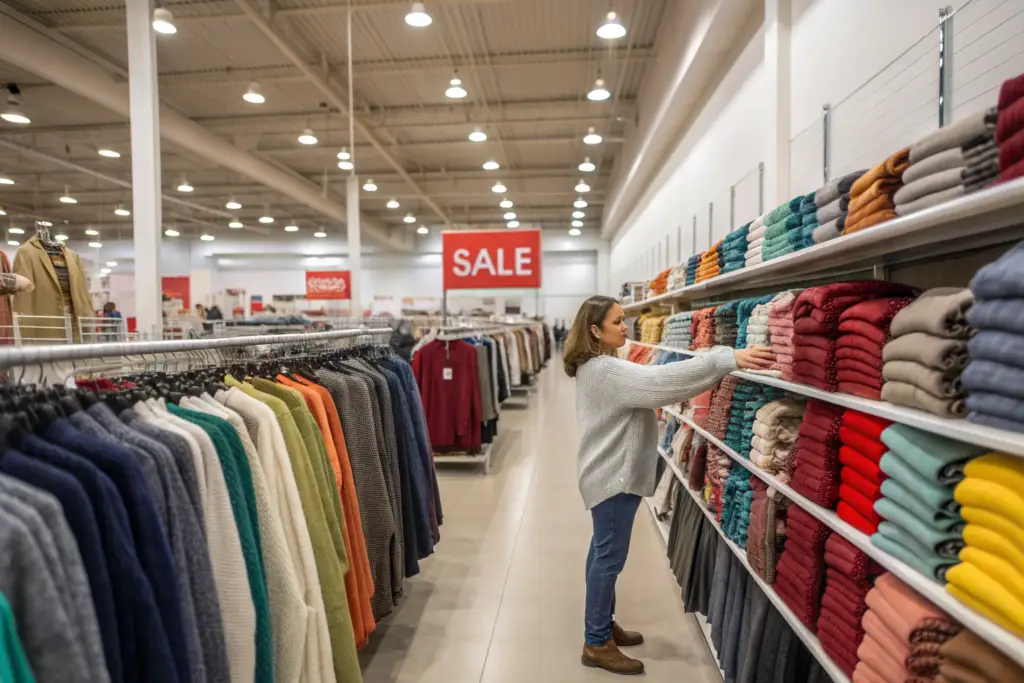
You walk through your 3PL warehouse. Or maybe your garage. And you see it. The racks of deadstock. Hundreds of units of a style you were sure would be a hit. You look at them and you do not see potential revenue. You see storage fees. You see tied-up cash. You see a silent monument to a bad buy. It makes your stomach drop. You need this inventory gone. But you do not want to torch your brand's reputation by dumping it for $5 at a flea market.
The best strategies for liquidating excess wholesale clothing inventory involve a tiered approach that protects brand equity: First, private flash sales to your existing email list at a modest discount. Second, selling to established B2B off-price platforms like B-Stock or direct to discount retailers. Third, utilizing DDP export channels to sell the stock in secondary international markets where it is still in season. Fourth, donating to verified charities for a tax write-off rather than paying ongoing storage fees.
I am the owner of Shanghai Fumao. I have seen this from the production side. Sometimes the overstock is not the brand's fault. Sometimes a factory runs 5% over on cutting to cover defects, and you end up with 200 "perfect" extra units you didn't plan for. You need a system to deal with this. You need to turn that deadstock into working capital without killing your full-price business. Here is how you do it.
How Can You Move Deadstock Without Destroying Your Brand's Premium Image?
This is the biggest fear. You have spent years building a brand that stands for quality and intentional design. You sell a jacket for $295. If your loyal customers see that same jacket on a discount site for $79, they feel cheated. They will never pay full price again. You lose trust. The short-term cash from liquidation is not worth the long-term erosion of your pricing power.
You can move deadstock without destroying brand image by strictly segmenting the audience and the channel. Keep discounting off your main website homepage. Use private, password-protected "Archive Sales" for email subscribers only. Utilize discreet B2B liquidation marketplaces where the end consumer never sees the transaction. And most importantly, remove or alter branding elements if goods are destined for dollar stores or off-price chains where the association would be damaging.

Why Are Private Flash Sales to Email Subscribers More Profitable Than Public Markdowns?
Public markdowns train your customer to wait. If you put a "SALE" banner on your homepage every August, you are telling your best customers that everything will be 30% off if they just wait 8 weeks. You are conditioning them to delay purchase.
A Private Flash Sale does the opposite. It rewards loyalty and creates urgency without the public spectacle.
Here is a specific example. A client of ours, a women's contemporary brand in San Diego, had 150 units of a linen dress left over after the summer season. Instead of putting it on the sale page of their website, they did this:
- Sent an email with the subject line: "For Your Eyes Only: The Summer Archive."
- The email body was simple: "We found a small batch of our sold-out Linen Midi in the studio. We're offering it first to our top clients at 25% off. Link expires in 48 hours. Use code ARCHIVEVIP."
- The link went to a hidden collection page on their Shopify site. It was not accessible from the main navigation.
The result? They sold 110 units in 36 hours. The sell-through was high. The discount was modest (25% instead of 50%). And the rest of their customer base had no idea there was a discount happening. The brand's perceived value remained intact.
Compare that to a public 50% off sale. You might sell all 150 units, but you have just told your entire email list that your product is only worth $147, not $295. The brand equity damage is significant.
Here is the playbook we recommend to our manufacturing clients to share with their own customers:
| Channel | Discount Depth | Visibility | Risk to Brand Image |
|---|---|---|---|
| Main Site Banner | 20-30% | Very High | High (Trains discount expectation) |
| Email Subscriber Flash Sale | 25-40% | Medium (Controlled) | Low (Feels exclusive) |
| Sample Sale Site (e.g., 260 Sample Sale) | 50-70% | Medium (Off-site) | Medium (Known as a discount channel) |
| B2B Liquidation Marketplace | 70-90% of Cost | None to Consumer | Very Low (Anonymized) |
When Should You Remove Your Brand Labels Before Liquidating Stock?
This is a tough question. It feels like cutting off your nose to spite your face. But in certain situations, de-branding is the smartest financial move.
If you have 500 units of a basic hoodie that are just sitting, and the only offer you have is from a closeout buyer who supplies rural gas stations or discount bins, you should consider removing the label. Here is why:
- Channel Conflict: If a customer finds your $65 hoodie in a bin for $12, they will never view your brand the same way.
- Search Engine Dilution: If that discounted hoodie gets listed on eBay or Poshmark by a flipper, it creates a permanent record of the low price online. Future customers searching "[Your Brand] Price" will see that $12 listing.
- Liability: If the reason you are liquidating is a minor quality issue (e.g., a button that needs reinforcing), you do not want that defective item associated with your main line.
However, cutting labels is expensive. It costs labor. It damages the garment neck if not done carefully. I only advise this if the alternative is donating and getting a tax write-off that is less than the cash offer from the liquidator.
We had a situation with a menswear brand client. They had 300 units of a chambray shirt where the color was slightly "off" from the approved lab dip. It was a beautiful shirt, just not their exact blue. We helped them connect with a liquidator who specialized in de-branded goods. The liquidator paid $3.50 per unit. The alternative was to store them for another year, paying $0.25 per unit per month in storage. Over 12 months, that is $3.00 per unit just to store it. Selling for $3.50 now was a better net result than holding out hope for a full-price miracle that was never coming.
What Are the Most Reliable B2B Channels for Offloading Bulk Apparel?
You have tried the private sale. You moved 200 units. You still have 800 units left. You need a wholesale exit. You need a B2B buyer who will take the entire lot off your hands in one shot. But you do not want to get scammed. And you do not want to spend 40 hours negotiating with 20 different small buyers. You need a reliable, scalable channel.
The most reliable B2B channels for offloading bulk apparel are established online liquidation marketplaces (like B-Stock Solutions or Liquidation.com), direct relationships with off-price retailers (like Ross, TJX, or Burlington), and specialized jobbers who buy specific categories (e.g., a buyer who only does men's outerwear). The key to maximizing recovery is providing a clear manifest with exact quantities, sizes, and a condition grade (Grade A Shelf Pulls vs. Grade B Irregulars).
How Do Online Liquidation Marketplaces Like B-Stock Actually Work?
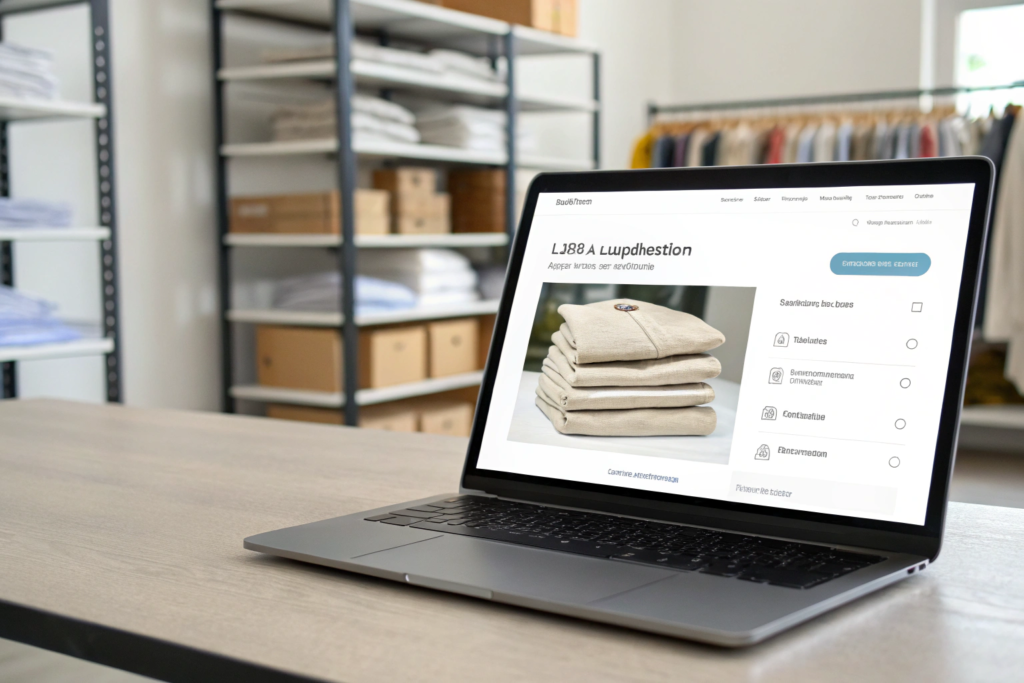
Think of B-Stock as eBay for pallets of inventory, but the buyers are all vetted businesses, not consumers. This is where major retailers like Macy's and Nordstrom send their returns and overstock. You can do the same as a small brand.
Here is the process:
- Listing Creation: You create a manifest. You take photos of the actual pallet or lot. You describe the condition (e.g., "New with Tags, Shelf Pulls, Assorted Sizes").
- Auction or Fixed Price: You set a reserve price or let the market bid it up over a 3-5 day period.
- Buyer Pays Freight: Usually, the buyer arranges and pays for freight. This is crucial. You are not eating the shipping cost.
- Payment Released: The marketplace holds the funds and releases them to you after the buyer confirms receipt.
The advantage here is Market Discovery. You might think your 800 units of leggings are worth $2 each. But if there is a fitness boutique liquidator who needs exactly that color for a bundle, they might bid $4 each. The competitive bidding drives up the recovery rate.
A client of ours used B-Stock for the first time last fall. They had 1,200 units of a women's blouse that just didn't sell through. They were quoted $0.80 per unit by a local jobber. They listed it on B-Stock with a clear manifest and good photos. The lot sold for $2.40 per unit. That is a 3x improvement. It took about 2 hours of work to create the listing and 30 minutes to coordinate the Bill of Lading for the truck. That is a high return on effort.
What Does a "Jobber" Look for and How Do You Find a Good One?
A jobber is a professional middleman. They buy excess inventory from brands and sell it to smaller retailers, dollar stores, or export markets. They are not interested in your brand story. They are interested in the math.
What a Jobber Needs to See:
- Assortment Integrity: Is it a full size run? Or is it 90% Small and Medium? Broken sizes are worth less.
- Seasonality: Are they coats in July? Or swimwear in December? If so, they will factor in 6 months of storage cost.
- Packaging: Is it in polybags? Or is it loose and dusty? If they have to re-bag it, that is a cost deduction.
Finding a good jobber is about networking. You do not want to just google "clothing jobber" and send an email. You will get lowball offers from bottom feeders.
The best way is to ask your factory. We at Shanghai Fumao have a network of trusted jobbers who specialize in specific categories and geographies. We know the guy in Los Angeles who only buys denim. We know the woman in New Jersey who specializes in kids' wear for the Caribbean market.
Here is a simple table of jobber types:
| Jobber Type | Best For | Typical Recovery Rate (% of COGS) |
|---|---|---|
| Local Generalist | Small lots (<500 units) mixed categories | 5-15% |
| Category Specialist | 500+ units of one category (e.g., all sweaters) | 15-30% |
| Export Specialist | Large lots (1000+ units) for Africa/South America | 10-25% (but fast cleanout) |
| Sample Sale Liquidator | High-end designer overstock | 30-50% (requires high perceived value) |
If you have 500 units of a decent quality basic tee, a Category Specialist might pay $1.50 per shirt. A Generalist might offer $0.50. The difference is the specialist knows exactly which of their customers needs that specific item.
Is Donating Inventory a Smarter Financial Move Than Deep Discounting?
Sometimes the numbers just don't work. The cost of labor to pick, pack, and ship a $2 item is more than the $2 you get back. Or maybe you just want to do good and clear the space immediately. Donation is an option. But if you just drop the clothes off at Goodwill and take a blurry photo for your records, you are leaving money on the table in the form of tax deductions you might not be able to claim.
Donating inventory can be a smarter financial move than deep discounting when the cost of liquidation (storage fees, labor, platform commissions) exceeds the net cash recovery. However, to maximize the benefit, you must donate to a qualified 501(c)(3) organization, obtain a detailed receipt listing the fair market value of the goods, and understand that for C-Corps, the deduction is often limited to the lower of cost basis or fair market value, with special enhanced deductions available for "qualified contributions."
How Do You Properly Document a Donation for IRS Section 170(e)(3)?
This is where many small brands mess up. They think they can deduct the retail price of the donated goods. "I donated 100 jackets worth $29,500 retail!" That is not how it works.
For most businesses, the tax deduction for donated inventory is limited to the Cost Basis (what you paid for it). If the jacket cost you $12 to make, you can deduct $12 per unit. You cannot deduct $295.
However, there is an important exception under IRS Section 170(e)(3) . If you donate the inventory to a qualified charity that uses the goods specifically for the care of the ill, the needy, or infants, you may be eligible for an Enhanced Deduction.
This enhanced deduction is calculated as:
(Cost Basis) + (50% of [Fair Market Value - Cost Basis])
Example:
- You donate 100 jackets to a homeless shelter.
- Your Cost Basis: $12.00 each.
- Fair Market Value (FMV): $60.00 each (the price you sell to wholesale accounts).
- Regular Deduction: $12.00 x 100 = $1,200.
- Enhanced Deduction: $12.00 + (0.50 * ($60 - $12)) = $12.00 + $24.00 = $36.00 per unit.
- Total Deduction: $3,600.
That is a huge difference. It often makes the tax savings from donation greater than the cash you would net from a jobber.
Documentation Checklist for IRS Compliance:
- Receipt from Charity: Must be on their letterhead, dated, with description of goods and statement that they are for the care of the needy.
- Cost Records: You must have the invoice from the factory showing the $12.00 cost.
- FMV Justification: You need a wholesale price list showing the $60.00 price.
I am not a CPA. Do not take this as final tax advice. But I have seen this strategy save our clients thousands of dollars. The key is the type of charity. Donating to a museum fundraising auction does not qualify for the enhanced deduction. Donating to a shelter or a disaster relief organization does. You need to check with your accountant to see if this applies to your business structure.
When Does the Cost of Storage Exceed the Value of the Goods?
This is a simple math exercise that many brand owners avoid because it forces them to face the loss. But holding onto deadstock is not free. It costs money every single month.
Calculation:
- You have 1,000 t-shirts. Cost basis $5.00. Total inventory value $5,000.
- Storage fee at 3PL: $0.45 per unit per month.
- Monthly Cost: $450.
- Annual Cost: $5,400.
After just 11 months, you have paid more in storage fees than the shirts cost to make. And the shirts are not getting more valuable. They are getting dusty. The styles are getting older.
The break-even point on holding vs. liquidating is usually around 6-9 months. If the goods have been sitting for 9 months with no movement, the cost of holding them for another year is almost always higher than the cash you can get from a liquidator today.
We advise our clients to set a Hard Deadline. If a style is not re-ordered within 180 days of the initial delivery, we trigger a discussion about liquidation. We would rather see the brand take a small loss now and use that cash to invest in a new, fresh style that is selling well. Cash flow is oxygen. Deadstock is carbon monoxide. You need to vent it out before it suffocates the business.
How Can You Prevent Excess Inventory in Your Next Production Run?
You have liquidated the problem. You have cash in hand. Now let's make sure you do not end up back in this same position six months from now. Prevention is better than cure. And with the right factory partner, you can structure your production to avoid the deadstock pileup in the first place.
Preventing excess inventory requires a shift from bulk forecasting to flow production. This involves three key strategies: First, using Greige Reservation to hold raw fabric without committing to finished goods. Second, utilizing Split Shipments to phase deliveries throughout the season. Third, establishing a Re-Order Agility Program with your factory that guarantees a 4-week turnaround on proven best-sellers, allowing you to chase demand rather than pre-buy it.
What Is a "Split Shipment" and How Does It Reduce Your Risk?
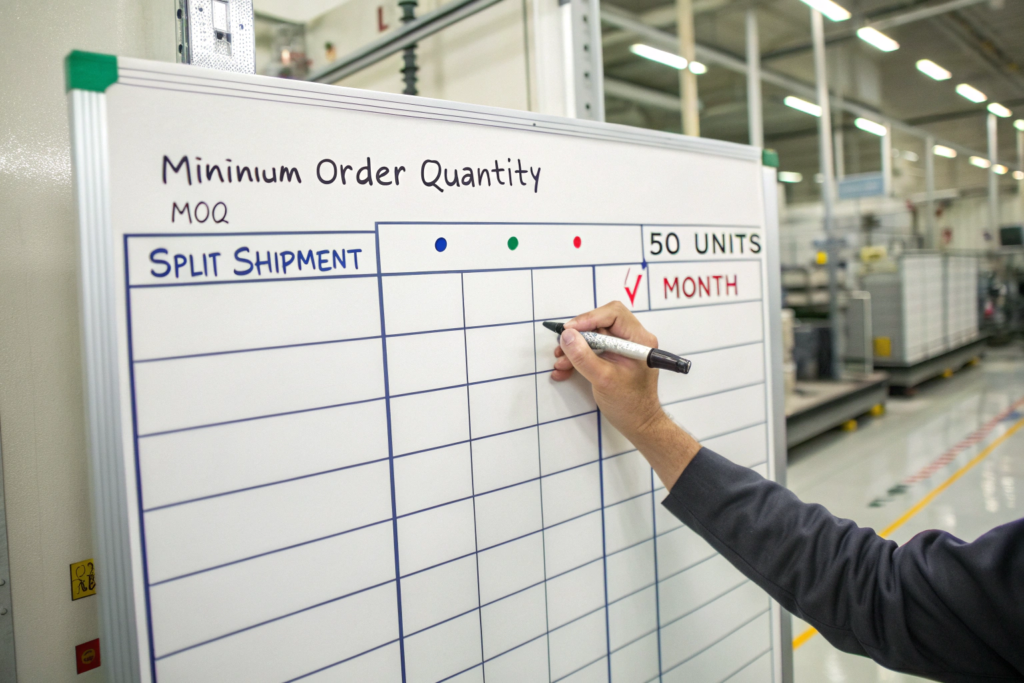
Most brands think in terms of one delivery. "I need 1,000 hoodies by September 1st." They get all 1,000 on September 1st. They sell 400 in September, 300 in October, and then the weather turns warm in November. They are stuck with 300 units.
A Split Shipment changes the delivery schedule. Instead of 1,000 units on Sept 1, you ask for:
- 400 units on Sept 1 (Initial Fill).
- 300 units on Oct 1 (Replenishment #1).
- 300 units on Nov 1 (Replenishment #2).
The Benefits:
- Warehouse Cost: You are paying for storage of 400 units for the first month, not 1,000.
- Demand Sensing: By October 1st, you know if the hoodie is a hit or a miss. If it is a hit, you confirm the November shipment. If it is a miss, you can cancel or reduce the November shipment.
- Factory Relationship: Factories actually like split shipments if planned in advance. It allows them to level-load their production. They can make the 400 units now and slot the 300 units into a gap next month.
We implemented this for a client in Portland with their rain jacket program. They used to get one big shipment in September. If it was a dry fall, they were stuck. Now they get 40% in September, 30% in October, and 30% in November. The November order is "at risk"—meaning they can adjust the color mix or cancel it entirely based on October sales data. This flexibility costs about 3% more in unit price to cover the factory's scheduling complexity. But the reduction in end-of-season markdowns saves them 15-20% on the bottom line. It is a net win.
At Shanghai Fumao, we build these split shipment schedules into the initial PO. We call it Program Planning. It treats your brand like a partner with ongoing needs, not a one-off transaction.
How Can a "Re-Order Agility" Program Keep Best-Sellers in Stock?
You have a style that explodes. You sold out in two weeks. You need 300 more units now. You call the factory. They say, "Sorry, 8 week lead time." By the time the re-order arrives, the buzz is gone.
A Re-Order Agility Program is a pre-negotiated agreement with your factory.
Here is how we structure it:
- Fabric Reservation: You commit to buying the greige fabric for the item upfront. You pay for the fabric. It sits on our shelf.
- Capacity Hold: We agree to hold 10% of our monthly sewing capacity for "re-order slots."
- Trigger: When you sell out, you email "RE-ORDER: Style XYZ, 300 units."
- Execution: We pull the reserved fabric, dye it in the next available batch (1 week), and cut/sew it in the reserved capacity slot (2 weeks).
- Delivery: You have the goods in 4 weeks instead of 8.
This program requires trust and a small financial commitment upfront for the fabric. But it transforms your supply chain from a slow-moving barge to a speedboat. You can chase the trend. You can keep your best-seller in stock during the peak of the season.
The alternative is to guess demand upfront, over-order to be "safe," and then end up in this article reading about liquidation strategies. The choice is yours.
Conclusion
Liquidating excess inventory is not a sign of failure. It is a necessary business function, like paying taxes or renewing a lease. The key is to approach it with the same strategic intent you bring to a new product launch. You started this article looking at a pile of unwanted stock with dread. Now you have a tiered action plan.
We explored how to protect your brand image by using private flash sales and discreet B2B channels, avoiding the public markdown race to the bottom. We looked at the mechanics of online liquidation marketplaces and jobbers, giving you specific benchmarks for what to expect in terms of recovery rates. We demystified the tax implications of donation, showing how a gift to a qualified charity can sometimes yield a better net result than a lowball cash offer. And most importantly, we looked forward, outlining how split shipments and re-order agility programs can prevent the pileup from happening in the first place.
The goal is not to be perfect with every buy. The goal is to have a system that turns your mistakes (or your over-cuts) back into working capital as quickly and profitably as possible. Deadstock is just inventory that hasn't found the right home yet. Sometimes that home is a private sale to your VIP list. Sometimes it is a container ship headed to South America. And sometimes it is a homeless shelter that needs warm coats.
If you are struggling with a specific lot of inventory and you need a partner to help you think through the options—or if you want to set up a production plan that prevents this problem next season—we are here to help. We see the whole picture, from cutting table to warehouse shelf.
Reach out to our Business Director, Elaine. She can connect you with the right contacts in our network for liquidation or help you structure a smarter PO for your next run. Email her at elaine@fumaoclothing.com. Let's clean up that warehouse and free up your cash for what comes next with Shanghai Fumao.