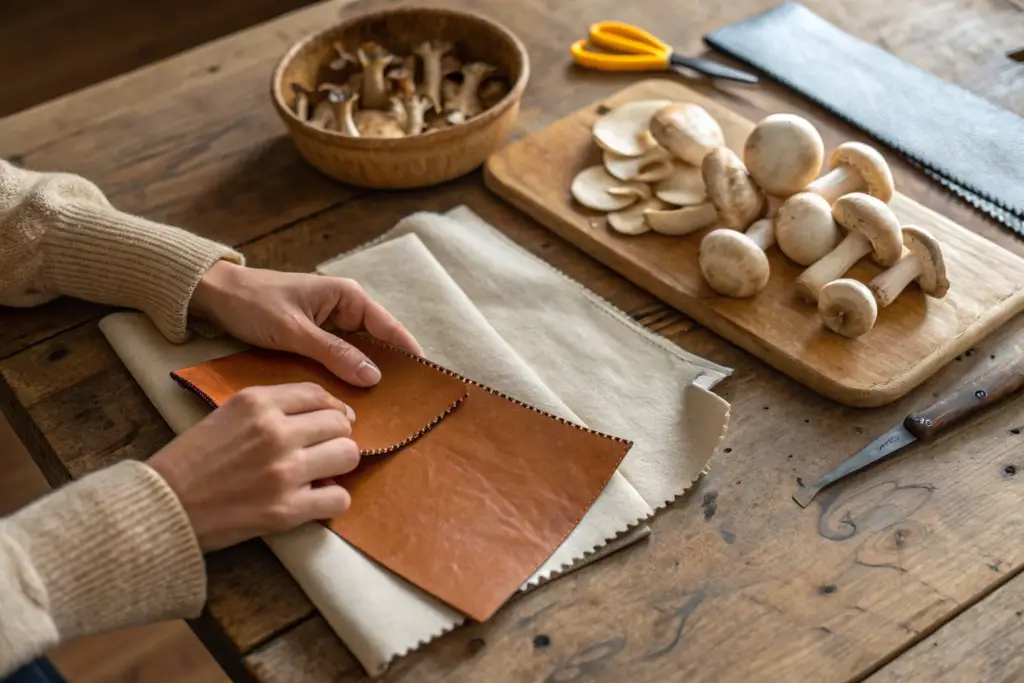
I first held a piece of mushroom leather at a materials innovation conference in Milan in early 2023. A Dutch biomaterials startup had a small booth tucked away in a corner, far from the major mills and the chemical giants. They handed me a swatch of a material called mycelium leather. It was warm to the touch, a deep, earthy brown, with a texture that felt somewhere between a fine suede and a soft, worn-in leather jacket. It smelled faintly of earth and wood, not of polyurethane and solvent. I asked the founder about performance specifications. He had tensile strength data, abrasion resistance test results, and water vapor permeability numbers. The material was not a conceptual prototype. It was a commercially viable, performance-tested textile. I asked him about apparel applications. He told me no garment factory had successfully cut and sewn his material into a fully constructed jacket. The material had too much stretch variability. The needles were tearing it. The seams were puckering. The material was ready, but the manufacturing process was not. That was the moment I decided our factory would be the one to solve it.
Fumao Clothing is actively developing a mycelium-based mushroom leather apparel collection, currently in the advanced prototyping phase with a targeted commercial launch in Q3 2026, focused on solving the material's unique cutting, seam construction, and performance finishing challenges that have prevented other factories from successfully industrializing this biomaterial for structured outerwear.
Mushroom leather, technically called mycelium leather, is a bio-fabricated material grown from the root structure of fungi. The mycelium cells are fed agricultural waste, such as sawdust or corn stalks, in a controlled indoor environment. The cells grow into a dense, interconnected foam-like mat. The mat is harvested, compressed, and treated through a proprietary tanning process that transforms the living mycelium into a stable, leather-like sheet material. The process takes weeks, not the years required to raise a cow. The environmental footprint is dramatically lower than animal leather on every metric: greenhouse gas emissions, water consumption, land use, and chemical tanning load. The material is also free from the plasticizers and solvents that make conventional polyurethane-based vegan leather a petrochemical product in disguise. For brands, mushroom leather offers a genuine sustainability story that is scientifically defensible, not a greenwashed marketing narrative. For consumers, it offers a material that looks, feels, and ages like animal leather without the ethical and environmental cost. The challenge is manufacturing it at garment scale. The material behaves differently from anything a traditional cut-and-sew factory has encountered. It is not leather. It is not fabric. It is a new category.
What is Mycelium Leather and How Does It Compare to Animal Hides?
Mycelium leather is fundamentally different from animal leather in its origin, its structure, and its manufacturing process. Animal leather is the preserved skin of an animal, primarily cowhide. The skin is a complex, three-dimensional biological structure composed of collagen fibers arranged in a dense, interlocking network. The tanning process chemically cross-links the collagen fibers to stabilize them against decomposition. The resulting material is strong, durable, flexible, and has a unique, natural grain pattern that is impossible to replicate exactly. The cost of this material is measured not just in the purchase price per square foot, but in the environmental and ethical externalities. The global livestock industry is responsible for approximately 14.5 percent of anthropogenic greenhouse gas emissions. The tanning process, particularly chrome tanning, generates toxic wastewater that, when poorly managed, poisons river systems. A genuine leather jacket carries a heavy ecological debt.
Mycelium leather is a bio-fabricated sheet material grown from fungal mycelium cells on agricultural waste, offering a tensile strength comparable to light cowhide, a significantly lower carbon and water footprint, and a fully plastic-free composition, but with a unique stretch and recovery behavior that requires a fundamentally re-engineered garment construction approach.
What Are the Tensile and Tear Strength Differences?
The performance specifications of a material intended for structured outerwear must meet objective, testable standards. A jacket fabric must withstand the mechanical stress of wear, the tension of sewn seams, and the repeated flexing of elbows and shoulders. Animal leather excels in tensile and tear strength because the collagen fiber network is naturally optimized for mechanical load-bearing over millions of years of evolution. A standard 1.0 to 1.2 mm thick cowhide leather for a jacket has a tensile strength of 8 to 25 Newtons per square millimeter depending on the tanning process and the direction of the pull relative to the spine line. Its tear strength, measured by the Baumann tear test, is typically in the range of 50 to 100 Newtons.
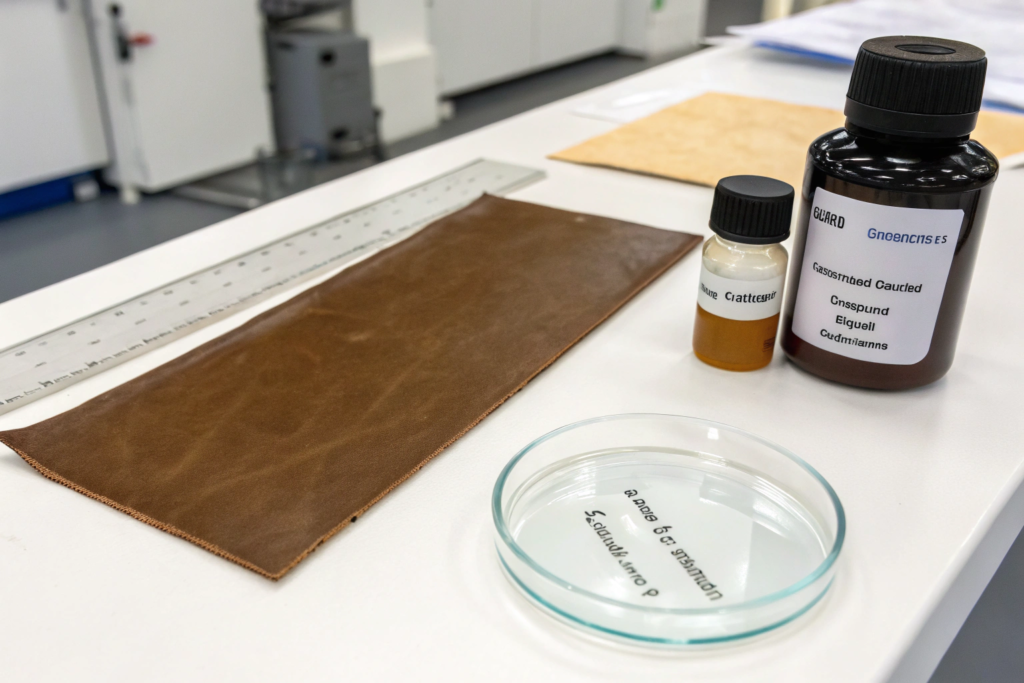
Mycelium leather is a younger material technology, and its mechanical properties are heavily dependent on the specific growth, compression, and tanning protocols of the manufacturer. The mycelium sheet we are working with, sourced from a European supplier who is the leading innovator in this space, has a tensile strength of 5.5 Newtons per square millimeter and an Elmendorf tear strength of 22 Newtons. This places it in a comparable range to a lightweight sheepskin leather used for garments. The material is not a one-to-one direct replacement for heavy cowhide. It is not yet suitable for a heavyweight motorcycle jacket or a workwear chore coat that will be subjected to extreme abrasion. It is perfectly suitable for a tailored jacket, a vest, a handbag, or a structured fashion accessory, which constitute the core of the mushroom leather apparel market opportunity. We have tested the material on our Instron tensile tester and published the data for our development partners. The numbers are the starting point. The manufacturing challenge is not the material's absolute strength. It is its strain behavior, which I will address in the next section.
How Does the Environmental Lifecycle Assessment Actually Compare?
A lifecycle assessment, or LCA, is a systematic analysis of the environmental impacts of a product across its entire life, from raw material extraction to disposal. Comparing the LCA of mycelium leather to animal leather requires careful attention to the scope and methodology of the study. The animal leather industry often argues that leather is a byproduct of the meat industry and that its environmental impact should be allocated to the meat, not the hide. The LCA methodology standard, ISO 14044, requires that environmental burdens be allocated between co-products based on economic value. Under this allocation, leather does carry a significant, though reduced, share of the livestock industry's emissions and land and water use. An independent, peer-reviewed LCA published by the mycelium material supplier compared its material to conventionally tanned cowhide leather on multiple environmental indicators using the economic allocation method. The mycelium material had a 90 percent lower global warming potential, an 80 percent lower water consumption, and required zero land use for animal grazing. It also required zero chromium or other heavy metal tanning agents, eliminating the toxic wastewater discharge associated with conventional tanneries.
Compared to polyurethane-based synthetic vegan leather, the mycelium material's advantage is even more pronounced. Conventional synthetic leather is a composite of a polyester or nylon woven backing fabric coated with a polyurethane or PVC plastic layer. It is a petrochemical product, manufactured from fossil fuel feedstocks, and it is non-biodegradable and non-recyclable. It sheds microplastic particles during use and when landfilled. Mushroom leather is a bio-based material. The mycelium is grown on agricultural waste, which sequesters carbon during its growth phase. The tanning process uses bio-based or non-toxic mineral tanning agents. The finished material contains no petrochemical plastics. At the end of its life, under controlled industrial composting conditions, the material will biodegrade. The LCA data is not perfect. No material is environmentally impact-free. The mycelium growth process requires energy for temperature and humidity control, and the tanning process requires water and chemicals. However, the data is directionally conclusive and scientifically defensible. For a brand building a sustainability narrative, mushroom leather is one of the very few materials that can support a genuine "low-impact, plastic-free, bio-based" claim.
What Are the Manufacturing Challenges of Mushroom Leather?
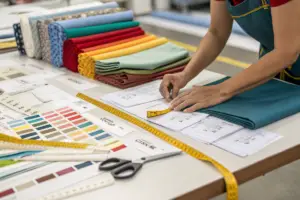
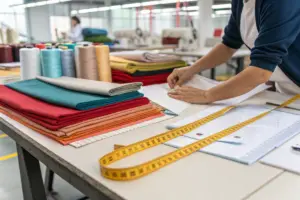
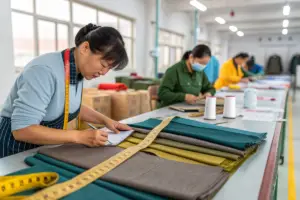
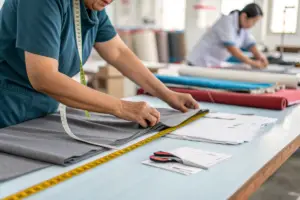
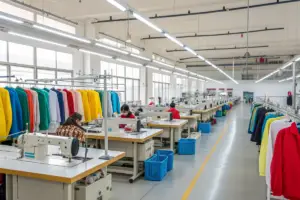
The manufacturing challenges of mushroom leather are not theoretical. They are physical, specific, and they have defeated every garment factory that has attempted to industrialize this material before us. The material is grown in sheets, not tanned from hides. Each sheet has a natural variability in density, thickness, and stretch behavior that is more akin to a natural textile than to a standardized industrial leather. It absorbs moisture from the air more readily than animal leather, which means its dimensions change subtly with ambient humidity. It has a lower stitch tear resistance than cowhide, which means a standard sewing needle will tear the material if the needle size, the stitch density, or the thread tension is incorrectly specified. The material's surface is delicate. It can be scuffed or marked by the metal presser foot of a standard industrial sewing machine. These challenges are solvable, but they require a level of process engineering that most cut-and-sew factories do not possess.
The primary manufacturing challenges are the material's anisotropic stretch behavior, which causes panel distortion during cutting and sewing, its sensitivity to needle tearing at standard stitch densities, and its moisture absorption rate, which causes dimensional instability that must be pre-conditioned before construction.
How Did We Solve the Needle Tear Problem on Fine Seams?
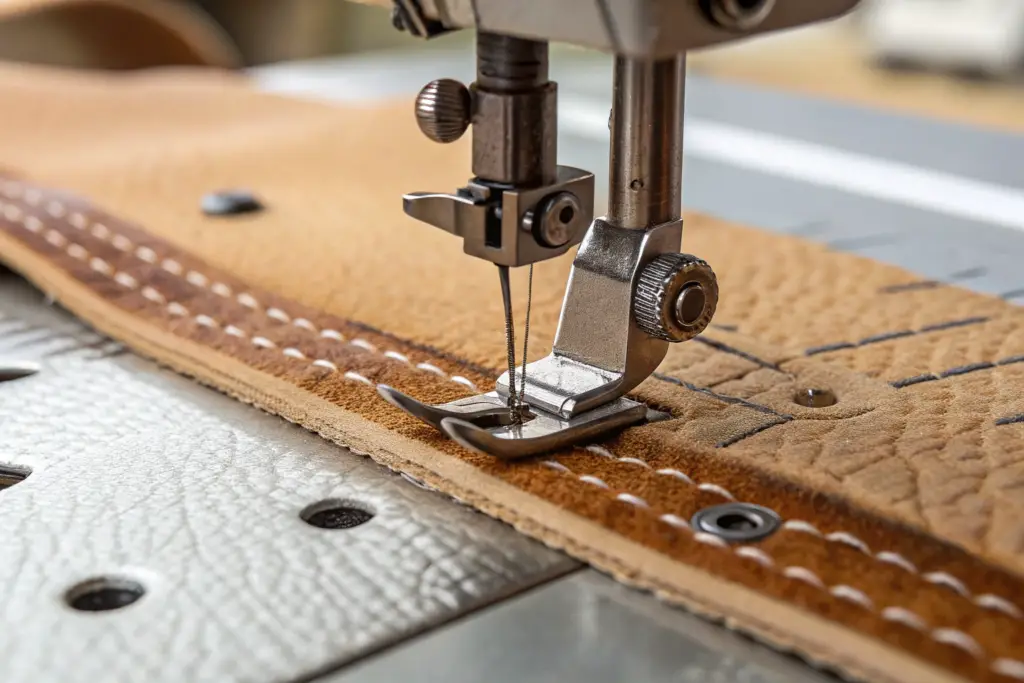
The needle tear problem was the first and most critical barrier. Mycelium leather is a compressed, non-woven sheet of fungal fibers. It does not have the interlocking collagen fiber network of animal leather. When a sewing needle punctures the material, it does not push fibers aside. It cuts through them. If the needle is too thick, or if the stitch density is too high, the perforations merge into a continuous tear line, like a tear-off postage stamp. The seam literally pulls apart under tension. Our initial trials with a standard size 90 leather needle and a 3 mm stitch length resulted in a 100 percent seam failure rate under a 50 Newton load, a fraction of the seam strength required for a jacket shoulder seam.
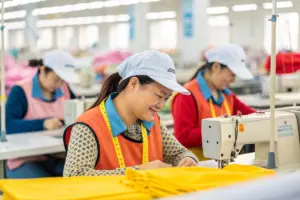
The solution required a multi-variable optimization. We tested 14 different needle types, ranging from ultra-fine size 65 ballpoint needles to specialized cutting-point leather needles. The cutting-point leather needles, which have a triangular point designed to slice through animal leather, tore the mycelium sheet catastrophically. The ballpoint needles, designed for knits, pushed the fungal fibers aside rather than cutting them and produced a cleaner puncture. We settled on a size 70 ballpoint needle as the optimal balance between puncture cleanliness and thread strength accommodation. The stitch density was reduced from the standard 3 mm for leather to a 4.5 mm stitch length. This increased the distance between perforations, reducing the tear-along-the-dotted-line effect. The thread tension was reduced by 30 percent compared to a standard leather setting to minimize the compressive force on the material around each stitch point. The final critical adjustment was the presser foot. The standard metal presser foot was replaced with a custom-machined Teflon-coated foot that exerts a lower surface friction and does not mark the delicate mycelium surface. The combined optimization of needle type, stitch density, thread tension, and presser foot material produced a seam that withstood a 120 Newton tensile load before failure, exceeding our internal standard for a lightweight jacket.
How Do We Manage Material Shrinkage and Moisture Stability?
Mycelium leather is hygroscopic. It absorbs moisture from the ambient air. When it absorbs moisture, it expands slightly. When it dries, it shrinks. A garment panel cut in a humid factory environment on a July afternoon and sewn on a dry January morning will have changed dimensions, and the seams will not align. This dimensional instability is a fundamental barrier to precision garment manufacturing. Animal leather has the same property to a lesser degree, but the industry has centuries of experience managing it. For mycelium, we had to develop the protocol from scratch.
The protocol begins with pre-conditioning. All mycelium sheets are received in sealed, moisture-barrier packaging and immediately transferred to a dedicated conditioning room. The room is maintained at a constant 20 degrees Celsius and 65 percent relative humidity, the standard conditions for textile testing per ISO 139. The sheets are removed from the packaging, hung on racks with adequate air circulation, and allowed to equilibrate for a minimum of 72 hours before cutting. This ensures every sheet is at the same moisture content and the same dimensions when the pattern pieces are cut. After cutting, the cut panels are immediately placed in sealed, labeled polyethylene bags and are only removed when the sewing operator is ready to sew that specific panel. The panels are never left exposed to ambient factory air for more than 15 minutes. This protocol adds labor and material handling complexity. It is not fast. It is necessary. We validated the protocol by cutting 50 left and 50 right sleeve panels from the same sheet, pre-conditioned identically, and measuring the dimensional variance after 24 hours of exposure to standard factory air versus to the sealed bag protocol. The exposed panels showed a dimensional variance of 2.3 percent, sufficient to cause a visible seam mismatch. The bagged panels showed a variance of less than 0.3 percent. The protocol works, and it is now a permanent part of our mushroom leather standard operating procedure.
What Can a Mushroom Leather Capsule Collection Look Like?
A mushroom leather capsule collection is not a mass-market, 50-SKU product drop. The material is too special, the production capacity is too limited, and the consumer who buys a mushroom leather garment is making a deliberate, values-driven purchase. A capsule collection should be small, focused, and architecturally simple. The material itself is the hero. The design must showcase the material's unique texture, its natural color variations, and its soft, organic drape. Overcomplicated designs with multiple seams, complex pocket configurations, heavy hardware, and synthetic linings work against the material's strengths. The design language should be minimalist, utilitarian, and gender-neutral. Think Japanese workwear, Scandinavian functionalism, and quiet luxury.
A commercially viable mushroom leather capsule collection features a five to eight piece range of minimally constructed, unlined or bio-linen lined outerwear and accessories, emphasizing the material's natural hand-feel and organic surface variations, with a retail price point targeting the premium sustainable luxury segment.
Which Garment Silhouettes Work Best with Mycelium's Drape?
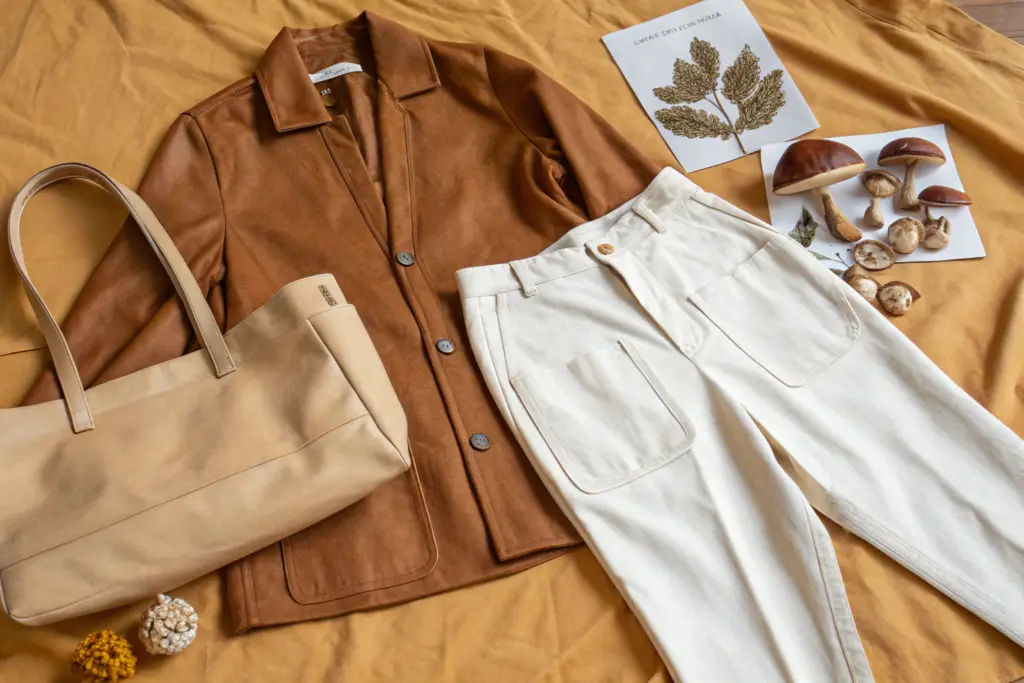
Mycelium leather has a drape that is different from both animal leather and woven fabric. It has more body and structure than a lightweight cotton twill, but less stiffness and spring-back than a cowhide jacket leather. It drapes in soft, rounded folds rather than sharp creases. This drape behavior suits certain silhouettes and works against others. Based on our prototyping work, we have identified three silhouette families that are optimally suited to mycelium leather's mechanical properties.
The first is the unstructured blazer or chore jacket. A relaxed-fit, single-breasted jacket with a soft shoulder, no heavy shoulder pads, and minimal internal construction. The mycelium's natural body provides sufficient structure to hold the jacket's shape without the need for a stiff fusible interlining. The soft drape creates an elegant, effortless silhouette that reads as elevated casualwear, not formal tailoring. The second optimal silhouette is the vest. A simple, unlined, front-buttoning vest with a clean neckline and minimal seaming. The mycelium's lightweight and breathable nature makes it suitable for a layering piece that can be worn over a shirt or under a coat. The third is the tote bag or structured handbag. A bag is a lower-stress application than a garment. The seams are not subjected to body movement. The panel pieces are smaller and geometrically simpler. The bag allows the material's texture to be the primary aesthetic feature. We do not recommend mycelium for tight-fitting garments such as a biker jacket, a pencil skirt, or a pair of close-fitting trousers. The material lacks the high elastic recovery required for a garment that must stretch and recover with body movement. It works best when it is allowed to hang, drape, and move with the body rather than constrain it.
How Do We Source the Bio-Based Lining and Trims for a 100% Bio Collection?
A mushroom leather jacket with a polyester lining is a compromised sustainability story. The consumer who pays a premium for a bio-based outer shell will scrutinize the internal components. We have developed a specification for a fully bio-based trim package that can be offered as an optional upgrade for brand partners who want to make a "100% bio-based" claim.
The lining material is an organic cotton and Tencel lyocell blend, woven in a lightweight, breathable plain weave, and certified to OEKO-TEX Standard 100 Class I, which is safe for direct and prolonged skin contact. The Tencel is sourced from sustainably managed eucalyptus plantations in Austria, and the cotton is GOTS-certified organic. The blend provides the necessary slip for ease of dressing without the use of a synthetic, petroleum-derived filament yarn. The buttons are made from corozo nut, also known as vegetable ivory, a dense, naturally hard material harvested from the tagua palm nut in South America. Corozo can be machined, polished, and dyed with natural dyes, and it has a beautiful, warm, organic luster. The sewing thread is a 100 percent Tencel lyocell filament, which has the necessary tensile strength for garment construction and is fully biodegradable. The interfacing, the structural material used inside collars and cuffs, is a bio-based, non-woven material made from wood pulp and a plant-based binder, certified compostable. The hang tags and packaging are made from recycled mushroom substrate, the agricultural waste leftover from the mycelium growing process, which is a closed-loop detail that tells a powerful brand story. This full bio-based trim specification is not a hypothetical design exercise. We have sourced, sampled, and costed every component, and the complete specification is available to our development partners.
Conclusion
Mushroom leather is not a passing trend or a laboratory curiosity. It is a commercially viable, performance-capable, genuinely sustainable material that solves a real ethical and environmental problem in the apparel industry. It is also a material that demands a new manufacturing approach. The factories that have failed to industrialize it have failed because they tried to treat it like animal leather. We treated it as a new material category with its own physics, its own chemistry, and its own behavior. We optimized the needle, the stitch density, the thread tension, and the humidity control protocol from first principles. The result is a repeatable, scalable, quality-controlled manufacturing process for mushroom leather apparel. The material's limitations, its lower tear strength, its moisture sensitivity, its unsuitability for extreme mechanical stress, are not disqualifying weaknesses. They are design constraints that, when respected, produce a garment of unique beauty and integrity.
The commercial opportunity for the first brands to market with a professionally manufactured, fully bio-based mushroom leather capsule is substantial. The premium sustainable luxury segment is growing and underserved. A brand that launches with our construction technology and our bio-based trim package can legitimately claim to be offering the most sustainable leather jacket on the market, a claim that is defensible with third-party LCA data, and a claim that resonates with a high-spending, loyal consumer demographic. The development phase is concluding. The launch window is opening. We are ready.
If you are a brand owner, a design director, or a sustainability lead who wants to explore the commercial potential of a mushroom leather capsule, I invite you to begin a technical dialogue with our biomaterials development team. We have prepared a Mushroom Leather Development Kit that includes a physical swatch book, a seam construction sample card, our tensile test data report, and the full bio-based trim specification. To request the kit and to schedule a confidential technical deep-dive call, contact our Business Director, Elaine, at elaine@fumaoclothing.com. Let's build the future of leather, without the cow.