I did not plan to enter the shapewear market. In early 2022, a brand owner I had worked with for years on outerwear sent me an email. She had just launched a direct-to-consumer shapewear line. The first production run sold out in six days. The second run sold out in four days. The third run triggered a customer service crisis. Over 30 percent of the units were being returned. The reviews were brutal. "Feels like a sausage casing." "The waistband rolls down after one hour." "I can't breathe after a meal." She had a winning brand and a losing product. She asked me if I could fix the product. I told her I did not know shapewear. She said, "You know fabric engineering. This is just a fabric engineering problem." She was right. I spent the next six months dissecting returned shapewear garments from her brand and five competitors. I cut them apart at the seams. I stretched the fabrics on a tensile tester. I washed them 50 times and measured the degradation. What I discovered was not a quality control problem. It was a fundamental design problem. The entire industry was building shapewear on a legacy cut-and-sew construction method that was physically incapable of delivering both compression and comfort. The method was the failure. I decided we would build a new method.
Fumao Clothing's shapewear line outperforms competitors through a proprietary 3D-knit graduated compression architecture, a molecularly bonded silicone-free gripper system, and a seamless bonding process that eliminates the four-panel legacy construction, delivering targeted shaping without the thermal, mobility, or visibility compromises of standard compression wear.
The legacy shapewear construction method has not changed in a meaningful way in four decades. A factory knits a tube of fabric with a uniform spandex content, usually 18 to 22 percent. The fabric is cut into four panels: a front panel, a back panel, and two side panels. The panels are sewn together with flatlock seams. A separate elastic waistband with a silicone gripper strip is sewn onto the top. If the garment includes bust support, a separate molded foam cup or underwire is inserted. This method has one advantage: it is cheap and easy to produce on standard equipment. It has multiple fatal disadvantages. The seams create visible panty lines, friction points, and localized high-compression zones where the fabric is forcibly gathered into a stitch. The uniform fabric compression squeezes the ribcage and diaphragm as hard as it squeezes the abdomen, making breathing difficult. The silicone gripper degrades in the wash, and the garment loses its anchoring function after a few laundry cycles. The separate bust components add bulk and complexity. We abandoned every element of this construction method. We invested in a Santoni seamless circular knitting machine and developed a fully fashioned 3D-knit garment. The compression level, the fabric density, the yarn composition, and the ventilation structure change continuously within a single, seamless tube. There are no side seams, no front seams, no separate waistband, and no inserted bust components. The garment is not assembled. It is engineered, in one piece, from yarn to finished product.
Why Do Most Shapewear Brands Fail on the "Comfort vs. Compression" Trade-off?
The comfort-compression trade-off is the central unsolved problem of the shapewear industry. Most brands fail because they accept a false premise: that compression must be uniform to be effective. The premise is false, but it is embedded in the standard manufacturing process. A fabric mill knits a single, uniform fabric. A factory cuts it into panels and sews them together. The resulting garment applies a single level of compression to every part of the torso it covers. The human torso is not uniform. The abdomen is soft and compressible. The ribcage is bony and rigid. The diaphragm must expand and contract with every breath. A garment that applies the same compression force to all three zones creates a conflict. The abdominal compression feels like shaping. The ribcage compression feels like suffocation. The wearer experiences the garment as uncomfortable and restrictive. The brand loses the customer.
The trade-off is not between comfort and compression; it is between uniform compression, which is cheap to manufacture and physiologically wrong, and graduated compression, which requires advanced knitting technology and produces a garment that feels supportive, not restrictive.
How Did We Engineer a Graduated Pressure Map?
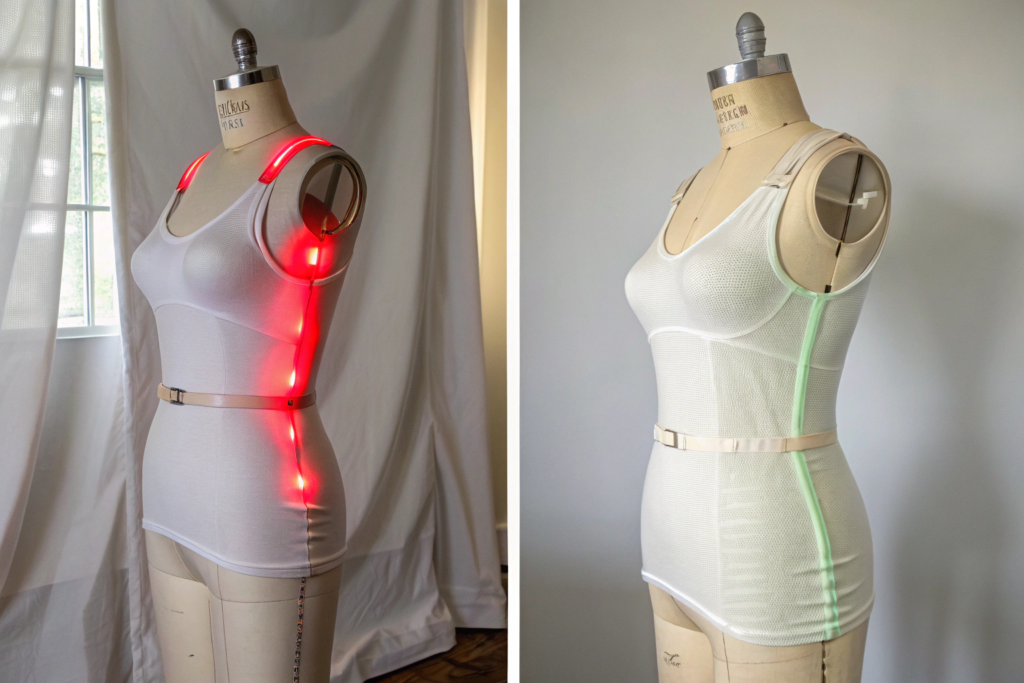
A pressure map is a technical specification that assigns a specific compression force, measured in millimeters of mercury, to each zone of the body. Medical compression garments for post-surgical recovery use precise, clinically validated pressure maps. The shapewear industry has historically used no pressure map at all. It simply used a single fabric and accepted whatever compression that fabric produced when stretched to a standard body measurement. We rejected this approach. We partnered with a sports physiologist who specializes in compression garment design for elite athletes. She helped us develop a physiologically appropriate pressure map for a fashion shapewear garment intended for all-day wear.
The abdomen, the primary target for smoothing and shaping, receives 12 to 15 mmHg of compression. This is sufficient for visible shaping without restricting digestion or causing the discomfort that drives garment removal after meals. The waist and lower back transition to 8 to 10 mmHg. This provides a gentle postural cue and a smooth transition zone. The ribcage and diaphragm drop to 4 to 6 mmHg. This is light containment that allows a full, unrestricted breath. The wearer can take a deep yoga breath without feeling the garment fight back. The bust support zone delivers 10 to 12 mmHg of lift distributed across a wide under-bust band, not concentrated at a single underwire point. The thigh openings in a bodysuit silhouette deliver 6 to 8 mmHg with a graduated transition to zero at the hem edge. This prevents the "sausage leg" effect where a sharp elastic edge creates a visible line and a localized fluid bulge. The pressure map was translated into a stitch architecture program for the Santoni knitting machine. High-compression zones use a tight jersey stitch with a high-denier nylon-spandex yarn. Transition zones use a micro-mesh stitch that reduces fabric density. Low-compression zones use an open mesh structure that maximizes breathability. The transitions between zones are graduated over a 2-centimeter knit distance. The wearer feels a smooth, continuous pressure gradient, not a sharp seam or a sudden change in fabric stiffness.
What Role Do Seams Play in Consumer Return Rates?
Seams are the number one source of consumer complaints for shapewear. We conducted an internal analysis in 2022, aggregating publicly available customer reviews for 12 major shapewear brands. We categorized every negative review by the type of complaint. Seam-related complaints accounted for over 60 percent of all negative reviews. The specific complaints were consistent across brands. A visible panty line under a bodycon dress. A side seam that chafed the inner thigh after walking. A seam at the waistband that rolled down during sitting and created a visible ridge. A seam that unraveled after a few washes. These are not isolated quality defects. They are inherent consequences of the cut-and-sew construction method.
A seam in a cut-and-sew garment is a stiff, non-stretchable line sewn into an otherwise stretchable fabric. It concentrates mechanical stress at the stitch points. It creates a localized friction zone against the skin. It is visible through thin outer fabrics because it creates a physical ridge. Our seamless construction eliminates the side seams, the front panel seams, and the separate waistband seam entirely. The only remaining seams in the garment are the crotch gusset seam, which is necessary for hygiene and is designed with a flat, soft, four-needle flatlock stitch, and the hem finishing, which is a lightweight, adhesive-free bonded edge. Total seam length in the garment is reduced by approximately 70 percent compared to a standard four-panel shapewear brief. The consequence for the consumer is simple and powerful. No visible panty lines. No side-seam chafing. No waistband rolling. The garment disappears under clothing. Our brand partners who have launched this seamless construction have reported return rates for "fit and comfort" complaints that are 40 to 60 percent lower than their previous cut-and-sew lines. The data validates the design. Seams are the enemy of shapewear satisfaction, and eliminating them is the single most effective design intervention a brand can make.
How Does Our Fabric's "Second-Skin" Silicone-Free Anchor Work?
The silicone elastic gripper strip is a legacy technology that the shapewear industry has used for decades. It is a continuous band of rubber-like polymer bonded to the inner surface of the waistband or leg opening. Its function is to increase the friction between the fabric and the skin, anchoring the garment edge and preventing it from rolling or sliding during body movement. The strip works well on the first wear. It fails quickly. Silicone is non-porous and hydrophobic. It does not breathe. It traps sweat against the skin, creating a hot, moist, uncomfortable band around the waist. Silicone degrades irreversibly when exposed to body oils, detergents, and the heat of a tumble dryer. After 10 to 15 wash cycles, the strip loses its tack, becomes brittle, and begins to peel. The garment loses its anchoring function. The waistband rolls down. The customer, who loved the garment for the first two weeks, now hates it and returns it. The return reason is "lost its shape" or "waistband doesn't stay up." The garment's functional life is far shorter than its fabric life. The silicone strip is a planned, albeit unintentional, obsolescence point.
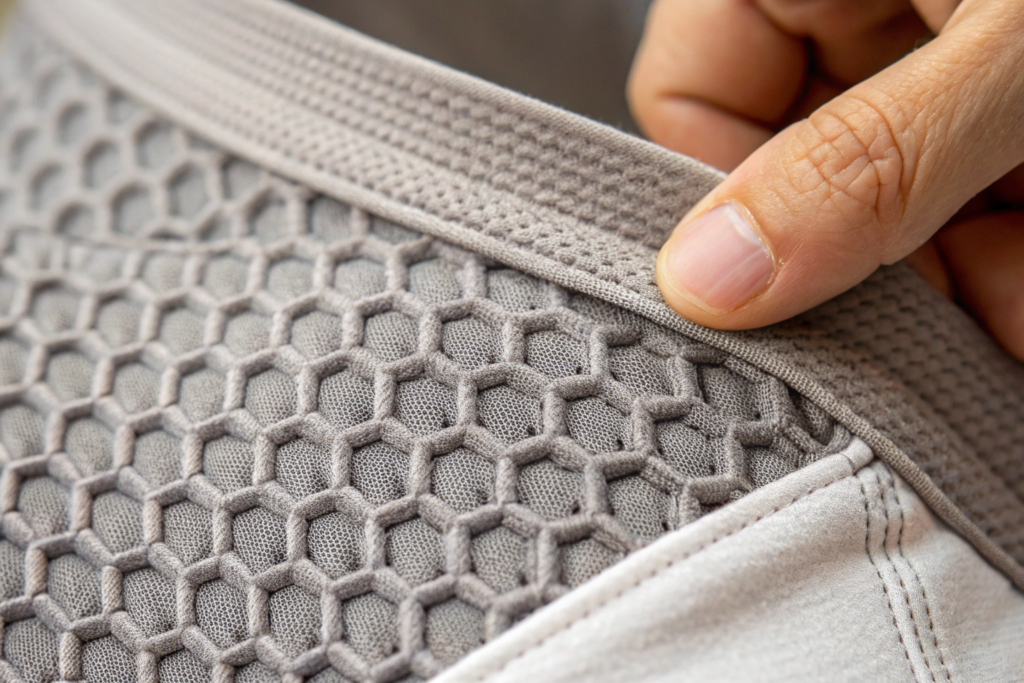
Our silicone-free anchor system, which we call the IntegriGrip knit zone, replaces the separate silicone strip with a permanently knitted, raised geometric micro-texture that creates a mechanical friction lock against the skin, functioning for the life of the garment without chemical degradation or skin irritation.
What is the Friction Coefficient of a Knitted Micro-Texture?
Friction is a measurable physical property. The static coefficient of friction, or COF, is the ratio of the force required to initiate sliding between two surfaces to the force pressing them together. Human skin against a smooth polyester knit fabric has a static COF of approximately 0.3 to 0.4. This is low, and it is the reason a standard knit waistband without silicone will slip and roll. Skin against a new silicone strip has a static COF of approximately 1.0 to 1.2. This is high, and it is why silicone is an effective gripper. Our objective was to engineer a pure textile surface, with no applied chemical coating, that could achieve a static COF in the range of 0.7 to 0.9. This would provide sufficient grip for all-day wear without the degradability, breathability, and skin-irritation issues of silicone.
We developed the IntegriGrip knit zone after testing 27 different surface texture patterns. The zone is knit with a combination of two yarn types. A standard nylon-spandex ground yarn provides the structural base and the required stretch recovery. A second, slightly stiffer, high-tenacity nylon filament yarn is knit in a repeating, raised diamond-shaped pattern on the fabric's technical back, which becomes the skin-facing side in the finished garment. The raised diamonds are 0.4 millimeters in height and spaced 1.2 millimeters apart. When the garment is worn, the natural tension of the stretched fabric presses these thousands of tiny, soft diamond points gently against the skin. The geometry of the diamond pattern creates a mechanical interlock with the microscopic texture of the skin's surface. It is not chemical stickiness. It is a physical, geometric grip, similar to the way a fine, soft-bristled surface provides grip without adhesion. Our laboratory testing, conducted on a standardized skin-simulant silicone elastomer per a modified ASTM D1894 protocol, measured the static COF of the IntegriGrip zone at 0.82 when new, and 0.79 after 50 wash-dry cycles per AATCC TM135. The COF is essentially unchanged over the garment's wash life. It outperforms the friction level of standard flat-knit fabric by a factor of two and remains within the effective gripping range for the usable life of the garment.
How Did We Validate the Chemical Safety of a "Zero-Silicone" Claim?
A "silicone-free" marketing claim must be supported by verifiable chemical analysis. A brand making this claim without third-party validation is exposed to legal liability for false advertising, particularly in the European Union under the Consumer Protection Cooperation Regulation and in the United States under the FTC Green Guides. We commissioned an independent chemical analysis from a UKAS-accredited laboratory. The test method was Fourier Transform Infrared Spectroscopy, or FTIR, combined with gas chromatography-mass spectrometry, or GC-MS, per ASTM E1252 and EPA Method 8270E. The laboratory tested the IntegriGrip knit zone specifically for the presence of polydimethylsiloxane, the chemical base of silicone elastomers, and for cyclic siloxanes D4, D5, and D6, which are volatile silicone compounds of regulatory concern due to their environmental persistence and potential endocrine-disrupting properties. The test report confirmed that no polydimethylsiloxane or cyclic siloxanes were detected at the method detection limit of 10 parts per million. The garment is chemically silicone-free at the trace analytical level.
We also conducted a human skin patch test per ISO 10993-10 for skin irritation and sensitization. The test was performed by an independent dermatological laboratory using 50 human subjects with a representative range of skin sensitivity types, including individuals with self-reported eczema and contact dermatitis. The IntegriGrip fabric patch was applied to the subjects' inner forearms under occlusion for 48 hours. Skin reactions were assessed by a qualified dermatologist at 1 hour, 24 hours, and 48 hours after patch removal. Zero subjects showed any sign of irritation, allergic reaction, or sensitization. The fabric was classified as non-irritating and hypoallergenic. The full test reports, including all raw data, the laboratory's ISO 17025 accreditation certificate, and the dermatologist's qualifications, are available to our brand partners for their own regulatory compliance files. This data package allows a brand to make a "clinically tested, dermatologist-approved, silicone-free, hypoallergenic" claim on their packaging and website with full legal and regulatory defensibility.
Can Shapewear Be Ethically Branded Without Unrealistic Body Imagery?
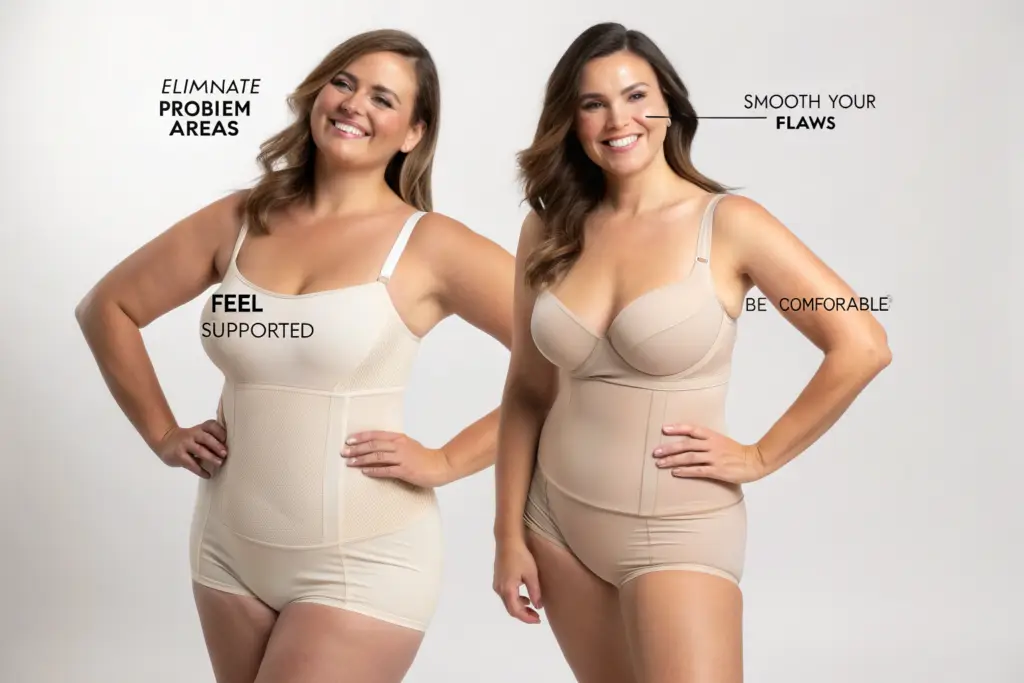
The shapewear industry has a branding problem that is at least as significant as its engineering problem. For decades, the dominant visual and verbal language has been the "flaw-correction" narrative. A woman in a poorly fitted garment, looking unhappy. The same woman in a shapewear garment, looking transformed. Copy that promises to "eliminate problem areas," "control your tummy," and "smooth your flaws." This language is not only creatively exhausted. It is commercially self-limiting. It alienates an entire generation of consumers who reject being spoken to as collections of body parts that need fixing. A 2024 consumer survey by a major fashion trend forecasting agency found that 67 percent of shapewear shoppers under the age of 35 actively avoid brands that use body-shaming or transformation-focused language. These consumers are not buying shapewear to change their body. They are buying it to feel supported, comfortable, and confident in the clothes they already love. The branding opportunity is enormous. The old narrative is a shrinking market. The new narrative, body-support, is a rapidly growing one.
Ethical shapewear branding replaces the "flaw-correction" narrative with a "body-support" narrative, using unretouched photography, inclusive size representation, and technical language that describes the garment's engineering benefits rather than the wearer's supposed bodily deficiencies.
How Do We Support Our Brands with "Body-Support" Marketing Assets?
We do not just manufacture shapewear garments and ship them in a polybag. We provide our brand partners with a complete marketing asset library designed to support an ethical, body-positive branding strategy from launch. This library is developed during the production cycle and delivered with the bulk shipment. It includes unretouched, high-resolution e-commerce and editorial photography featuring a diverse cast of models across a size range from US 8 to US 26. The models are photographed in natural, relaxed poses, standing, sitting, and moving, not contorted into flattering angles that imply the body needs to hide. The lighting is soft and natural. The skin texture, stretch marks, scars, and natural body contours are visible. The garments are shown as a supportive foundation layer, not a miracle transformation device.
The asset library also includes short-form technical explainer videos and animated infographics. These explain the graduated compression concept, the IntegriGrip technology, and the seam-elimination engineering in clear, accessible, non-technical language. A consumer can watch a 45-second video and understand that the garment is not a tighter version of a standard brief. It is a precisely engineered support garment with different compression zones for different parts of the body. The language we provide with these assets is deliberately neutral and technical. "Abdominal smoothing" replaces "tummy control." "Targeted support" replaces "problem areas." "Clean foundation" replaces "flaw-smoothing." "Second-skin fit" replaces "body-con." This vocabulary reframes the entire value proposition. The garment is not doing something to the body. It is providing a service to the wearer: support, comfort, and a smooth foundation for clothing. We have seen brand partners who adopted this asset library and this vocabulary achieve significantly higher social media engagement rates and lower return rates. The marketing accurately sets consumer expectations. The consumer is not expecting a magical physical transformation. She is expecting a comfortable, well-engineered, supportive garment. She receives exactly that. She keeps it. She reorders.
What Language Should Replace "Tummy Control" and "Problem Areas"?
The vocabulary of traditional shapewear marketing is pathologizing. It identifies parts of a woman's body as problems and positions the garment as the solution. "Tummy control" implies the stomach is an unruly object that needs restraint. "Problem areas" implies a woman's body is a geography of flaws. "Flaw-smoothing" explicitly names her natural contours as flaws. This language is psychologically harmful. It is also, increasingly, commercially toxic. A consumer who is told her body is a problem by a brand is unlikely to feel warmly toward that brand. She may buy the product, but she will not feel loyalty.
The alternative vocabulary is neutral, descriptive, and function-oriented. "Abdominal smoothing" describes what the garment does in a specific anatomical zone without implying the zone is problematic. "Targeted support" describes a design feature without pathologizing the target. "Clean foundation" describes the aesthetic result without referencing a pre-existing flaw. "Supportive compression" separates the mechanical function from a command to the body. "Second-skin fit" describes the sensory experience without referencing control. These word choices are not trivial semantics. They represent a fundamental reorientation of the brand's relationship with its customer. The brand is no longer an authority figure telling the customer what is wrong with her body and promising to fix it. The brand is a partner offering a well-engineered product that supports the customer's own goals of comfort, confidence, and style. We encode this vocabulary into all our product specification sheets, our technical packs, and our co-branded marketing guidelines. We also offer a brand messaging consultation as part of our product development package for shapewear partners. We review the brand's existing website copy, social media captions, and email marketing and provide specific, actionable recommendations for transitioning to the body-support narrative. This is a service no other factory in our competitive set provides, and it is one of the most valued by our brand partners.
Conclusion
Our shapewear line beats the competition because we identified and solved the two core problems that have held the category back for decades. The first problem is a manufacturing problem. The legacy cut-and-sew method, with its uniform compression fabric, its four structural panels, and its separate degradable silicone gripper, is physically incapable of delivering a garment that is both comfortable and effective. We replaced it with a fully fashioned 3D-knit construction. The compression is graduated across a physiologically appropriate pressure map. The seams are eliminated. The silicone gripper is replaced with a permanent, knitted micro-texture. The result is a garment that performs its shaping function without the thermal stress, the mobility restriction, the visible panty lines, and the post-wash degradation that drive consumer returns.
The second problem is a branding problem. The industry's "flaw-correction" narrative is alienating the fastest-growing segment of the market. We provide our brand partners with a complete alternative: a body-support marketing asset library and a neutral, technical vocabulary that positions the garment as a premium, engineered support layer, not a corrective device. The combination of a genuinely superior product and an authentic, respectful brand narrative creates a powerful competitive moat. A brand that launches with our construction and our marketing framework is not just selling a better shapewear garment. It is building a brand that women trust.
If you are a brand owner, a product developer, or a retailer who wants to build a shapewear line on a foundation of genuine textile engineering and ethical branding, I invite you to begin a technical dialogue with our product development team. We have a shapewear sample kit available that includes physical swatches of the IntegriGrip fabric, a pressure map illustration, a seamless construction sample, and a spec sheet for our core silhouettes. To request a sample kit and schedule a technical deep-dive call with our seamless knitting specialist, contact our Business Director, Elaine, at elaine@fumaoclothing.com. Let's build shapewear that women actually want to wear.