I stood in our shipping department last August, staring at a stack of cartons that should have been in Dallas two weeks earlier. The problem was not the coats. The coats were perfect: 800 units of lightweight linen dusters, beautifully sewn, packed in moisture-barrier polybags, ready to sell. The problem was a three-digit code on a customs form. Our freight forwarder had classified the dusters under the wrong Harmonized Tariff Schedule code. US Customs flagged the shipment. The cartons sat in a bonded warehouse in Long Beach, accumulating storage fees of $180 per day, while a broker in Los Angeles argued with a CBP officer about fiber content percentages. The brand owner in Dallas was losing peak selling days. I was losing sleep. We fixed the error. We reclassified the coats correctly. The shipment cleared. But the delay cost the brand a two-week selling window in August, and August is irreplaceable in the summer coat business. I learned a lesson that reshaped our entire import process. Importing is not a shipping task. It is a compliance discipline.
Importing lightweight summer coats from China to the USA in 2026 requires mastery of five interconnected processes: correct Harmonized Tariff Schedule classification to avoid customs delays and overpayment, preparation of compliant documentation including a detailed packing list and a manufacturer’s affidavit for fiber content, selection of the right Incoterms and shipping mode based on your cash flow and inventory strategy, anticipation of the 2026 regulatory landscape including potential tariff adjustments and sustainability documentation requirements, and partnership with a licensed customs broker who understands apparel specifically, not just general cargo.
The good news is that this process is learnable and repeatable. Thousands of shipments of apparel clear US customs every day without incident. The brands that clear smoothly are the ones that treat importing as a core business function, not an afterthought to be delegated to the cheapest freight forwarder. At Shanghai Fumao, I have managed the export of summer coats to the US for over a decade. I have made the classification mistakes, paid the demurrage fees, and learned the hard lessons so that my brand partners do not have to. Let me walk you through the entire process from factory floor to your warehouse door, with a focus on the specific challenges that lightweight summer coats present compared to other apparel categories.
HS Code Classification: The Foundation of Compliant Importing
The Harmonized Tariff Schedule of the United States, or HTSUS, is the numerical classification system that determines the duty rate applied to every product entering the country. It is organized into chapters, headings, and subheadings. Apparel products fall primarily under Chapters 61 and 62. Chapter 61 covers knitted or crocheted garments. Chapter 62 covers woven garments. Within each chapter, the classification drills down by garment type, fiber content, and gender. A women’s woven cotton trench coat and a women’s woven silk kimono have completely different HTS codes and potentially different duty rates. The classification decision is not a matter of opinion. It is a legal determination with financial and compliance consequences. A wrong classification can result in overpaid duties that erode your margin, or underpaid duties that trigger a CBP audit, backdated penalties, and interest charges. I have seen both outcomes.
The most common HS codes for lightweight women’s summer coats imported from China are 6202.11.00 for women’s woven wool overcoats, 6202.12.00 for women’s woven cotton overcoats, 6202.13.00 for women’s woven man-made fiber overcoats, 6202.19.00 for women’s woven overcoats of other textile materials such as linen or silk, and 6202.92.00 for women’s woven cotton anoraks and windbreakers. The duty rate for most of these classifications from China is currently 27.7% under Section 301 tariffs, though this rate may change in 2026 depending on the US trade policy review.
The 27.7% duty rate is a combination of the standard Most Favored Nation rate, which varies by product, and the additional Section 301 tariff, which is currently 7.5% on most apparel items from China. This combined rate applies to the FOB value of the goods, meaning the price you pay the factory before shipping and insurance. If you pay $20 per coat FOB, the duty owed is approximately $5.54 per coat. That cost must be built into your landed cost calculation and your retail pricing model. A brand that ignores this line item or assumes a lower rate will find their margin evaporating when the customs broker’s invoice arrives. I provide every brand partner with an estimated duty calculation based on the specific HS code for their coat design before we begin production. The estimate is not a guarantee. CBP makes the final determination at the port of entry. But an informed estimate allows you to plan your pricing with realistic cost inputs, not wishful thinking.
What Is the Difference Between a Coat, a Jacket, and a Shirt for Customs Purposes?
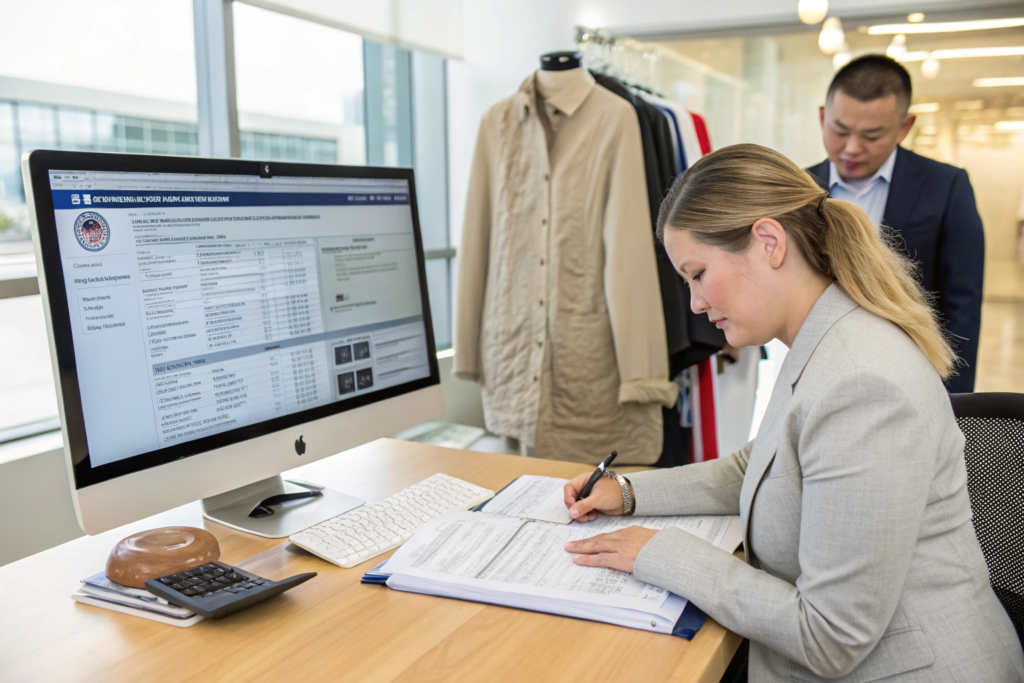
This distinction matters because different garment types fall under different HTS headings with different duty rates. US Customs generally defines an overcoat or a coat as a garment designed to be worn over other clothing for warmth or protection, typically extending below the mid-thigh, with full sleeves and a full front opening. A jacket is similar but typically shorter, ending at the hip or upper thigh. A shirt or a blouse is a garment designed to be worn next to the body or over undergarments, not over other outer garments. A shacket, the shirt-jacket hybrid that dominates the summer-to-fall category, sits in a classification gray area. Is it a heavy shirt or a light jacket? The classification depends on the specific construction. If the shacket has a full lining, substantial pocket construction, and heavy fabric over 250 GSM, CBP will likely classify it as a jacket under Chapter 62. If the shacket is unlined, lightweight, and designed to be worn open over a t-shirt, it may be classified as a shirt under Chapter 62, specifically 6206 for women’s woven blouses and shirts. The duty rate difference can be significant. A women’s woven cotton blouse from China currently carries a combined duty rate of approximately 19.7%, compared to 27.7% for a coat. The 8% difference on a $20 FOB cost is $1.60 per unit. On an order of 500 units, that is $800 in duty savings. The classification must be legally defensible. You cannot call a heavy, lined, padded garment a "shirt" to save on duties. CBP will reclassify it, and you will owe the difference plus potential penalties. But for a genuinely lightweight, shirt-constructed shacket, the lower shirt classification may be correct and supportable. Work with your customs broker to obtain a binding ruling from CBP if you have any doubt. A binding ruling provides legal certainty and protection against reclassification.
How Does Fiber Content Affect HS Classification and Duty Rates?
Fiber content is the second most important classification factor after garment type. The HTS distinguishes between wool, cotton, man-made fibers like polyester and nylon, and other vegetable fibers like linen and hemp. The fiber content of the shell fabric, not the lining or trim, determines the primary classification. If your summer coat has a 55% linen, 45% cotton shell, it is classified as a linen coat because linen is the predominant fiber by weight. If the coat has a 52% cotton, 48% polyester shell, it is classified as a cotton coat. The fiber content must be verified by laboratory testing. CBP will not accept a manufacturer’s verbal claim or a hangtag statement as proof. We provide an independent lab test report for every fabric we use, showing the exact fiber composition by percentage weight. This report accompanies the shipment documentation and is available for CBP inspection if requested. A common mistake is ignoring the fiber content of the lining. While the shell determines the primary classification, a lining made of a different fiber may affect the classification if the garment is considered a composite good. For most standard coat constructions, the shell dominates and the lining is ignored for classification purposes. However, if the lining is separately identifiable and substantial, such as a removable quilted lining, it may be classified separately and attract its own duty. Removable linings are not recommended for summer coats because they add cost, complexity, and a potential duty liability that does not apply to fixed linings.
Shipping Methods, Incoterms, and Logistics Planning for 2026
Choosing the right shipping method and Incoterm is a strategic decision that balances three variables: speed, cost, and cash flow timing. The wrong choice can erode margin through excess freight costs or lost sales through late delivery. The right choice aligns your logistics with your inventory planning and your retail calendar. Summer coats have a defined selling season. The demand curve rises in April, peaks in June and July, and declines sharply in late August. A shipment that arrives in September has missed 80% of the full-price selling window. The shipping method must be reverse-engineered from the required in-stock date, not selected based on the lowest cost per cubic meter.
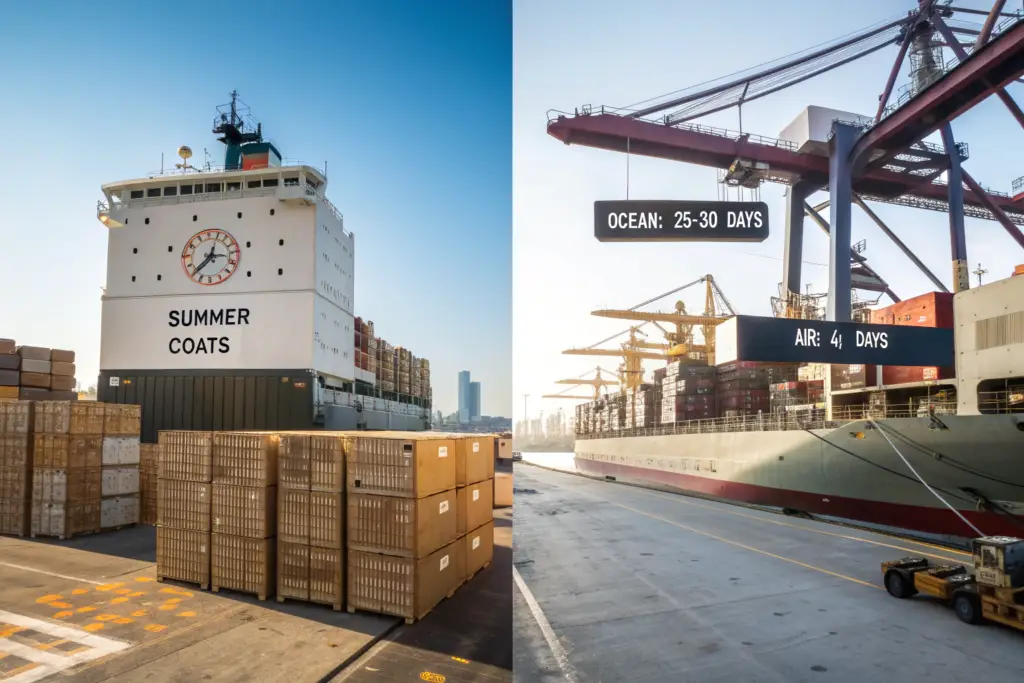
The two primary shipping methods for importing summer coats from China to the USA are ocean freight, which takes 25 to 35 days port-to-port from Shanghai to Los Angeles and costs approximately $3,000 to $5,000 for a 20-foot container or $150 to $250 per cubic meter for less-than-container-load shipments, and air freight, which takes 5 to 7 days airport-to-airport and costs approximately $3.50 to $5.50 per kilogram. For a typical summer coat weighing 400 grams, air freight adds $1.40 to $2.20 per unit compared to ocean freight, which adds approximately $0.30 to $0.60 per unit.
Ocean freight is the default choice for planned production with a predictable timeline. If your production finishes in early April, a late April ocean shipment arrives at your US warehouse in late May, perfectly timed for the June selling peak. Air freight is the emergency option for late production, unexpected re-orders, or early-season sellouts that require rapid replenishment. I have used air freight to deliver 200 units of a viral quilted jacket to a New York brand in seven days flat, allowing them to capture a trend wave that would have been missed with a four-week ocean transit. The air freight cost ate 8% of their margin on that replenishment order, but the alternative was zero margin on zero sales because the inventory would have arrived after the demand evaporated. The Incoterm you choose determines where the cost and risk transfer from the seller to you. FOB (Free on Board) means we deliver the goods to the port and load them onto the vessel. You pay the ocean freight, insurance, and destination charges. DDP (Delivery Duty Paid) means we handle and pay for everything, including freight, insurance, and import duties, and deliver the goods to your warehouse door. For a first-time importer, DDP is strongly recommended. It simplifies the process, eliminates surprise costs, and provides a single, fixed landed cost per unit. Once you have experience with the import process, you may choose to transition to FOB or FCA (Free Carrier) to gain more control over freight costs and carrier selection.
What Incoterm Should a First-Time Importer Use for Summer Coats?
DDP is the safest and simplest Incoterm for a first-time importer. Under DDP, we at Shanghai Fumao assume full responsibility for the shipment from our factory floor to your designated warehouse. We book the freight. We pay the ocean or air charges. We engage the customs broker. We pay the import duties and any customs exam fees. You receive a single invoice with a single per-unit landed cost. There are no additional charges. There are no surprise storage fees at the port. There is no requirement for you to have a US customs bond or a relationship with a broker. DDP removes the learning curve and the financial risk from your first import experience. The trade-off is transparency. A DDP price is a bundled price. You cannot see the individual cost components, the FOB unit cost, the freight cost, the duty cost, and the broker fee, separately. Some brand owners prefer to unbundle these costs to negotiate each component independently. Unbundling is a valid strategy for experienced importers with established broker and freight forwarder relationships. For a first shipment, the bundled DDP approach protects you from the mistakes that I described at the beginning of this article. The broker classification error, the port storage fees, the customs exam charges: under DDP, these are our problems and our costs, not yours. Once you have successfully imported two or three shipments and have a working knowledge of the process, you can explore FOB or FCA terms with your own freight forwarder. I recommend this phased approach to every new brand partner.
How Should You Plan Your Production Timeline to Hit the Summer Selling Season?
The production timeline for summer coats must be built backward from the in-stock date at your US warehouse. The in-stock date is not the date the goods arrive at the port. It is the date the goods are checked in, counted, and available for sale at your fulfillment center or retail location. The port-to-warehouse leg typically adds 5 to 10 days for container drayage, customs clearance, and truck delivery. Here is a realistic timeline for a summer coat collection launching in late May 2026. Fabric sourcing and sample development should be completed by December 2025. Bulk fabric ordering should be placed by January 2026. Production cutting and sewing should run from February to March 2026. Quality control inspection and finishing should be completed by early April 2026. Ocean freight booking should be confirmed for mid-April 2026. The vessel departure from Shanghai should occur around April 15th to 20th. The vessel arrival at Los Angeles or Long Beach should occur around May 5th to 10th, assuming a 20 to 25 day transit. Customs clearance and drayage to the warehouse should complete by May 15th to 20th. The goods are available for sale by May 25th, just in time for the pre-summer marketing push and the June sales acceleration. This timeline includes a two-week buffer at each major milestone. The buffer is not optional. Fabric mills deliver late. Ports get congested. Customs selects random containers for exam. The buffer absorbs these disruptions without pushing the in-stock date past the selling window. I have learned through painful experience that a timeline without buffers is a fantasy. The buffer is the difference between a successful launch and a missed season.
Documentation, Duties, and Customs Clearance in 2026
The documentation package that accompanies your shipment is not just paperwork. It is the legal record that CBP uses to assess duties, verify compliance, and detect illegal transshipment or undervaluation. Errors or omissions in the documentation can delay clearance, trigger intensive exams, or result in penalty assessments. The documentation must be accurate, complete, and consistent across all documents. A discrepancy between the commercial invoice value and the packing list quantity, even a small one, will cause a customs hold. The responsibility for documentation accuracy falls on the importer of record, which is you if you are importing under FOB terms, or us if you are importing under DDP terms. Regardless of the Incoterm, you should review and understand every document before the shipment sails.
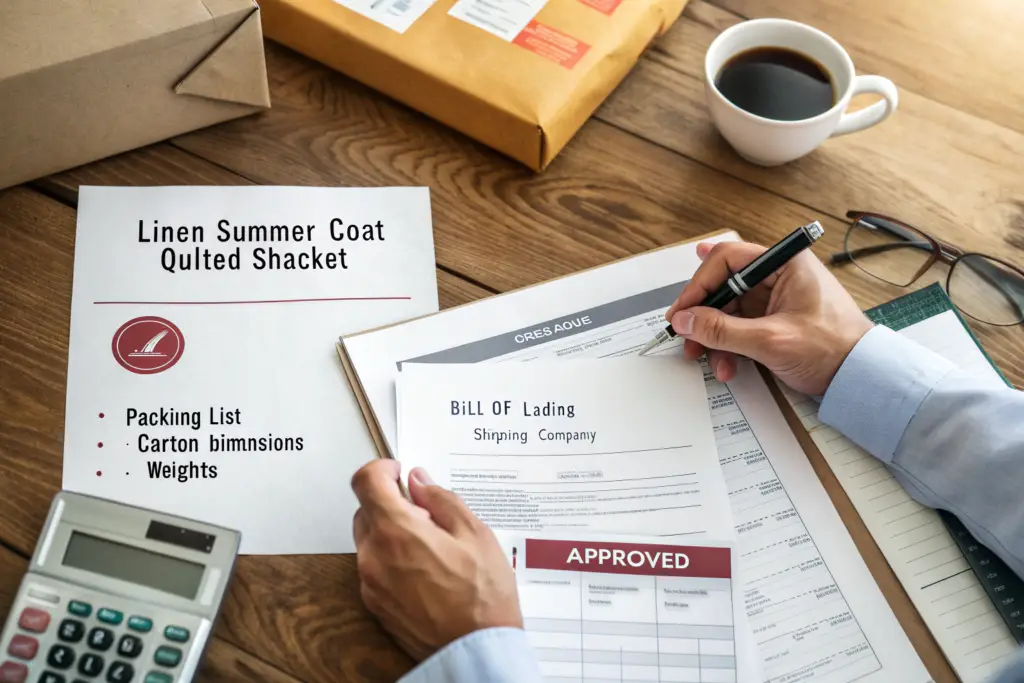
The essential documents for importing summer coats from China to the USA are: the commercial invoice, which lists the seller, buyer, goods description, HS codes, unit values, total value, and Incoterm, the packing list, which lists the carton numbers, carton dimensions and weights, and the quantity of units per carton, the bill of lading for ocean freight or the air waybill for air freight, which serves as the contract of carriage and the document of title, the manufacturer’s affidavit for fiber content, which is a notarized statement from the factory certifying the fiber composition of each garment, and the US Customs entry summary, which is filed by the customs broker and calculates the duties owed based on the commercial invoice data.
For 2026, I anticipate an increased focus on sustainability documentation. The European Union is implementing digital product passports for textiles, and while the US does not currently require this, major US retailers and brands are voluntarily adopting similar standards. A coat imported in 2026 may need to be accompanied by documentation proving the origin of the raw materials, the dyeing and finishing processes, and the social compliance status of the factory. This is not a legal requirement at the US federal level as of today, but it is rapidly becoming a commercial requirement for brands that sell to informed consumers. We provide a certificate of origin, an Oeko-Tex certification if applicable, and a BSCI social compliance audit report as part of our standard export documentation package. These documents do not affect customs clearance, but they support your brand’s sustainability claims and provide a defense against greenwashing accusations.
What Is a Customs Bond and Why Do You Need One?
A customs bond is a financial guarantee between the importer, a surety company, and CBP. It guarantees that CBP will receive the duties, taxes, and fees owed on the imported goods, even if the importer defaults. A bond is required for any formal entry, which is any shipment valued over $2,500. A summer coat shipment from China will almost certainly exceed this threshold and require a formal entry and a bond. There are two types of bonds. A single-entry bond covers one specific shipment. The premium is typically 0.5% to 1% of the shipment value, with a minimum premium of $50 to $75. A continuous bond covers all shipments imported by the same importer over a 12-month period. The premium is based on 10% of the estimated annual duties, taxes, and fees, with a minimum annual premium of approximately $250 to $500. If you plan to import more than two or three shipments per year, a continuous bond is more cost-effective. If you are importing a single test order, a single-entry bond is the better choice. Under DDP terms, we include the bond cost in our DDP price. You do not need to arrange a bond separately. Under FOB terms, you must arrange your own bond through your customs broker. The broker will typically handle the bond application as part of the entry filing process. The cost of the bond will appear as a line item on the broker’s invoice.
How Are Section 301 Tariffs Impacting Summer Coat Imports in 2026?
Section 301 tariffs on Chinese-origin goods were first imposed in 2018 and have been modified several times through subsequent trade policy reviews. As of the current trade framework heading into 2026, most apparel items from China, including women’s summer coats, remain subject to an additional 7.5% ad valorem duty on top of the standard MFN duty rate. The standard MFN rate for a women’s woven cotton overcoat is approximately 19.7%. The Section 301 addition brings the total to 27.7%. This rate applies unless an exclusion has been granted for a specific product category. The exclusion process is unpredictable and political. I do not advise building a business model that depends on a tariff exclusion being granted or renewed. The 2026 landscape may shift. The current administration has signaled a review of the Section 301 framework, and it is possible that rates could increase, decrease, or be restructured by product category. I monitor trade policy developments through the Office of the United States Trade Representative website, our customs broker’s policy updates, and the American Apparel and Footwear Association’s trade alerts. I share relevant developments with our brand partners as soon as they are announced. For planning purposes, I recommend modeling your landed cost with the current 27.7% rate and including a sensitivity analysis that shows the margin impact of a potential increase to 35% or a decrease to 20%. This analysis allows you to stress-test your pricing strategy and understand your margin risk before you commit to a production order. If your margin cannot survive a 35% duty rate, you may need to adjust your retail price, reduce your cost of goods through material substitution, or diversify your sourcing to include countries not subject to Section 301 tariffs, such as Vietnam or India. I do not recommend abandoning Chinese manufacturing solely because of tariff uncertainty. Chinese factories remain the most capable and responsive partners for complex garment categories like summer coats. The tariff is a manageable cost input if it is correctly forecast and priced into the product.
Conclusion
Importing lightweight summer coats from China to the USA in 2026 is a structured process that rewards preparation and penalizes improvisation. The brands that clear customs smoothly, land goods on time, and preserve their margin are the brands that treat importing as a core competency. They know their HS codes. They know their fiber content percentages. They know their Incoterms and their shipping timelines. They have a customs bond in place before the vessel sails. They have a documented landed cost model that includes duty, freight, insurance, brokerage, and port handling. They do not guess. They calculate.
The import process can feel overwhelming the first time you navigate it. There are acronyms. There are government forms. There are fees that appear on invoices with cryptic descriptions. This complexity is a barrier to entry, and it is also a competitive moat. The brands that invest the time to learn the process are rewarded with access to the best factories, the best fabrics, and the best margins in the apparel industry. The brands that avoid the complexity and source domestically or through intermediaries pay a premium that limits their growth and their profitability.
At Shanghai Fumao, we have managed the export side of this process for hundreds of summer coat shipments to the US. We know the HS codes that apply to linen dusters, quilted shackets, and chiffon kimonos. We know the documentation package that US customs expects. We know the shipping timelines that align with the summer selling season. We offer DDP shipping to first-time importers to remove the complexity and the risk from your first order. For experienced importers, we offer FOB terms with full documentation support, allowing you to use your own freight forwarder and broker while we ensure the paperwork is accurate and complete.
If you are planning to import summer coats from China in 2026, do not wait until the goods are ready to ship to figure out the logistics. The time to plan your import strategy is now, during the design and development phase. A small investment in classification research, duty modeling, and timeline planning at the front end will return tenfold in avoided delays, reduced storage fees, and captured full-price selling days.
To discuss your specific import strategy and receive a detailed landed cost estimate for your summer coat designs, contact our Business Director, Elaine. She can provide HS code classifications for your specific garment types, a DDP door-to-door quotation with all costs included, and a production timeline that aligns with your target in-stock date. Email Elaine at: elaine@fumaoclothing.com.