In early 2019, I watched a brand owner in North Carolina absorb a cost increase that nearly sank his business. He had been importing classic chino shorts from China for five years, building a loyal customer base and a steady margin. When the US Trade Representative imposed an additional 15% tariff on Chinese apparel under Section 301, his landed cost per unit jumped overnight. His shorts, previously subject to a standard 16.5% import duty, were now being charged an additional 7.5% punitive tariff on top. His total duty burden rose to 24% of the declared value. He had priced his inventory months earlier, and his retail partners had already committed to wholesale pricing. He could not pass the cost through. He absorbed it. His margin on that season's order effectively disappeared. He called me afterward, not to complain, but to ask a question I have heard repeatedly since. "How do I plan for this when I don't know what the tariff will be next year?"
The potential tariff implications for US companies importing classic shorts from China and other manufacturing countries include the baseline Most Favored Nation duty rates under the Harmonized Tariff Schedule, which for woven cotton shorts typically range from 14.9% to 16.5% depending on the specific fiber composition and gender classification, the additional Section 301 punitive duties that were imposed on Chinese apparel and remain in place at varying rates, and the ongoing risk of new or increased tariff actions under shifting US trade policy, all of which directly affect the landed cost, the competitive positioning, and the inventory planning of any brand importing classic shorts.
At Shanghai Fumao, I have navigated my brand partners through multiple tariff regimes over the past decade. The rules are complex, the rates are subject to change, and the financial consequences of misclassification or poor planning are severe. But this landscape is not unmanageable. With the right knowledge and the right partner, a brand can understand its exposure, plan for contingencies, and make sourcing decisions based on facts rather than fear. Let me break down exactly what you need to know.
How Does the Current HTS Classification Determine Your Baseline Duty Rate?
Every garment imported into the United States is classified under a specific ten-digit code within the Harmonized Tariff Schedule of the United States. That code determines the baseline duty rate, the amount of import tax that US Customs and Border Protection will assess on the shipment before any additional tariffs are applied. The classification is not a matter of the importer's preference or the factory's suggestion. It is a legal determination based on the physical characteristics of the garment, and an incorrect classification can result in underpaid duties, penalties, and audits.
The HTS classification for classic shorts depends on three primary factors: the gender of the intended wearer, with men's shorts classified under Heading 6203 and women's shorts under Heading 6204, the fiber composition, with cotton shorts typically attracting a 16.5% duty rate under the applicable subheading and man-made fiber shorts attracting a higher 27.9% rate, and the construction type, with woven shorts classified in Chapter 62 and knit shorts classified in Chapter 61, making it essential for importers to provide accurate and detailed product information to their customs broker to ensure correct classification and duty payment.
What Are the Specific HTS Codes for Different Types of Classic Shorts?
The HTS is organized hierarchically. The first four digits identify the heading, the next two the subheading, and the final four the statistical suffix. For apparel, the classification turns on the fiber, the gender, and the fabric construction. Getting any of these wrong means paying the wrong duty, potentially for years.
Men's woven cotton shorts fall under HTS 6203.42.4051, with a duty rate of 16.5%. Women's woven cotton shorts fall under HTS 6204.62.4051, also at 16.5%. If the shorts contain 70% cotton and 30% polyester, the classification and rate may change depending on which fiber predominates by weight. If the shorts are made from man-made fibers, polyester or nylon, the duty rate jumps to 27.9% under the relevant subheading. Knit shorts are classified in Chapter 61, with different rates. A factory that tells a buyer "the duty rate for shorts is about 16%" is oversimplifying a determination that has specific legal and financial consequences. This HTS classification for apparel resource is the authoritative reference. At Shanghai Fumao, we provide our brand partners with the detailed fiber composition and construction information that their customs broker needs to classify the goods correctly.
How Can a Misclassification Trigger a Customs Audit and Penalties?
US Customs and Border Protection enforces compliance through audits, and apparel is one of the most frequently audited categories. A misclassification that results in underpaid duties, even if unintentional, can result in a demand for back duties covering multiple years, plus interest, plus penalties. The financial exposure is not limited to the current shipment.
A common misclassification scenario involves fiber content. A pair of shorts labeled as cotton but actually containing a significant percentage of polyester may be classified under the cotton subheading by a broker who relies on the label rather than testing. If CBP tests the fabric and finds the misclassification, the importer is liable for the difference between the 16.5% cotton rate and the 27.9% man-made fiber rate on all shipments of that product. The difference of 11.4 percentage points, multiplied by the declared value of all shipments over several years, can produce a liability figure that is catastrophic for a small or mid-size brand. This customs compliance and audit risk is entirely avoidable through accurate product information and a qualified customs broker. At Shanghai Fumao, we provide independent lab test reports on fiber composition for every fabric lot, giving the importer documented evidence to support their classification.
What Are the Section 301 Tariffs on Chinese Apparel and Are They Still Active?
The Section 301 tariffs are the layer of additional duties imposed by the United States on imports from China beginning in 2018, separate from and in addition to the baseline HTS duty rates. These tariffs were imposed under a trade law that authorizes the US Trade Representative to take action against foreign trade practices deemed unfair. The tariffs have been modified, reduced, increased, and partially excluded over the years, creating a landscape that is confusing and constantly shifting. The critical question for any importer of classic shorts from China is: what is the current status, and what could change?
The Section 301 tariffs on Chinese apparel, including classic shorts, remain active and are currently assessed at rates of 7.5% to 25% on top of the baseline HTS duty depending on the specific product category and the status of any granted exclusions, with woven cotton shorts generally falling under the List 3 or List 4A tariff actions, meaning that the effective total duty burden on a shipment of classic shorts from China can range from approximately 24% to 41.5% of the declared value when combining the baseline duty and the Section 301 tariff.
What Is the Difference Between List 3 and List 4A Tariffs for Apparel?
The Section 301 tariffs were imposed in waves, each wave covering a different list of products. List 1 and List 2 targeted industrial goods. List 3, imposed in 2018 and 2019, covered a broad range of consumer goods and included many apparel categories. The List 3 tariff rate was initially 10%, was raised to 25%, and was later reduced to 7.5% for many products under a subsequent agreement. List 4A covered additional apparel categories that were not included in List 3.
Most woven cotton classic shorts fall under List 3 or List 4A, depending on the specific HTS code. The current List 3 rate is 7.5% for most apparel items. The List 4A rate was initially 15%, was reduced to 7.5%, and has remained at that level. The importer must determine which list applies to their specific product. The determination is made by the HTS code. A customs broker can confirm the applicable Section 301 duty for any specific HTS code. This Section 301 tariff on Chinese goods information is maintained by the US Trade Representative and is essential for accurate landed cost calculation.
Could Section 301 Tariffs Increase or Be Removed Entirely?
The Section 301 tariffs are imposed by executive action, not by legislation. This means they can be modified, increased, decreased, or terminated by the President without congressional approval. This administrative flexibility cuts both ways. A new administration could increase the tariffs as a negotiating tactic. The same administration could remove them as part of a trade agreement.
The Section 301 tariffs are currently under a statutory four-year review process. The US Trade Representative is required to review the tariffs and determine whether they remain effective and appropriate. This review process creates the possibility of rate changes, either upward or downward. The expiration of certain exclusions, which have temporarily removed specific products from the tariff list, creates another vector of change. An importer whose product was covered by an exclusion that has expired may face a sudden increase in effective duty rate. This tariff policy outlook and risk assessment is a critical input for inventory planning and supplier diversification decisions. At Shanghai Fumao, we monitor tariff developments continuously and advise our brand partners on the implications for their specific programs.
How Does De Minimis Treatment Affect Small Shipments of Classic Shorts?
The de minimis provision, Section 321 of the Tariff Act of 1930, allows goods valued at $800 or less per person per day to enter the United States duty-free and with simplified customs clearance. This provision has become a central pillar of the direct-to-consumer cross-border e-commerce model. A brand shipping a single pair of classic shorts directly from a Chinese factory to a US consumer pays no duty, no Section 301 tariff, and no Merchandise Processing Fee, provided the shipment value does not exceed $800 and the shipments are properly structured.
The de minimis exemption applies to individual shipments of classic shorts valued at $800 or less per person per day, allowing these small parcels to enter the United States without the payment of HTS duties or Section 301 tariffs and with significantly reduced customs documentation requirements, making it a powerful cost-saving mechanism for direct-to-consumer brands shipping from China to US customers, though proposed regulatory changes and legislative action could lower or eliminate this threshold for Chinese-origin goods, potentially subjecting small shipments to the same duty and tariff burden as commercial freight.
How Does the $800 De Minimis Threshold Work in Practice?
The de minimis rule allows each person to receive up to $800 in imported goods per day without duty assessment. For a direct-to-consumer apparel brand, this means a customer who orders two pairs of classic shorts at $65 each, total value $130, receives the shipment duty-free. The same customer could theoretically order another shipment the next day up to $800 and receive it duty-free.
The shipment must be properly documented as a Section 321 entry. The customs declaration, typically a postal or express consignment form, must accurately state the value and the contents. The total value of all shipments from the same shipper to the same recipient on the same day is aggregated for the $800 threshold. This provision has enabled the growth of direct-to-consumer cross-border shipping from Chinese factories and fulfillment centers. Brands that use this model can offer lower prices to consumers because the landed cost does not include duty. This de minimis customs threshold is a significant competitive advantage for DTC brands shipping from China.
What Are the Proposed Changes to De Minimis for Chinese Goods?
The de minimis provision has come under intense policy scrutiny. The volume of de minimis shipments from China has grown exponentially with the rise of fast fashion e-commerce platforms. Lawmakers have expressed concern that the exemption is being exploited to avoid tariffs and that the volume of small packages has overwhelmed CBP's inspection capacity.
Several legislative proposals have been introduced to restrict or eliminate de minimis treatment for Chinese-origin goods. Some proposals would lower the threshold for all countries. Others would specifically exclude goods from China or from countries subject to Section 301 tariffs. A proposed rule change could remove de minimis eligibility for goods subject to Section 301 tariffs, which includes most Chinese apparel. If such a rule is adopted, every pair of classic shorts shipped directly from China to a US consumer, regardless of value, would be subject to the full HTS duty and Section 301 tariff. The landed cost would increase by 25% to 40% overnight. This de minimis reform proposals is a critical regulatory risk that DTC brands must monitor closely. At Shanghai Fumao, we are actively tracking these developments and working with our brand partners to prepare contingency plans.
How Can Brands Legally Mitigate Tariff Exposure on Classic Shorts?
Tariff exposure is not a fixed cost that must be passively accepted. There are legal strategies that importers can use to reduce their duty burden, and these strategies are well-established in customs law. They require careful planning, proper documentation, and compliance with specific regulatory requirements. They are not loopholes or shortcuts. They are legitimate customs planning techniques that large importers use routinely and that small and mid-size importers can also access with the right guidance.
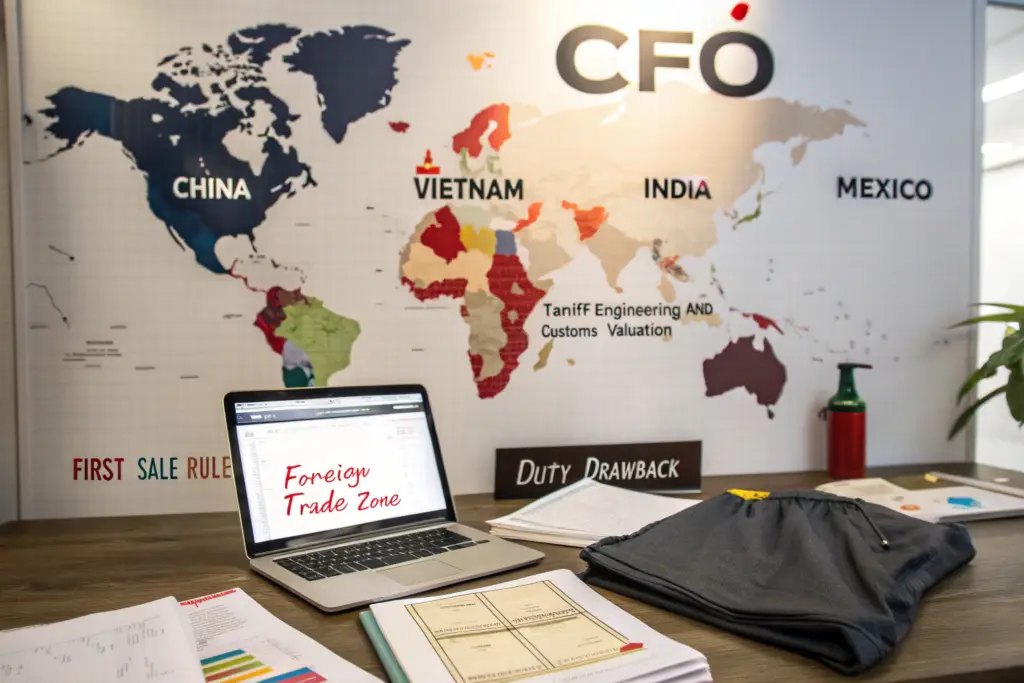
Brands can legally mitigate tariff exposure on classic shorts imports through several established customs strategies, including tariff engineering, which involves designing the garment to fall under a lower-duty classification through specific fiber blends or construction features, utilizing a Foreign Trade Zone or bonded warehouse to defer duty payment until the goods are withdrawn for US consumption, claiming duty drawback on imported fabric that is re-exported as finished shorts, and exploring country-of-origin diversification by shifting production to countries that are not subject to Section 301 tariffs, such as Vietnam or India, or that benefit from free trade agreements with the United States.
What Is Tariff Engineering and How Does It Apply to Shorts?
Tariff engineering is the practice of designing a product to lawfully fall within a lower-duty tariff classification. It is not evasion. It is compliance with a more favorable tariff heading. The product is genuinely what it claims to be. The design choices are made with customs classification as one of the considerations.
For classic shorts, an example of tariff engineering involves the fiber composition. A 100% cotton short attracts a 16.5% duty plus Section 301 tariffs. A short with 51% cotton and 49% linen, by weight, is still classified as a cotton short. But a short with 51% linen and 49% cotton is classified as a linen short, which falls under a different HTS heading with a potentially different duty rate. The decision to adjust the fiber blend by a few percentage points can have a significant duty impact. Another example involves the construction. A short with a specific pocket configuration or a specific closure type might fall under a different subheading. These design decisions must be made in consultation with a customs attorney or a qualified consultant. The garment must be genuinely constructed as specified. This tariff engineering for apparel is a specialized area of customs law.
How Does Country-of-Origin Diversification Reduce Tariff Exposure?
The Section 301 tariffs apply to goods of Chinese origin. The country of origin for customs purposes is the country where the goods were last substantially transformed. A classic short assembled in Vietnam from Chinese fabric is of Vietnamese origin, provided the assembly operation constitutes a substantial transformation.
Vietnam, India, Bangladesh, and other apparel-producing countries are not subject to Section 301 tariffs. The duty on a pair of classic shorts imported from Vietnam is the baseline HTS rate, without the additional 7.5% or 25% Section 301 surcharge. This tariff differential can be significant enough to offset higher production costs in alternative countries. The shift to a new country requires developing new supplier relationships, qualifying new factories, and managing longer lead times. It is a strategic decision, not a tactical one. But for brands with significant China exposure, country-of-origin diversification is the most durable solution to Section 301 risk. This apparel sourcing country diversification strategy has been adopted by many major brands over the past five years. At Shanghai Fumao, we have supported brand partners in evaluating these options while continuing to serve as their reliable China-based manufacturing partner for programs that remain cost-effective despite the tariff environment.
Conclusion
The tariff landscape for US companies importing classic shorts is complex, layered, and subject to change. The baseline HTS duty rate, which can be as high as 16.5% for cotton shorts and 27.9% for synthetic shorts, is the foundation. The Section 301 tariffs on Chinese goods, currently adding 7.5% to 25% on top of the baseline, are the additional layer that has reshaped the economics of importing from China. The de minimis exemption, currently allowing sub-$800 shipments to enter duty-free, is under active policy review and could be restricted or eliminated for Chinese goods.
But this landscape, as daunting as it appears, is navigable. The key is accurate information, proper classification, and proactive planning. A brand that works with a qualified customs broker, classifies its products correctly, understands its Section 301 exposure, and has a contingency plan for policy changes is in a position to manage its tariff costs effectively. Strategies such as tariff engineering and country-of-origin diversification are available to brands that are willing to invest in the planning and the relationships required.
At Shanghai Fumao, we help our brand partners understand their tariff exposure at the product level. We provide the detailed product information that supports accurate customs classification. We monitor the policy environment and communicate changes that affect our partners' costs. And we offer production solutions, including flexible country-of-origin options, that help brands manage their tariff risk. If you are importing classic shorts and want to ensure your tariff exposure is understood and managed, contact our Business Director, Elaine, at elaine@fumaoclothing.com. Let's build a sourcing strategy that accounts for the tariffs of today and prepares for the tariffs of tomorrow.