A Portland-based apparel brand once launched a beautiful collection of lightweight, open-knit cotton sweaters for their Summer resort line. The sweaters were visually stunning—airy, breathable, with a beautiful drape and a soft hand feel. The wholesale accounts loved them. The customers loved them. Then the returns began. The loose, low-density knit structure, which gave the sweaters their beautiful airy quality, also made them extremely prone to snagging, pulling, and losing their shape after minimal wear. A single snag on a door handle or a piece of jewelry would pull an entire row of yarn, creating an irreparable run. The knitting density—specifically the gauge and the GSM—had been selected purely for aesthetic effect, without consideration for the mechanical durability required for a garment that would be worn, packed, and washed. The brand had designed a beautiful textile that was structurally too fragile for its intended use.
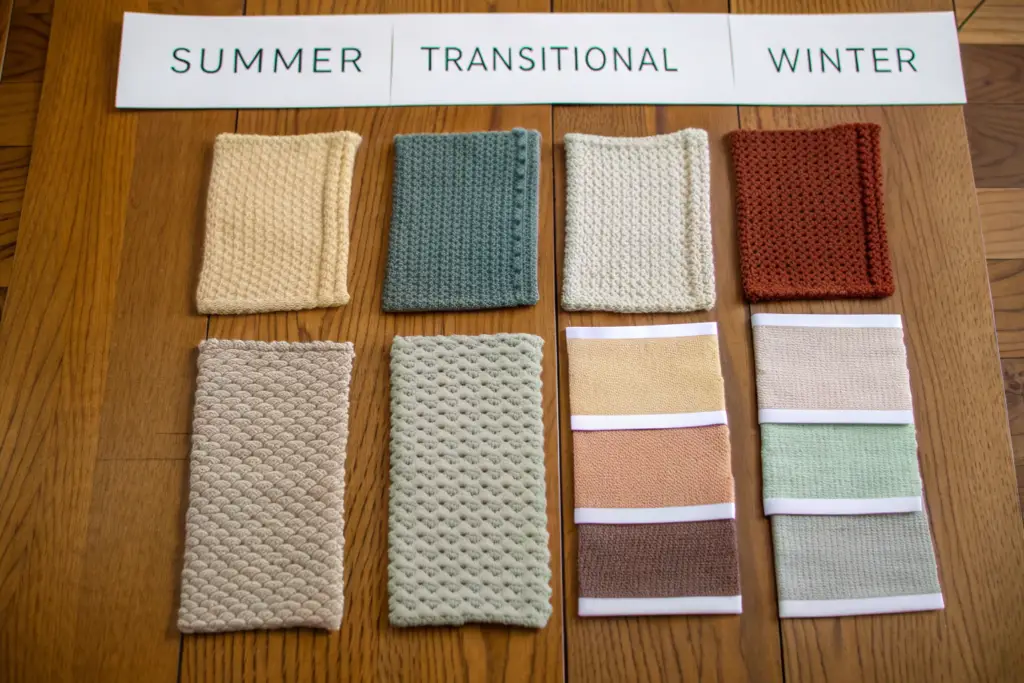
The suitable knitting density for a seasonal garment is determined by the interplay of three specific, measurable parameters: the gauge of the knitting machine, expressed as needles per inch, which sets the fundamental fineness or chunkiness of the knit; the fabric weight, measured in grams per square meter (GSM), which determines the warmth, opacity, and drape; and the stitch type—single jersey, interlock, rib, or fleece—which determines the stretch, recovery, and structural stability, with Summer garments typically requiring a fine gauge of 18-28 GG at a weight of 100-160 GSM in an open, breathable single jersey or mesh structure, Transitional garments requiring a mid gauge of 12-18 GG at 160-260 GSM in a stable interlock or lightweight fleece, and Winter garments requiring a coarse gauge of 5-12 GG at 260-400+ GSM in a dense rib, cable, or heavy fleece structure.
At Shanghai Fumao, I specify knitting density parameters on every tech pack for every seasonal collection. The gauge, the GSM, and the stitch type are not aesthetic preferences; they are engineering specifications that determine whether the garment will keep the wearer comfortable, hold its shape, and survive the mechanical stresses of its intended season.
Why Does "Summer Knitwear" Require a Fine Gauge, Low GSM, and an Open Stitch Structure?
A Miami-based resort wear brand once sourced a beautiful, mid-weight 220 GSM cotton jersey for their Summer t-shirt collection. The fabric was soft, had a beautiful drape, and felt substantial and premium on the hanger. The t-shirts launched in July. Customers in humid, 95-degree Miami heat wore them once and never again. The fabric was too heavy, trapping heat against the body. The tight, dense jersey structure did not breathe, and the wearer felt clammy and overheated within minutes of stepping outside. The garment that felt perfect in an air-conditioned boutique was unwearable in the climate it was designed for.
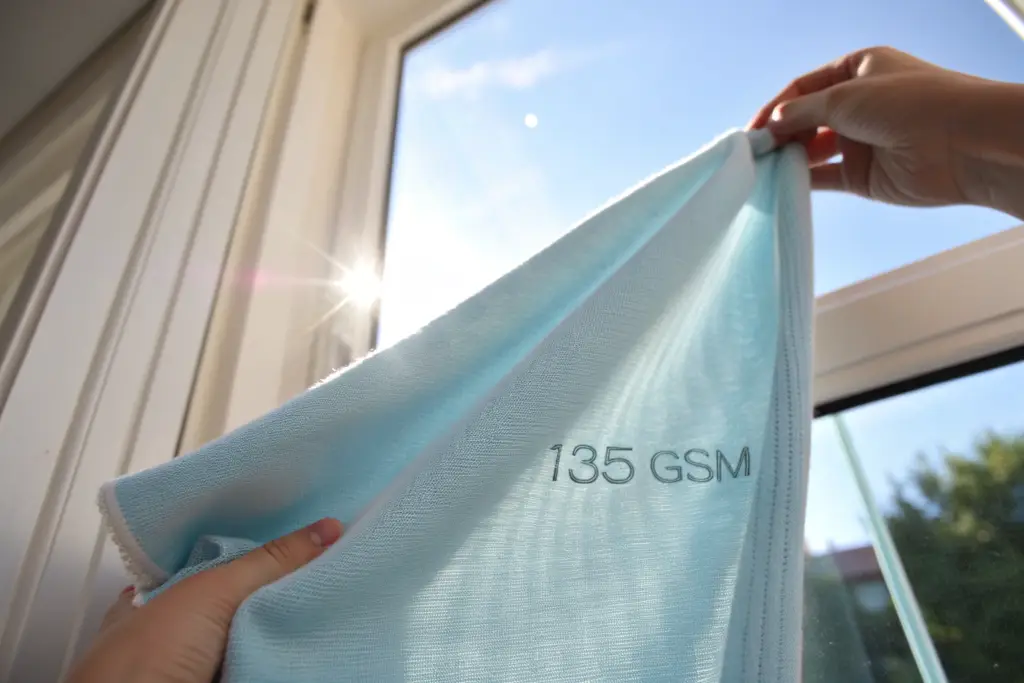
Summer knitwear requires a fine gauge of 18-28 GG, a low weight of 100-160 GSM, and an open stitch structure such as a lightweight single jersey, a mesh knit, or a fine-gauge pointelle because the primary thermal requirement of a Summer garment is to minimize insulation and maximize airflow, and a high-gauge, low-GSM knit with an open structure allows body heat to escape freely through the fabric while ambient air circulates through the stitch openings, creating a cooling effect through convection that a heavier, denser knit cannot provide.
The physics of Summer comfort is about heat dissipation. A high-gauge, low-GSM knit has a low thermal resistance because there is less fiber mass per square meter to trap body heat, and the open stitch structure allows air to flow through the fabric. A 220 GSM dense jersey acts like a thermal blanket, trapping a layer of warm air against the skin.
How Does a "Mesh Stitch" Structure at 18 GG Provide Greater Breathability Than a "Single Jersey" at the Same Gauge and GSM?
A single jersey is a continuous, closed fabric surface with small, evenly spaced stitch openings. A mesh stitch deliberately creates larger, patterned openings in the fabric structure—small holes or eyelets that allow direct airflow through the garment. At the same gauge and GSM, the mesh stitch will provide significantly greater ventilation.
Why Should "Summer Knits" Be Tested for "Snag Resistance" Given Their Open, Lower-Density Structure?
The fine, open stitch structure that provides excellent breathability also exposes individual yarn loops to snagging hazards. A Summer knit with a low GSM and an open stitch should be tested for snag resistance using a mace snagging test method, and the yarn should be selected with a higher twist and a smoother surface to reduce the likelihood of individual loops catching on external objects.
What "Mid-Gauge Transitional Knits" Provide the Ideal Balance of Breathability and Warmth for Spring and Fall?
A Chicago-based contemporary brand once designed their Spring collection using the same heavy 320 GSM fleece they had used for their successful Winter hoodies. The Spring days in Chicago were cool in the morning but warmed to 65 degrees by afternoon. The heavy fleece hoodies were perfectly comfortable during the 8 AM commute but became oppressively hot by noon, leaving the wearer sweating and uncomfortable for the rest of the day. The brand needed a fabric that provided warmth during the cool morning and breathability during the warm afternoon—a true transitional performance that a heavy Winter fleece could not deliver.
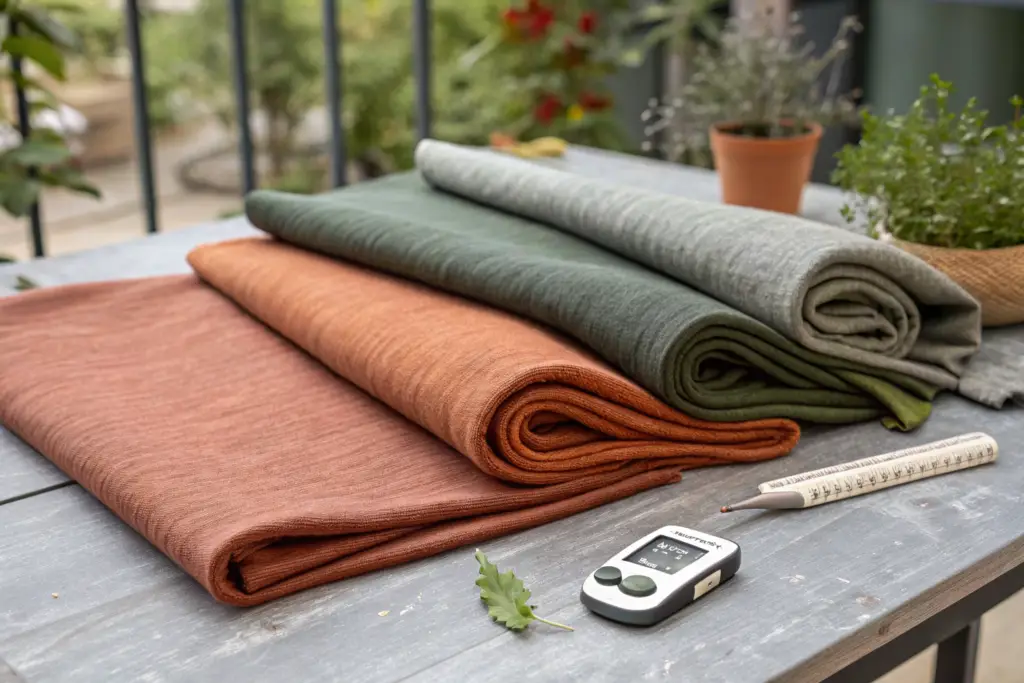
Mid-gauge transitional knits, typically produced on 12-18 GG machines at 160-260 GSM, provide the ideal balance of breathability and warmth for Spring and Fall because they are constructed using a stable stitch structure—such as interlock, lightweight French terry, or fine-gauge rib—that provides enough fabric density to trap a thin, insulating layer of warm air against the skin during cooler morning and evening temperatures, while remaining sufficiently breathable and low in thermal resistance to prevent overheating when ambient temperatures rise during the day, effectively functioning as a thermal buffer that smooths the temperature swings characteristic of transitional seasons.
Transitional dressing is about managing thermal variability. A Winter knit is designed for a consistently cold environment. A Summer knit is designed for a consistently warm environment. A transitional knit must perform across a 20-degree temperature swing within a single day, and its mid-weight, stable structure is engineered precisely for this thermal buffering function.
How Does an "Interlock Knit" at 18 GG and 200 GSM Provide More Dimensional Stability Than a "Single Jersey" at the Same Weight?
An interlock knit is a double-face structure with two interconnected layers of loops, creating a fabric that is essentially two single jerseys locked together. This double-layer construction gives the interlock significantly greater dimensional stability, less edge curl, and better shape retention than a single jersey of the same weight, making it ideal for transitional garments that will be worn as outer layers and need to hold their shape.
Why Is a "Lightweight French Terry" at 240 GSM a Superior Transitional Fabric Compared to a "Heavy Single Jersey" at the Same Weight?
A French terry has a smooth, flat outer face and a soft, looped inner back. The looped back creates a thin layer of insulating air pockets against the skin, providing warmth without adding bulk. A heavy single jersey at the same GSM is dense and compact, providing warmth through mass but lacking the insulating air layer that makes French terry thermally efficient at a lower weight.
What "Heavy-Gauge, High-Density Winter Knits" Provide Genuine Thermal Insulation Without Excessive Bulk?
A Boston-based heritage knitwear brand once designed a Winter sweater collection using a beautiful, soft 12 GG merino wool at 220 GSM—a fabric weight that felt substantial on the hanger and looked premium in product photography. The sweaters launched in November. Customers in Boston, New York, and Chicago wore them through December and January and complained that the sweaters were "not warm enough." The 220 GSM, 12 GG merino was a beautiful transitional-weight fabric, but it lacked the thermal mass and loft required for genuine Winter insulation in a cold climate. The brand's customers expected a Winter sweater to keep them warm in freezing temperatures, and the fabric simply did not have the thermal capacity.
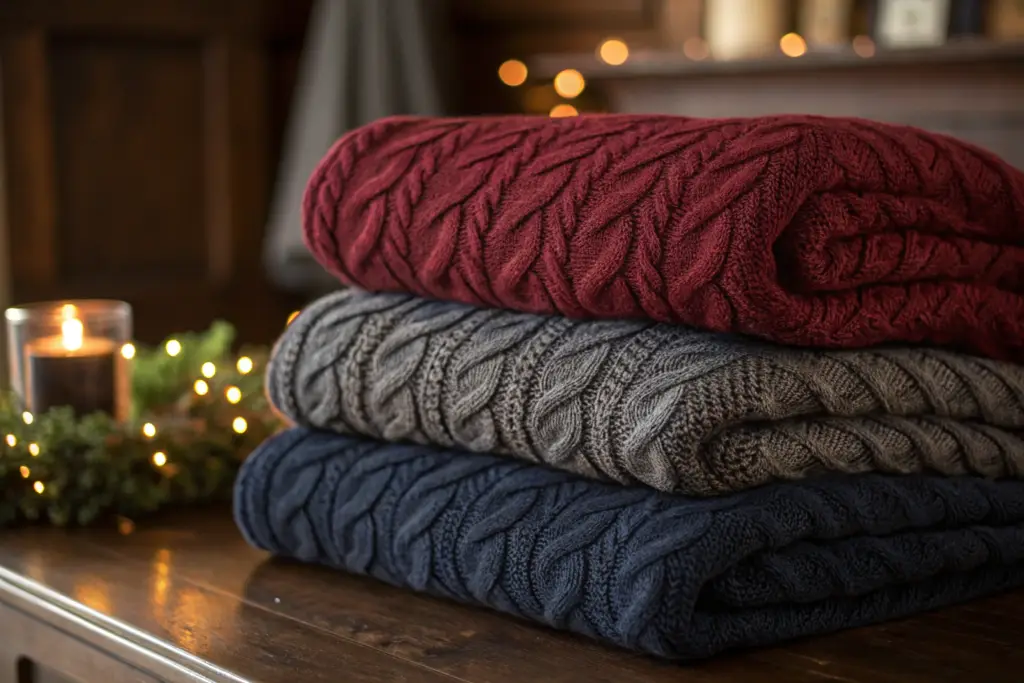
Heavy-gauge, high-density Winter knits, produced on coarse 5-12 GG machines at 280-400+ GSM, provide genuine thermal insulation without excessive bulk by using a thick yarn and a three-dimensional stitch structure—such as a cable knit, a dense rib, a heavy interlock, or a fleece-backed jersey—that creates deep air pockets within the fabric's structure, and it is these trapped air pockets, not the fiber mass itself, that provide the primary insulation by preventing body heat from conducting through the fabric to the colder outside environment, achieving a high thermal resistance with a lower fabric weight than a solid, compact knit of the same insulation value.
The physics of insulation is about trapped air. Still air is an excellent insulator. A heavy cable-knit structure creates deep, three-dimensional air pockets that trap body heat. A dense, compact knit of the same weight but with a flat structure has fewer air pockets and lower thermal resistance. The insulation comes from the structure, not just the mass.
How Does a "Cable-Knit Structure" at 5 GG and 350 GSM Provide More Insulation Than a "Flat Jersey" at the Same Weight?
A cable-knit structure creates deep, raised, three-dimensional patterns with significant loft—the thickness of the fabric measured from face to back. The loft creates large, deep air pockets that trap body heat efficiently. A flat jersey at the same weight is thinner and denser, with smaller, shallower air pockets and lower thermal resistance.
Why Is a "Fleece-Backed Jersey" at 380 GSM More Thermally Efficient Than a "Double-Layer Jersey" at the Same Total Weight?
A fleece-backed jersey has a dense, soft pile of brushed fibers on the interior face. This pile structure creates millions of tiny air pockets against the skin, trapping a layer of warm air immediately next to the body. A double-layer jersey achieves the same total weight by stacking two flat fabric layers, which creates less internal air space and lower thermal efficiency.
How Do You Specify "Knitting Density Parameters" on a Tech Pack to Ensure the Factory Produces the Correct Seasonal Weight?
A Nashville-based casualwear brand once specified "medium weight sweater knit" on their tech pack. The factory, interpreting "medium weight," selected a 200 GSM single jersey cotton. The brand had envisioned a 260 GSM interlock with a more substantial hand feel. The bulk order arrived, and the sweaters were too light, too thin, and lacked the structured drape the brand's design required. The word "medium" had been interpreted differently by the brand and the factory, and the difference in interpretation produced a garment that did not match the designer's vision.
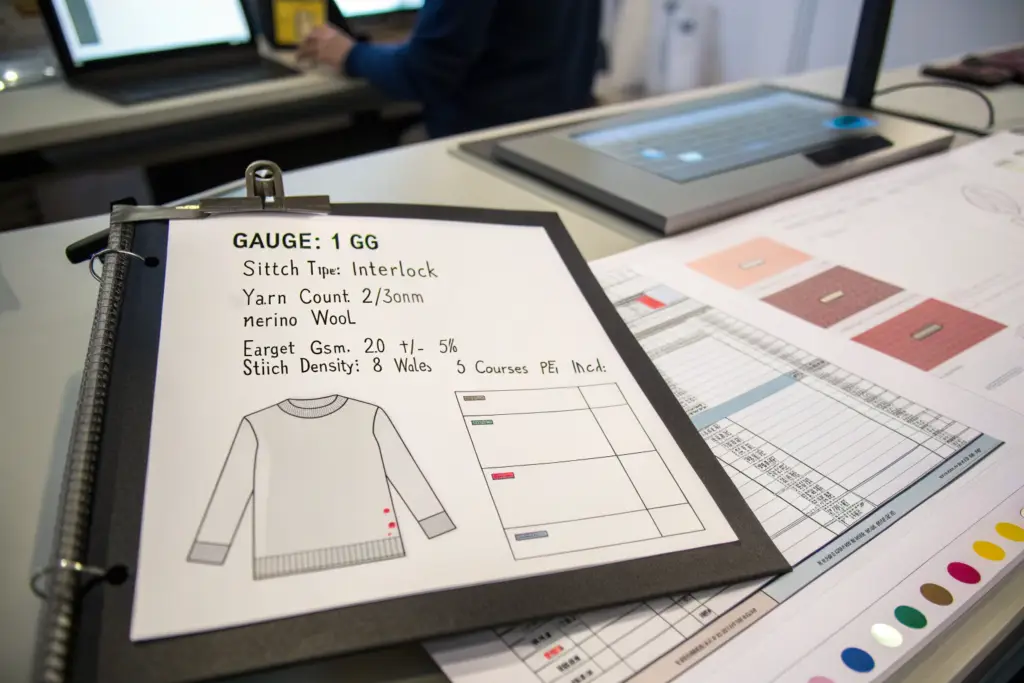
To specify knitting density parameters on a tech pack and ensure the factory produces the correct seasonal weight, the brand must provide four specific, measurable values: the machine gauge in GG, the stitch type by name and ISO or industry-standard code, the target fabric weight in GSM with a tolerance of +/- 5%, and the stitch density expressed as wales per inch and courses per inch, supplemented by a physical, signed reference swatch that the factory can measure and compare against, replacing the subjective word "medium" with an objective, measurable specification that can be verified with a GSM scale and a pick glass on the factory floor.
"Weight" is a sensory description. "220 GSM, 14 GG interlock, 28 wales x 36 courses per inch" is a manufacturing specification. The factory's QC team can cut a swatch from the bulk fabric, weigh it on a digital GSM scale, and confirm it measures 220 GSM within the 5% tolerance. The specification is testable, verifiable, and enforceable.
How Is "Wales Per Inch and Courses Per Inch" Measured, and Why Does It Matter More Than GSM Alone?
Wales are the vertical columns of stitches in a knit fabric. Courses are the horizontal rows. The wale and course density, counted using a pick glass magnifier, defines the tightness of the knit structure. Two fabrics can have the same GSM but different wale and course densities, producing different drape, stretch, and opacity. Specifying both GSM and stitch density provides a complete definition of the fabric's structure.
Why Must the "Reference Swatch" Be a Physical Sample, Not a Digital Photograph?
A digital photograph cannot be weighed, measured, or touched. A physical reference swatch can be weighed on a GSM scale, its stitch density counted with a pick glass, and its hand feel evaluated tactilely. It provides the factory with a physical, three-dimensional target to replicate, not just a numerical specification to interpret.
Conclusion
Suitable knitting densities for different seasonal wears are defined by the measurable parameters of machine gauge, fabric weight in GSM, and stitch type—not by subjective terms like "lightweight" or "heavy." Summer garments require a fine gauge of 18-28 GG at 100-160 GSM in an open, breathable structure such as a single jersey or mesh knit that maximizes airflow and minimizes thermal insulation. Transitional garments for Spring and Fall require a mid-gauge of 12-18 GG at 160-260 GSM in a stable structure such as interlock, lightweight French terry, or fine-gauge rib that balances breathability with a thin insulating air layer. Winter garments require a coarse gauge of 5-12 GG at 280-400+ GSM in a three-dimensional structure such as cable-knit, dense rib, or fleece-backed jersey that creates deep, insulating air pockets. The tech pack must specify these parameters in objective, measurable terms—gauge, GSM with tolerance, stitch type, wale and course density, and a physical reference swatch—so the factory can produce the correct seasonal weight without relying on subjective interpretation.
At Shanghai Fumao, I specify knitting density parameters on every seasonal tech pack and provide a physical reference swatch for every fabric quality. My QC team verifies the GSM and stitch density of incoming fabric against the specification before the fabric is released to the cutting table. A "medium weight" sweater is a wish. A "220 GSM, 14 GG interlock" sweater is a product.
If you are a brand buyer developing a seasonal knitwear collection and you want a manufacturing partner who specifies knitting density in objective, measurable parameters, contact my Business Director, Elaine. She can share our knitting density specification template, our seasonal fabric weight guide, and physical reference swatches from our current fabric library. Reach Elaine at: elaine@fumaoclothing.com. Specify the gauge, the GSM, and the stitch type—not the adjective.