
A brand owner sent me an email in the spring of 2024 that I still have pinned to my desktop. He wrote, "I thought I was paying $18,000 for this order. My freight forwarder just sent me an invoice for an additional $4,200. Port fees, customs exam, demurrage, something called an MPF. I don't know what half of these charges are. My margin on this order is now negative. Can you explain what happened?" He had bought his goods on an FOB basis, Free on Board. The FOB price he negotiated with his factory was $18,000. That price covered the cost of the garments and the trucking to the port of Shanghai. It did not cover ocean freight, marine insurance, U.S. customs clearance, duties, the Merchandise Processing Fee, the Harbor Maintenance Fee, the customs bond, the potential customs examination fee, the port terminal handling charges at the U.S. destination, or the final trucking to his warehouse in Denver. All of those costs were on his side of the transaction. He did not know that. He had compared the FOB price from his factory to a DDP price from us and chosen the FOB because it was $3,000 lower. By the time the container was in his warehouse, the FOB route had cost him $4,200 more than the DDP route would have, and he had spent hours of his own time managing a freight forwarder he did not know and a customs process he did not understand. The cheapest price had been the most expensive outcome.
Fumao Clothing's DDP vs FOB Calculator reveals the true, fully landed cost of a garment shipment by itemizing every post-FOB cost line—ocean freight, insurance, duty, MPF, HMF, bond, exam fees, port charges, and final delivery—and comparing it to our all-inclusive DDP price, exposing the hidden cost gap that a simple FOB quote conceals.
The fundamental problem with FOB pricing for small and medium-sized brands is information asymmetry. The factory quotes an FOB price. The brand owner, unfamiliar with the arcane cost structure of international logistics, interprets this as the total cost of getting the goods to their door. The factory sales representative does not correct this misunderstanding, because a lower-appearing price is easier to sell. The brand owner budgets against the FOB price. Months later, the goods arrive, and a cascade of invoices from the freight forwarder, the customs broker, the port authority, and the trucking company hits the brand's accounts payable. The brand owner has no ability to predict, audit, or contest these invoices. They pay them because the alternative is the container sitting in a port warehouse accumulating daily storage charges. The experience is financially stressful, operationally distracting, and trust-destroying. Our DDP model and the calculator we built to explain it are designed to eliminate this entire experience. A DDP price is a single, all-inclusive number. The garments. The freight. The insurance. The customs. The duties. The delivery. One price. One invoice. One delivery. Zero surprises.
Why Does the "FOB Mirage" Cost Small Brands Thousands?
The term "FOB" sounds like a complete transaction. It is not. FOB, under Incoterms 2020, means the seller delivers the goods on board the vessel nominated by the buyer at the named port of shipment. The seller's obligation ends when the container crosses the ship's rail in Shanghai or Ningbo. From that point forward, every single cost and every single risk transfers to the buyer. The buyer is now the shipper of record on the ocean bill of lading. The buyer is the importer of record on the U.S. customs entry. The buyer is legally and financially responsible for everything that happens between a container port in China and a warehouse in the United States. Most small and medium-sized brand owners have never been an importer of record before. They do not have a continuous customs bond. They do not understand the difference between a formal entry and an informal entry. They do not know what a customs examination entails or what it costs. They have no relationship with a freight forwarder, so they are paying spot market rates for ocean freight, not contract rates. The FOB price is a mirage. It appears to be the total cost, but it is only the visible, small fraction of the actual cost journey. The brand owner who falls for the mirage budgets for the FOB number, spends the difference on marketing or inventory, and then faces a cash flow crisis when the real invoices arrive.
The FOB mirage costs small brands thousands because it hides the ocean freight spot market premium, the mandatory U.S. customs fees, the unpredictable port demurrage charges, and the costly mistakes of inexperienced customs documentation behind a deceptively low factory-gate price.
What Hidden Fees Does a Standard FOB Invoice Exclude?
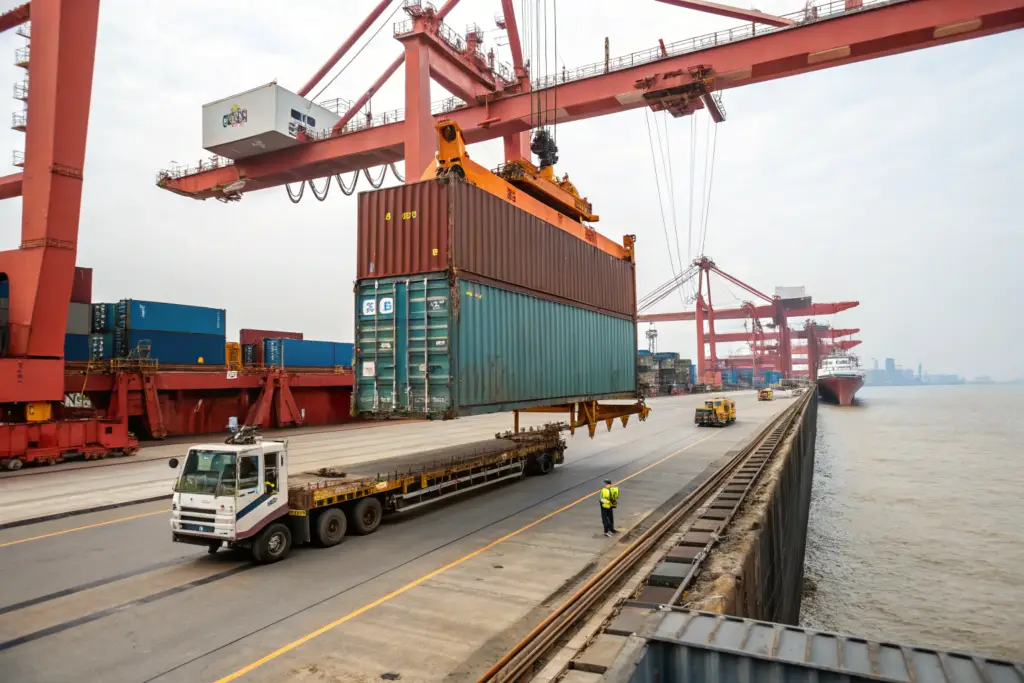
A standard FOB invoice from a factory contains a single line: the total FOB value of the goods. The hidden fees that follow are numerous, complex, and individually small but collectively large. The first is ocean freight. A brand shipping a single 20-foot container from Shanghai to Los Angeles pays the spot market rate, which can fluctuate by thousands of dollars depending on the season, the global shipping capacity, and the fuel surcharges. The brand has no negotiating power. The second is marine cargo insurance, which is optional but reckless to forgo. The third, and the most opaque, are the U.S. destination charges. These include the Terminal Handling Charge at the U.S. port, which is the fee the port charges to unload the container from the ship and move it to the container yard. The Merchandise Processing Fee, or MPF, is a U.S. Customs and Border Protection fee assessed on all formal entries, calculated at 0.3464 percent of the entered value, with a minimum of $27.75 and a maximum of $538.40. The Harbor Maintenance Fee, or HMF, is an additional 0.125 percent of the entered value on ocean freight imports. Then there is the customs bond. A single-entry bond costs approximately 0.5 to 0.8 percent of the total entered value. If the brand imports more than twice a year, a continuous bond is more economical but requires an upfront annual payment.
The most financially dangerous hidden fee is the customs examination. U.S. Customs and Border Protection randomly selects containers for examination. A Non-Intrusive Inspection, or NII, where the container is X-rayed, costs a few hundred dollars. A physical Tail Gate Exam, where customs officers open the container doors and visually inspect the cargo, costs between $300 and $800 depending on the freight forwarder's charges. A full Intensive Exam, where the entire container is unloaded and every carton is inspected, costs between $1,500 and $5,000 and adds a week of delay. During that week, the container is accruing port storage fees and demurrage, which is the penalty the shipping line charges for not returning the empty container to the port within the free days allowance. A standard free days allowance is 4 to 7 days. After that, the per-diem charge escalates rapidly. A brand that is not prepared for these fees can face a situation where the cost of extracting the container from the port exceeds the remaining margin on the goods. We have seen this happen. The FOB invoice did not warn them. Our DDP calculator includes all of these fees in the single price, and we absorb the risk of customs examination and port delays.
How Does DDP Turn Variable Logistics Costs into a Fixed Price?
DDP, Delivered Duty Paid, is the mirror image of FOB under Incoterms 2020. The seller bears all costs and all risks of transporting the goods to the named place of destination, cleared for import, with all duties and taxes paid. The seller arranges and pays for the export clearance, the ocean freight, the marine insurance, the U.S. import customs clearance, the duties, the MPF, the HMF, the customs bond, any customs examination fees, the port terminal handling charges, any demurrage or storage charges, and the final trucking to the buyer's warehouse or Amazon FBA center. The buyer pays a single, all-inclusive price and receives the goods at their door.
How can we offer a fixed DDP price for a logistics chain with so many variable costs? The answer is scale and risk pooling. We ship multiple containers every week to the United States. We have a contracted ocean freight rate with our carrier that is significantly lower than the spot market rate. We hold a continuous customs bond that covers all our shipments, reducing the per-shipment bond cost to a marginal amount. We process hundreds of customs entries per year, which gives us a flat-fee arrangement with our customs broker, not a per-entry variable fee. We understand the customs documentation requirements perfectly, which reduces our examination rate to near zero because our paperwork is always complete and correct. Most importantly, we self-insure against the variable costs of port delays and examinations. The DDP price we quote includes a small, calculated risk premium for these low-probability but high-impact events. Because we pool the risk across all our shipments, the risk premium is small, and the price to the individual brand is stable and predictable. The brand receives a single line item on their purchase order. That number is the total cost of the goods, delivered to their door, with all taxes and duties paid. There is no freight forwarder to call, no customs entry to file, no exam to panic about, and no port storage invoice arriving six weeks after the goods are delivered. The brand owner who used our DDP model does not receive a surprise $4,200 invoice. They receive a delivery confirmation. The DDP price is not a logistics service. It is peace of mind, priced and guaranteed.
How to Use the Calculator to Compare Real Landed Costs?
Our DDP vs FOB calculator is a simple, transparent spreadsheet tool we provide to any brand owner considering an order with us. It is not a black box. Every line item is visible, every assumption is stated, and every cost input can be adjusted by the brand owner to match their specific situation. The purpose of the calculator is not to force a choice in our favor. It is to ensure the brand owner makes a fully informed decision based on the true comparative landed cost, not on the misleading FOB factory-gate price. The calculator has two columns. The left column is the FOB Estimate. The brand owner inputs the FOB price they have received from any supplier, including us. The calculator then adds, line by line, the estimated ocean freight for the container size and the destination port, the marine insurance at a standard rate of 0.3 percent of the commercial invoice value, the U.S. customs duty at the correct HTS code rate for the specific garment type, the Merchandise Processing Fee, the Harbor Maintenance Fee, the customs bond fee, a conservative estimate for port terminal handling and documentation fees, and the final trucking cost to the delivery address based on the zip code distance from the port. The right column is the DDP price. It is a single number we provide based on the same order specifications.
Using the calculator reveals that the apparent FOB savings are almost entirely consumed by freight, duty, and port fees, and that the DDP price, when all hidden costs are itemized, is consistently within 3 to 5 percent of the true FOB landed cost, while eliminating the financial risk of customs delays and examination fees.
What Data Should You Input for an Accurate FOB Estimate?
An inaccurate input produces an inaccurate comparison. The most common error a brand owner makes when estimating their FOB landed cost is underestimating the ocean freight rate. A brand owner searches "shipping container cost China to USA" on Google, finds a rate from 2021, or finds a misleadingly low base rate that excludes the fuel surcharge, the peak season surcharge, and the terminal handling charges, and plugs that number into their budget. The real cost is higher. We update the ocean freight rate in our calculator quarterly based on the actual spot market rates quoted by three major freight forwarders for less-than-container-load and full-container-load shipments. We use the median rate. We include the fuel surcharge and the peak season adjustment.
The second critical input is the correct HTS code and duty rate. A knitted cotton t-shirt has a different HTS code and a different duty rate than a woven polyester blouse. Misclassification can result in an underpayment of duty, which is a customs violation with penalties, or an overpayment, which erodes margin. Our calculator includes a built-in HTS code lookup for the most common apparel categories, with the duty rate automatically populated. The third critical input is the delivery address zip code. The final trucking cost from the port to a warehouse in rural Montana is vastly different from the trucking cost to a warehouse in Long Beach, California. The calculator uses a standard freight rate matrix to estimate the trucking cost based on distance from the port of entry. The brand owner can override any of these inputs with their own verified numbers if they have them. The calculator is a tool for transparency, not a sales argument. If the brand owner's own freight forwarder has quoted them a lower rate, they should use that number. The point is to ensure the comparison is complete and honest.
Can a Calculator Predict Customs Exam Risk and Cost?
A calculator cannot predict whether a specific container will be pulled for a customs examination. That is a random variable. A calculator can, however, incorporate the statistical probability and the financial consequence of an examination into the landed cost comparison. Our calculator includes a small, optional "Exam Risk Cost" line item in the FOB Estimate column. It is calculated by taking the industry-average examination rate for apparel imports, approximately 3 to 5 percent, multiplying it by the average cost of a combined exam scenario, approximately $1,200 for a mix of X-ray and tailgate exams, and adding it as a small probabilistic cost. For a 500-unit order, this risk-adjusted cost is typically between $40 and $80. It is a tiny number, but its presence on the FOB Estimate column reminds the brand owner that this cost exists and will be their responsibility.
In the DDP column, the Exam Risk Cost is zero. Not because the risk is absent, but because the risk is absorbed by us. We do not charge our DDP clients for customs examinations. We pay the exam fees, we pay the demurrage during the exam delay, and we pay the port storage. The DDP price is a fixed, guaranteed price that does not change regardless of what happens during the customs clearance process. This is a genuine financial risk transfer. The brand owner, under an FOB arrangement, carries an unhedged, binary risk. A single intensive exam can cost thousands of dollars and wipe out the margin on the entire order. Under our DDP arrangement, that risk is ours. The calculator makes this risk transfer visible. A brand owner who sees the Exam Risk Cost line item for the first time often has a moment of realization about the true cost structure of FOB sourcing. The risk is not theoretical. It is real, it is quantifiable, and it is the brand's liability under FOB.
How Does a Predictable Landed Cost Change Your Cash Flow Planning?
Cash flow is the lifeblood of a small or medium-sized apparel brand. A predictable cash flow allows a brand owner to invest confidently in marketing, to place larger re-orders for winning styles, and to pay their team on time. An unpredictable cash flow creates a perpetual state of financial anxiety. The brand owner holds excess cash in reserve, not for growth, but as a buffer against an unknown logistics invoice. Growth opportunities are missed because cash is frozen in a contingency fund. FOB sourcing is a direct source of cash flow unpredictability. The brand owner commits to a purchase order knowing the FOB price, but not knowing the final landed cost. The freight rate might spike between the order date and the ship date. The customs exam might trigger. The port might be congested, and demurrage might accrue. The final invoice from the freight forwarder arrives weeks after the goods, and it is a variable, unbudgeted expense. The brand owner's cash flow model, built on the FOB price, is inaccurate by design.
Predictable DDP landed costs transform cash flow planning from a reactive scramble into a proactive financial strategy, enabling accurate unit economics, confident marketing investment, and the financial stability to scale from small test orders to full production runs without the fear of a hidden logistics invoice destroying the margin.

How Does Certainty on Unit Cost Impact Your Retail Pricing Strategy?
Retail pricing is a calculation. The brand owner takes the fully landed unit cost, multiplies it by a target markup, and arrives at a retail price. If the fully landed unit cost is unknown, the retail price is a guess. A guess that is too low destroys margin. A guess that is too high makes the product uncompetitive. FOB sourcing introduces a fundamental uncertainty into the unit cost that propagates through the entire pricing model. The brand owner might budget a landed unit cost of $25 based on the FOB price and an estimated freight and duty cost. If the actual landed cost comes in at $28, and the retail price has already been set and published on the website and in wholesale catalogs, the brand's margin has shrunk from the planned 60 percent to 53 percent. Over a 1,000-unit run, that is $3,000 of lost margin, unrecoverable because the price cannot be changed retroactively.
DDP pricing eliminates this margin uncertainty. The landed unit cost is a fixed, contracted number before the purchase order is issued. The brand owner can calculate the exact margin for every unit, set the retail price with precision, and have full confidence that the margin will be realized when the goods are sold. This precision also enables more sophisticated pricing strategies. A brand can confidently offer a wholesale discount to a retailer, knowing their own margin is secure. A brand can run a promotional discount for a Black Friday sale without the fear that a hidden logistics cost will turn the promotion into a loss. The financial control that DDP pricing provides is not a small operational convenience. It is a strategic competitive advantage, particularly for direct-to-consumer brands that operate on data-driven unit economics.
What Happens to the "Cost of Capital" When You Free Up a Contingency Fund?
The cost of capital is the opportunity cost of cash that is tied up in unproductive uses. A brand that sources FOB must hold a large cash contingency fund to cover the unpredictable tail-end logistics costs. That cash sits in a low-interest business savings account, earning near zero, while it waits for a freight forwarder's invoice that may or may not arrive. That cash cannot be used to purchase additional inventory for a proven best-seller. It cannot be invested in a social media advertising campaign that could acquire new customers. It cannot be used to hire a design freelancer for the next collection. It is frozen capital, and the brand is paying an invisible tax on its own financial risk management.
When a brand switches to DDP pricing, the contingency fund for logistics is no longer necessary. The DDP price is the total cost. There are no post-delivery invoices. The brand can safely reallocate the contingency fund to revenue-generating activities. The return on that liberated capital is significant. A brand that moves $20,000 from a contingency savings account to a Meta advertising campaign that generates a 3x return on ad spend has turned that $20,000 into $60,000 in revenue. The same $20,000 sitting in a savings account earned $50 in interest. The true cost of the FOB contingency fund is not the interest rate. It is the lost growth. Our calculator does not model the cost of capital liberation explicitly, but the brand owners who have switched to our DDP model consistently report that the ability to redeploy their contingency cash into marketing and inventory was one of the most significant, and unexpected, financial benefits of the switch. They did not just save money on logistics. They unlocked growth capital they did not know they had.
Conclusion
The DDP vs FOB Calculator is not a sales tactic. It is an educational tool that exposes the structural financial inequality between the factory's FOB quotation and the brand's actual landed cost. The traditional FOB model transfers all post-port costs and all post-port risks to the buyer, who is usually the party least equipped to predict, manage, or absorb them. The buyer budgets against the FOB number, which is a partial cost, and then experiences the remainder of the cost as a series of unpredictable, stressful, margin-destroying invoices. The DDP model consolidates all costs into a single, contracted, guaranteed price. The buyer pays one invoice, receives the goods at their door, and never interacts with a freight forwarder, a customs broker, or a port authority. The financial outcome is a predictable, stable landed cost that enables precise unit economics, confident retail pricing, and the liberation of cash previously trapped in logistics contingency funds.
The calculator makes this comparison explicit, line by line, risk by risk. It reveals that the apparent savings of FOB are largely illusory when the full cost picture is assembled, and that the small premium of DDP is purchasing not just logistics services, but financial certainty and operational peace of mind. For a brand that values its time, its mental bandwidth, and its ability to plan for growth, the DDP route is not an expense. It is an investment in a scalable, predictable supply chain.
If you are currently evaluating FOB versus DDP options for your upcoming production order, or if you have been burned by a post-delivery freight forwarder invoice and want to understand how to prevent it from happening again, I invite you to use our calculator with your own numbers. Contact our Business Director, Elaine, at elaine@fumaoclothing.com to request a copy of the DDP vs FOB Calculator and to schedule a 20-minute walkthrough of a landed cost comparison specific to your order volume, your product category, and your delivery zip code. Let's replace your logistics uncertainty with a single, guaranteed number.