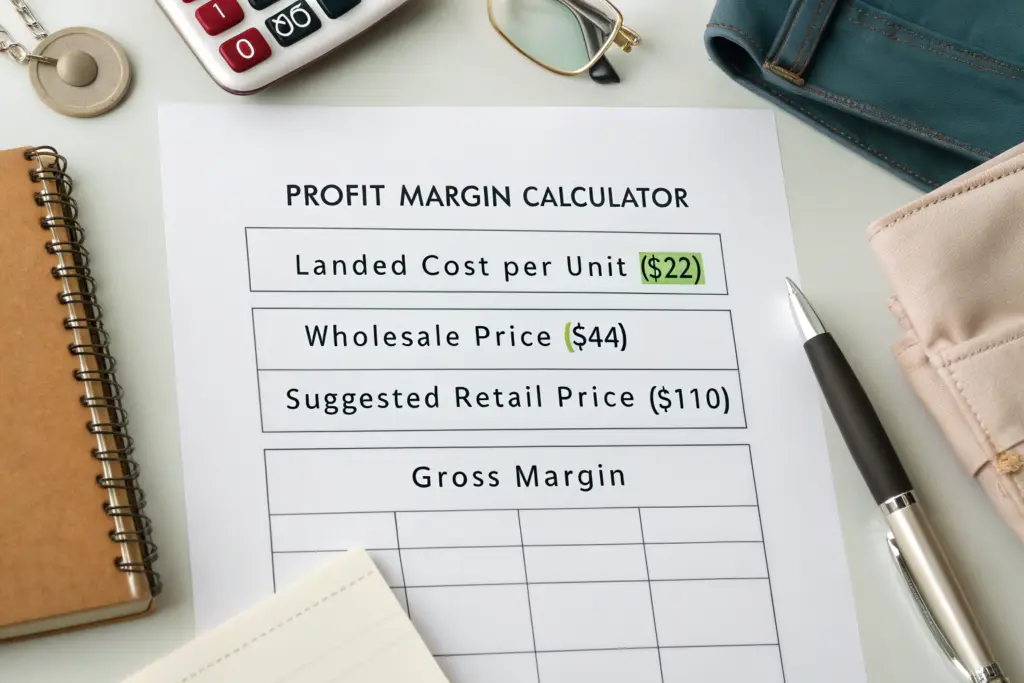
You have received your first shipment of beautifully made garments from your CMT or private label factory. You have your exact landed cost. Now comes the moment of truth: setting the retail price. Price it too low, and you will not have enough margin to cover your marketing, your operations, and still make a profit. Price it too high, and your customers will not buy. A brand owner told me, "Pricing felt like the final exam of my business plan. I knew my costs, but I was terrified of getting the markup wrong. I didn't want to leave money on the table, but I also didn't want to scare away customers."
The perfect retail markup for your wholesale clothing imports is not a single, magic number. It is a strategic calculation based on a deep understanding of your total landed cost, your brand's positioning, and the standard industry formulas. The two most common methods are: 1) The Keystone Markup (a simple 2x or 2.2x multiplier on your landed cost, common for private label brands), and 2) The Margin-Based Formula (a target Gross Margin, typically 50-60% for direct-to-consumer, which back-calculates the required price). The "perfect" markup is the one that maximizes your profit while aligning with your customer's perceived value.
At Shanghai Fumao, we believe our partnership is successful when your business is profitable. Understanding your true costs is the first step in a smart pricing strategy. Let me walk you through the essential calculations and strategic considerations to find your perfect retail markup, ensuring your brand is both competitive and highly profitable.
What Is Your True "Landed Cost" Per Unit and Why Is It the Foundation?
The single biggest mistake in pricing is using the wrong cost basis. You cannot set your retail price based on the factory's FOB or CMT labor quote. You must use your Total Landed Cost—the all-in, true cost of getting a single, ready-to-sell unit into your warehouse (or your customer's hands). Every overlooked expense at this stage is a direct hit to your eventual profit margin. This calculation is the non-negotiable foundation of a sound pricing strategy.
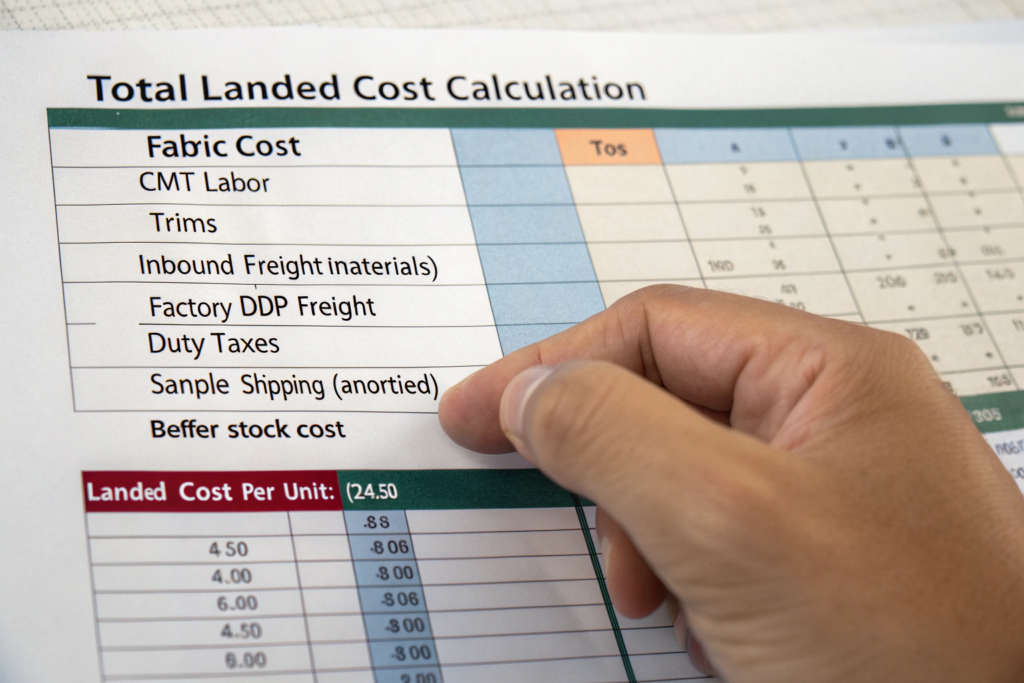
Your True Landed Cost is the sum of all expenses required to get one saleable unit to your distribution point. This includes: the factory's CMT or FOB price, all raw material costs (if CMT), all inbound freight for materials, all logistics for the finished goods (including DDP charges, customs duties, and insurance), the cost of sampling amortized over the production run, and the cost of your buffer stock. Divide this total cost by the number of units you actually have available to sell.
A brand founder I advised was setting her retail price based on her factory's CMT quote, thinking she had a huge margin. When we sat down and added all her real costs—the air freight for the zippers, the DDP charges on the final shipment, the 5% fabric buffer she had to buy—her true landed cost per unit was nearly 35% higher than she thought. She was shocked. She immediately adjusted her pricing model and saved her business from a disastrously unprofitable season. This is the essential discipline of accurate costing. We help our partners build this complete picture with our transparent costing tools .
What Are the Most Commonly Forgotten Costs in a Landed Cost Calculation?
The "phantom" costs that often get missed include:
- Sample Development Costs: The cost of all fit samples and their shipping, amortized over the production run.
- Inbound Material Freight: The cost of shipping your fabric and trims to the CMT factory.
- Buffer Stock Cost: The extra 3-5% of materials you had to buy, but which did not become saleable units.
- Warehousing & Fulfillment: The cost of storing and shipping each unit to your end customer.
Every dollar counts. An accurate cost accounting model is your best friend.
How Do You Factor in the Cost of Your Own Time (The "Time Tax")?
This is a CMT-specific cost. How many hours did you spend sourcing materials, managing logistics, and coordinating with the factory? If you are a solo founder, your time has immense value. Assign an hourly rate to your operational work and add a portion of that cost to your total landed cost. This reveals the true profitability of your model. This is an honest conversation we have with our CMT partners .
What Are the Standard Markup and Margin Formulas for a Private Label Brand?
Once you have your true landed cost, you need a reliable formula to translate that into a retail price. While the "right" price is ultimately determined by your market and brand, starting with a proven industry formula gives you a strategic baseline. The two most fundamental are the simple Keystone Markup and the more precise Target Margin Method.
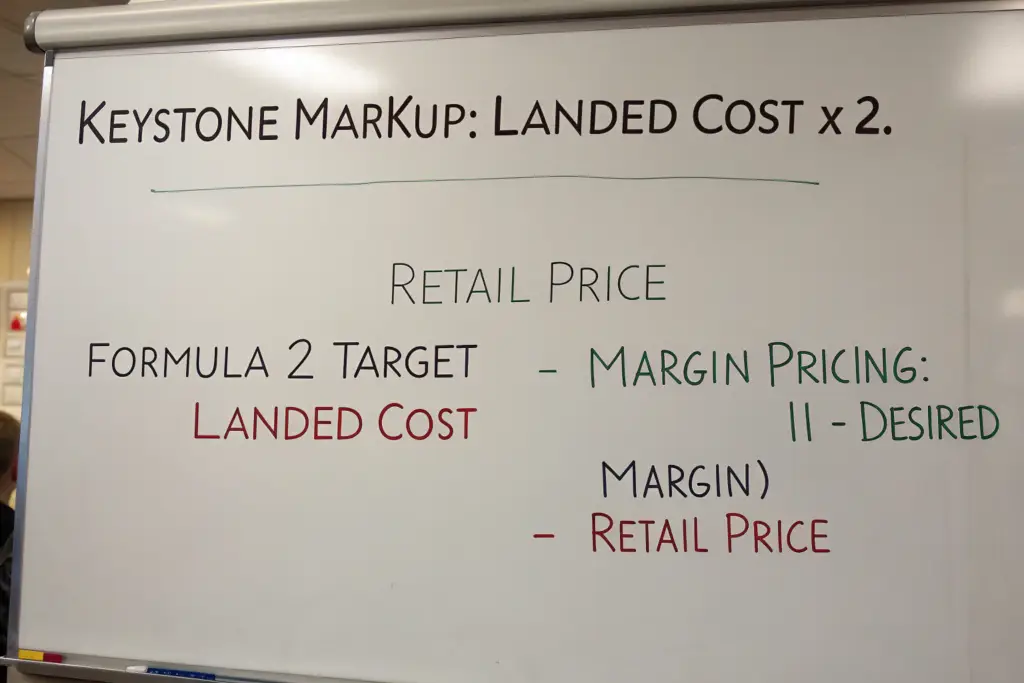
The two standard pricing formulas are: 1) Keystone Markup: Retail Price = Landed Cost x 2.2 (or 2.5 for a more premium brand). This simple multiplier is a common starting point. 2) Target Margin Method: Retail Price = Landed Cost / (1 - Desired Gross Margin). For example, if your landed cost is $20 and you want a 60% gross margin, your price is $20 / (1 - 0.60) = $50. This method gives you precise control over your profitability.
A brand selling elevated basics uses the Target Margin Method. Their landed cost for a signature tee is $18. They have a strict business model that requires a 65% gross margin to cover their high marketing spend and still be profitable. Their formula is $18 / (1 - 0.65) = $51.42. They price the tee at $52. This is not an arbitrary number; it is a business requirement. They know that every tee they sell at full price contributes exactly the margin they need. This is the power of data-driven pricing. We help our partners build these models with our cost transparency .
What Is the Difference Between "Markup" and "Margin"?
This is a crucial distinction.
- Markup is the percentage added to the cost to arrive at the selling price. A 100% markup on a $20 cost is a $40 price (cost x 2).
- Margin is the percentage of the selling price that is profit. A $40 price with a $20 cost has a 50% margin ($20 profit / $40 price).
Many new brands confuse the two, which can lead to accidentally pricing themselves into a loss. Always think in terms of your target gross margin. This is the language of a professional financial plan .
How Does Your Brand's Positioning Affect the Markup You Can Command?
The formula provides a baseline, but your brand's positioning determines the final multiplier. A value-oriented brand might use a 2.0x keystone. A contemporary brand might use 2.5x. A luxury brand, with a powerful story and unique materials, might use a 3x-4x markup or even higher. The strength of your brand and the uniqueness of your product are what justify a higher multiple. This is the art of brand-based pricing .
How to Validate Your Markup with a Competitive Market Analysis?
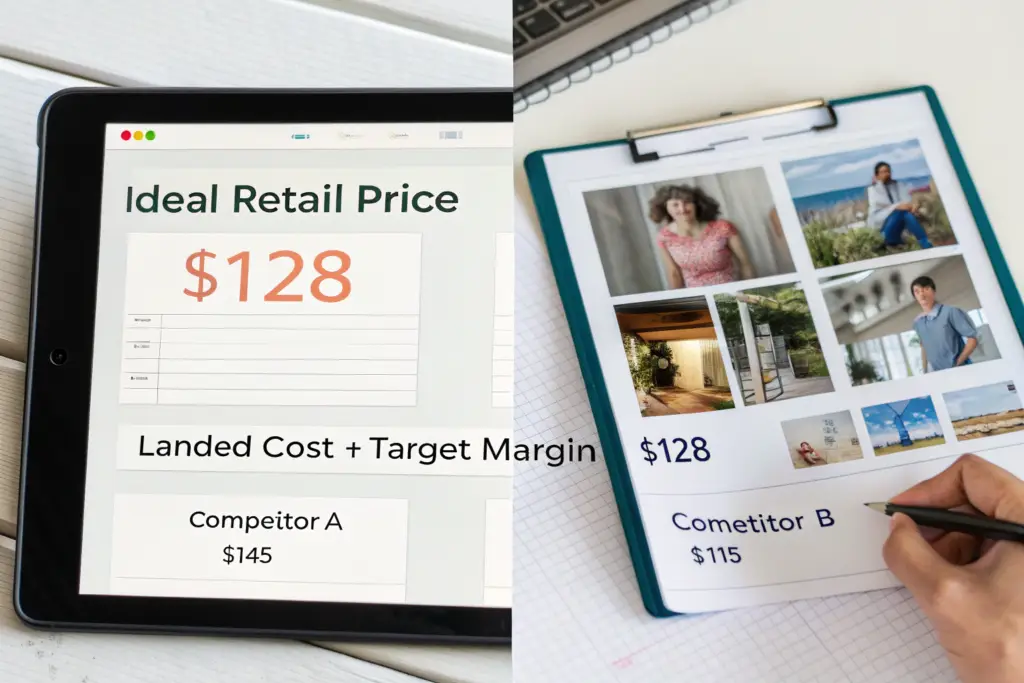
Your internal math might say you need to charge $128 to hit your target margin. But what if your closest competitors are selling a similar product for $89? You cannot operate in a vacuum. The final step in setting your retail price is a competitive reality check. This is where you validate whether your calculated price is viable in your specific market, given your product's unique value proposition.
Validating your markup involves a thorough competitive analysis. Identify 3-5 direct competitors who target a similar customer. Analyze their pricing for comparable products. If your calculated price is significantly higher, you must justify that premium. Do you have a demonstrably superior fabric? A unique design? A powerful sustainability story? If yes, your price can stand. If not, you must either find ways to lower your landed cost or adjust your target margin expectation for that specific product.
A women's wear brand we work with calculated an ideal retail price of $145 for a new linen dress. They then analyzed their top three competitors, who were priced between $110-$130. The brand's price was at the high end. However, they had a powerful, defensible justification: their dress was made from a unique, custom-milled organic linen from a specific farm, and their ethical manufacturing story was a core part of their brand. They launched at $148 and it was a best-seller. The unique value justified the premium. They validated their pricing against the market successfully. This is the strategic process we guide our partners through in our product development and pricing discussions .
What Makes a Product "Premium Enough" to Command a Higher Markup?
A higher price must be justified by tangible, communicable value. This can be:
- A Unique, Superior Fabric: A material that is demonstrably softer, more durable, or more sustainable.
- An Innovative or Complex Design: A style that cannot be easily copied.
- A Powerful, Transparent Brand Story: A compelling narrative of ethical production and quality.
You must be able to articulate this value clearly to your customer. This is the essence of value-based brand building .
How Can CMT Help You Achieve a Better Margin Than Full-Package Competitors?
This is a key strategic advantage. Because CMT gives you direct control over material sourcing, you can often achieve a lower landed cost on premium fabrics than a competitor using Full-Package. This means you can either offer a more competitive price or enjoy a higher profit margin at the same retail price. Your manufacturing model is a pricing weapon. This is the financial power of our CMT wholesale model .
How Does Fumao's Cost Transparency Help You Build a Profitable Pricing Model?
A profitable pricing model is built on a foundation of accurate, transparent cost data. We believe it is our responsibility to provide our B2B partners with this clarity. We do not just send an invoice; we provide the detailed cost breakdowns that empower you to make smart, strategic pricing decisions for your business. Your profitability is a measure of our partnership's success.
Fumao's cost transparency is a direct input to your profitable pricing model. We provide detailed, line-by-line cost breakdowns for both CMT and Full-Package orders. We help you identify and account for all hidden costs, from buffer stock to DDP logistics. Our Project Managers are a resource for discussing cost optimization strategies that can improve your margins without sacrificing quality. We give you the financial clarity to price with confidence.
A new brand founder told us, "Your clear invoicing and cost breakdowns were the only reason I could build a real financial model. I knew my exact landed cost from day one. I could price my products with confidence, knowing my margin was real. I didn't have to guess." That is our goal. To provide the financial transparency that allows our partners to build a sustainable, profitable business. This is the foundation of a trusted B2B manufacturing partnership .

What Cost Data Do We Provide to Support Your Pricing Strategy?
We provide:
- Itemized CMT Labor Quotes.
- Detailed Full-Package FOB Quotes with Material Breakdowns.
- Accurate DDP Logistics Estimates.
- Guidance on Realistic Buffer Stock and Freight Costs.
This complete data set is the fuel for your pricing engine. This is the standard of our transparent financial practice .
How Can We Help You Cost-Engineer a Product to Hit a Specific Retail Price?
If you have a specific target retail price and margin in mind, share it with us. We can reverse-engineer the process. We can look at the design and the BOM and suggest specific, collaborative changes—a different fabric blend, a simplified construction detail—that can lower the landed cost without sacrificing the design's integrity. This collaborative cost engineering is a powerful tool for profitability. This is the value of our strategic development partnership .
Conclusion
Calculating the perfect retail markup for your wholesale clothing imports is a blend of precise accounting, strategic formula application, and market validation. It is not a guessing game. It starts with a ruthless understanding of your true landed cost, applies a proven formula based on your brand's goals, and is then tested against the reality of your competitive landscape.
At Shanghai Fumao, we empower this process by providing the radical cost transparency that is the essential foundation. We give you the clean, accurate data you need to build a profitable pricing model and the strategic guidance to optimize your costs. We are your partner in building a financially thriving brand.
If you are ready to build a pricing strategy based on real numbers and a transparent partnership, let's talk. Our Business Director, Elaine, can walk you through our cost breakdown process. Please email Elaine at: elaine@fumaoclothing.com.