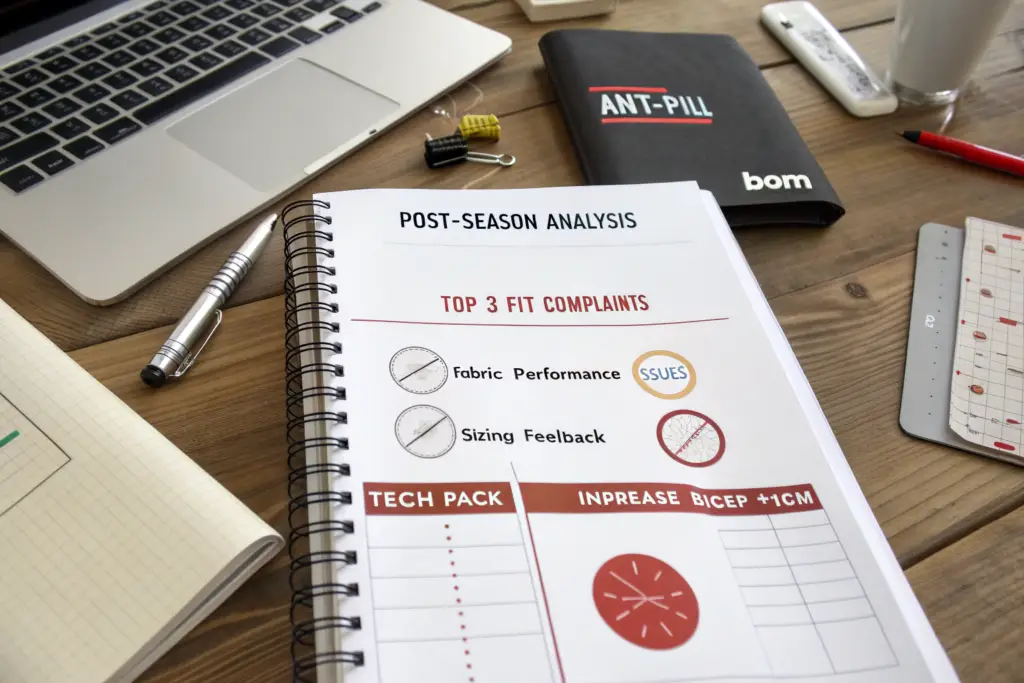
You have just closed out another season. You are looking at your sales data, and it looks good. But then you start reading the customer reviews and the emails from your wholesale buyers. "The sleeves were too long." "The fabric pilled after two washes." "The size Medium fit like a Small." A knot forms in your stomach. You realize that this feedback, while painful to read, is a goldmine. A data-driven brand owner told me, "I used to dread negative feedback. Now, I see it as the most valuable R&D data I could ever get. It's a direct, free instruction manual from my customer on how to make my next run better."
Using buyer feedback to improve your next production run is a systematic, four-step process: 1) Collect and Structure the Feedback (separating the subjective noise from the objective, recurring data points), 2) Diagnose the Root Cause in Your Supply Chain (is it a fabric issue, a pattern issue, or a construction issue?), 3) Translate the Feedback into Precise Technical Revisions in your Tech Pack and BOM, and 4) Validate the Fix with a Thorough Pre-Production Sample review before committing to bulk. It is the most powerful and cost-effective R&D process available.
At Shanghai Fumao, we see this feedback loop as an essential part of a mature B2B partnership. We work with our partners to analyze the data and implement the technical fixes that turn customer complaints into a superior next-season product. Let me show you the exact process we use to transform raw feedback into a measurably better garment.
How to Systematically Collect and Analyze Buyer Feedback?
The first step is to move from reading emotional anecdotes to analyzing structured, quantitative data. A single angry email might be an outlier. But if ten different customers say the same thing—"the neckline is too wide"—you have a statistically significant problem that requires an engineering solution. The key is to create a system that consolidates feedback from all channels and identifies the recurring themes.
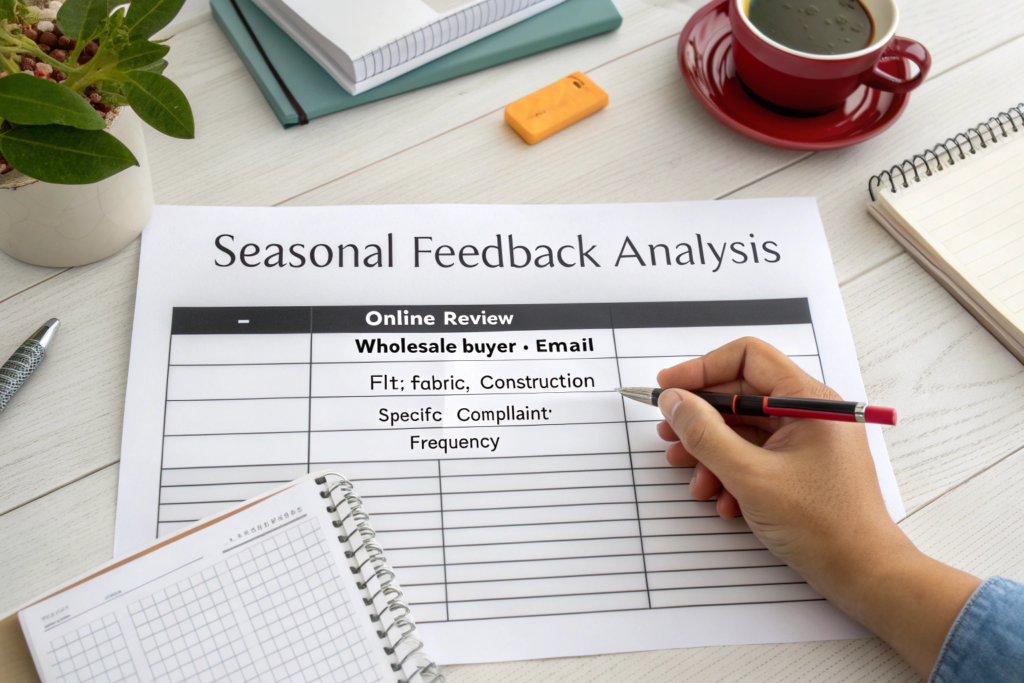
Effective feedback analysis requires a structured system. Consolidate feedback from all sources: online reviews, wholesale buyer comments, customer service emails, and social media. Categorize each complaint into specific, actionable categories: Fit (e.g., sleeve length, neckline), Fabric (e.g., pilling, shrinkage), and Construction (e.g., buttons falling off, seam unraveling). Then, prioritize the issues based on their frequency and their impact on returns and brand reputation. This data-driven approach identifies the top 2-3 issues to fix first.
A men's wear brand we work with does this brilliantly. After each season, their operations manager compiles a "Post-Mortem Feedback Report." For their recent chino run, the report showed that the #1 complaint by a large margin was "waist fits true, but the thigh is too tight." The #2 complaint was "fabric started pilling after a few washes." They brought this report to us. We did not have to guess what to fix. The customer told us exactly what was wrong. This is the power of structured data. This is the first step in our collaborative improvement process .
What Are the Best Sources for Gathering Actionable Feedback?
Go beyond just online reviews. Proactively solicit feedback from:
- Your Wholesale Buyers: They have direct, aggregated customer feedback and are a crucial source.
- Your Customer Service Inbox: Analyze return reasons and direct complaint emails.
- Post-Purchase Surveys: A simple email asking "How does it fit?" can yield volumes of data.
- Social Media Comments and DMs.
Aggregate this into a single, structured view. This is a key part of data-driven brand management .
How to Separate "Subjective Opinion" from "Objective Defect"?
"I didn't like the color" is subjective and not actionable unless it is a widespread sentiment. "The seam came apart after one wash" is an objective defect. "The sleeves are too long" is a fit issue that can be measured. Focus your engineering efforts on the recurring, objective complaints about fit, fabric performance, and physical durability. These are the problems you can actually solve. This is the focus of our quality control partnership .
How to Diagnose the Root Cause in Your Supply Chain?
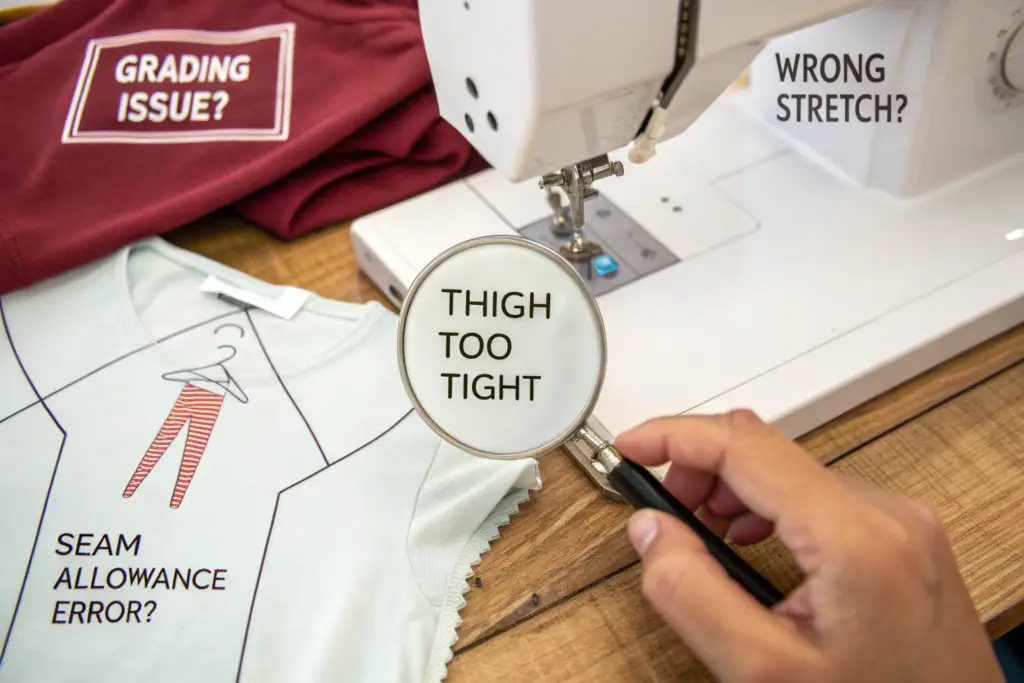
Once you have identified the top recurring issues, the next critical step is diagnosis. You cannot fix a problem until you know its true root cause. Is that "thigh too tight" a pattern grading error? Is it because the fabric has less mechanical stretch than the original sample? Or is it because the sewing operator is taking a larger seam allowance? A wrong diagnosis leads to a wasted fix. This is where the deep expertise of your manufacturing partner becomes invaluable.
Diagnosing the root cause requires a collaborative investigation with your factory. For a fit issue, you must examine the original pattern, the grade rule, and the specific fabric's behavior. Was the grading correct on paper, but the fabric's real-world shrinkage affected the fit? For a fabric performance issue, you must investigate the mill's quality and the specific batch used. For a construction issue, you must examine the sewing line's process and machine settings. Data from the factory's QC reports is essential for this diagnosis.
A brand came to us with the complaint that the zippers on their best-selling dress were failing. Our team investigated. We examined the returned units. We reviewed the fabric and the zipper spec. The root cause was subtle but clear: the fabric was a tight weave with no give, and the zipper was slightly too short for the opening. The stress of the wearer pulling it closed was causing the zipper tape to tear. The fix was a zipper that was 1cm longer and a small, reinforced stitching detail at the stress point. This collaborative diagnosis solved the problem at its source. This is the value of our technical problem-solving .
How Can Factory QC Data Help Pinpoint a Construction Problem?
Your factory's in-line QC reports and final AQL data are treasure troves. If a button attachment was a recurring issue, was it flagged during production? Reviewing this data can tell you if the problem was a systemic one on the sewing line or a random occurrence. This data is essential for an accurate diagnosis. This is part of our transparent QC reporting .
Who Is the Best Person to Diagnose a Fit Issue?
It is a collaboration between you, your fit model, and the factory's pattern maker. You provide the customer feedback ("thigh too tight"). The factory's pattern maker can then analyze the pattern and grade rules. They can measure the returned garments against the spec. A live fit session, where you discuss the feedback with the pattern maker, is often the fastest way to a correct diagnosis. This is a key part of our collaborative development .
How to Translate Feedback into Precise Tech Pack and BOM Revisions?
You know what the problem is and why it happened. Now, you must translate that understanding into a clear, precise, and measurable change in your manufacturing blueprint. A vague note to the factory like "make the sleeves better" is useless. The fix must be encoded in the Tech Pack and the Bill of Materials (BOM) , the two documents that govern the entire production process. This is the most critical step.
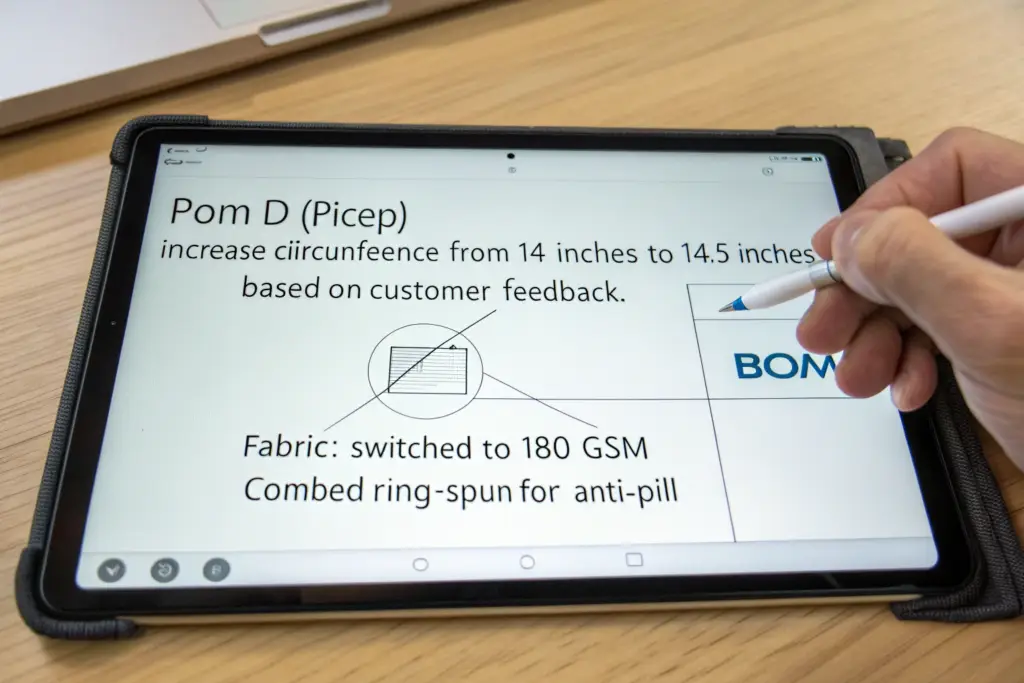
Translating feedback into action means making precise, measurable revisions. If the feedback was "thigh too tight," you must change the measurement on the Graded Spec Sheet for the Thigh POM for the affected sizes, adding a specific increment (e.g., "Increase Size 8-14 thigh circumference by 1/2 inch"). If the feedback was "fabric pilled," you must change the BOM to specify a higher-grade, anti-pill fabric, such as "180 GSM Combed Ring-Spun Cotton." Every fix must be an objective, verifiable change in the technical documentation.
The men's wear brand from before, with the "thigh too tight" issue, worked with our pattern maker. They adjusted the thigh measurement on the graded spec sheet for sizes 30-36 by a half-inch. They also changed the BOM to specify a cotton twill with 2% spandex for added mechanical stretch. The next production run, based on these precise Tech Pack revisions, received zero complaints about the thigh. The customer feedback was directly and successfully translated into a better product. This is the ultimate expression of a data-driven development cycle .
What Is the Most Effective Way to Communicate a Fit Change to a Factory?
Always use a visual. Take a screenshot or a photo of the affected POM on the spec sheet. Circle it. Write the exact change directly on the image: "Increase from 14" to 14.5"." Then, in your email, state the change again clearly. This visual, annotated method eliminates ambiguity and ensures the pattern maker understands the exact correction required. This is our standard communication protocol .
How to Specify a Better Fabric to Fix a Pilling Problem?
"Do not use cheap fabric" is not a specification. You must specify the upgrade. For example, change the BOM from "Carded Open-End Cotton Jersey" to "Combed Ring-Spun Cotton Jersey, 30/1, 180 GSM, with anti-pill finish." This is a clear, verifiable instruction that allows the sourcing team to procure the correct quality. Our sourcing team can guide you on the best material upgrade to solve the specific performance issue. This is the value of our fabric expertise .
How to Verify That the Fix Worked Before Committing to Bulk?
You have analyzed the feedback, diagnosed the root cause, and made precise revisions to your Tech Pack. Now, the final, critical step is to prove that the fix worked before you commit to thousands of units. You cannot just trust that the changes were made. You must physically verify them on the next season's Pre-Production (PP) Sample. This is your final quality gate.
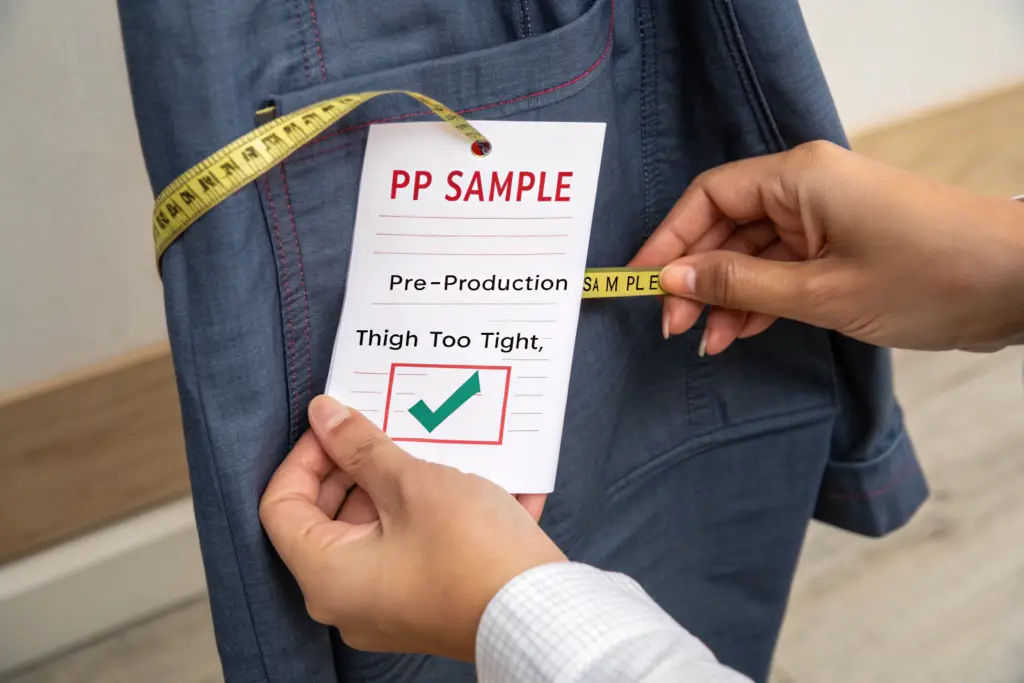
The PP Sample is the ultimate verification tool for your feedback-driven changes. It is the first unit made with the revised Tech Pack, using the upgraded bulk fabric. You must measure the corrected POMs against the new spec. You must wash-test the sample to verify the new fabric's performance. This is a non-negotiable step to confirm that the problem has been truly solved before the bulk production run begins. Only when the PP Sample passes this audit should you give the green light.
The best-performing brands we work with treat the next season's PP Sample as a formal audit of the previous season's feedback. They have a checklist. For the chino example, the checklist item was: "Verify thigh measurement on sizes 30-36 is +0.5 inch from last season's spec." They measured it. It was correct. They then put the pants on their fit model and had him squat and move. The fit was confirmed as improved. They then approved the bulk. This disciplined, verification-driven approach is what separates professional brands from amateurs. This is the purpose of our pre-production quality assurance .
What Should Be on Your PP Sample Audit Checklist?
Your checklist should be directly derived from your feedback analysis. For each top complaint from the previous season, you should have a specific, measurable check on the new PP sample. For example:
- Complaint: "Sleeves too long." -> Check: "Measure sleeve length POM against new, reduced spec."
- Complaint: "Fabric pilled." -> Check: "Wash PP sample 3 times. Inspect surface for pilling."
This ensures every fix is formally verified. This is the core of our quality improvement cycle .
How to Involve Your Factory in This Verification Step?
Share your feedback report with your Project Manager. They are your partner in quality. Schedule a video call to review the PP sample together. Have them walk you through the measurements. This collaborative review ensures everyone is aligned on the new standard before bulk production begins. This is the foundation of a true quality partnership .
Conclusion
Buyer feedback is the most honest and valuable R&D data your business will ever receive. It is a free guide to building a better, more successful product. The brands that thrive are those that treat every negative review not as a personal failure, but as a precise, actionable instruction for improvement. The process of collecting, diagnosing, translating, and verifying this feedback is the engine of continuous improvement.
At Shanghai Fumao, we are your partners in this process. We provide the technical expertise to help you diagnose problems, the precise execution to implement your revisions, and the rigorous PP sample verification to ensure the fix has worked. We help you turn customer complaints into your greatest competitive advantage.
If you are ready to build a systematic feedback loop that makes every production run better than the last, let's talk. Our Business Director, Elaine, can discuss how we can integrate your buyer feedback into our development process. Please email Elaine at: elaine@fumaoclothing.com.