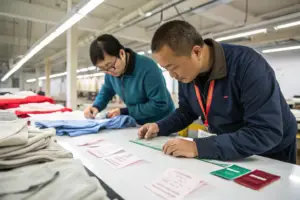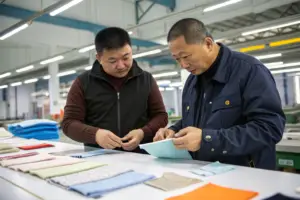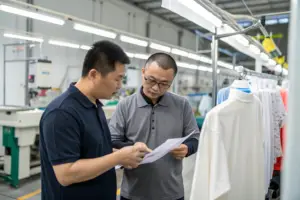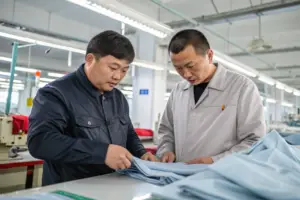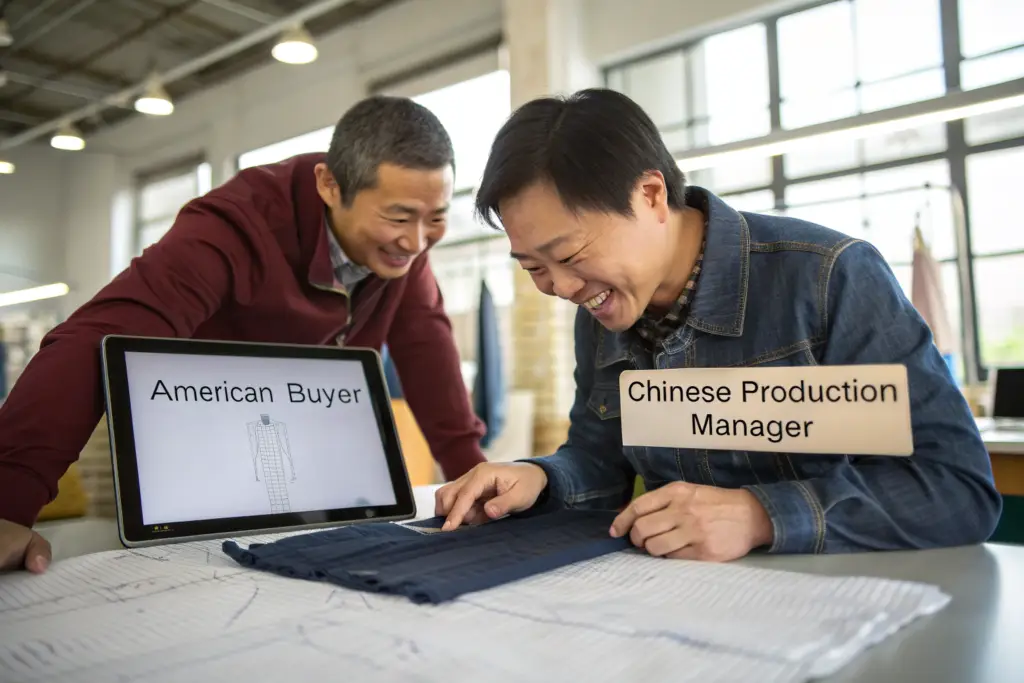
I have two languages in my head. Mandarin, which I speak with my workers on the floor. And English, which I use to email my clients in America. But the most important language I speak is Visual. A picture of a crooked seam. A red circle around a loose thread. A video of a sewing machine in slow motion. These are the things that bridge the 7,000-mile gap. You do not need to learn Chinese to make great clothes in China. You need to learn how to communicate in a way that leaves zero room for interpretation.
Overcoming language barriers with Chinese apparel factories is not about fluency in Mandarin. It is about fluency in Precision and Redundancy. You must eliminate vague adjectives like "nice" or "soft" from your vocabulary. Replace them with numbers: "200gsm," "12 stitches per inch," "Pantone 19-4052." You must also use multiple channels to convey the same information. Say it in an email. Show it in a photo. Point to it in a video. This triple-redundancy ensures that even if the English word is misunderstood, the visual and the sample are not. The best communication is a sealed physical sample with a red line drawn on it.
I have been navigating this language divide for 15 years from the factory side. I have seen the mistakes that cost money and the simple fixes that save relationships. Let me show you exactly how to make sure your message lands perfectly every time.
Why Do "Visual Specs" Work Better Than Long Emails?
I receive hundreds of emails a week. If you send me a 500-word email describing a change to a sleeve, I have to translate it. Then my pattern maker has to translate my translation. Somewhere in that chain, the word "slightly tighter" becomes "very tight" or "no change." I have seen it happen.
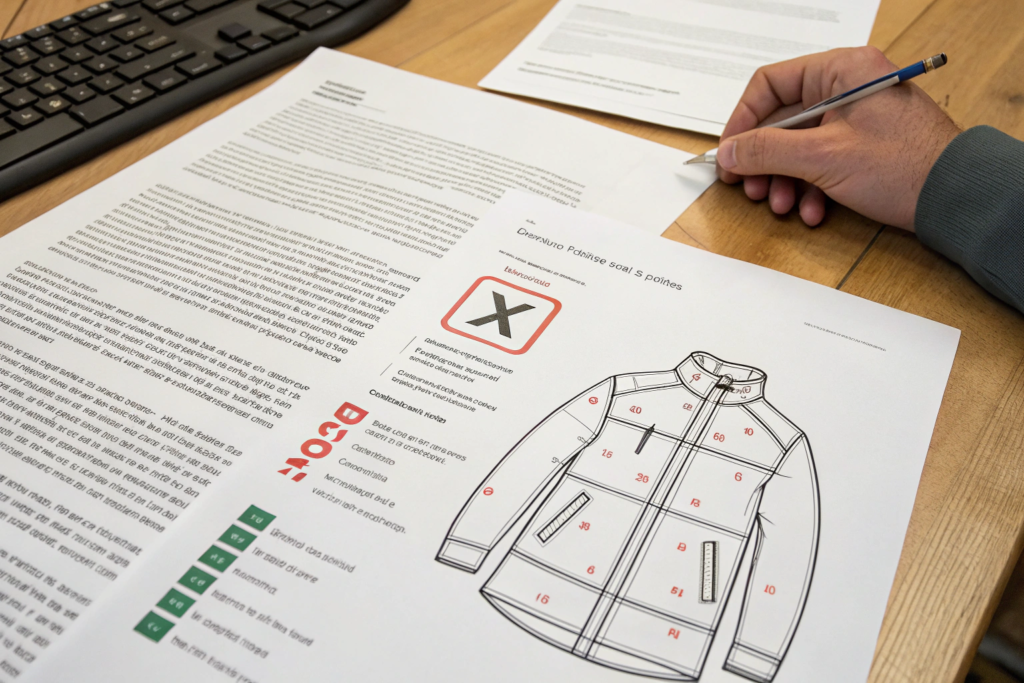
Visual specs work better than long emails because they bypass the brain's language processing center and speak directly to the eye. A factory worker in China does not need to know the English word for "armhole." They need to see an arrow pointing to the armhole with "+1cm" written next to it. This is a universal language. Photos with annotations, technical flat sketches with callouts, and short video clips demonstrating a fit issue are the most effective communication tools. They reduce the revision rounds from three to one.
How to Annotate a Photo for a Non-English Speaking Seamstress?
This is the single most effective trick I teach my clients. You received the fit sample. The sleeve is too long. Do not write: "The sleeve seems a bit long, can we shorten it maybe an inch or so?"
The "Red Pen Rule" for Photos:
- Print the photo of the garment on the model. Or use a tablet with a stylus.
- Draw a red line exactly where you want the sleeve to end.
- Draw a red arrow pointing from the current hem to the new line.
- Write only the number: "-3cm" or "-1.25in".
Why This Works:
The seamstress on Line 3 does not have a ruler in her head for "an inch or so." She has a ruler in her hand for "3cm." She looks at the photo. She sees the red line. She measures 3cm up from the hem on the actual garment. She cuts. It is perfect.
The "Hand Feel" Photo Trick:
You want the fabric to be softer? Do not say "Softer."
- Take a video of you scrunching the sample fabric in your hand. Show how stiff it is.
- Take a video of you scrunching a different fabric that has the softness you want.
- Send both videos. Caption: "We want #2 feel. Not #1 feel."
This is the "Show, Don't Tell" method. It eliminates the subjective adjective problem. I have used this method with our finishing department. Instead of saying "More peach finish," I show them a swatch of the target hand feel. They match it exactly.
At Shanghai Fumao, we keep a library of these "Hand Feel Standards" just for this reason. It is a visual and tactile dictionary.
Why is a "Sealed Sample" the Only 100% Reliable Communication Tool?
Words are wind. Emails are deleted. But a physical sample with a signed hangtag is a legal document in the garment industry.
The Process:
- You approve a final fit sample or a lab dip swatch.
- You sign and date a hangtag attached to it.
- You send it back to us via courier.
- We lock it in the QC Manager's office.
The Power of the Sealed Sample:
When we are in the middle of bulk production, and a new worker asks, "Is this blue dark enough?" we do not look at an email. We do not look at a Pantone book. We open the cabinet. We take out Your Sealed Sample. We hold it up next to the bulk fabric.
If it matches, we proceed.
If it does not match, we stop.
There is no argument. There is no language misunderstanding. There is only "Match" or "No Match."
I cannot tell you how many disputes this has prevented. A buyer once emailed me: "The bulk shirts look lighter than the photo I saw on my phone." I sent him a photo of the bulk shirt next to his sealed sample in our lightbox. He replied: "Okay, they are exactly the same. My phone screen is the problem." Case closed. Relationship saved.
How to Use Translation Apps Correctly for Technical Apparel Terms?
Google Translate is amazing for ordering coffee. It is dangerous for ordering a "French Seam." If you type "French Seam" into a generic translator, it might give you the Chinese words for "Stitch from France." That is not what it is.
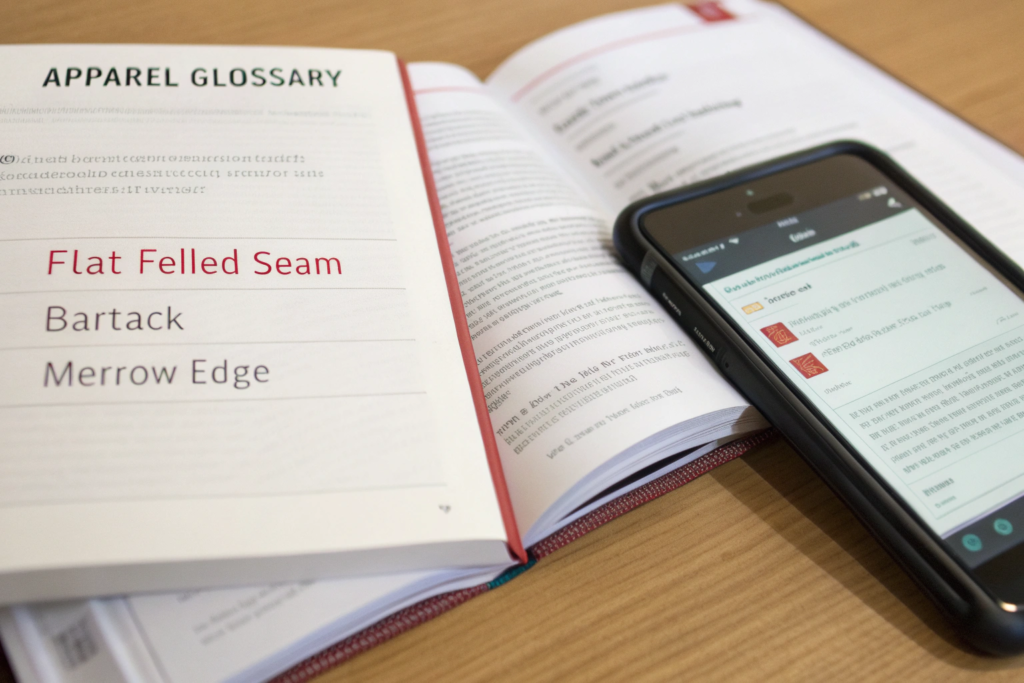
Translation apps must be used with technical caution. For specific apparel terms like "Flat Felled Seam," "Bartack," or "Merrow Edge," you should not rely on real-time translation. Instead, use a pre-vetted, bilingual Apparel Glossary or Tech Pack Template. Better yet, use the universal Stitch Type ISO Number (e.g., ISO 401 for Chainstitch). Numbers do not translate poorly. If you must use an app, use it to translate the surrounding context, but keep the technical noun in English AND provide a visual reference.
What Are the Most Commonly Mistranslated Apparel Words?
I have a list on my wall of "Words That Cause Headaches." Here are the top offenders and what to use instead.
| English Word | Bad Translation Result | Better Way to Say It |
|---|---|---|
| "Soft" | . Can mean weak structure. | "Peach Finish" or "Sueded Hand Feel" + Provide Swatch. |
| "Tight Fit" | . Can mean uncomfortable small. | "Slim Silhouette" + Provide Measurement Tolerance (+/- 0.5"). |
| "Heavy Fabric" | . Refers to weight on a scale. | "280gsm" or "Thick Gauge Yarn" . |
| "Clean Finish" | . Means not dirty. | "Bound Seam" or "Turned Hem" (Name the specific construction). |
| "Button Stand" | Direct translation nonsense. | "Placket" + Show Photo. |
The Strategy:
Always pair the English term with the ISO Stitch Number or a Clear Photo.
Example:
Instead of: "Please use a clean finish on the neck."
Write: "Neckline finish: Self Fabric Binding (See Photo A)."
This is how professional buyers communicate. They assume the person reading the email has excellent sewing skills but limited English vocabulary. They make it impossible to misunderstand.
How to Use WeChat's Translate Feature for Factory Conversations?
WeChat is the operating system of Chinese business. You will use it to talk to your factory contact. The built-in translation is good, but you need to feed it good input.
Rules for WeChat Translation:
- Short Sentences: Break long paragraphs into single sentences. The translation engine handles short chunks better.
- No Slang: Do not use "Gonna," "Wanna," or "Lit." Use formal business English. "We will ship tomorrow." Not "We're gonna get it out the door."
- Repeat the Key Word: The translation might garble the middle of a sentence. Put the most important word at the end of a short sentence.
- "Please check the collar. We need to fix the collar."
The "Back Translation" Check:
This is a pro move. After the factory sends you a Chinese message, you translate it to English. Then you translate that English back to Chinese using the same app.
- If the original Chinese matches the back-translated Chinese, the meaning is clear.
- If it is different, the message was ambiguous. Ask for clarification using a photo.
I do this myself when communicating with new fabric mills. It takes 10 seconds. It saves a week of wrong fabric being knit.
Why is "Over-Communication" the Key to Trust in Asia?
In American business culture, silence often means "Everything is fine." In Chinese factory culture, silence often means "I am embarrassed to tell you there is a problem." Or "I am waiting for you to ask." This cultural gap causes more delays than any shipping snafu.
Over-communication builds trust because it actively solicits confirmation and exposes hidden delays. You should never assume a task is complete because you sent an email. You should ask for a specific confirmation. "Please confirm you received the revised Tech Pack." "Please send a photo of the cut fabric by Friday." This level of follow-up is not seen as annoying in a Chinese factory context. It is seen as professional and careful. It signals that you are a serious buyer who values precision.

What is the "Read Receipt" Trap in Cross-Cultural Communication?
You sent a WeChat message. It says "Read." You think: "Great, they saw it. They are working on it."
The Reality:
In a busy factory office, a manager might glance at the message, see it requires a detailed answer, and think: "I will reply when I have the exact data." They do not want to give you a vague answer. So they say nothing. Days pass. You get angry.
The Fix: The "Non-Yes/No" Question.
Do not ask: "Did you get the file?"
Ask: "I sent the file. Please reply with the number 1 when you have saved it to your computer."
This requires zero English skill to answer. It takes the pressure off. It gives you the confirmation you need.
The "Photo Confirmation" Request:
Do not ask: "Are the labels sewn?"
Ask: "When labels are sewn on first piece, please send 1 photo of the inside neck."
I train my own staff to do this with our US clients. If a client sends a long email with six questions, my staff is trained to reply within 1 hour: "Received. Will reply with details in 4 hours." That simple line reduces client anxiety to zero. It is over-communication, and it works.
This is a tactic that has transformed how we work with new brands.
The Setup:
We create a shared album on Google Photos or a shared folder on Dropbox.
The Routine:
- Monday 9am Shanghai Time: We upload 3 photos.
- Fabric roll arriving.
- Spreading machine laying out fabric.
- First cut pieces bundled.
- No Captions Needed. The time stamp and the visual tell the story.
The Benefit:
You wake up in New York. You check the album. You see the fabric is in the cutting room. You do not need to email me: "Where are we?" You already know. You do not need to read Chinese. You just need to see the progress.
This eliminates 30% of the back-and-forth emails that clog up my day and your day. It is a silent, visual handshake. We started doing this at Shanghai Fumao two years ago. Our client satisfaction scores on communication went up dramatically.
How to Structure a "Language-Proof" Tech Pack?
Your Tech Pack is your voice in the factory when you are asleep. If it is vague, you will get a vague garment. If it is precise, you will get exactly what you drew.
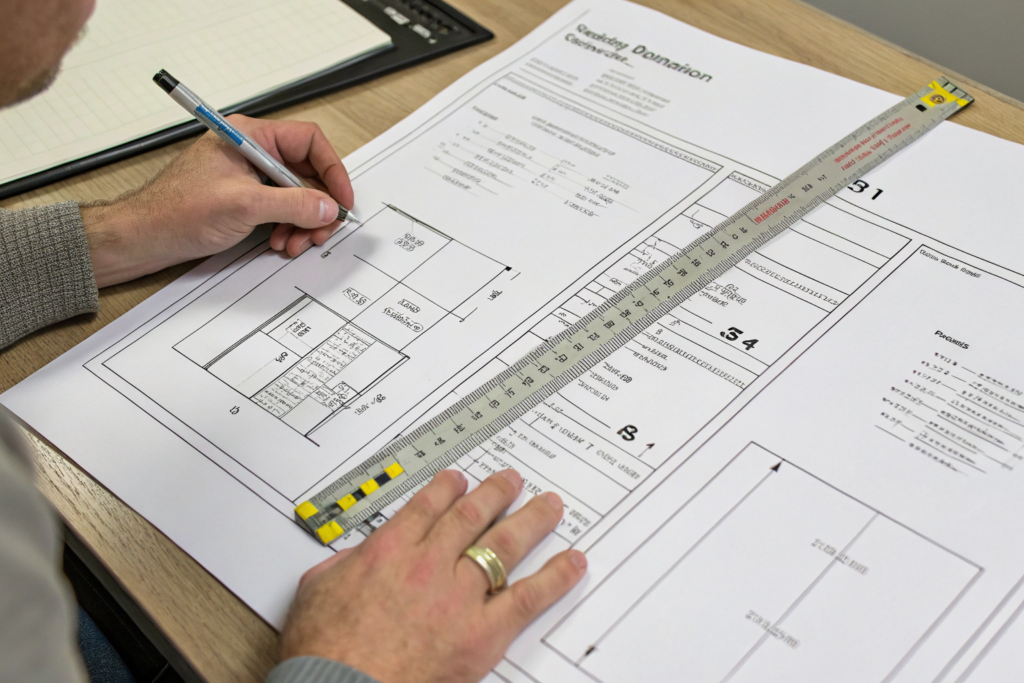
A language-proof Tech Pack relies on numbers, tolerances, and reference visuals rather than descriptive prose. Every measurement must have a "+/- Tolerance." Every seam must be called out with a stitch type code (e.g., ISO 401). Every trim must have a physical reference swatch or a clear photo with a scale reference (like a coin or a ruler). The document should be bilingual for the key headers (e.g., "Fabric / 面料"). This upfront investment in documentation reduces sampling rounds and eliminates the "I thought you meant..." errors.
What Are the 5 Sections a Factory Actually Needs in a Tech Pack?
Many designers send over-stuffed Tech Packs with 20 pages of inspiration images. The factory pattern maker ignores those. They look for these five specific sections.
The "Language-Proof" Tech Pack Structure:
| Section | What the Factory Needs | Language Barrier Fix |
|---|---|---|
| 1. Cover Page | Style Name, Your PO Number, Date. | Bold, Large Font. (Numbers are universal). |
| 2. Front/Back Sketch | Black and white line drawing. | No shading. No floating elements. Just the outline. |
| 3. Measurement Chart | Points of Measure (POM) diagram. | Use arrows and letters (A, B, C) that correspond to the chart. No words like "Chest." Just "A." |
| 4. Bill of Materials (BOM) | Fabric Code, Color Code, Trim Code. | Use our internal codes if possible. e.g., "Fabric: SF-JSY-001 (180gsm)." |
| 5. Stitch & Seam Details | Close-up photos of seam types. | Circle the specific stitch on a photo of an existing sample. |
If you give us those five things, we can make a sample with 95% accuracy on the first try, even if we never speak the same language.
At Shanghai Fumao, we provide a blank Tech Pack template to new clients. It forces them to fill in the numbers and the diagrams. It stops them from writing paragraphs of text. It is the single best tool we have for closing the language gap.
How to Use "Reference Samples" Instead of Describing Fit?
You want the fit of a shirt to be "relaxed but not boxy." That is a nightmare to translate. It is a dream to copy.
The "Borrowed Fit" Method:
- Go to your closet. Find a shirt whose fit you love. It can be from any brand.
- Ship that physical shirt to us.
- Include a note: "We want this exact chest width and sleeve length. Adjust collar height to be 0.5cm shorter than this reference."
What We Do With It:
We take apart the reference sample. We measure every seam. We analyze the pattern shape. We reverse-engineer the "DNA" of the fit.
The Language-Proof Result:
You get a sample that fits like the shirt you love. You did not have to write a single word about "drape" or "silhouette." The physical object did the talking.
This is the ultimate language hack. It is how the biggest brands in the world work with their overseas partners. They do not send essays. They send garments.
I had a client send me a vintage Levi's jacket and a sticky note: "Make this, but with our fabric." We did. He sold out in pre-orders. The fit was perfect because the reference was perfect.
Conclusion
Overcoming the language barrier with a Chinese apparel factory is not about becoming bilingual. It is about becoming bi-visual. It is about shifting your communication from words to images, from paragraphs to measurements, and from assumptions to confirmations.
The factories that succeed in the global market are the ones that have learned to read pictures and numbers. The brands that succeed are the ones that learn to speak that visual language. When you send a photo with a red line, you are speaking the native language of the factory floor. When you send a sealed sample, you are handing over a piece of physical truth that cannot be lost in translation.
At Shanghai Fumao, we have built our client service model around this principle. We do not expect you to learn Mandarin. We expect you to learn how to use a red pen on a photo. We expect you to give us numbers, not adjectives. In return, we give you clarity and speed.
If you are ready to experience a partnership where language is not a barrier, I invite you to reach out to our Business Director Elaine. She is an expert at guiding clients through our visual communication process. Her email is elaine@fumaoclothing.com. Let's draw our way to a perfect collection.