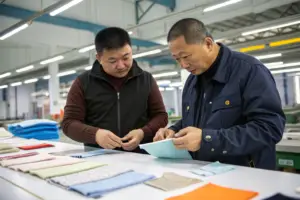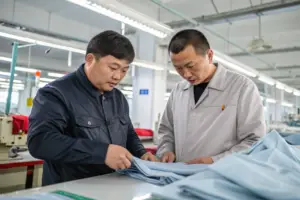
You have narrowed your supplier search. The samples look promising. The price negotiation is complete. You are one step away from wiring a deposit. Then a quiet hesitation stops your hand. You remember the last time. The pants arrived. They looked like the sample in the photo, but after one wash, they shrank two sizes. Or the beautiful rust color bled onto a customer's white leather sofa. Or the fabric, which felt substantial in your hand, developed holes at the thigh after three wears. The sample was a promise. The bulk production broke that promise. Your only protection at this moment, the only thing that stands between you and a warehouse full of unsalable linen pants, is a set of fabric tests conducted on the actual production material before the cutting blade touches it.
Before ordering linen pants from Shanghai Fumao, you should request five specific fabric tests: a fiber composition analysis to verify 100% flax content, a shrinkage test under home laundry conditions, a color fastness to rubbing and light test, a seam slippage test for woven durability, and a tensile strength test to confirm the fabric can withstand the stress of a wide-leg silhouette. These tests must be performed on the bulk production fabric, not the approval sample, and the results must be delivered in a dated lab report from an accredited third-party laboratory like SGS or Intertek.
My name is Elaine. I run Shanghai Fumao's production operations. I have spent over a decade on factory floors, watching fabric rolls arrive from mills and sometimes discovering that they do not match what was promised. I have seen the consequences of skipping a test. I have also seen a $400 test save a $30,000 order. In this article, I will walk you through each test, explain exactly what it measures, show you a real example of a failure it prevented, and give you the specific standard you should reference in your purchase order. I will also tell you which tests we run as standard practice and which ones you should specifically request. Because when you order from us, you are not just buying pants. You are buying the evidence that the pants will perform as promised.
Why Is a Fiber Composition Analysis the First and Non-Negotiable Test?
You ordered 100% linen. You paid for 100% linen. The label you designed says "100% Linen." But the fabric that arrived at our cutting table might be a blend of flax and viscose, or flax and polyester. A blend is not necessarily inferior fabric. It is simply not what you ordered, and more critically, not what you legally labeled. The U.S. Federal Trade Commission enforces the Textile Fiber Products Identification Act with fines and product recalls. If a random customs test reveals a fiber blend that does not match your label, you are legally liable, not the factory. The fiber composition test is your legal shield.
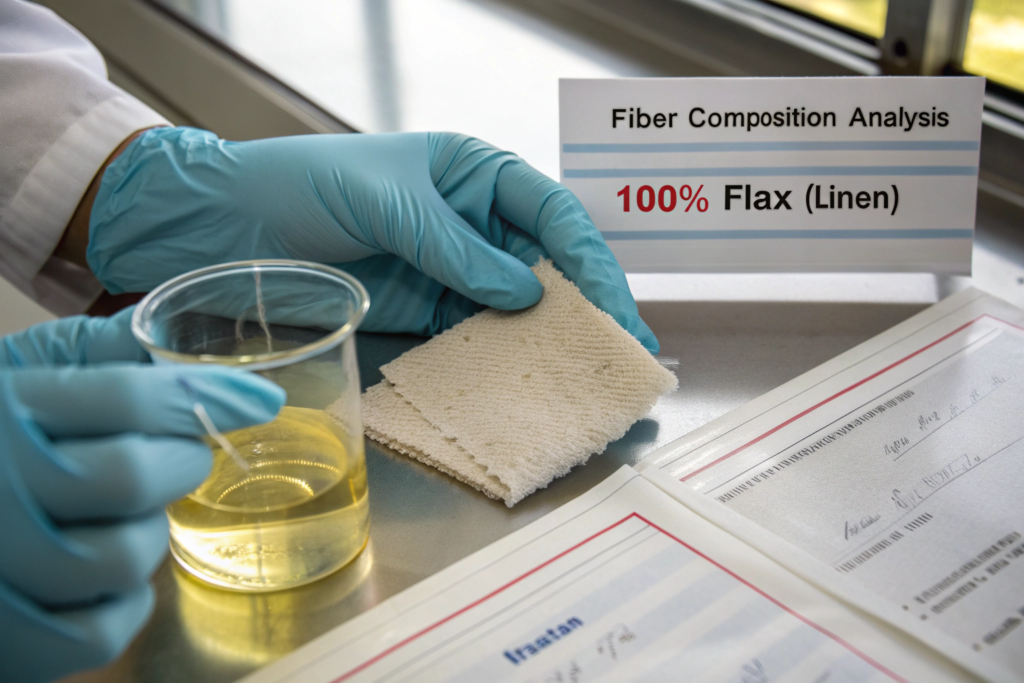
The fiber composition analysis, conducted according to ISO 1833 or AATCC 20 standards, chemically separates the fibers in the fabric and quantifies each type as a percentage. A report stating "100% Flax" with a testing laboratory logo from SGS or Intertek is the only acceptable evidence that your linen pants are legally and commercially genuine. A supplier's verbal assurance or an unverified mill certificate is not sufficient.
How Does a Quantitative Chemical Analysis Differ From a Supplier's Mill Certificate?
A mill certificate is a piece of paper the fabric mill gives the garment factory. It says, "This roll is 100% linen." It may be honest. It may be a template where the mill clerk typed "100% linen" without testing the specific batch. Mill certificates are not independently verified. They are documents of trust between a mill and a factory. You, the brand owner, are outside that trust circle.
A quantitative chemical analysis is different. A laboratory technician cuts a sample from your specific fabric roll. They weigh it. They dissolve it in specific solvents that target different fiber types. For example, a 75% sulfuric acid solution dissolves viscose but leaves flax intact. A 70% sulfuric acid solution dissolves flax. The technician measures the weight before and after each chemical treatment and calculates the exact percentage of each fiber present. This is how we discovered a substitution in early 2024. A mill sent us fabric for a Los Angeles client's linen pant order. The mill certificate said "100% Linen." Our standard incoming inspection includes a random fiber analysis. The lab report came back: 82% Flax, 18% Viscose. The mill had blended in cheaper viscose to cut their cost, assuming we would not test. We rejected the entire fabric lot before a single meter was cut. The client never knew there was a problem because we caught it at the gate. The AATCC 20 test method is the definitive standard for fiber analysis in textiles. Ask for the specific test standard number in your purchase order. "Supplier shall provide an ISO 1833 fiber composition report from an ISO 17025 accredited laboratory for the bulk production fabric." This sentence removes all ambiguity.
Why Must This Test Be Performed on Bulk Fabric, Not the Approval Sample?
The approval sample you signed off on three months ago was made from a specific roll of fabric, often a special "sampling meterage" the mill provided. The mill has every incentive to send their best, most consistent fabric for sampling. The bulk order, however, is 1,000 meters dyed in a large batch under production pressure. The dyehouse might substitute a different yarn lot. The mill might change the weaving tension.
This sample-versus-bulk discrepancy is the source of countless disputes. At Shanghai Fumao, our protocol is to cut a swatch from the first roll of the bulk fabric that arrives from the dye house. This swatch goes to the lab. The lab tests it. We compare the bulk test report side-by-side with the sample test report. If the fiber composition matches, we proceed. If it deviates by more than 1%, we pause and investigate. I recall an incident where the bulk fabric was indeed 100% flax, but the flax fiber was a shorter staple length than the sample. The lab report flagged a higher percentage of short fibers, which would pill more easily. We caught this only because we tested the bulk. We informed the brand, and they made an informed decision to accept the fabric with a slight discount from the mill, rather than discovering the pilling through customer returns. A textile testing laboratory directory can help you find an accredited facility near the production site. The cost of this test is approximately $150 to $250. The cost of recalling 1,000 mislabeled pants from your retail accounts is exponentially higher.
How Do Shrinkage and Colorfastness Tests Prevent Customer Returns?
A customer buys your linen wide-leg pants. She wears them once. She loves them. She washes them according to the care label. She pulls them out of the dryer. They are now three inches shorter and the beautiful terracotta color has faded to a pale, uneven peach. She is angry. She returns them. She leaves a one-star review describing your brand as "cheap, shrinks immediately." That review stays online forever, silently killing future sales. Shrinkage and colorfastness are the two most common reasons for consumer returns in the natural fiber apparel category. Both are preventable with pre-production testing.
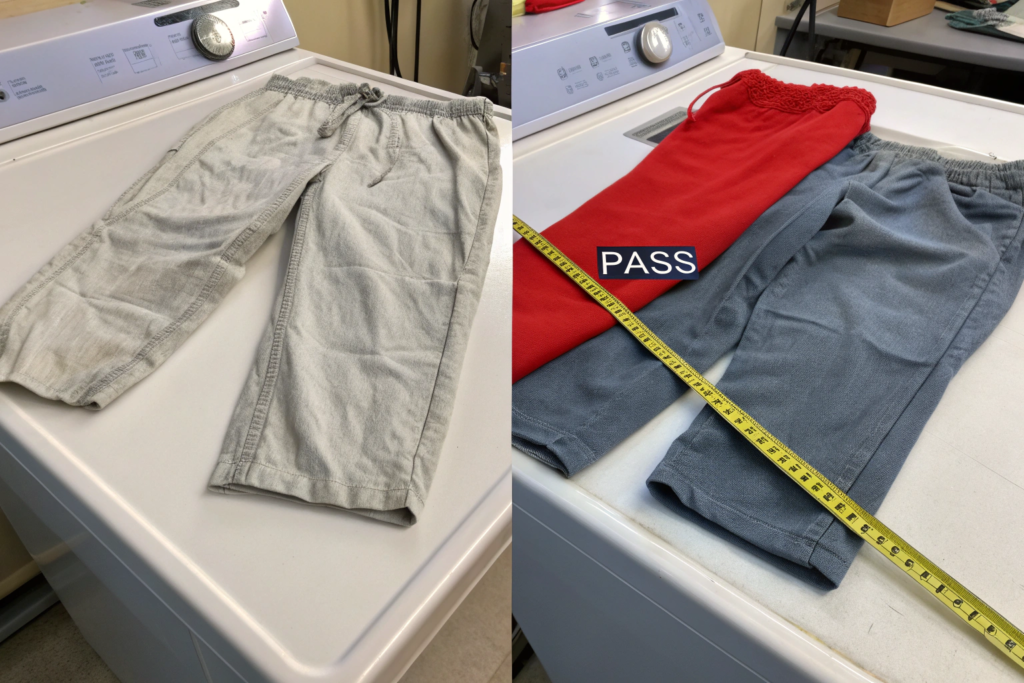
A shrinkage test following AATCC 135 or ISO 6330 washes the fabric under standardized home laundry conditions and measures the dimensional change. A colorfastness test suite, including colorfastness to rubbing (crocking), washing, and light, measures whether the dye transfers to other fabrics or fades under exposure. The pass threshold for shrinkage should be under 3% in length and width. The pass threshold for rubbing fastness should be Grade 4 or above on the grey scale for dark colors.
What Shrinkage Rate Is Acceptable for a Wide-Leg Linen Pant?
Linen shrinks. This is a physical property of flax fiber. The question is not whether it will shrink, but how much and whether you have accounted for it. Raw, unwashed linen can shrink 5% to 7% on the first wash. A pant with a 32-inch inseam that shrinks 6% becomes a 30-inch inseam. That is a different product. The customer ordered a full-length wide-leg pant and received ankle-grazers. This is not a minor disappointment; it is a product mismatch.
The industry standard for acceptable residual shrinkage in a finished garment is under 3%. To achieve this, the fabric must be pre-shrunk, either through a sanforization mechanical process or through a garment wash after construction. We pre-wash all our linen fabric before cutting at Shanghai Fumao. But we still test the bulk cut pieces because the pre-wash process itself can vary. The test is simple. A technician cuts a marked square of fabric, exactly 50cm by 50cm. They wash and dry it according to the care label instructions you intend to provide. They measure the square again. The difference, expressed as a percentage, is the shrinkage rate. I worked with a Canadian brand in 2023 that had a 14% return rate on their linen pants. They were not pre-washing their fabric, and the supplier had not disclosed the raw shrinkage. We took over the production. We implemented a compulsory AATCC 135 shrinkage test on every dye lot. We guaranteed a residual shrinkage of under 2.5%. Their return rate for fit issues dropped to 3% on the next season. The test cost them $100 per lot. It saved them thousands in return shipping and lost customer lifetime value. You should also consider that wide-leg pants, with their generous circumference, shrink differently in width than a tight-fitting garment. The width shrinkage can cause the side seams to twist if the shrinkage is uneven. A comprehensive report measures both warp (length) and weft (width) shrinkage separately.
How Does Crocking Fastness Test Protect Your Brand's Reputation?
Crocking is the technical term for color transfer by rubbing. A customer wears your dark indigo or deep rust linen pants. They sit on a white fabric sofa. They stand up. A faint shadow of rust color remains on the cushion. Or they carry a light-colored leather handbag. The bag rubs against the pant as they walk. The bag is now stained. The customer is now a former customer who is telling everyone they know about the pants that ruined their expensive sofa.
The crocking test replicates this scenario in a controlled lab environment. A white crock cloth is rubbed against the dyed fabric under a specified pressure and for a specified number of strokes. The amount of color transferred to the white cloth is visually compared against a standard grey scale. Grade 5 means no color transfer. Grade 1 means heavy transfer. For dry crocking, Grade 4 is the minimum acceptable for apparel. For wet crocking, which simulates the dye bleeding when the fabric is damp from sweat or rain, Grade 3 is often the accepted minimum, though we target Grade 4. Dark, saturated colors like deep indigo, black, or the trending oxidized mineral tones I described in a previous article are at the highest risk for crocking failure. The dye concentration required to achieve these deep shades can overload the fiber's ability to hold the dye molecule. A skilled dye house uses a "soaping off" process after dyeing to remove unfixed surface dye. A cheap dye house skips this to save water and time. The crocking test exposes whether the soaping process was thorough. The AATCC 8 crocking test standard is the reference method. Ask for the dry and wet crocking results for every dark color in your order. If the supplier cannot provide a passing grade, they are using a substandard dyeing process.
What Mechanical Tests Guarantee the Seams Won't Split on a Wide-Leg Silhouette?
Wide-leg linen pants are not stress-tested the way a pair of skinny jeans is. A skinny jean fails because the fabric rips under tension when the wearer bends their knees. A wide-leg pant fails in a different way. The generous cut means the fabric itself is rarely under extreme stretch. But the seam, particularly the side seam running from the hip to the hem, is under a different kind of load. The weight of the wide leg, especially in a heavy 240 GSM linen, pulls downward with gravity. When the wearer sits, the fabric spreads, and the side seam is pulled apart laterally. A weak seam will open up, revealing gaps between the stitches. The fabric does not tear. The seam simply separates, like a zipper unzipping. This is called seam slippage.
The seam slippage test, conducted per ASTM D1683 or ISO 13936, measures the force required to open a sewn seam by a specific distance. For a wide-leg linen pant, the side seam must withstand a minimum of 12 kg of force without opening more than 6mm. Additionally, a tensile strength test per ASTM D5034 measures the force required to rupture the fabric itself, with a minimum acceptable value of 35 pounds of force for medium-weight linen. These tests certify that the pant will survive sitting, bending, and the stress of daily wear.
How Does ASTM D1683 Simulate a Seam Blowing Out?
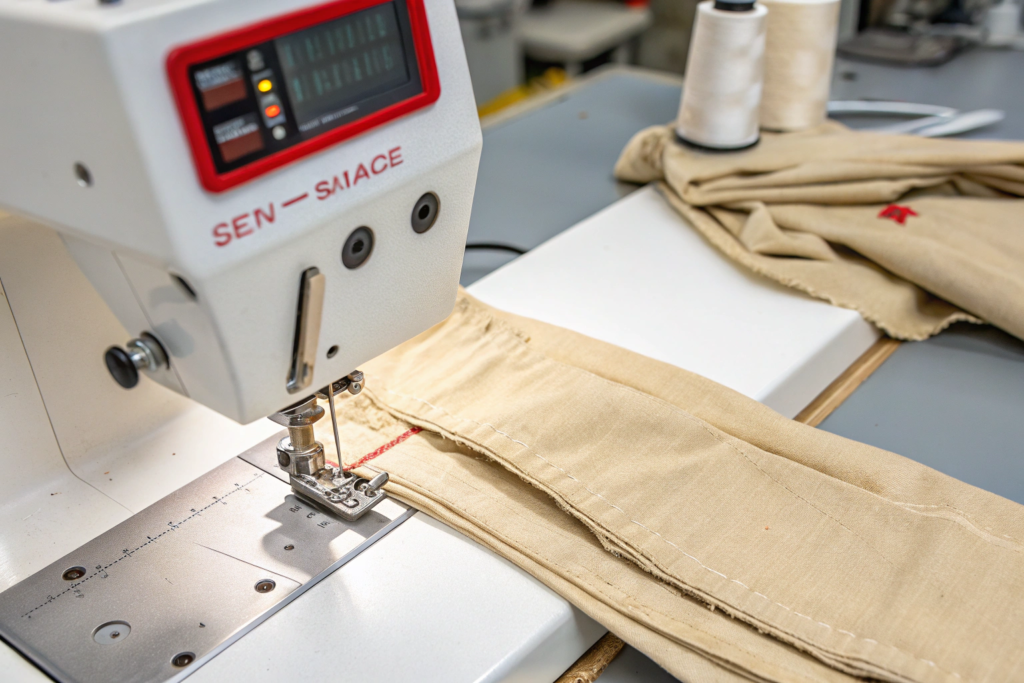
The testing apparatus looks like a vice. Two metal clamps grip the fabric on either side of a sewn seam. The machine pulls the clamps apart at a controlled speed, applying increasing force perpendicular to the seam. The test measures two things. The first is seam slippage: the force at which the yarns in the fabric begin to slide apart at the seam, opening a visible gap of a specified width, usually 6mm. The second is seam strength: the force at which the stitching thread actually breaks or the fabric tears.
For a wide-leg linen pant, the seam slippage resistance is more critical than the ultimate breaking strength. A seam that gaps at low force looks terrible even if it does not completely fail. The wearer sits down, the seam at the hip opens slightly, and the white lining or the skin underneath becomes visible. The garment feels cheap and poorly made. I saw this failure mode on a batch of wide-leg pants a startup brand brought to us for diagnosis in 2022. Their previous supplier had used a basic single-needle lockstitch on the side seams with a short stitch length on an open-weave linen. The stitch length was too short, and the needle had perforated the yarns so closely that it created a perforated tear line, like a postage stamp. The seam didn't slip; it ripped along the stitch line. We corrected this by adjusting the stitch density, changing the needle size to a finer gauge that parted the yarns rather than cutting them, and switching to a reinforced two-needle seam. The ASTM D1683 standard for woven seam slippage is the precise test method we reference. Request this test specifically if you are using an open-weave or gauze linen, which is trending for 2026. The loose weave is beautiful but inherently has lower yarn friction. The yarns slide apart more easily. The seam slippage test reveals whether the seam construction compensates for the fabric's natural slipperiness.
Why Is Tensile Strength a Separate Concern From Seam Strength?
A fabric can have strong seams but still fail because the base fabric itself is weak. This happens when a mill over-processes the linen to achieve a soft hand feel. They wash it with aggressive enzymes for too long. The enzymes eat away at the cellulose fiber, weakening the internal structure. The fabric feels beautifully soft, but it has lost its structural integrity. A pant made from such fabric will develop holes at the knee or the rear thigh after a few wears, not because the seams broke but because the fabric itself disintegrated.
The tensile strength test measures the force required to rupture the fabric. It uses a similar machine to the seam test but grips the fabric itself, not a seam. The ASTM D5034 grab test is the standard method for woven fabrics. A medium-weight linen of 200-240 GSM should achieve a minimum breaking force of 35 pounds in the warp direction and 25 pounds in the weft direction. If the numbers come back lower, the fabric has been chemically weakened. I recall a situation in 2023 where a linen pant sample felt incredibly soft and luxurious. The brand loved it. We sent the bulk fabric for tensile testing as part of our standard protocol. The warp strength came back at 22 pounds, well below our 35-pound floor. We traced the issue to the finishing mill. They had used a heavy enzyme wash to overcompensate for a batch of stiff, low-quality flax. The fabric was essentially partially decomposed. We rejected the lot and sourced from a different mill. The brand was initially frustrated by the delay. Three months later, they learned that a competitor using the same mill had a catastrophic return rate due to fabric tearing. The fabric strength testing in garment manufacturing guide explains the relationship between enzymatic finishing and tensile strength loss. Softness at the expense of durability is not a trade-off you should accept. Demand both the soft hand feel and the tensile strength report. A quality mill can achieve both.
How Do You Request These Tests and Integrate Them Into Your Purchase Order?
Knowing the tests is half the battle. The other half is ensuring they are actually performed, on the right fabric, by a credible lab, and that the results are contractually binding. A vague email to your supplier saying "please test the fabric" is not sufficient. You need to specify the test standards, the pass thresholds, the testing laboratory, and the consequence of failure directly in the purchase order or the manufacturing agreement. This transforms a testing request from a suggestion into a contractual obligation with financial implications.
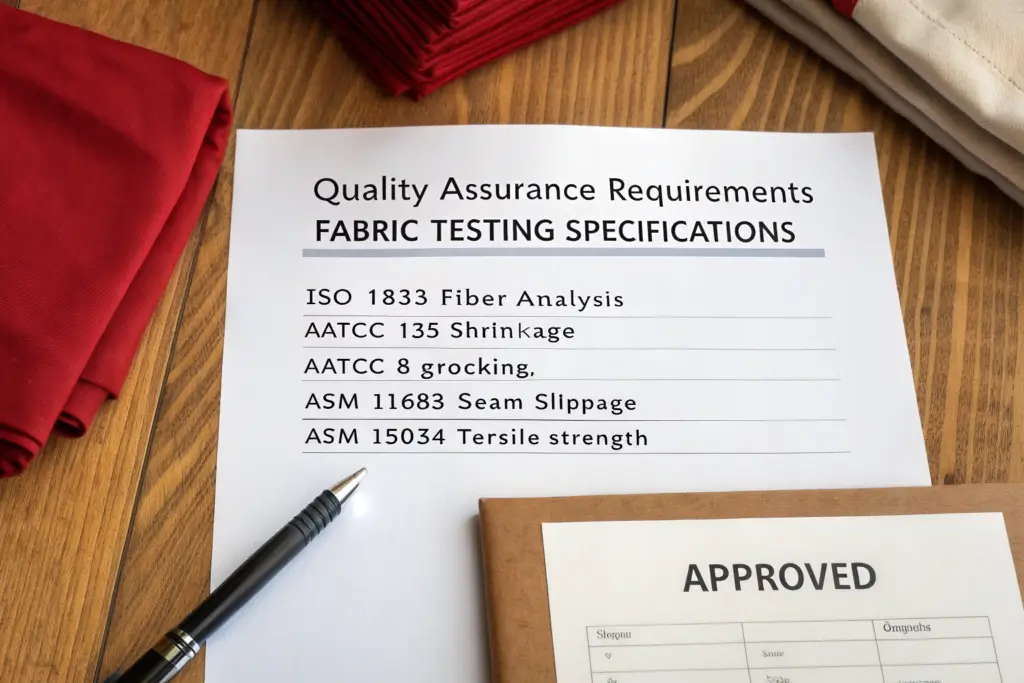
To integrate fabric tests into your order, you must include a "Quality Assurance and Testing Schedule" as an appendix to the purchase order. This schedule lists each required test, the applicable standard, the pass threshold, the accredited laboratory authorized to perform the test, and the date by which the report must be delivered. The PO must state that production fabric will not be cut until all test reports are received and approved in writing. Without this clause, testing can be bypassed without consequence.
What Is the Exact Clause Language You Should Use in a PO?
Legal language does not need to be complicated. It needs to be specific. I have seen purchase orders that say "Supplier shall ensure quality." This is unenforceable because "quality" is undefined. A specific testing clause removes the ambiguity.
Here is the language I recommend our clients include in their purchase order appendix. "The Supplier shall, at Supplier's expense, commission the following tests on the bulk production fabric prior to cutting. Tests shall be performed by SGS, Intertek, or Bureau Veritas. Test reports bearing the laboratory's accreditation mark and dated within 30 days of the scheduled cutting date must be submitted to the Buyer for written approval. No cutting shall commence without such approval."
Then list the tests in a table format:
| Test | Standard | Pass Threshold |
|---|---|---|
| Fiber Composition | ISO 1833 / AATCC 20 | 100% Flax (± 2% tolerance) |
| Dimensional Stability (Shrinkage) | AATCC 135 / ISO 6330 | Max 3% in warp and weft |
| Colorfastness to Rubbing (Crocking) | AATCC 8 / ISO 105-X12 | Grade 4 dry, Grade 3-4 wet |
| Seam Slippage | ASTM D1683 / ISO 13936-1 | Min 12kg at 6mm opening |
| Tensile Strength | ASTM D5034 | Min 35 lbf warp, 25 lbf weft |
The clause should conclude: "Failure to meet any pass threshold shall require the Supplier to re-source the fabric and re-test at Supplier's expense, with the ship date extended accordingly. Repeated failure entitles the Buyer to cancel the order with full refund of deposit."
This clause protects you in multiple ways. It specifies who pays for the testing. It specifies which laboratories are acceptable, preventing the supplier from using an unknown, potentially biased lab. It specifies the exact pass numbers, so a result of Grade 3.5 crocking when Grade 4 is required is an objective failure, not a subject of debate. It specifies the consequence of failure: re-source, not negotiate. A reputable supplier will accept this clause without resistance. At Shanghai Fumao, we actually prefer this clause. It clarifies expectations and eliminates post-shipment disputes. A supplier who resists a specific testing clause is signaling that they are not confident in their fabric quality.
What If the Supplier Claims They Already Do These Tests?
Many suppliers will say, "We have our own internal QC lab. We test everything." An internal QC lab is a good sign, but it is not a substitute for a third-party accredited laboratory. An internal lab is operated by factory employees whose salaries are paid by the factory owner. There is an inherent conflict of interest. A third-party lab like SGS or Intertek is an independent business whose only product is accurate test data. Their reputation and ISO 17025 accreditation depend on their impartiality.
I am proud of our internal QC lab at Shanghai Fumao. We use it for in-process control and rapid feedback. But we always commission a third-party report for the final bulk fabric tests that go to the client. The third-party report provides an independent verification layer. If a dispute ever arose, the third-party report would be accepted by an arbitrator or a court. The internal report would be considered a self-serving document. One of our European brand partners learned this distinction the hard way with a previous supplier. The supplier provided an "internal test report" showing passing results for REACH compliance. The goods were seized at Rotterdam port and independently tested, revealing high levels of a restricted phthalate. The internal report was worthless. The brand had no legal recourse. Since then, they only accept reports from laboratories accredited to ISO 17025 general requirements for testing laboratories. Ask your supplier for the accreditation certificate of the lab they use. A real accredited lab will have a certificate number that you can verify on the accreditation body's website. If the supplier hesitates to name the lab, they are likely using an unaccredited facility or are fabricating the reports.
Conclusion
The five fabric tests I have described—fiber composition, shrinkage, colorfastness, seam slippage, and tensile strength—are not a cost to be minimized. They are an insurance policy against the specific failure modes that turn a promising linen pant order into a financial loss. A fiber composition test saves you from a mislabeling lawsuit. A shrinkage test saves you from a flood of "doesn't fit after washing" returns. A crocking test saves you from the customer whose white sofa is now rust-colored. A seam slippage test saves you from pants that split at the side seam when the wearer sits down. A tensile strength test saves you from fabric that feels soft but tears like paper.
These tests must be performed on the bulk production fabric, not the approval sample. They must be performed by an accredited third-party laboratory. And they must be contractually mandated in your purchase order with clear pass thresholds and consequences for failure.
At Shanghai Fumao, we do not wait for clients to demand these tests. We commission them as part of our standard pre-production process and include the third-party reports in your shipment documentation. We do this because I have seen what happens when they are skipped, and I decided years ago that no shipment leaves our factory without a complete, passing test report file attached to it. If you are preparing an order and want to review our standard testing protocol, or if you want help drafting the testing clause for a purchase order with another supplier, I am happy to share our template. Contact me, Elaine, at elaine@fumaoclothing.com. The time to test the fabric is before it is cut, not after it is returned.