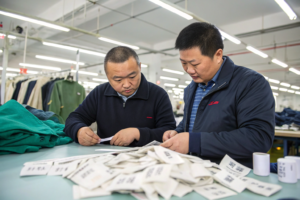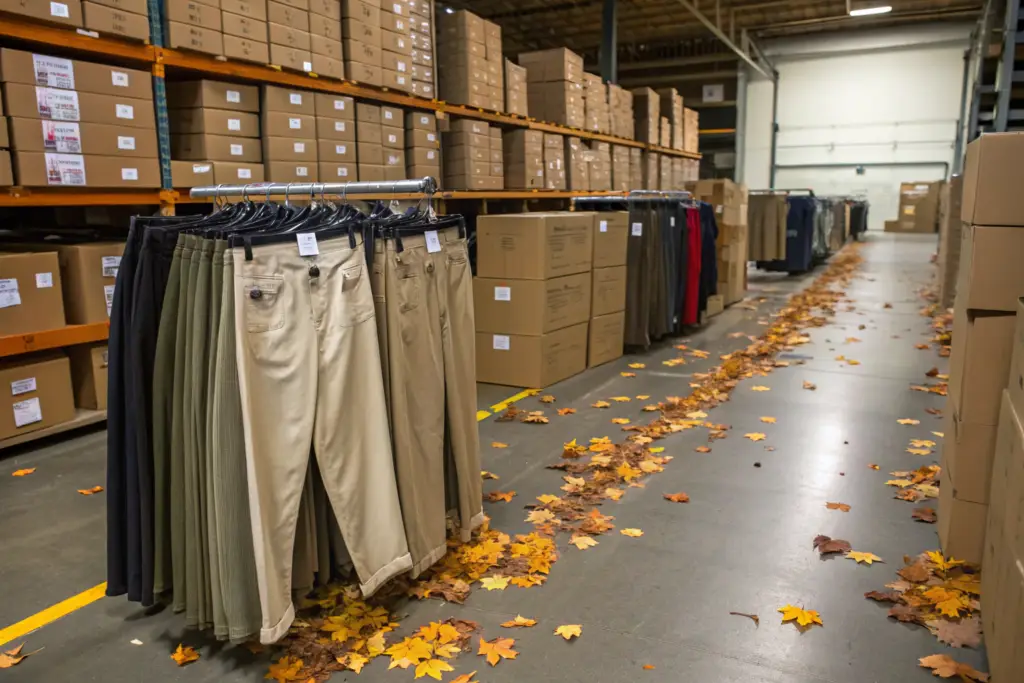
You designed a beautiful collection. The linen wide-leg pants were the hero piece. You booked the photo shoot, the influencer posts, the email blast to your list. The launch date was set. Then the shipping date came and went. The supplier's WhatsApp messages shifted from "next week" to "small delay" to silence. The photo shoot was rescheduled. The influencer posted something else. The email blast went out with a substitute product. The season passed. The pants arrived in September. Your warehouse is now full of summer pants in autumn, and your cash is trapped in dead inventory. Missing a season is not just a delay. It is a compounded financial loss that includes the product cost, the marketing spend, the lost full-price selling window, and the markdown you will eventually take.
You avoid missing fashion seasons by selecting a supplier whose production calendar is contractually locked to your retail calendar, not one who promises "fast delivery." This requires three interlocking commitments: a published production lead time with penalty-backed delivery dates, a weekly milestone reporting system that gives you early warning of any delay, and a logistics plan that pre-books vessel space before the goods are even finished. The supplier must treat your launch date as a shared deadline, not a suggestion.
My name is Elaine. I manage production at Shanghai Fumao. I have seen the other side of a missed deadline. I have been the factory owner who had to call a brand owner and tell them their shipment would be late. It is a gut-wrenching call that I never want to make. Over the years, I have rebuilt our production planning and client communication systems to make that call unnecessary. I want to share the specific, structural steps you can take to protect your season. These are not generic tips about "planning ahead." These are the exact contract clauses, milestone checkpoints, and logistical decisions that separate a season launched on time from a season lost.
What Production Milestones Must a Supplier Lock Into Your Contract?
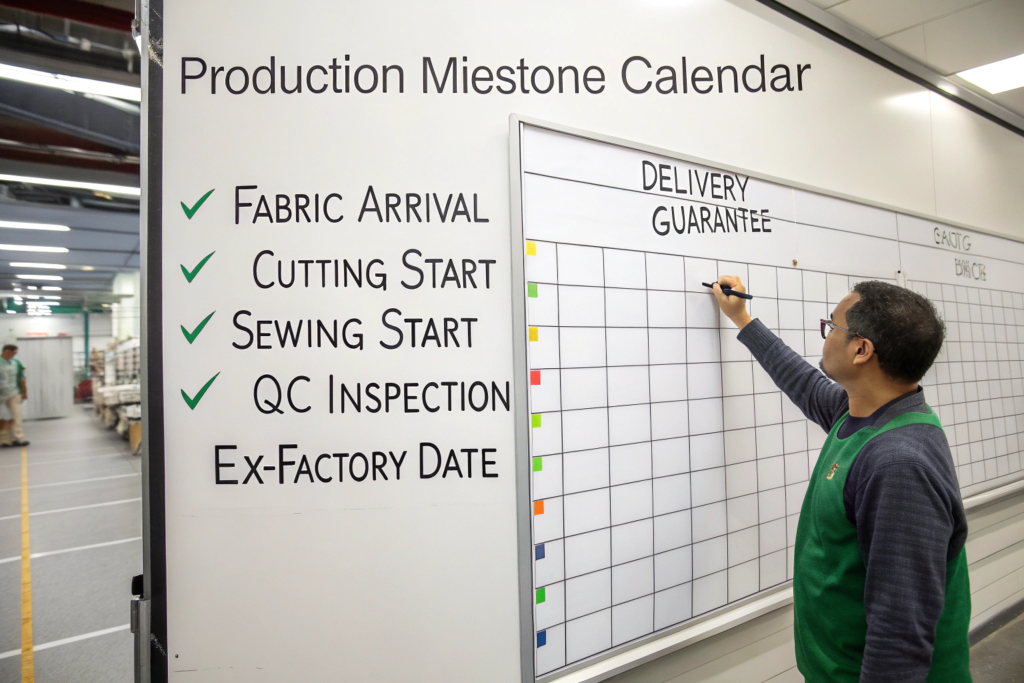
A vague promise of "shipping in 60 days" is not a production plan. It is a hope expressed as a number. A real production plan breaks the 60 days into distinct, measurable milestones. Each milestone has a completion date. Each completion date has a verification method. If a milestone is missed, you know within 24 hours, not two weeks later. The purpose of milestones is not to micromanage the factory. It is to collapse the information delay that turns a small, recoverable slip into a season-killing delay.
A production milestone schedule must include at minimum five locked dates: the fabric arrival date verified by a warehouse receipt photo, the cutting start date verified by a photo of the spread fabric on the cutting table, the sewing start date verified by an in-line photo of the first finished pieces, the final inspection date verified by a third-party QC booking confirmation, and the ex-factory date verified by a truck loading photo with a visible shipping mark. Each missed milestone should trigger a predefined communication and recovery action, not a silence.
How Does a Fabric Arrival Milestone Prevent the "Rolling Delay" Excuse?
The most common delay tactic I have seen in less reputable factories is the "rolling delay." You ask for an update. The supplier says, "Fabric arriving next week." Next week arrives. You ask again. They say, "The dye house had a small problem. Next week for sure." This continues for six weeks. The fabric was never ordered on time, or the dye house was never paid, or the fabric was allocated to another, higher-paying client.
A locked fabric arrival milestone shuts down this game. The milestone states: "Supplier shall provide a digital photo of the bulk fabric rolls in Supplier's warehouse, with the Buyer's order number clearly visible on the roll tags, no later than [Date X]." The date is calculated backward from your launch. If your pants must leave the factory by March 15 to arrive in your U.S. warehouse by April 15, the fabric must be on-site by January 15 to allow for cutting, sewing, finishing, and QC. If January 15 arrives and you do not receive a photo of the fabric rolls, the contract triggers a breach-of-milestone clause. You do not wait two more weeks. You schedule an immediate video call with the factory owner. You ask to see the fabric purchase order, the dye house delivery note, and the bank transfer receipt. One of three things will happen. The fabric exists and there was a genuine communication lapse, easily fixed. The fabric is delayed but verifiably in process, and you can adjust the downstream schedule. Or the fabric was never ordered, and you have just exposed the lie early enough to potentially shift production to a backup supplier or negotiate a partial air freight solution. The supply chain milestone tracking best practices emphasize that visual verification is superior to verbal assurance. A photo with your order number is evidence. A WhatsApp message is not.
Why Must the Ex-Factory Date Be Tied to a Truck Loading Photo?
The ex-factory date is the moment the goods leave the factory's legal possession and enter the logistics chain. It is the single most manipulated date in the export garment business. A factory claims the goods "shipped on March 15." What they actually mean is the goods were packed in cartons and sitting in their warehouse on March 15. The truck to the port did not arrive until March 20. The vessel booking was for March 25, but the container missed the cutoff and was rolled to the April 1 vessel. The factory reports "shipped March 15" to you, but the actual departure was April 1. Your three-week delay is hidden inside a definitional trick.
The ex-factory milestone must specify: "Supplier shall provide a digital photo of the sealed container or truck, with the shipping mark and container number clearly visible, being loaded at Supplier's loading dock, no later than [Date Y]." The photo must be date-stamped. The container number must match the booking confirmation you received from the freight forwarder. This single requirement eliminates the ambiguous gap between "production finished" and "logistics started." At Shanghai Fumao, our shipping clerk sends this photo to the client within minutes of the truck departing our dock. It is a small act, but it communicates that the responsibility has transferred from our production team to the shipping line, and we have recorded the exact moment. I recommend you also request the FCR or Forwarder's Cargo Receipt. This is a document issued by the freight forwarder confirming they have received the cargo from the shipper. It is an independent verification that the goods left the factory and entered the forwarder's custody. A factory that resists providing a truck loading photo or an FCR is a factory that intends to manipulate the ex-factory date.
How Can a Pre-Shipment Delay Recovery Plan Save Your Season?
Even the best factory can encounter a genuine delay. A machine breaks. A key worker falls ill. A typhoon closes the port for two days. You do not judge a supplier by whether a problem ever occurs. You judge them by what happens in the hour after the problem is identified. A reliable supplier does not just report the delay. They present a delay recovery plan. This plan should show you exactly how they intend to recover the lost time, what it will cost, and who will pay for it. The absence of a recovery plan, or a plan that says "we will try our best to catch up," is a red flag that means you will miss your season.
A pre-agreed delay recovery plan should be an appendix to your purchase order, outlining specific recovery actions for delays of one week, two weeks, and three weeks or more. Recovery actions include: adding a weekend shift with overtime pay at the supplier's cost, splitting the order across two sewing lines to parallel-process, and air-freighting a percentage of the order to cover your launch inventory at the supplier's expense. The trigger threshold and the cost allocation must be negotiated before the order is placed, not during the crisis.

What Recovery Actions Are Realistic for a One-Week Delay?
A one-week delay is serious but recoverable. The recovery mechanism is additional labor hours within the same facility. A factory with spare capacity or flexible labor can compress a seven-day delay into a two-day delay by authorizing overtime, adding a weekend shift, or temporarily reassigning workers from a less urgent order.
At Shanghai Fumao, our standard labor contract with our sewing operators includes a provision for "peak season overtime" up to a specified legal limit. We budget for this capacity buffer in our production planning. When a one-week delay hits, we activate the overtime protocol immediately. The weekend shift is announced. The production manager re-sequences the workflow to prioritize the delayed order without disrupting other clients' schedules. This overtime cost, typically a 1.5x or 2x wage premium, is absorbed by us if the delay was caused by our internal process. If the delay was caused by a force majeure event, the cost allocation follows the pre-agreed contract terms. I advise our clients to ask a simple question before placing an order: "What is your factory's authorized overtime capacity as a percentage of regular hours, and what is the protocol for activating it?" A factory that has no overtime protocol, or that says "we work overtime whenever needed" without a structured system, is a factory that either exploits its workers or cannot actually scale up labor on demand. The production capacity planning in garment manufacturing requires a documented understanding of normal capacity versus surge capacity. A good supplier knows their numbers and can tell you, "We can add 20% more labor hours for up to two weeks per month." A bad supplier guesses.
When Does Air Freight Become the Necessary Recovery Option?
When the delay exceeds two weeks, overtime alone will not close the gap. The math is simple. A two-week delay in a factory with 20% surge capacity requires ten weeks to recover through overtime alone. The season does not have ten weeks. At this point, the recovery plan must shift from production acceleration to logistics acceleration. The goods will be finished later than planned, but you must still meet your in-store date. The only way to compress the timeline is to switch from ocean freight, which takes approximately 25-35 days from Shanghai to a U.S. West Coast warehouse, to air freight, which takes approximately 5-7 days.
Air freight is expensive. It can cost four to eight times more than ocean freight. This cost must be pre-allocated in the contract. The clause should state: "For production delays exceeding 14 calendar days attributable to the Supplier, the Supplier shall air-freight a minimum of 30% of the order quantity to the Buyer's designated warehouse at the Supplier's expense, with the remaining balance to follow via ocean freight within 7 calendar days." The 30% figure is strategic. It covers your launch inventory, your photo shoot samples, and your initial wholesale shipments to key accounts. The remaining 70% can arrive two weeks later via ocean without killing your season. I was involved in a difficult situation with a San Francisco brand in 2023 before they moved their production to us. Their previous supplier had a four-week delay due to a fabric dye lot rejection and failed to offer any air freight solution. The brand missed their entire Memorial Day launch window. When they came to us, we built the air freight trigger clause into their first purchase order. The following season, an unrelated port congestion issue threatened their delivery. We activated the air freight clause, shipped 200 units by air to cover their launch, and the brand's season launched on time. The air freight cost us a portion of our margin, but it preserved a client relationship that has since generated four times that cost in repeat business. The air freight versus ocean freight decision framework explains the total cost calculation beyond the per-kilogram rate. A season saved is worth far more than the incremental freight cost.
Contracts and milestones create a legal framework. They do not create motivation. A factory that is legally protected but emotionally disengaged will meet the letter of the contract and nothing more. The supplier relationships that consistently deliver on time, season after season, are built on a shared deadline culture. The factory's production team knows your launch date. They have seen photos of your lookbook. They know that a specific boutique in Austin, Texas, is planning a trunk show around the delivery. This emotional connection transforms a contractual deadline into a personal commitment. You cannot legislate this culture. You have to select for it and then nurture it.
Proactive communication means the supplier initiates status updates, not just responds to your inquiries. It means sharing photos and videos of your product in progress without being asked. It means the production manager knows your brand story and can describe your end customer. A supplier who communicates proactively treats your deadline as their deadline, not as an external constraint to manage. This culture is the invisible factor that prevents delays that contracts alone cannot stop.
How Do Weekly Video Updates Replace the "Checking In" Email?
The "checking in" email is the most demoralizing ritual in the buyer-supplier relationship. You send it because you are anxious. The supplier receives it as an annoyance. They reply with a brief, uninformative sentence. Your anxiety increases. The cycle repeats weekly, consuming time and goodwill on both sides.
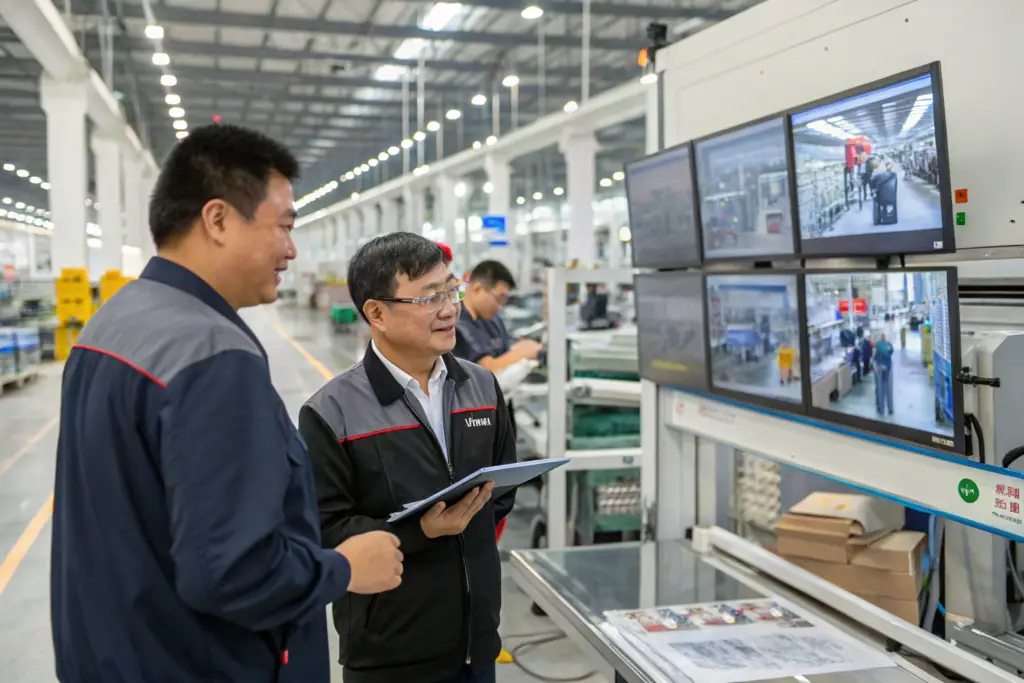
A proactive supplier breaks this cycle by sending a weekly video update before you ask. Every Monday, our account managers record a 90-second video on their phone. They walk through the production floor. They show your fabric on the cutting table. They show a finished sample on a dress form. They speak one or two specific sentences about the week's progress and the upcoming milestone. This video takes five minutes to produce and replaces ten emails. The client watches it with their morning coffee. They see their product being made. They hear the sewing machines in the background. They know the work is real. This practice originated from a suggestion by one of our long-term brand partners who said, "I just want to see my pants exist." She was tired of reading words. She wanted visual evidence. We institutionalized the practice across all accounts. The feedback has been overwhelmingly positive. One client told me the weekly video is the single most effective anxiety-reduction tool in their supply chain. The visual supply chain communication methods research confirms that video updates build trust faster than text because they provide non-verbal cues of honesty and transparency. You can ask your supplier to adopt this practice. If they say it is too time-consuming, they are telling you that your peace of mind is not worth five minutes a week.
Why Should Your Supplier Know Your End Customer?
Most factories see their client as the brand owner. They never think about the person who will ultimately wear the pants. This creates a disconnect. The factory's definition of "acceptable quality" stops at the brand owner's specification sheet. But the brand owner's definition of quality is determined by the end customer's experience. A supplier who understands the end customer makes better micro-decisions.
I remember when a brand partner sent us a video of their pop-up shop in Portland. The video showed a customer trying on our linen wide-leg pants, looking in the mirror, and smiling. She bought them. The brand owner sent this video to our production team's WeChat group. Our sewing supervisor, Mrs. Wang, who has worked here for twelve years, watched the video three times. She said to me, "The customer looks happy. These pants fit her well." After that day, Mrs. Wang's quality checks on that brand's orders became even more meticulous. She was not sewing for a specification sheet anymore. She was sewing for that smiling woman in Portland. This is a small story, but it captures the essence of a shared deadline culture. Share your brand's story with your supplier. Show them your Instagram feed. Tell them about the boutique in Charleston that hosts a linen pop-up every June. Tell them the name of your best-selling color and why your customers love it. A supplier who feels connected to your end customer is intrinsically motivated to meet your deadline. They are not shipping a purchase order number. They are shipping a product that a real person is waiting to wear. The supplier relationship management best practices literature emphasizes that relational governance, built on shared identity and mutual understanding, outperforms purely contractual governance in reducing supply chain disruptions. Contracts set the floor. Culture raises the ceiling.
Conclusion
Missing a fashion season is a preventable failure. It results from a chain of small, unaddressed gaps: a fabric arrival that was never verified, a production delay that was communicated too late, a logistics plan that assumed ocean freight would work even when the calendar said it would not, and a supplier relationship that was built on purchase orders instead of shared deadlines. You can close each of these gaps with specific, structural actions. Lock five production milestones into your contract and require photographic verification of each. Pre-negotiate a delay recovery plan that escalates from overtime to air freight at defined trigger points. Select a supplier who sends weekly video updates without being asked and who knows the name of your best-selling color.
At Shanghai Fumao, our production calendar is not an internal document. It is a shared dashboard. Our clients know when their fabric arrives, when their pants are cut, and when their container is loaded, because we send photos and videos at each step. We have air freight trigger clauses in our standard manufacturing agreement, and we have used them to protect our clients' seasons when circumstances beyond our control threatened a deadline. We do this because I learned, years ago, that a shipped order is not the same as a sold order. A product that arrives after the customer has moved on to fall fabrics is not a product. It is a problem.
If you are planning a collection with a fixed launch date and you need a manufacturing partner whose internal clock is synchronized with your retail calendar, I would like to talk with you. Contact me, Elaine, at elaine@fumaoclothing.com. Share your launch timeline, and I will show you exactly how our production milestones map to your key dates. Your season should not be a gamble. It should be a plan that executes. Let's build that plan together.